Sotto’s Late-Blooming Conscience: Better 30 Years Late Than Never… Right?
By Louis ‘Barok‘ C. Biraogo — March 4, 2026
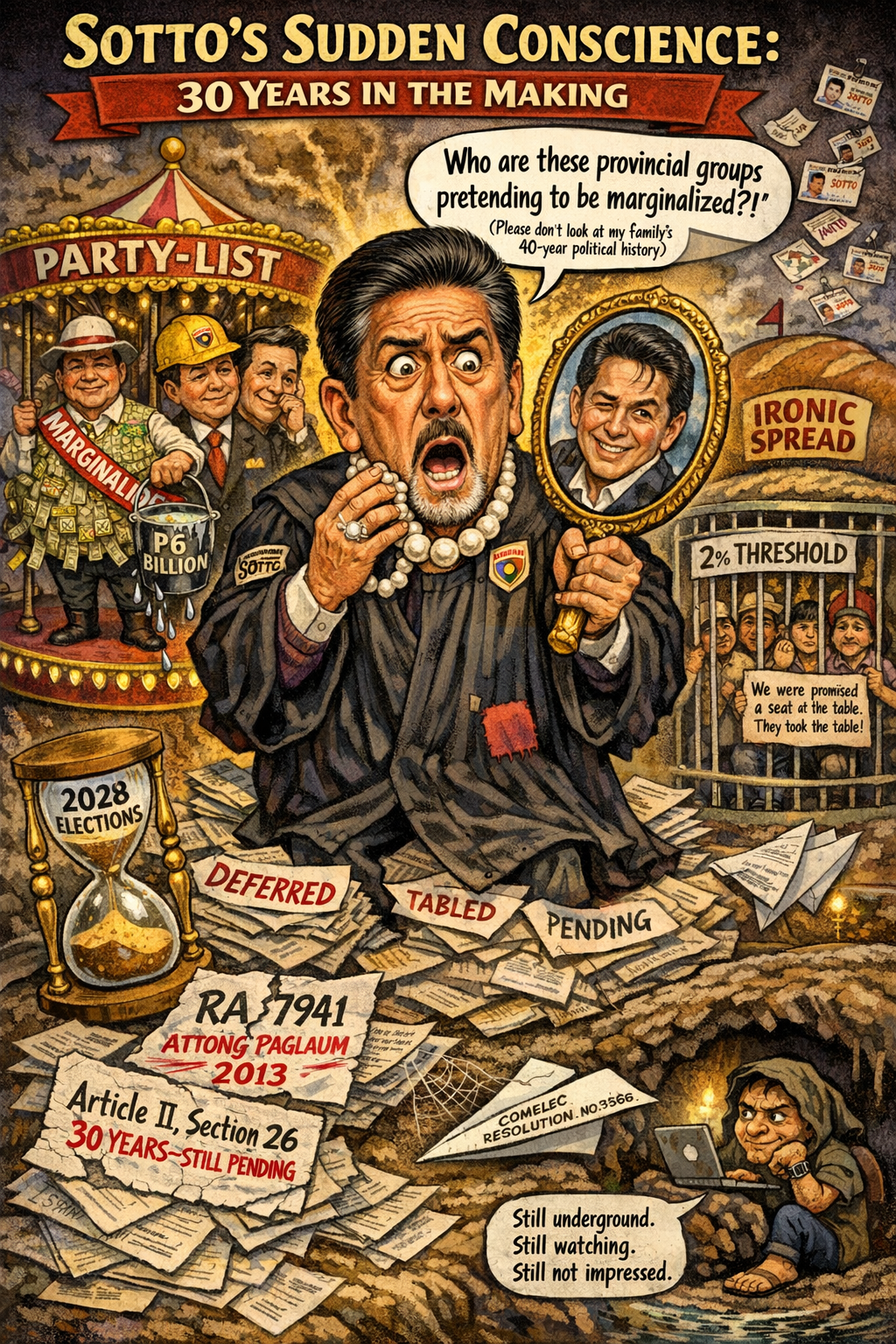
MGA ka-kweba, pull up a chair in this damp cave of mine and let me serve you a piping-hot plate of unfiltered truth. On March 2, 2026, Senate President Vicente “Tito” Sotto III stood before the Committee on Electoral Reforms and People’s Participation, furrowed his brow in mock horror, and declared the party-list system “misinterpreted and abused.” Susmaryano! Who are these provincial groups pretending to be marginalized, he thundered. How dare political parties with Senate seats, House seats, provincial boards, and city councils claim they’re underrepresented? The Constitution says “marginalized,” right? Cue the violins.
Your humble caveman almost dropped his laptop into the underground spring. The same Vicente Sotto III whose family has been swimming in political waters since the Marcos era is now clutching pearls over dynastic infiltration? The irony is so thick you could spread it on pandesal and call it reform. But fine. Let’s play along. Let’s eviscerate this circus with the scalpel of Article VI, Section 5(2) of the 1987 Constitution, the blunt club of the Party-List System Act (RA 7941), and the autopsy reports of every Supreme Court decision that turned a noble experiment into a golden ticket for the usual suspects.
Sotto’s Sudden Reform Fever: Hypocrisy Checks In, Convenience Pays the Bill
Sotto’s core lament is simple: the system was meant for the laborer, the peasant, the urban poor, the indigenous, the woman, the youth — not for “provincial groups” that already have “so many congressmen.” He even floated the ghost of a 50-50 split between political parties and “others,” echoing COMELEC Chair George Garcia. And he filed a bill to amend RA 7941 with shiny new cancellation grounds: failure to represent the marginalized, nominees who don’t belong to those sectors, material misrepresentation, and — my personal favorite — “acts detrimental to the government’s best interests.”
Partial truth? Yes. The abuses are real, and we’ll get to the bloodbath in a moment. But let’s not pretend Sotto’s sudden zeal is born of constitutional purity. This is the same legislative branch that has spent three decades refusing to pass a genuine anti-dynasty law despite the clear mandate of Article II, Section 26. Political convenience, thy name is Sotto. When your own clan has enjoyed district seats, senatorial glory, and now party-list backdoors, suddenly discovering that “political parties are not marginalized” is less revelation and more damage control ahead of 2028.
Constitutional and Legal Framework: What the Framers Actually Wrote (And What Everyone Ignored)
Let’s go back to the sacred text, because nothing ruins a good grift like the actual words.
Article VI, Section 5(2) of the 1987 Constitution:
“The party-list representatives shall constitute twenty per centum of the total number of representatives… For three consecutive terms after the ratification of this Constitution, one-half of the seats allocated to party-list representatives shall be filled, as provided by law, by selection or election from the labor, peasant, urban poor, indigenous cultural communities, women, youth, and such other sectors as may be provided by law, except the religious sector.”
Article XIII, Section 1 and Article II, Section 26 hammer home social justice and the prohibition against political dynasties. RA 7941, Section 2, repeats the mantra: “to enable Filipino citizens belonging to marginalized and under-represented sectors… to become members of the House of Representatives.” Section 3 defines parties to include national, regional, and sectoral — but the “marginalized” qualifier is the heartbeat.
Yet Section 3 also opened the door a crack for national and regional parties. Sotto is correct that the door has been kicked off its hinges. The law was never meant to be a parallel Congress for the already powerful. It was meant to be the emergency exit for those locked out of district politics.
Jurisprudential Autopsy: How the Supreme Court Turned Intent into a Free-for-All
Let’s dissect the body.
Ang Bagong Bayani-OFW Labor Party v. COMELEC (G.R. No. 147589, 2001) — the Court still had a spine. Nominees must belong to marginalized sectors. The system exists “to enable the marginalized and underrepresented to become lawmakers.” Beautiful.
Then came BANAT v. COMELEC (G.R. No. 179271, 2009), refining the math: 2% threshold, three-seat cap, proportional allocation. Still tethered to the constitutional purpose.
Enter Atong Paglaum v. COMELEC (G.R. No. 203766, 2013) — the decision that broke the dam. En banc, the Court ruled that national and regional parties need NOT represent marginalized sectors. Political parties can participate so long as they don’t field district candidates and aren’t “major” parties. Sectoral parties still must, but the floodgates opened. Dissenting voices (remember Justice Brion?) warned this would “deform” the system. They were right.
Fast-forward to An Waray v. COMELEC (G.R. No. 238595, 2024) — the Court upheld COMELEC’s cancellation powers for grave abuse and misrepresentation. Small consolation, but too little, too late. The jurisprudence has mutated from constitutional fidelity to pragmatic pluralism, and the marginalized got priced out of their own market.
Evisceration of Abuses: The Rogue’s Gallery of Masqueraders
Let’s name names, shall we? Because satire without receipts is just stand-up.
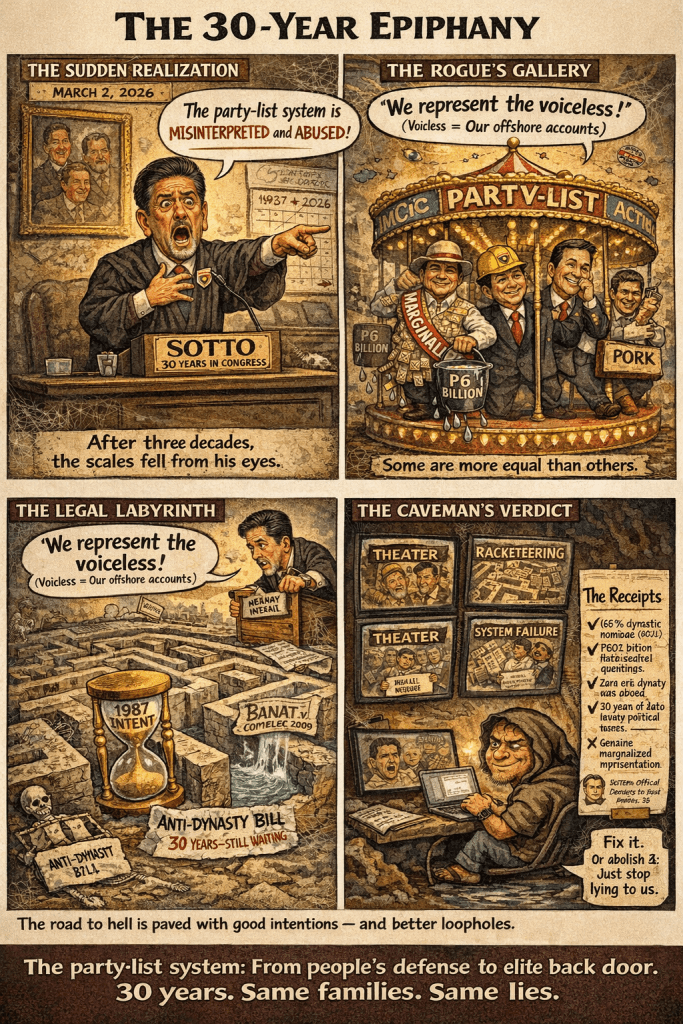
Provincial and regional groups masquerading as marginalized? Ako Bicol, anyone? A party-list that somehow represents a whole region already swimming in district congressmen. Its nominee Zaldy Co — yes, the one facing plunder charges at the Sandiganbayan in November 2025 for alleged P6-billion substandard flood-control projects — was busy inserting pork into the budget while Bicol drowns. How exactly is that “marginalized”?
Parties with full district representation double-dipping? ACT-CIS, led by Eric Yap, who somehow parlayed party-list seats into a net worth under scrutiny while linked to the same flood-control bonanza. The man resigned amid the stench. Yet his party kept the seats. Explain to me, using small words, how a group with House representation needs party-list life support.
Dynastic infiltration? PCIJ research and Kontra Daya data don’t lie: 66% of 19th Congress party-list groups had dynastic nominees. Nominees tied to entrenched families, not grassroots. Business interests capturing seats meant for the powerless? Check. Military retirees, contractors, trapos in borrowed marginalization costumes — all dominating seats while genuine peasant groups scrape for 2%.
Post-election substitution of nominees? The classic bait-and-switch. Voters elect “labor” or “youth”; post-proclamation, the nominee magically becomes the dynast’s nephew. COMELEC Resolution No. 9366 tried to curb this; the parties laughed.
And the crown jewel: parties without meaningful sectoral advocacy. Some exist only on paper, file a certificate of candidacy, win 2%, then vanish until the next budget insertion. Flood-control scandals, P805 billion allegedly milked — ex-Marines pointing fingers at party-list reps for kickbacks. This isn’t representation; it’s racketeering with a congressional ID.
Ethical Dimensions: RA 6713, RA 3019, and the Death of Public Service
RA 6713 — the Code of Conduct — demands “justness and sincerity” and prohibits conflicts of interest. RA 3019 (the Anti-Graft and Corrupt Practices Act), Sections 3(e) and 3(g), criminalizes giving unwarranted benefits and entering contracts with manifest partiality. When a party-list rep votes on a flood-control budget that his own family’s construction firm bids on, that’s not a gray area; that’s graft wearing a sectoral mask.
The constitutional mandate of social justice (Article XIII) is not a suggestion. It is the soul of the Republic. These abuses spit on it.
Options Analysis: Who Can Actually Fix This Mess?
- Congress (Sotto’s bill): Pass the amendments. Add strict sectoral proofs, ban dynastic nominees, prohibit post-election substitutions. But don’t stop at cosmetics — pass the anti-dynasty bill already, Article II, Section 26 is not decorative.
- COMELEC: Use its accreditation powers under RA 7941 Section 6 and COMELEC Resolution No. 9366 with actual teeth. Cancel registrations for misrepresentation. Enforce nominee-sector belonging pre-election.
- Supreme Court: A new petition can force a revisit of Atong Paglaum. The 2013 reading was policy, not holy writ. Overrule where it deformed constitutional intent.
- Executive: Veto bloated budgets. Issue executive orders barring government contractors from party-list runs.
- Civil society & genuine party-lists: File disqualification petitions. Publish nominee dossiers. Protest. Do not let this die as another Senate hearing spectacle.
Resolution Scenarios: From Cosmetic Band-Aid to Full Surgical Removal
Scenario A — Legislative reform: Amend RA 7941 to restore strict sectoral limits, impose quotas (minimum seats reserved for genuine marginalized), add transparency mandates, and anti-dynasty riders. Best outcome.
Scenario B — Judicial intervention: Supreme Court guts the Atong Paglaum expansion in a new landmark case. Possible, but courts hate revisiting their own mistakes.
Scenario C — COMELEC housecleaning: Mass cancellations before 2028. Fastest, but will be challenged as “disenfranchisement.”
Scenario D — Abolition: Scrap the whole thing via constitutional amendment. Nuclear option. Risks silencing the truly voiceless.
Scenario E — Hybrid: My Begrudging Favorite (Spoiler Alert: The Marginalized Still Lose, But Slower)
Keep the party-list circus limping along, but chain it down:
- 50% strict sectoral quota — genuine marginalized only, no dynastic cosplay
- Nominee track-record mandates — verifiable years in the sector, not family name
- Lifetime bans for graft convictions — plunderers barred forever
- Public nominee databases — full CVs, dynasty ties, pork links exposed
Triage, not cure.
My vote.
At least it quits pretending the patient is healthy while the dynasties keep looting the medicine cabinet.
Call to Action: Enough Platitudes — Time for Scalpels
Sotto’s bill is a start. But if it dies in the House like every other reform, it’s just theater. Genuine reform demands:
- Immediate passage of Sotto’s amendments PLUS a robust anti-dynasty law defining “political dynasty” with teeth.
- COMELEC rule: No accreditation unless 70% of nominees and officers have five-year verifiable track records in the claimed sector.
- Ban on post-election substitutions. Period.
- Mandatory disclosure of financial links to government contractors under RA 6713.
- Supreme Court advisory opinion or test case to realign jurisprudence with 1987 intent.
To the genuine marginalized sectors still fighting for crumbs: form coalitions, document everything, and drag these impostors into court. To the dynasts and trapos currently occupying party-list seats: your time is borrowed. The Constitution was written for the people, not your portfolios.
This is not about left or right. This is about whether the Republic still believes its poorest citizens deserve a seat at the table — or whether we’ve surrendered the House to the same families who already own the provinces, the Senate, and the budget.
The party-list system was meant to be the people’s last line of defense against elite capture. Instead, it became their favorite back door.
Fix it. Or abolish it. Just stop lying to us.
— Barok
Still underground. Still watching. Still not impressed.
Key Citations
A. Legal & Official Sources
- The 1987 Constitution of the Republic of the Philippines, Article VI. Official Gazette of the Republic of the Philippines.
- Republic Act No. 7941. An Act Providing for the Election of Party-List Representatives Through the Party-List System, and Appropriating Funds Therefor, 3 Mar. 1995.
- Republic Act No. 6713. Code of Conduct and Ethical Standards for Public Officials and Employees, 20 Feb. 1989.
- Republic Act No. 3019. Anti-Graft and Corrupt Practices Act, 17 Aug. 1960.
- Ang Bagong Bayani-OFW Labor Party v. COMELEC. G.R. No. 147589, Supreme Court of the Philippines, 26 June 2001, The LawPhil Project.
- BANAT v. COMELEC. G.R. No. 179271, Supreme Court of the Philippines, 21 Apr. 2009, The LawPhil Project.
- Atong Paglaum v. COMELEC. G.R. No. 203766, Supreme Court of the Philippines, 2 Apr. 2013, The LawPhil Project.
- An Waray v. COMELEC. G.R. No. 268546, Supreme Court of the Philippines, 6 Aug. 2024, The LawPhil Project.
B. News Reports
- Abarca, Charie. “Sotto: PH party-list system is ‘misinterpreted, abused’”. Philippine Daily Inquirer, 4 Mar. 2026.
- Philippine Center for Investigative Journalism. “Political Dynasties Also Swarm the Party-List Elections.” PCIJ.org, 4 Dec. 2024. Accessed 4 Mar. 2026.
- Philippine Center for Investigative Journalism. “DATA: 36 of 54 Party-List Groups in 19th Congress Have Nominees Belonging to Political Families.” PCIJ.org, 4 Dec. 2024. Accessed 4 Mar. 2026.
- Kontra Daya. “2025 Kontra Daya Report.” Kontra Daya, 2025. Accessed 4 Mar. 2026.

- “Forthwith” to Farce: How the Senate is Killing Impeachment—And Why Enrile’s Right (Even If You Can’t Trust Him)
- “HINDI AKO NAG-RESIGN!”

- “I’m calling you from my new Globe SIM. Send load!”

- “Mahiya Naman Kayo!” Marcos’ Anti-Corruption Vow Faces a Flood of Doubt

- “Meow, I’m calling you from my new Globe SIM!”

- “No Special Jail for Crooks!” Boying Remulla Slams VIP Perks for Flood Scammers

- “Philippine-Controlled” or Yankee Gas Station? The Davao Fuel Depot Farce Exposed

- “PLUNDER IS OVERRATED”? TRY AGAIN — IT’S A CALCULATED KILL SHOT

- “Several Lifetimes,” Said Fajardo — Translation: “I’m Not Spending Even One More Day on This Circus”

- “Shimenet”: The Term That Broke the Internet and the Budget

- “We Did Not Yield”: Marcos’s Stand and the Soul of Filipino Sovereignty

- “We Gather Light to Scatter”: A Tribute to Edgardo Bautista Espiritu





 KWEBA ni BAROK
Leave a comment