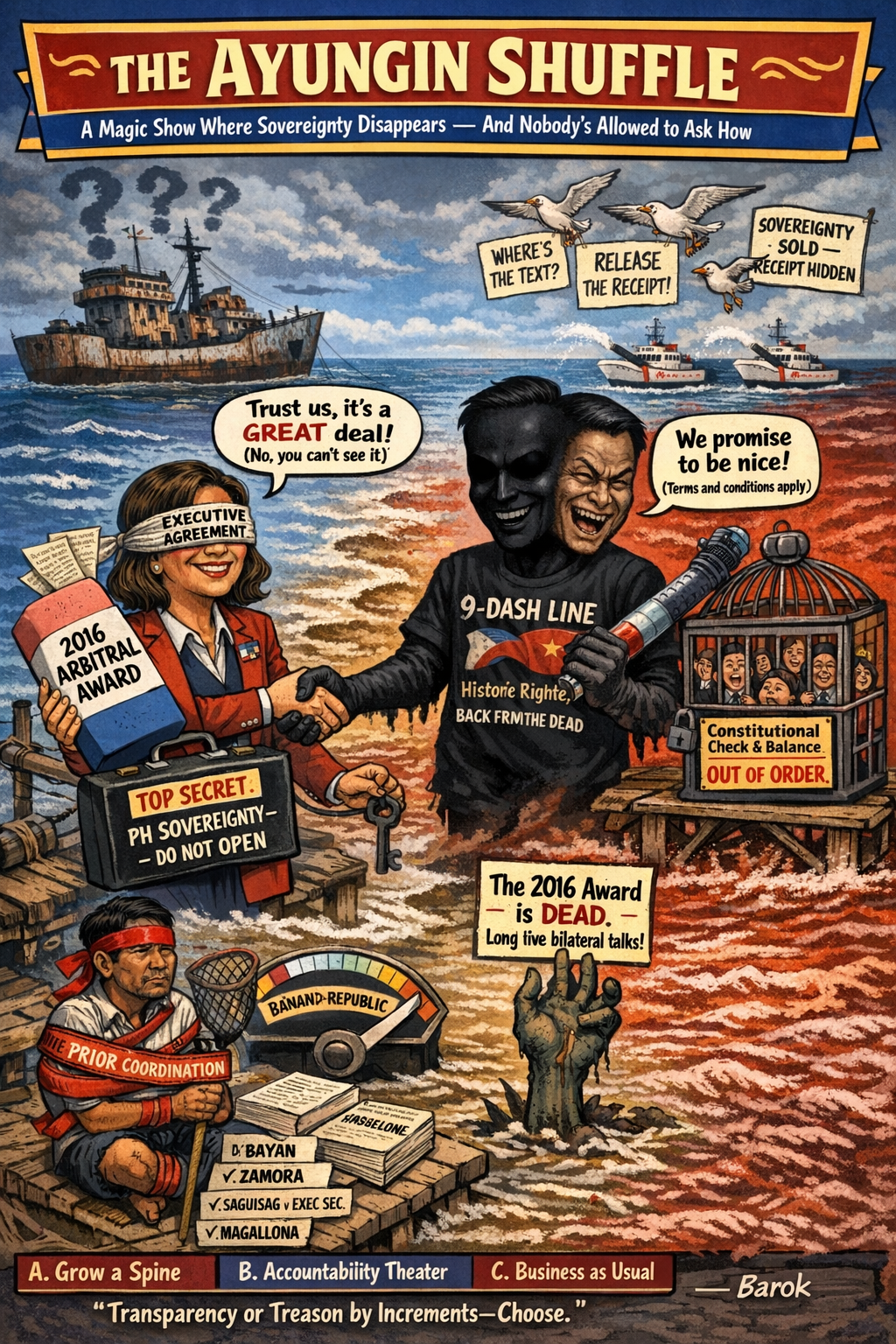
Because Nothing Says “Sovereign Rights” Like a Classified Handshake
By Louis ‘Barok‘ C. Biraogo — March 5, 2026
The National Embarrassment Begins Here
IN A shocking turn of events that will surprise absolutely no one who has watched this administration trip over its own shoelaces in the West Philippine Sea, the Department of Foreign Affairs has decided that the best way to defend Philippine sovereignty is to hide the evidence.
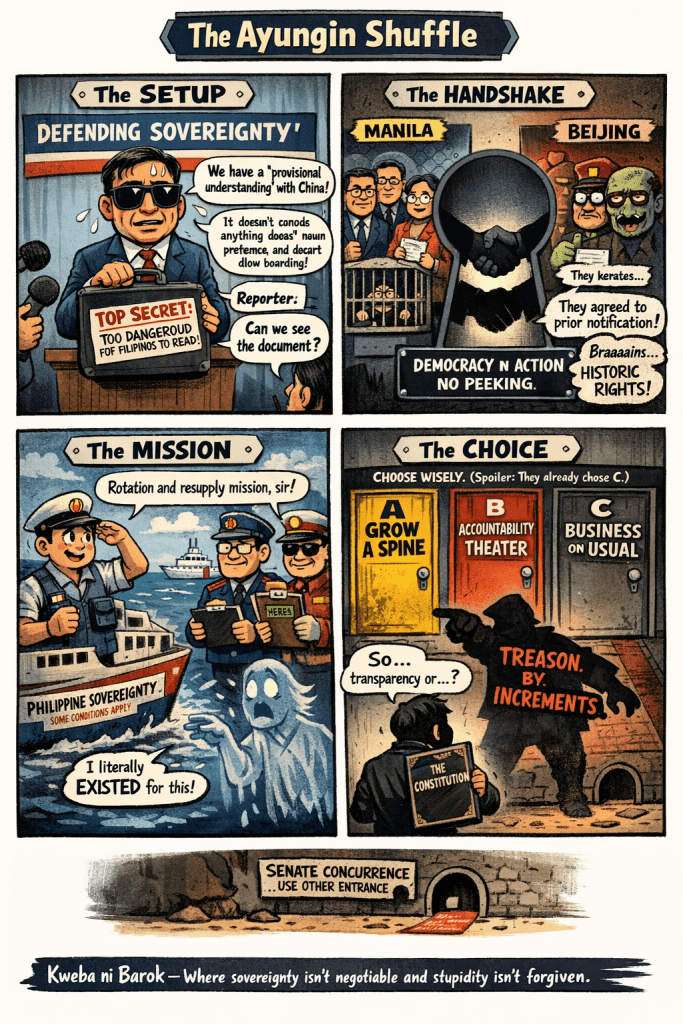
Mga ka-kweba, behold the “provisional understanding” of 2024 — a secret handshake between Manila and Beijing that has now governed thirteen rotation-and-resupply missions to the BRP Sierra Madre without a single “untoward incident,” according to DFA mouthpiece Rogelio Villanueva. The document? Still locked in a drawer. The critics? Malicious dullards who haven’t seen it. The Philippine people? Apparently too fragile to handle the truth.
Here’s the central paradox they want you to swallow whole: a deal that “doesn’t concede anything,” “doesn’t require permission,” and “doesn’t allow boarding” is somehow so radioactive that releasing it would magically endanger our troops. Right. Because nothing screams “ironclad defense of sovereignty” like treating the agreement like a state secret from a banana republic. If it’s really that bulletproof, publish the damn thing and watch the critics evaporate. But no — maximum discipline, minimum transparency. Classic.
Legal Gymnastics & National Humiliation 101
Treaty or No Treaty? That is the $64,000 Question.
Article XVIII, Section 21 of the 1987 Constitution is not a suggestion; it is a constitutional straitjacket:
“No treaty or international agreement shall be valid and effective unless concurred in by at least two-thirds of all the Members of the Senate.”
The DFA and National Security Adviser Eduardo Año are pulling the same tired executive-agreement sleight-of-hand we saw in Bayan v. Zamora (G.R. No. 138570) and Saguisag v. Executive Secretary (G.R. No. 212426). Those cases allowed executive agreements that merely implement existing treaties or fall squarely within presidential foreign-relations power. Fine. But when your “provisional understanding” sets operational rules, coordination protocols, and behavioral guardrails in waters the 2016 Arbitral Award already declared ours, it stops being cute diplomacy and starts being a binding commitment that alters how we exercise sovereign rights. That, mga ka-kweba, crosses the Rubicon into Senate territory. The executive cannot simply wave the magic wand of “national security” and make constitutional checks and balances disappear. We tried that with EDCA; at least there we had the decency to call it what it was.
UNCLOS & The Ghost of the Arbitral Award
The DFA is sweating bullets denying that this is a “provisional arrangement” under UNCLOS Articles 74(3) and 83(3). They protest too much. If it walks like a provisional arrangement — bilateral rules for managing activities in contested waters, prior coordination implied by China’s own spin, “principles” both sides must follow — and quacks like one, then it is one, regardless of the fancy name they slapped on it.
The 2016 Arbitral Award (PCA Case No. 2013-19) didn’t leave room for “overlapping claims.” Ayungin Shoal is a low-tide elevation inside our EEZ. China’s nine-dash line? Dead. Buried. Staked through the heart. Yet here we are, negotiating access to our own backyard as if the Tribunal never spoke. Contrast that with Magallona v. Executive Secretary (G.R. No. 187167), where the Supreme Court affirmed that RA 9522 and UNCLOS are now part of the law of the land. The baselines, the EEZ, the sovereign rights — all non-negotiable. The DFA’s frantic insistence that “there are no valid overlapping claims” is legally correct. So why the hell are we signing a bilateral operating manual that treats them as if they exist?
Who’s the Biggest Joke? Let’s Rank the Performers
The DFA: Masters of the Dullness of Reasoning
Villanueva’s masterpiece: “There is an inherent inconsistency and dullness of reasoning when critics criticize a document that they have not even seen.” Pot, meet kettle. If the deal is so airtight, why not publish a redacted version and shut everyone up? Is it protecting our troops, or protecting Theresa Lazaro and Eduardo Año from the embarrassment of whatever concessions are actually written in black and white? In a democracy, public office is a public trust. You don’t get to hide behind “maximum discipline” when you’re bartering access to Philippine territory. Transparency isn’t optional; it’s the bare minimum.
China: The Zombie That Refuses to Die
Beijing’s “historic rights” nonsense was killed, cremated, and scattered into the South China Sea by the 2016 Award. Yet here it is, shambling along, demanding prior notification and on-site verification while their coast guard waves machetes and seizes equipment. They signed this “provisional understanding” under the Vienna Convention’s pacta sunt servanda — good faith, remember? — then immediately leak their own version claiming we agreed to exactly what Manila denies. Propaganda win: China gets to play the reasonable adult managing disputes while we look like the beggar at the table.
The Critics: Right, Loud, and Politically Toothless
Jeffrey Ordaniel and the legal scholars are legally spot-on. This deal sidelines the Arbitral Award and sets a precedent that bilateral haggling trumps international law. But let’s be honest — they’re the Greek chorus in this tragedy: perfectly correct, perfectly ignored. Without the actual text, their accusations remain accusations. They’re shouting into the void while the executive treats the West Philippine Sea like its personal sandbox.
Secret Sellout: The Ayungin Backroom Deal Nobody’s Allowed to Read
What’s actually in the secret text? Based on everything the DFA is frantically denying and everything China is gleefully claiming, we can guess: prior notification dressed up as “coordination,” limits on how many boats and how often, maybe even a tacit “don’t embarrass us on camera” clause. It’s a “Don’t Ask, Don’t Tell” policy for Philippine sovereignty. We pretend we’re not seeking permission; they pretend they’re not extracting it. Result? China gets the propaganda victory of portraying the Philippines as a responsible partner in bilateral “management,” while the 2016 Award — our only real shield — gathers dust in the corner.
The Fork in the Sea: Dignity, Drama, or Continued Capitulation
Option A: Full Disclosure (The “Grow a Spine” Gambit)
Release the text tomorrow. Redact operational details if you must. Dare China to object. Reaffirm the Arbitral Award in the same breath. Watch the region breathe a sigh of relief.
Option B: Senate Inquiry (The “Accountability Theater”)
Drag Año and Lazaro to the Blue Ribbon Committee. It will be a circus, complete with grandstanding senators and leaked WhatsApp screenshots. But at least we’ll get a legislative record of this executive overreach.
Option C: Cowering in the Shadows (The “Business as Usual” Folly)
Keep the deal secret, keep sending missions, and pray the next Chinese water-cannon incident doesn’t turn fatal. This is the path of least resistance — and the fastest route to gradual erosion of everything we won in The Hague.
Impacts? This deal is a slow-acting poison. It normalizes bilateral negotiation over a matter the Tribunal already decided. It tells Vietnam, Malaysia, and Indonesia that folding to Beijing is the smart play. It tells the world that the Philippines’ “ironclad” commitment to the rules-based order lasts only until the first Chinese coast-guard vessel shows up with blades.
The Final Verdict: A Call to Sanity (Disguised as a Call to Arms)
Enough. A democracy does not run on secret handshakes in contested waters. The executive’s oath is to defend the territory, not to manage its slow-motion surrender.
Release the text.
Convene the Senate.
Reaffirm the 2016 Arbitral Award — loudly, publicly, relentlessly.
Because the 2016 Award isn’t just a piece of paper. It is the only legal weapon we have against the nine-dash-line zombie. And if we keep treating it like an embarrassing family secret, we don’t deserve to keep the West Philippine Sea.
The choice is simple: transparency or treason by increments.
Choose.
Barok has spoken.
Kweba ni Barok — where sovereignty isn’t negotiable and stupidity isn’t forgiven.
Key Citations
A. Legal & Official Sources
- 1987 Constitution of the Republic of the Philippines. Official Gazette of the Republic of the Philippines.
- Bayan (Bagong Alyansang Makabayan) v. Zamora. G.R. No. 138570, Supreme Court of the Philippines, 10 Oct. 2000, The LawPhil Project.
- Magallona v. Executive Secretary. G.R. No. 187167, Supreme Court of the Philippines, 16 Aug. 2011, The LawPhil Project.
- Republic Act No. 9522. The LawPhil Project, 10 Mar. 2009.
- Saguisag v. Executive Secretary. G.R. No. 212426, Supreme Court of the Philippines, 12 Jan. 2016, The LawPhil Project.
- The South China Sea Arbitration (Philippines v. China). PCA Case No. 2013-19, Permanent Court of Arbitration, 12 July 2016.
- United Nations Convention on the Law of the Sea. United Nations, 10 Dec. 1982.
- Vienna Convention on the Law of Treaties. United Nations, 23 May 1969.
B. News Reports
- Chi, Cristina “Philippines Defends Unpublicized Ayungin Deal with China.” Philstar.com, 4 Mar. 2026.
- ₱75 Million Heist: Cops Gone Full Bandit

- ₱6.7-Trillion Temptation: The Great Pork Zombie Revival and the “Collegial” Vote-Buying Circus

- ₱1.9 Billion for 382 Units and a Rooftop Pool: Poverty Solved, Next Problem Please

- ₱1.35 Trillion for Education: Bigger Budget, Same Old Thieves’ Banquet

- ₱1 Billion Congressional Seat? Sorry, Sold Out Na Raw — Si Bello Raw Ang Hindi Bumili

- “We Will Take Care of It”: Bersamin’s P52-Billion Love Letter to Corruption

- “Skewed Narrative”? More Like Skewered Taxpayers!

- “Scared to Sign Vouchers” Is Now Official GDP Policy – Welcome to the Philippines’ Permanent Paralysis Economy

- “Robbed by Restitution?” Curlee Discaya’s Tears Over Returning What He Never Earned

- “My Brother the President Is a Junkie”: A Marcos Family Reunion Special

- “Mapipilitan Akong Gawing Zero”: The Day Senator Rodante Marcoleta Confessed to Perjury on National Television and Thought We’d Clap for the Creativity

- “Just Following Orders” Is Dead: How the Hague Just Turned Tokhang’s Finest Into International Fugitives






 KWEBA ni BAROK
Leave a comment