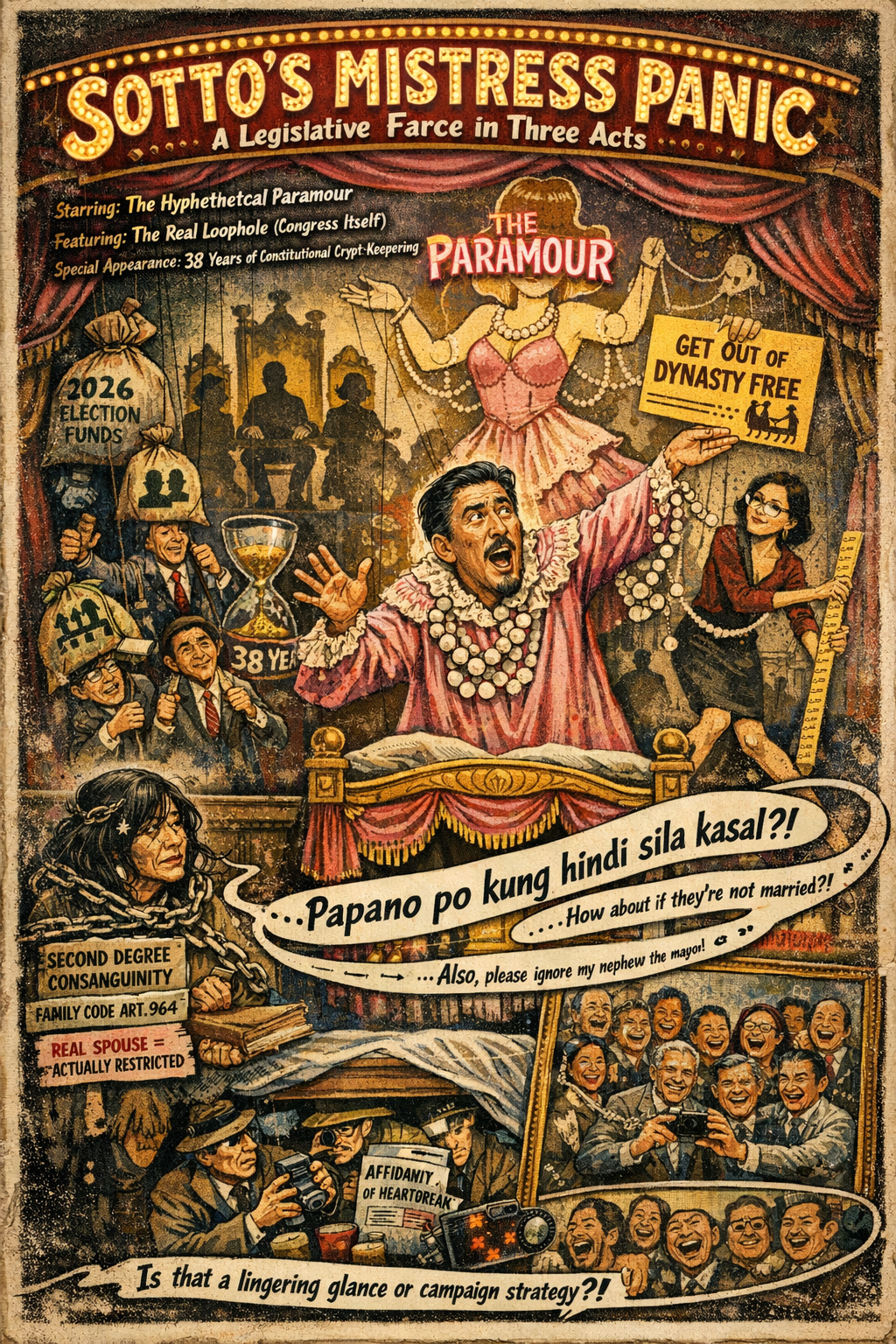
Congress’s Greatest Fear: A Girlfriend Who Might Actually End the Family Business
By Louis ‘Barok‘ C. Biraogo — March 8, 2026
MGA ka-kweba, we’ve finally arrived at the pinnacle of Philippine legislative theater: Senate President Vicente “Tito” Sotto III, that eternal guardian of moral propriety, clutching his pearls over the sultry specter of the mayor’s mistress. Imagine it—a bill meant to slay the hydra of political dynasties, 38 years in the constitutional crypt, now threatened not by the entrenched clans themselves, but by the hypothetical “kabit” who might sashay into office while the real power brokers sip their scotch in the shadows. It’s as if Congress has declared war on nepotism, only to pause mid-battle to debate whether the enemy’s concubine counts as a combatant. We, the weary audience in this national sitcom, can’t help but laugh through our disgust.
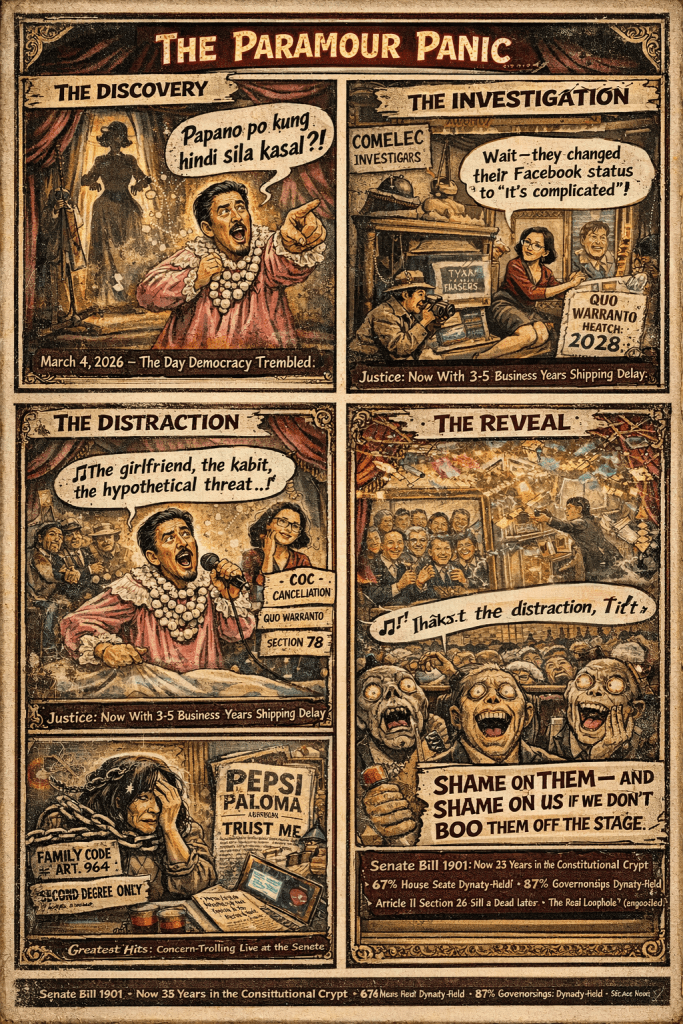
The Setup: A Farce in Three Acts, With Mistresses as the Chorus Line
Picture the Senate floor as a badly lit karaoke bar, where Sotto belts out his greatest hits of concern-trolling. On March 4, 2026, during the interpellation for Senate Bill 1901—the so-called Anti-Political Dynasty Act—he flags the “paramour loophole” with the gravitas of a man who’s just discovered fire. “Papano po kung hindi sila kasal?” he intones, painting vivid scenarios of governors installing their extramarital squeezes, only for the pair to fake a breakup and claim suffrage rights under Article V, Section 1 of the 1987 Constitution. It’s a masterclass in legislative misdirection: while the bill limps along, restricting only up to the second degree of consanguinity or affinity (think spouses, siblings, in-laws), Sotto diverts us to the bedroom antics of the elite. Senator Risa Hontiveros, ever the straight woman in this comedy, counters with promises of COC cancellations and quo warranto petitions for liars. But we know better—this is no policy debate; it’s a scripted delay, a glorious, gaping escape hatch for the dynasts who dominate the chamber. After all, in a Congress where 67% of House seats and 87% of governorships are dynasty-held, as studies remind us, why rush to self-immolate? As detailed in the GMA Network report, Sotto’s concerns spotlight potential evasions via extramarital partners and their kin.
Courtroom Carnage: Dissecting Loopholes with Legal Acid
Let’s dissect this “paramour loophole” with the precision it deserves—or rather, the mockery it invites. Sotto’s fear? A politician’s mistress, unbound by the Family Code‘s affinity rules (Executive Order No. 209, Article 964, Civil Code, which ties “relatedness” strictly to blood or marriage), could waltz into office, her siblings and spawn in tow, while the real Mrs. Tarpulano sits sidelined. Valid concern? Perhaps, if you’re living in a telenovela. But let’s wield the law with bite: this loophole isn’t a bug; it’s the feature of a bill so watered down it’s practically homeopathic. Senate Bill 1901‘s second-degree limit is the legislative equivalent of a chastity belt with a Velcro strap—easily slipped off by any dynasty worth its pork barrel.
Deconstruct the absurdity first: Sotto envisions Comelec sleuths proving cohabitation under Article 147 of the Family Code of the Philippines (Executive Order No. 209), where unmarried couples share property like de facto spouses. But enforcement? A farce. Invoke the Vagueness Doctrine from Estrada v. Sandiganbayan (G.R. No. 147781, 2001)—laws must be clear, or they’re void. How do you define a “paramour”? A lingering glance? A shared Netflix account? Will election investigators hide under beds, notarizing affidavits of heartbreak? “Break na kami,” cries the candidate, and poof—suffrage rights under Article V, Section 1 shield her. Hontiveros’ remedy? Cancellation of COC for misrepresentation (Section 78, Omnibus Election Code (Batas Pambansa Blg. 881)) or quo warranto post-victory (Rule 66, Rules of Court). Noble, but contrast with political reality: by the time a quo warranto crawls through the courts—like the glacial Republic v. Sereno (G.R. No. 237428, 2018), which ousted a Chief Justice—the mistress-congresswoman has already doled out 20 pork allocations, her dynasty’s grip unbroken. And let’s not forget Fermin v. COMELEC (G.R. No. 179242, 2008): misrepresentation must be material to eligibility. Proving a “willful concealment” of a fling? Good luck without violating privacy rights under Article III, Section 3.
Then there’s the equal protection clause (Article III, Section 1)—why bar the girlfriend but not the golf buddy? It’s discriminatory drivel, ripe for Supreme Court smackdown, as in Pamatong v. COMELEC (G.R. No. 161872, 2004), where candidacy restrictions must be reasonable, not a witch hunt for wandering eyes. We see the pattern: the bill pretends to honor Article II, Section 26 of the 1987 Constitution‘s dynasty ban, but trusts the wolves to define their own muzzles. In Biraogo v. COMELEC (G.R. No. 203603, 2012), the Court refused to compel enforcement without an enabling law, calling it a political question. Here, Congress finally acts, but only to codify evasion.
The Political Autopsy: Motivations, Shadows, and the Stench of Self-Preservation
Now, the autopsy: is Sotto’s intervention genuine diligence, or a smokescreen for the status quo? We, pulling back the curtain, spot the rot. Contrast his mistress-mongering with his own baggage—the resurfaced Pepsi Paloma scandal from 1982, where he allegedly strong-armed a desistance affidavit, only to slap cyber libel suits on filmmaker Darryl Yap in 2025 for dredging it up. Why fret over hypothetical paramours when your legislative history screams hypocrisy? Or those 2025-2026 coup rumors against him, tied to flood control probes exposing rivers of ill-gotten funds—scratch a dynasty, find corruption. Sotto’s family? Nephew Vico as Pasig Mayor, but oh no, not a dynasty, he insists. Why worry more about mistresses than the actual dynasts lounging in the Senate?
Senate Bill 1901 is elite self-preservation incarnate—a controlled burn that singes the edges but leaves the forest thriving. Limiting to second degree? It’s like banning family reunions but allowing the clan to rotate the hosting. The “paramour debate” is the perfect metaphor: Congress obsesses over the proxy’s bedroom status while ignoring the proxy system itself. Dynasties aren’t just ballot names; they’re monopolies on resource extraction—pork, permits, infrastructure. Connect the dots to systemic corruption: violations of Republic Act No. 6713‘s Code of Conduct aren’t anomalies; they’re the dynasty playbook, mandating justice and prohibiting favoritism, yet enabling it through “shadow dynasties.” Political scientists nail it—mistresses, bastards, in-laws as stand-ins keep power intact. The real scandal? A system where elites legislate their extinction but emerge stronger, as in the 87% dynasty-controlled governorships.
The Verdict: A Cynical Call to Revolution, Lest the Farce Continues
In the end, we verdict this charade a sham—democratic reform as kabuki theater, where Sotto’s sotto voce serenade lulls us back to sleep. The 1987 Constitution‘s Article II, Section 26 is a dead letter, betrayed by the very Congress it empowered. But hope flickers in cynicism: demand not tweaks, but revolution. Convene a constitutional convention to lock the gates behind these dynasts—automatic disqualification for any whiff of dynasty, not prohibition; merge with ironclad campaign finance reform to sever the money veins; empower Comelec to motu proprio probe, flipping the burden to the candidate. Real reform isn’t debating mistresses; it’s dismantling the theater altogether. Until then, we watch, disgusted, as the elites applaud their own performance. Shame on them—and shame on us if we don’t boo them off the stage.
Yours in ceaseless, scalding contempt for the dynasty lounge act we dignify with the name Congress,
— Barok
Writing from the Kweba, the last place truth is allowed to growl.
Key Citations
A. Legal & Official Sources
- The 1987 Constitution of the Republic of the Philippines. Official Gazette of the Republic of the Philippines, 1987.
- The Family Code of the Philippines. Executive Order No. 209, Official Gazette of the Republic of the Philippines, 6 July 1987.
- The Civil Code of the Philippines. Republic Act No. 386, Official Gazette of the Republic of the Philippines, 1949, (Article 964).
- Omnibus Election Code of the Philippines. Batas Pambansa Blg. 881, The LawPhil Project, 3 Dec. 1985.
- Code of Conduct and Ethical Standards for Public Officials and Employees. Republic Act No. 6713, The LawPhil Project, 20 Feb. 1989.
- Philippines, Senate. Senate Bill No. 1901: AN ACT PROHIBITING POLITICAL DYNASTIES IN NATIONAL AND LOCAL ELECTIVE OFFICES AND PARTY-LISTS, AND PROVIDING PENALTIES THEREFOR. 20th Congress, 2026. Senate of the Philippines Legislative Information System.
- Biraogo v. Commission on Elections. G.R. No. 192935, Supreme Court of the Philippines, 7 Dec. 2010. Digest.ph.
- Estrada v. Sandiganbayan. G.R. No. 147781, Supreme Court of the Philippines, 2001, The LawPhil Project.
- Pamatong v. Commission on Elections. G.R. No. 161872, Supreme Court of the Philippines, 13 Apr. 2004, The LawPhil Project.
- Republic v. Sereno. G.R. No. 237428, Supreme Court of the Philippines, 19 June 2018, The LawPhil Project.
B. News Reports
- Ombay, Giselle. “Sotto Flags Paramours, Kin in Anti-Political Dynasty Bill.” GMA News Online, GMA Network, 4 Mar. 2026.
- Philippine Center for Investigative Journalism. “71 of 82 Philippine Governors Belong to Political Families.” PCIJ.org, 8 Dec. 2024
- Philippine Center for Investigative Journalism. “8 in Every 10 District Reps Belong to Dynasties. More Than Half Are Reelectionists in 2025.” PCIJ.org, 26 Oct. 2024,
- ₱75 Million Heist: Cops Gone Full Bandit

- ₱6.7-Trillion Temptation: The Great Pork Zombie Revival and the “Collegial” Vote-Buying Circus

- ₱1.9 Billion for 382 Units and a Rooftop Pool: Poverty Solved, Next Problem Please

- ₱1.35 Trillion for Education: Bigger Budget, Same Old Thieves’ Banquet

- ₱1 Billion Congressional Seat? Sorry, Sold Out Na Raw — Si Bello Raw Ang Hindi Bumili

- “We Will Take Care of It”: Bersamin’s P52-Billion Love Letter to Corruption

- “Skewed Narrative”? More Like Skewered Taxpayers!

- “Scared to Sign Vouchers” Is Now Official GDP Policy – Welcome to the Philippines’ Permanent Paralysis Economy
- “Robbed by Restitution?” Curlee Discaya’s Tears Over Returning What He Never Earned

- “My Brother the President Is a Junkie”: A Marcos Family Reunion Special

- “Mapipilitan Akong Gawing Zero”: The Day Senator Rodante Marcoleta Confessed to Perjury on National Television and Thought We’d Clap for the Creativity

- “Just Following Orders” Is Dead: How the Hague Just Turned Tokhang’s Finest Into International Fugitives

 KWEBA ni BAROK
Leave a comment