Anne Curtis: Unwilling Star of Congress’s Most Unhinged Legal Argument
By Louis ‘Barok‘ C. Biraogo — March 9, 2026
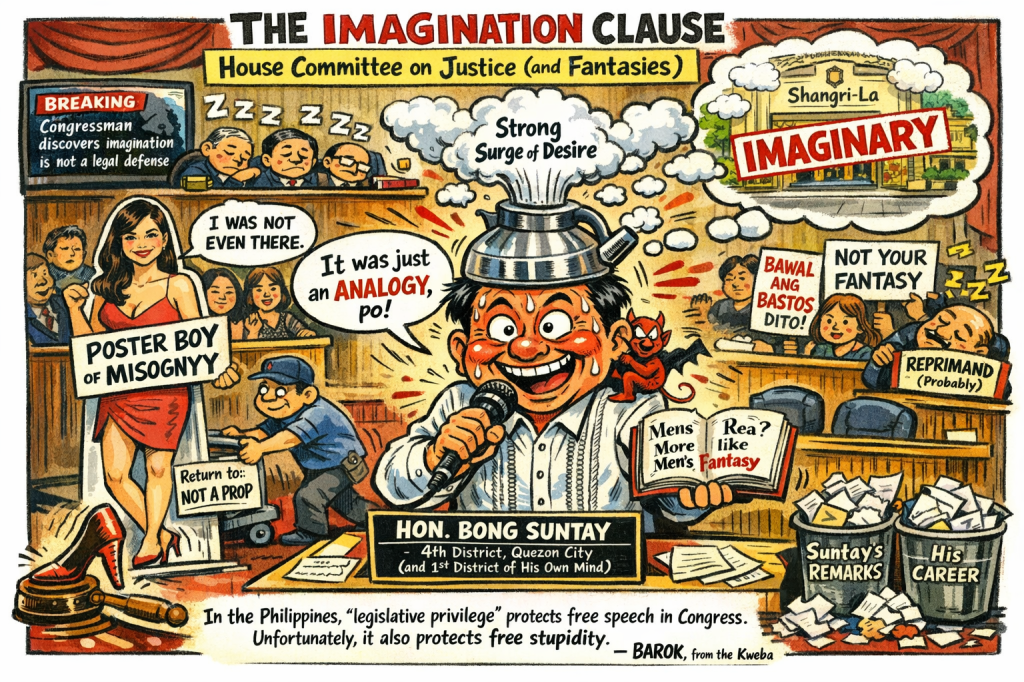
THE scandal involving Quezon City 4th District Representative Bong Suntay and his now-infamous “analogy” about Anne Curtis during the House impeachment proceedings against Vice President Sara Duterte is a masterclass in political self-sabotage, wrapped in a bow of constitutional posturing and casual misogyny. What was meant to be a clever rhetorical flourish defending Duterte’s wild threats has instead become a viral exhibit of why some men should never be allowed near a microphone, a law book, or—God forbid—a public office.
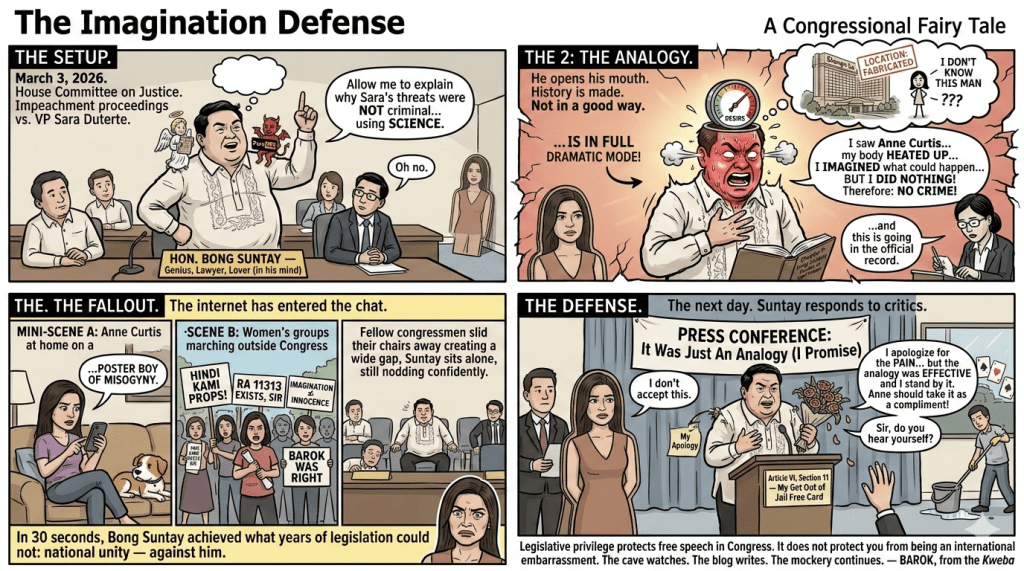
Picture this: It’s March 3, 2026, in the hallowed halls of the House Committee on Justice, mid-deliberations on impeaching Sara Duterte. Suntay, apparently channeling the spirit of a hormone-addled teenager defending his browser history, decides the best way to argue that “imagination” cannot be criminalized is to confess—on live television, no less—that seeing Anne Curtis (at Shangri-La, he initially claimed, though he later admitted that part was fabricated) sparked a “strong surge of desire,” his body “heated up,” and he “imagined what could happen.” But hey, it’s just imagination, so no crime, right? Just like Sara’s alleged threats were “just words.” Brilliant legal reasoning, counselor. Truly, the stuff of future bar exam hypotheticals—if the bar ever adds a category for “How to Tank Your Career in Under 30 Seconds.”
The bar exam never prepared you for this.”
I. The Fantasy, The Farce, and The Folly
Suntay’s “analogy” isn’t an analogy; it’s a confession disguised as jurisprudence. He didn’t invoke Curtis to illuminate a principle of mens rea or actus reus—he dragged her into his public daydream to make a point about Duterte’s bombast. The result? He objectified a woman who wasn’t even in the room, reduced her to a prop in his macho legal kabuki theater, and managed to embarrass not just himself, but the entire institution he claims to serve.
The petitioners—women’s groups like World March of Women-Pilipinas, Sentro ng mga Nagkakaisa at Progresibong Manggagawa-Women, Gabriela Women’s Party, and others—aren’t wrong to cry foul. Normalizing the casual narration of sexual fantasies about real women in a legislative setting does real harm. It reinforces the toxic idea that women’s bodies are fair game for public commentary, especially when uttered by men in power. The cultural damage is undeniable: every young woman watching learns that even Congress isn’t safe from leering commentary.
Yet let’s be brutally honest: the legal case they built is a shotgun blast of statutes—Republic Act No. 11313 (Safe Spaces Act), Republic Act No. 9710 (Magna Carta of Women), Republic Act No. 6713 (Code of Conduct), and the Code of Professional Responsibility and Accountability (CPRA) for lawyers—hoping something sticks. It’s advocacy theater, timed perfectly for Women’s Month, and while the outrage is justified, the criminal hook under the Safe Spaces Act is shaky at best. Curtis wasn’t present, the remark wasn’t directed at her in a harassing manner, and the setting was a legislative session, not a street corner. Malum prohibitum or not, intent may not matter, but context and elements do. Prosecutors chasing this as a slam-dunk crime are setting themselves up for a textbook dismissal.
Suntay’s defense? The classic “it was just an analogy” gambit, backed by the constitutional fortress of legislative privilege. He claims no malice, no immorality—heck, he even suggested Curtis should take it as a compliment (because nothing says flattery like being cast as the star of a congressman’s private porno reel). He later apologized for the “pain” caused but stood by the analogy’s “effectiveness.” Translation: Sorry you got offended, but I’m not sorry I said it, and look, I’m finally famous!
II. The Legal Kabuki Theatre
Article VI, Section 11 of the 1987 Constitution—the Speech or Debate Clause—exists for a reason: to protect legislators from executive or judicial harassment so they can debate freely, even offensively. In Osmeña v. Pendatun (G.R. No. L-17144, 1960), the Supreme Court made clear that while Congress can discipline its own for disorderly behavior, courts generally cannot touch speech uttered in the course of legislative proceedings. Suntay’s words, however boorish, fall squarely within that shield. Criminal prosecution? Dead on arrival. The Ombudsman complaint will likely languish in procedural purgatory or get deferred to Congress.
Republic Act No. 11313‘s spirit is noble—protecting women from gender-based harassment—but applying it here stretches the law like congressional attendance records. No direct victim in the room, no targeted catcall, just a stupid hypothetical. The petitioners are right that misogyny shouldn’t hide behind “context,” but the criminal bar is high for good reason.
Republic Act No. 6713, however—the Code of Conduct and Ethical Standards for Public Officials—is where the real hammer lies. Section 4(a) demands upholding the dignity of public office; Section 4(c) requires professionalism and justness. Narrating your sexual “surge” during official deliberations? That’s the opposite of dignity. It’s the ethical equivalent of showing up to court in a bathrobe. This is Suntay’s Achilles’ heel: not criminal, but administratively damning.
III. The Prosecutorial Dead Ends and the Only Real Venue
The Ombudsman route is DOA thanks to privilege. Expect a polite deferral or indefinite shelving. The House Ethics Committee? That’s the constitutionally sound arena. Precedent in Osmeña v. Pendatun affirms Congress’s inherent power to police its members. The House already authorized the probe on March 4, 2026, and struck Suntay’s words from the record. This is where accountability—if any—will happen.
IV. The “Why They Really Did It” Section
Suntay? Desperate bid for relevance in a Sara Duterte defense squad that’s losing steam. A toxic brew of macho posturing, rhetorical clumsiness, and the delusion that shock value equals eloquence. He handed his critics a gift-wrapped scandal.
The petitioners? Genuine advocates seizing a teachable moment during Women’s Month. But the shotgun legal strategy and timing scream broader agenda: spotlight Safe Spaces enforcement and distract from impeachment fatigue.
The opposition? Opportunistic glee. They didn’t create the mess—Suntay did—but they’re happy to fan the flames to tar pro-Duterte forces with misogyny.
The media and online mob? Celebrity + sex + politics = clicks. Anne Curtis’s rejection of Suntay’s “non-apology” (and her calling him the “poster boy of misogyny”) turned it nuclear.
V. The Chismis and Conspiracies
Online whispers call this a “distraction” from Sara’s impeachment or proof of “deep state macho politics.” Dismiss the tinfoil-hat nonsense—no grand conspiracy, just one man’s mouth outrunning his brain. But it does expose the persistent undercurrent of casual sexism in Philippine power circles.
VI. Options, Outcomes, and Predictions
Suntay faces two paths: contrition (genuine apology, gender training, step back from committees) or the Legalistic Dinosaur route (hide behind privilege, non-apologies, dare them). History says he’ll pick the latter—he’s already minimizing.
House outcomes: Reprimand (most likely, a slap on the wrist). Censure or committee removal (possible but optimistic). Expulsion? In fantasyland.
Courts/Ombudsman: Dismissal or limbo.
VII. Impacts and Implications
Legally, no redefinition of privilege—Osmeña v. Pendatun still rules. Politically, Suntay’s brand is scorched earth; the “old boys’ club” image of Congress gets another coat of tarnish. Culturally, this becomes shorthand for “don’t do this”—fueling conversations on misogyny in politics.
VIII. The Barok-ian Demand
- To the House Ethics Committee: Investigate swiftly, publicly, and without mercy. Let this not fade into committee purgatory.
- To the Ombudsman: Issue a clear opinion on privilege’s limits—don’t hide.
- To Suntay: Apology isn’t enough. Resign from key posts, undergo mandatory training, demonstrate remorse beyond words.
- To the public: Don’t forget. Weaponize this memory against every future bastos in power.
IX. Recommendations
- Mandatory annual gender sensitivity training for all House members and staff—no exceptions.
- Formal IBP reminder to lawyer-legislators on CPRA obligations.
- House leadership public statement redefining decorum standards for the 19th Congress.
This isn’t just about one congressman’s fever dream. It’s about demanding that power stop treating women as rhetorical disposable props.
Until then, the cave watches, the blog writes, and the mockery continues.
— Barok
In the Kweba,watching idiots so you don’t have to.
Key Citations
A. Legal & Official Sources
- Republic Act No. 11313. An Act Defining Gender-Based Sexual Harassment in Streets, Public Spaces, Online, Workplaces, and Educational or Training Institutions, Providing Protective Measures and Prescribing Penalties Therefor. LawPhil Project, 2019.
- Republic Act No. 9710. An Act Providing for the Magna Carta of Women. LawPhil Project, 2009.
- Republic Act No. 6713. Code of Conduct and Ethical Standards for Public Officials and Employees. LawPhil Project, 1989.
- The 1987 Constitution of the Republic of the Philippines. Official Gazette of the Republic of the Philippines, 1987.
- Osmeña v. Pendatun, G.R. No. L-17144. Supreme Court of the Philippines, October 28, 1960, The LawPhil Project.
- Code of Professional Responsibility and Accountability (CPRA). Supreme Court of the Philippines, A.M. No. 22-09-01-SC, April 11, 2023.
B. News Reports
- Manatlao, Eirene. “Bong Suntay Faces Complaint at Ombudsman over Remarks on Anne Curtis.” Rappler, 6 Mar. 2026.
- De Leon, Dwight. “Bong Suntay Draws Flak for Suggesting Sexual Fantasy about Anne Curtis.” Rappler, 4 Mar. 2026.
- “Forthwith” to Farce: How the Senate is Killing Impeachment—And Why Enrile’s Right (Even If You Can’t Trust Him)
- “HINDI AKO NAG-RESIGN!”

- “I’m calling you from my new Globe SIM. Send load!”

- “Mahiya Naman Kayo!” Marcos’ Anti-Corruption Vow Faces a Flood of Doubt

- “Meow, I’m calling you from my new Globe SIM!”

- “No Special Jail for Crooks!” Boying Remulla Slams VIP Perks for Flood Scammers

- “PLUNDER IS OVERRATED”? TRY AGAIN — IT’S A CALCULATED KILL SHOT

- “Several Lifetimes,” Said Fajardo — Translation: “I’m Not Spending Even One More Day on This Circus”

- “Shimenet”: The Term That Broke the Internet and the Budget
- “We Did Not Yield”: Marcos’s Stand and the Soul of Filipino Sovereignty

- “We Gather Light to Scatter”: A Tribute to Edgardo Bautista Espiritu

- $150M for Kaufman to Spin a Sinking Narrative



 KWEBA ni BAROK
Leave a comment