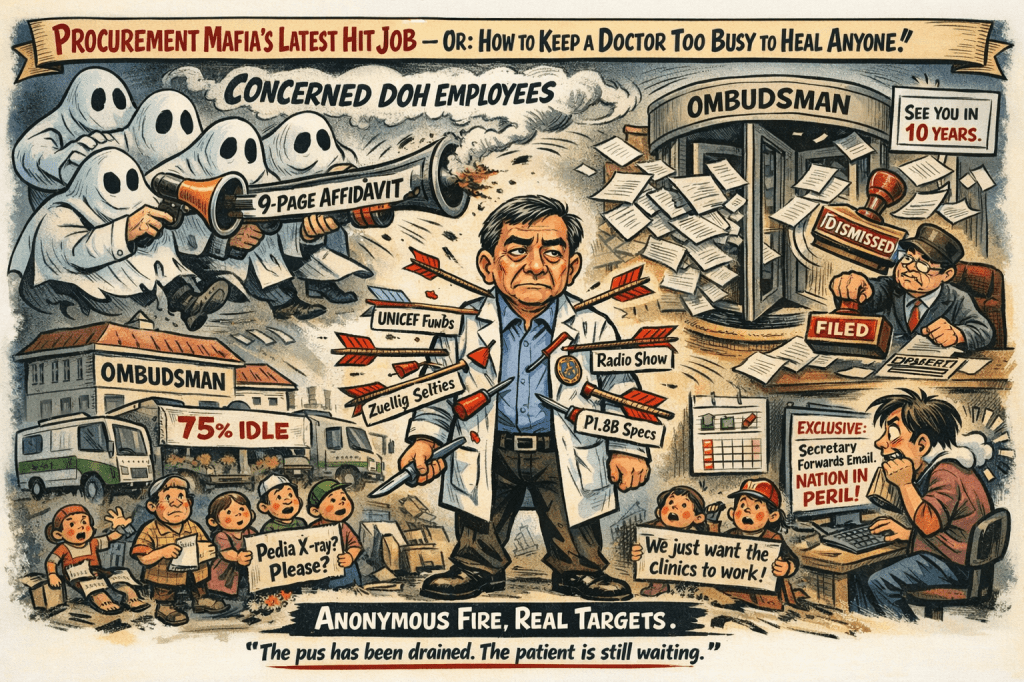
Herbosa Tries to Fix Clinics; Bureaucrats Try to Fix Him Instead
By Louis ‘Barok‘ C. Biraogo — March 11, 2026
MGA ka-kweba, ladies and gentlemen, grab your scalpels and your sense of smell—because the pus is flowing freely from the Office of the Ombudsman once again.
It is March 2026, Rappler is hyperventilating on cue, and a fresh nine-page love letter from the phantom cabal known as “Concerned DOH Employees” has landed on the Ombudsman’s desk accusing Secretary Teodoro “Ted” Herbosa and his team of rigging a P1.8-billion mobile-clinic procurement. The complaint reads like a prosecutor’s wet dream—except when you actually read it with adult eyes. What we have here is not a graft exposé. It is a masterclass in bureaucratic assassination by affidavit, served with a side of selective amnesia and footnotes that bleed hypocrisy.
Welcome to Kweba ni Barok, where we do not clutch pearls—we perform the autopsy. Let us eviscerate this corpse with the cold precision it deserves.

“They couldn’t kill the clinics, so they came for the doctor instead“
Anonymous Phantoms Fire Drive-By Affidavits
Anonymous complaints are the Philippine Ombudsman’s equivalent of a drive-by shooting: loud, messy, and the shooter is already three barrios away by the time the sirens wail. The task force’s own bible—Administrative Order No. 07—explicitly warns that anonymous filings require “sufficient corroborative evidence” before they waste public resources. Here? Zero named sources, zero attached affidavits with jurats, zero identified preferred supplier. Just vibes and a nine-page tantrum.
The Supreme Court has already slapped this nonsense down in Laurel v. Desierto: anonymity is constitutionally disfavored precisely because it shields the malicious from perjury charges. Yet here we are, pretending that a group that has filed five separate complaints against the same Secretary since August 2025 (UNICEF cash, psychiatric drugs, radio show, Zuellig selfies, and now this) is a noble whistleblower collective instead of a coordinated hit squad.
Who benefits from keeping Herbosa permanently on the defensive? Not the 75% of Mindanao provinces staring at idle mobile clinics. The real winners are the same procurement mafia that has turned DOH into a multi-billion-peso vending machine for decades—those faceless suppliers, fixers, and tenured bureaucrats who profit every time specifications are written in invisible ink that only their product can read. Murillo’s removal? Not conspiracy. Just the Secretary finally installing someone who will actually deliver functioning clinics instead of defending the status quo of 25% operability. Cry harder, ghosts.
“Illegal Interference”? More Like Legal Supervision with Attitude
The core accusation—Herbosa’s executive assistants dared to forward a “market study”—is being sold as a capital offense. Let us consult reality.
Under the Administrative Code of 1987 (Book III, Chapter 10), the Secretary is the department. He is the Head of the Procuring Entity (HOPE) under Republic Act No. 12009. GPPB guidelines explicitly encourage market studies to inform specifications. The idea that the end-user unit’s first draft is holy writ and any comment from the Secretary’s office is “ultra vires interference” is legally illiterate. It is called supervision, children. Look it up.
“Tailor-fitted specifications”? Without naming the supposed beneficiary, this is not evidence—it is a slogan. The Supreme Court in Martel v. People requires dolus malus—actual evil intent—before you can brand someone a crook. A policy disagreement over pediatric X-ray knobs versus guaranteed reagents is not evil intent; it is called “being the boss.”
And the removal of Murillo? Management prerogative, pure and simple. The Secretary can reassign undersecretaries at will. Turning a lawful personnel action into “evidence of conspiracy” is the legal equivalent of calling your ex’s new boyfriend a criminal because he drives a better car.
Butter Knives vs. Supreme Court Artillery: The Legal Mismatch
Let us dissect the invoked statutes with the mercy they deserve.
Republic Act No. 3019, Section 3(e) – Manifest partiality, evident bad faith, gross inexcusable negligence. The complainants forgot the part where the Supreme Court in Ampil v. Office of the Ombudsman still requires proof, not speculation. No contract awarded. No supplier named. No public funds disbursed. The pre-procurement conference never even happened. This is not graft; this is a PowerPoint deck that never left the conference room.
Republic Act No. 12009, Section 92 – Bid rigging requires an actual scheme, collusion, and a winner. Postponing a conference to get specifications right is not rigging; it is prudence. The 75% non-functionality report the complainants wave like a bloody shirt actually justifies Herbosa’s intervention—why repeat the same defective specs that turned Mindanao into a graveyard of idle X-ray machines?
The Arias Doctrine (Arias v. Sandiganbayan) – still the single greatest shield for Cabinet officials in Philippine jurisprudence. A Secretary is entitled to rely on subordinates unless the irregularity is so glaring that a blind man could see it. Forwarding a market study does not qualify. The complainants’ own document cites Fonacier and Ampil—cases that still required actual evidence of unwarranted benefit. They have none.
Preventive Suspension? Only If You Ignore the Constitution
The Ombudsman’s own rules require “strong evidence of guilt” for preventive suspension under Republic Act No. 6770, Section 24. A Cabinet secretary serving at the President’s pleasure? Good luck. Malacañang has already signaled Herbosa “still enjoys the trust of the President.” The Supreme Court in Office of the Ombudsman v. Samaniego never said the Ombudsman can override the Chief Executive’s political judgment without ironclad proof.
Even if the case crawls to the Sandiganbayan, welcome to a five-to-ten-year vacation in legal purgatory. By the time a verdict drops, the next administration will have replaced everyone twice over. This is not justice; it is theater.
Harassment Masquerading as a “Pattern of Corruption”
The analysis document helpfully lists every prior complaint: UNICEF funds, psychiatric drugs to Rotary, the PINASigla radio show, Zuellig Pharma selfies, arbitrary reassignments. Notice the pattern? Every single one filed by the same anonymous chorus. This is not a “pattern of corruption.” This is a bureaucratic circular firing squad using the Ombudsman as ammunition.
Meanwhile, COA has been screaming for years about P11.5 billion in delayed DOH projects and P405 million in idle equipment—problems that predate Herbosa by decades. The procurement mafia doesn’t want reform; they want the old system where nobody asks why reagents are missing or why clinics sit in warehouses collecting dust.
The Rogue’s Gallery: Who Really Pulls the Strings?
- Herbosa: Physician first, administrator second. His sin? Trying to make things actually work.
- Baggao: Loyal undersecretary who refused to be a rubber stamp for yesterday’s failures.
- Romualdez-Aquino & Tope: Executive assistants doing their job—transmitting the boss’s policy direction.
- Murillo: Disgruntled ex-official whose “upgraded” specs apparently could not overcome the 75% failure rate of the previous batch.
- Anonymous Complainants: Cat’s-paws for the same entrenched interests that have turned DOH procurement into a cottage industry.
- Rappler et al.: Amplification platforms for leaks that arrive with convenient timing and zero accountability.
Likely Outcomes: Dismissal or Endless Kabuki Theater
The most likely outcome? Dismissal at evaluation or preliminary investigation stage—exactly as the law demands when evidence is this anemic. Any other scenario rewards harassment and chills genuine reform.
The real impact? While lawyers circle the wagons, millions in Mindanao still wait for clinics that actually function. Every month this circus continues is another month without pediatric X-rays, without reagents, without dignity. The “procurement integrity” crowd has once again prioritized process purity over patients.
Barok’s Non-Negotiable Demands
- Release every TOR draft, every market study, every email—right now. Transparency is the only disinfectant.
- Anonymous complainants: put your names where your affidavits are supposed to be, or shut up.
- Ombudsman: apply the same rigor you would if the respondent were not a Marcos appointee. Dismiss with prejudice and send the bill for wasted resources to the ghosts.
- Congress: investigate the weaponization of the Ombudsman, not the Secretary.
- Herbosa: keep delivering. The rule of law protects the innocent as fiercely as it punishes the guilty—and right now the real threat to public health is not “tailor-fitted specs.” It is tailor-fitted complaints.
The skeleton beneath the pretense is simple: this is not about graft. It is about power—who gets to decide whether Filipino patients get functioning clinics or just another round of bureaucratic kabuki.
The pus has been drained. The patient—Philippine governance—still needs urgent surgery.
But at least now we know exactly where the scalpel should cut.
— Barok
The rule of law doesn’t take anonymous dictation. Neither do I.
Key Citations
A. Legal & Official Sources
- Executive Order No. 292: Instituting the “Administrative Code of 1987”. Official Gazette of the Republic of the Philippines, 25 July 1987.
- Rules of Procedure of the Office of the Ombudsman. Administrative Order No. 07, Office of the Ombudsman, 10 Apr. 1990, The LawPhil Project.
- Republic Act No. 3019 (Anti-Graft and Corrupt Practices Act). LawPhil Project, 1960.
- Republic Act No. 12009 (New Government Procurement Act). LawPhil Project, 2024.
- Republic Act No. 6770 (The Ombudsman Act of 1989). LawPhil Project, 1989.
- Republic Act No. 6713 (Code of Conduct and Ethical Standards for Public Officials and Employees). LawPhil Project, 1989.
- The 1987 Constitution of the Republic of the Philippines. Official Gazette of the Republic of the Philippines, 1987.
- Arias v. Sandiganbayan, G.R. No. 81563. LawPhil Project, 19 Dec. 1989.
- Laurel v. Desierto. G.R. No. 145368, Supreme Court of the Philippines, 12 Apr. 2002. The LawPhil Project, Arellano Law Foundation.
- Ampil v. Office of the Ombudsman. G.R. No. 192685, Supreme Court of the Philippines, 31 July 2013. The LawPhil Project, Arellano Law Foundation.
- Martel v. People. G.R. Nos. 224720-23, Supreme Court of the Philippines, 2 Feb. 2021. The LawPhil Project, Arellano Law Foundation.
- Fonacier v. Sandiganbayan. Supreme Court of the Philippines, 5 Dec. 1994, The LawPhil Project.
- Office of the Ombudsman v. Samaniego. Supreme Court of the Philippines, 5 Oct. 2010, The LawPhil Project.
B. News Reports
- Cruz, James Patrick. “DOH Chief Herbosa, 3 Others Face Graft Complaint over P1.8-B Mobile Clinics.” Rappler, 9 Mar. 2026.
- “Forthwith” to Farce: How the Senate is Killing Impeachment—And Why Enrile’s Right (Even If You Can’t Trust Him)
- “HINDI AKO NAG-RESIGN!”

- “I’m calling you from my new Globe SIM. Send load!”

- “Mahiya Naman Kayo!” Marcos’ Anti-Corruption Vow Faces a Flood of Doubt

- “Meow, I’m calling you from my new Globe SIM!”

- “No Special Jail for Crooks!” Boying Remulla Slams VIP Perks for Flood Scammers

- “PLUNDER IS OVERRATED”? TRY AGAIN — IT’S A CALCULATED KILL SHOT

- “Several Lifetimes,” Said Fajardo — Translation: “I’m Not Spending Even One More Day on This Circus”

- “Shimenet”: The Term That Broke the Internet and the Budget

- “We Did Not Yield”: Marcos’s Stand and the Soul of Filipino Sovereignty

- “We Gather Light to Scatter”: A Tribute to Edgardo Bautista Espiritu

- $150M for Kaufman to Spin a Sinking Narrative


 KWEBA ni BAROK
Leave a comment