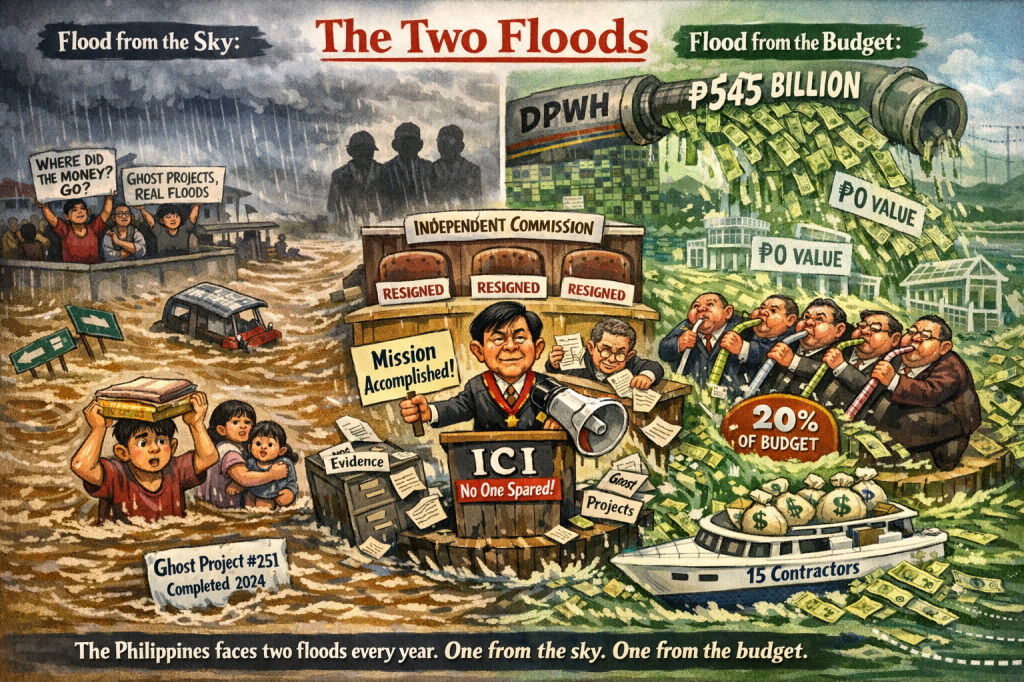
A sweeping investigation into flood control corruption was supposed to expose a decade of graft. Instead, it may reveal how hard it is to investigate the system itself.
By Louis ‘Barok‘ C. Biraogo — March 12, 2026
THE Philippines has a strange relationship with water.
Every year it arrives predictably: monsoon rains, swelling rivers, submerged streets, children wading through brown floodwater. What arrives less predictably—but just as regularly—is the discovery that billions of pesos meant to stop those floods have vanished.
And now the government’s own anti-corruption probe may itself be sinking.
President Ferdinand Marcos Jr. recently declared that the Independent Commission for Infrastructure (ICI) has already “fulfilled its brief,” according to a report by Philippine Daily Inquirer. That may sound bureaucratic. But behind that carefully worded sentence lies a political drama that could determine whether the Philippines is witnessing a genuine anti-corruption crusade—or another unfinished investigation in a country littered with them.
To understand why the ICI’s uncertain future matters, we must begin where the scandal began: in the floodwaters.
The Scandal Beneath the Floodwaters
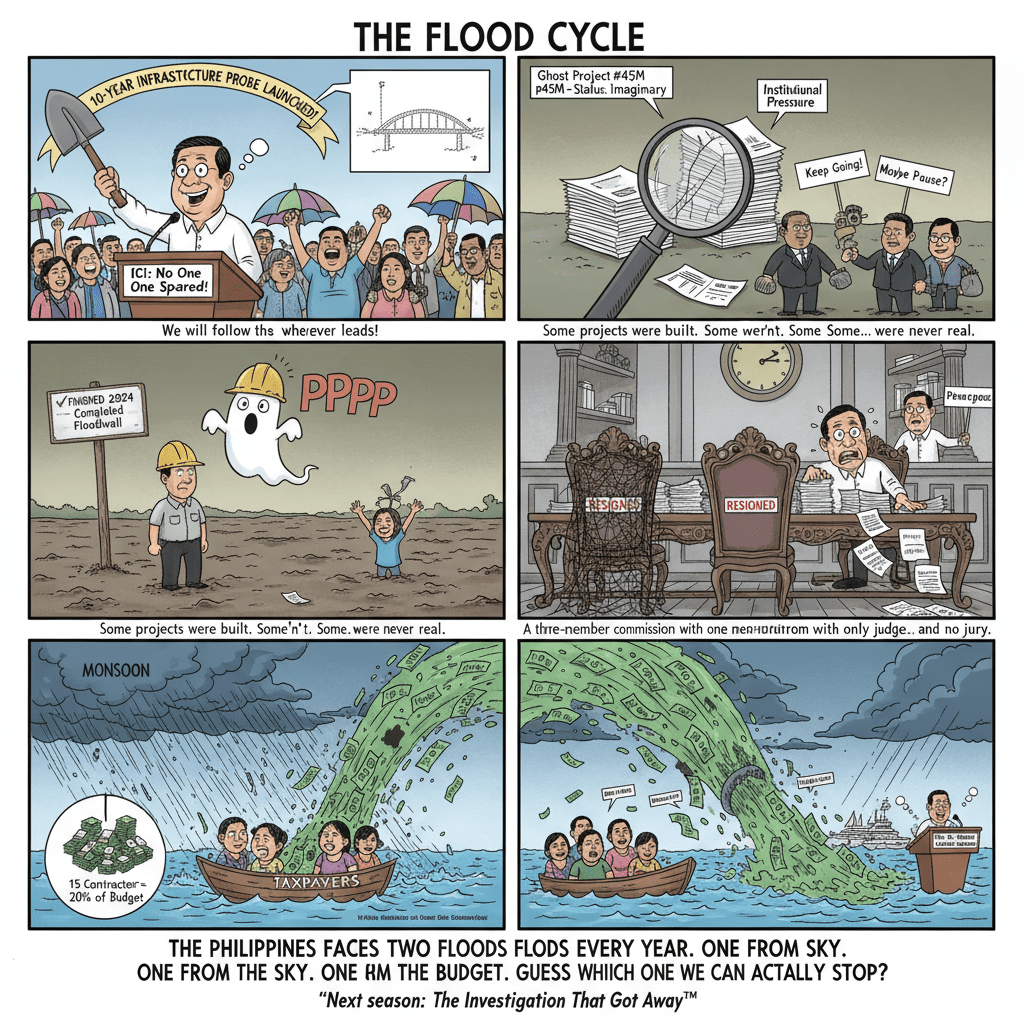
The infrastructure corruption scandal erupted after repeated typhoons and monsoon floods exposed something alarming: some flood control projects simply didn’t work.
Others, investigators discovered, did not exist at all.
In some cases, government records listed projects as completed even though nothing had been built—a classic “ghost project,” a term widely used in corruption investigations and defined in sources like Investopedia’s explanation of fraud and fictitious transactions.
Across the country, investigators eventually found hundreds of suspicious projects, including more than 250 ghost infrastructure works discovered during inspections, according to the Philippine News Agency report on the flood-control probe.
The financial scale is staggering.
Since 2022 alone, roughly ₱545 billion has been spent on flood-control projects—many now suspected of corruption, according to a Reuters investigation into the Philippine flood-control spending controversy.
Even more troubling, government audits showed that just 15 contractors received about 20% of the flood-control budget, according to summaries of the scandal compiled in the Wikipedia entry on the Philippine flood-control project controversy.
When money concentrates that tightly in a sector already notorious for graft, alarm bells should ring.
Instead, the flood alarms rang.
The Commission That Was Supposed to Clean the System
Facing public outrage, President Marcos created the Independent Commission for Infrastructure (ICI) through Executive Order No. 94, signed in September 2025, as detailed in the official announcement from the Presidential Communications Office.
The commission’s mandate was sweeping.
It was tasked to:
- Investigate infrastructure projects from the past 10 years
- Subpoena witnesses and collect evidence
- Recommend criminal cases to the Department of Justice (DOJ) or the Office of the Ombudsman, the Philippines’ constitutionally mandated anti-corruption body described by Britannica’s overview of the Ombudsman institution.
It was an unusually ambitious probe.
It would examine projects not only under Marcos—but also under previous administrations.
That meant the investigation could potentially implicate political figures across multiple governments.
The message from Malacañang was simple: no one would be spared.
But Then the Resignations Began
The first cracks appeared quietly.
Commission members began resigning.
Then investigators themselves began warning that the inquiry was facing institutional and political pressure.
Today only one commissioner remains: former Supreme Court justice Andres Reyes Jr., whose judicial career is documented in the Supreme Court of the Philippines official website.
A three-member commission with one member is like a courtroom with only a judge and no jury.
Technically functional.
Politically fragile.
The President’s Delicate Balancing Act
This is where Marcos enters the story.
His administration argues that the ICI has already produced results.
The commission has conducted hearings, processed thousands of pages of evidence, and recommended charges against dozens of individuals, according to the Inquirer report summarizing the commission’s accomplishment report.
Supporters of the president say the investigation is now entering its natural phase: prosecution.
Once fact-finding ends, cases must be filed before the Department of Justice (DOJ) or the Office of the Ombudsman, institutions whose roles in prosecuting corruption cases are explained in the Philippine DOJ official mandate page.
From this perspective, the commission has done its job.
It gathered evidence.
Now the justice system must take over.
The Critics See Something Else
Opposition figures see a different story.
They argue that declaring the commission’s job “done” while key investigations remain incomplete risks turning the probe into a partial reckoning.
And partial reckonings are a Filipino specialty.
The Philippines has a long tradition of high-profile investigations that begin with dramatic hearings and end with quiet legal limbo.
Critics ask uncomfortable questions:
- Why were the vacant commissioner posts never filled?
- Why did the probe lose momentum just as it approached powerful political figures?
- Why do infrastructure corruption investigations almost always stop just before reaching the top?
These questions have fueled protests and anti-corruption rallies across the country, as reported in a Reuters story on anti-corruption demonstrations in Manila.
The Political Minefield
The flood-control investigation is politically explosive for a simple reason:
Everyone is potentially implicated.
The projects span three administrations:
Infrastructure in the Philippines is deeply tied to political patronage.
Members of Congress often lobby for projects in their districts.
Contractors cultivate relationships with politicians.
Public works agencies manage billions in funds.
In such a system, corruption rarely belongs to one administration alone.
It becomes systemic.
The Uncomfortable Question: Who Really Controls Infrastructure Money?
At the center of the controversy lies a powerful institution: the Department of Public Works and Highways (DPWH), the government agency responsible for national infrastructure and engineering projects, as outlined on the official DPWH website.
For decades, the DPWH has been considered one of the most politically captured agencies in the Philippine bureaucracy.
Why?
Because infrastructure spending is the lifeblood of local political power.
Flood control projects, in particular, are attractive vehicles for corruption because they are technically complex and difficult to verify.
A bridge is visible.
A floodwall buried beneath soil is not.
That opacity creates opportunity.
Marcos: Reformist or Firefighter?
President Marcos now faces a paradox.
On one hand, he initiated the investigation.
He also suspended certain flood-control funding programs and ordered reviews of infrastructure allocations, actions referenced in summaries of the scandal such as the Wikipedia overview of the Philippine flood-control investigation.
He promised powerful politicians would face jail time.
These are not the actions of a president trying to bury a scandal.
On the other hand, the commission investigating the scandal now appears weakened.
And political pressure to limit the probe is immense.
If the investigation proceeds too aggressively, it could destabilize alliances within Congress and the bureaucracy.
If it proceeds too cautiously, it risks looking like a whitewash.
The Possible Futures
The ICI saga could unfold in several ways.
Scenario 1: Genuine Prosecutions
The DOJ and Ombudsman file cases based on the commission’s findings.
High-profile arrests follow.
This would represent one of the most significant anti-corruption victories in modern Philippine history.
Scenario 2: Selective Accountability
Lower-level officials and contractors are prosecuted.
Politicians escape.
This is the most common outcome in past scandals.
Scenario 3: Institutional Collapse
The commission quietly fades away.
Cases stall.
Public outrage fades with the next news cycle.
The Deeper Truth
The real story of the flood-control scandal is not merely about missing money.
It is about a structural problem.
In the Philippines, corruption in infrastructure has become almost routine.
Billions are allocated.
Projects are announced.
Floods continue.
Then another investigation begins.
The Independent Commission for Infrastructure (ICI) was supposed to break that cycle.
Whether it succeeds will depend on a single question:
Will the investigation follow the money wherever it leads?
Or will it stop just before reaching the people who control it?
Until that question is answered, the Philippines will continue to face two floods every year.
One from the sky.
And one from the budget.
Key Citations
A. Reports & Studies
- Wikipedia contributors. Flood Control Projects Scandal in the Philippines. Wikipedia.
- Investopedia Editors. Fraud Definition and Financial Misconduct. Investopedia.
B. News Articles
- Philippine Daily Inquirer. Marcos: ICI Done with Assigned Tasks but….
- Reuters. Philippines’ Marcos Says No One Will Be Spared in Infrastructure Corruption Probe.
- Reuters. Thousands of Anti-Graft Protesters Take to Streets in Manila.
- Philippine News Agency. Probe Finds Hundreds of Ghost Flood-Control Projects.
C. Official Websites
- Presidential Communications Office. President Marcos Signs EO 94 Creating Independent Commission for Infrastructure.
- Department of Justice. Mandate of the DOJ.
- Department of Public Works and Highways. About DPWH.
- Encyclopaedia Britannica. Ferdinand Marcos Jr.
- Encyclopaedia Britannica. Rodrigo Duterte.
- Encyclopaedia Britannica. Benigno Aquino III.

- “Forthwith” to Farce: How the Senate is Killing Impeachment—And Why Enrile’s Right (Even If You Can’t Trust Him)

- “HINDI AKO NAG-RESIGN!”

- “I’m calling you from my new Globe SIM. Send load!”

- “Mahiya Naman Kayo!” Marcos’ Anti-Corruption Vow Faces a Flood of Doubt

- “Meow, I’m calling you from my new Globe SIM!”

- “No Special Jail for Crooks!” Boying Remulla Slams VIP Perks for Flood Scammers

- “PLUNDER IS OVERRATED”? TRY AGAIN — IT’S A CALCULATED KILL SHOT

- “Several Lifetimes,” Said Fajardo — Translation: “I’m Not Spending Even One More Day on This Circus”

- “Shimenet”: The Term That Broke the Internet and the Budget

- “We Did Not Yield”: Marcos’s Stand and the Soul of Filipino Sovereignty

- “We Gather Light to Scatter”: A Tribute to Edgardo Bautista Espiritu

- $150M for Kaufman to Spin a Sinking Narrative





 KWEBA ni BAROK
Leave a comment