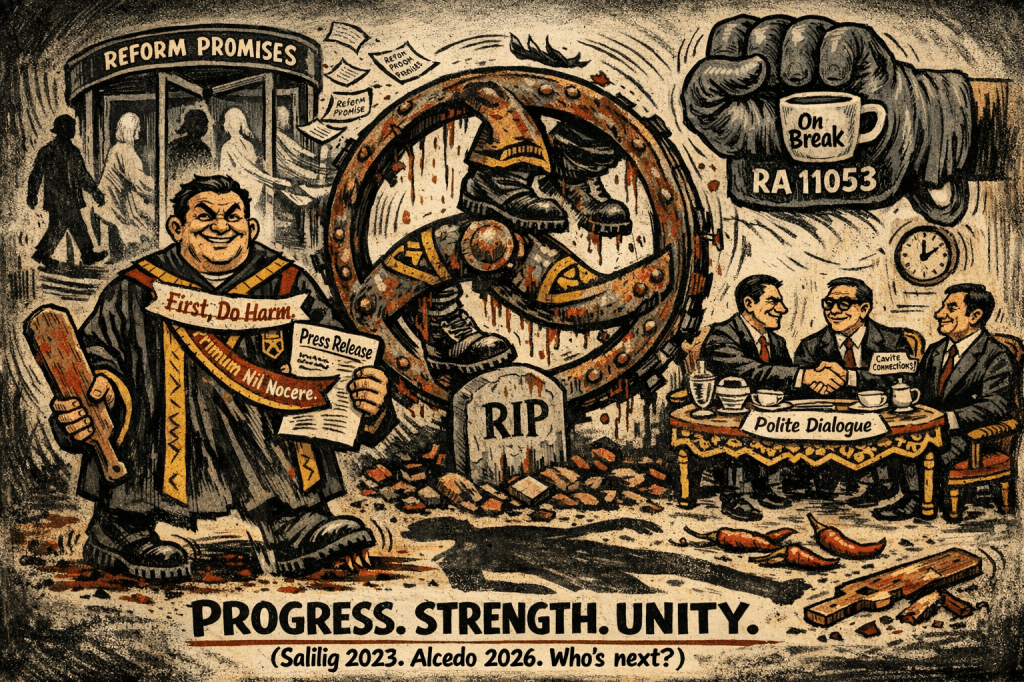
Chili Seeds, Broken Legs, and Another Round of “We’ll Do Better” Promises
By Louis ‘Barok‘ C. Biraogo — March 12, 2926
ANOTHER body. Another promise. Another round of “stricter monitoring” from an organization whose monitors must have been on permanent coffee break when Mark Kenneth Alcedo was being beaten to death in a Cavite field, chili seeds ground into his flesh in the name of brotherhood.
Ah, Tau Gamma Phi, the Triskelions—three legs running toward progress, strength, and unity, they say. But in Cavite, those legs are stomping on graves: John Matthew Salilig in 2023, Mark Kenneth Alcedo in 2026, and God knows who next if we keep swallowing their reformist snake oil. As your analyst deep in the cave, I’ve dissected enough Philippine legal fiascos to know this isn’t just a “rogue chapter” mishap; it’s a festering tumor on our society’s underbelly, where fraternity “tradition” meets torture, and the law’s supposed iron fist turns into a limp handshake. Let’s eviscerate this mess, section by section, with the precision of a Supreme Court ponente and the bite of a street brawler calling out the hypocrites.
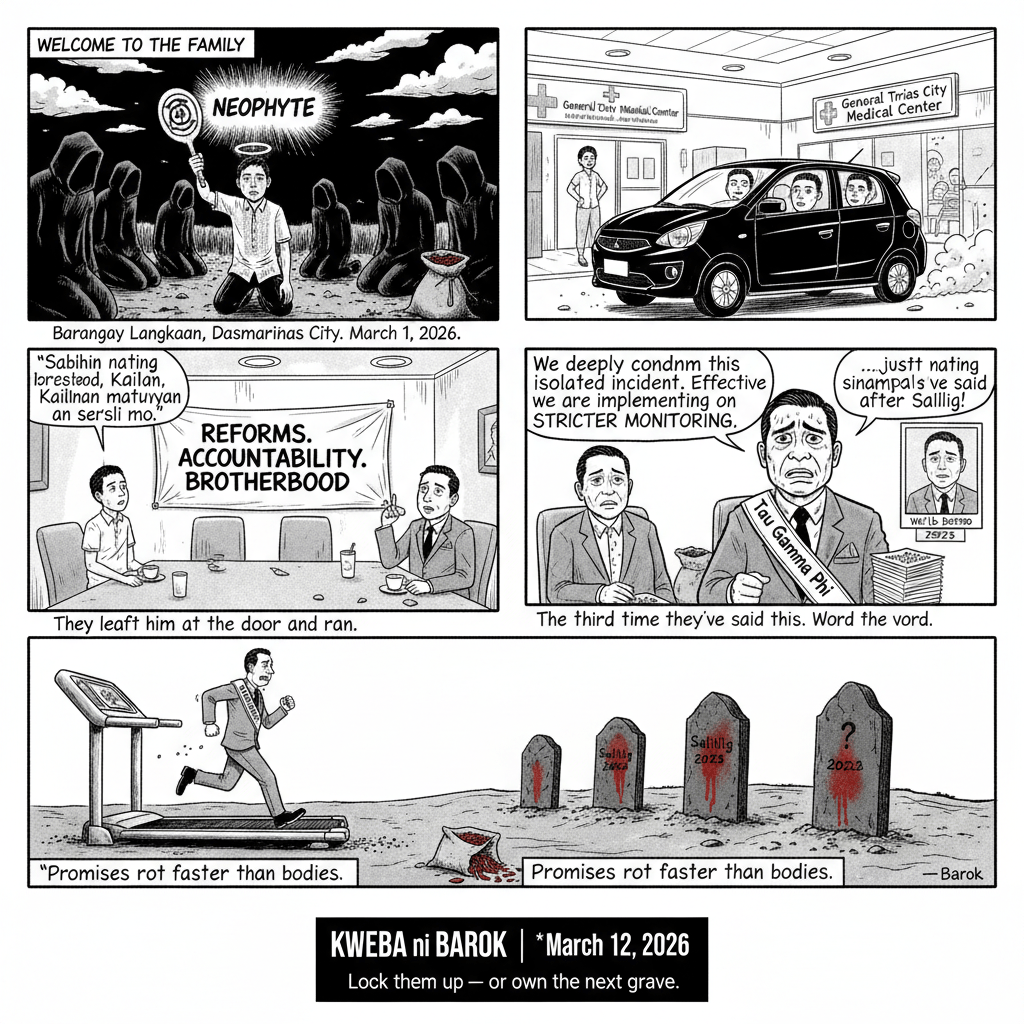
(A Tau Gamma Phi Fairy Tale)
Chili Seeds and Broken Bones: The Brutal Reality
Let’s start with the gore, because nothing screams “brotherhood” like blunt force trauma and genital humiliation. On March 1, 2026, in an open field in Barangay Langkaan, Dasmariñas City, Cavite—away from prying eyes, because why risk school cameras when you can play torturer in the wild—19-year-old maritime student Mark Kenneth Alcedo and two other neophytes were allegedly subjected to Tau Gamma Phi’s initiation rites. Alcedo didn’t make it. Autopsy: death by blunt force trauma to the lower extremities, the kind that comes from paddles, kicks, or whatever medieval tools these “brothers” wielded in the name of loyalty. And the cherry—or should I say chili—on top? Investigators found fruits and chili seeds smeared on his groin and buttocks. Yes, you read that right: chili seeds on genitals. Because nothing says “welcome to the family” like searing pain in your most vulnerable spots, turning a young man’s dream of upward mobility into a nightmare of degradation.
Am I outraged on behalf of the State? Damn straight — and if the law had teeth, it’d already be chewing through their Triskelion tattoos. This wasn’t an accident; it was a ritualized assault, methodically planned to break bodies and spirits. The survivors—those two other neophytes—have already filed affidavits, painting a picture of paddling, whipping, and humiliation straight out of Republic Act No. 11053‘s definition of hazing. Mock the absurdity? Oh, please. “Tradition” as justification for torture is like calling a firing squad a team-building exercise. These aren’t ancient rites; they’re sadistic games for insecure men proving their worth by inflicting pain. And Tau Gamma, with your motto Primum Nil Nocere—“First, Do No Harm”—how’s that working out? You’ve harmed, you’ve killed, and now you’re promising reforms like a recidivist thief swearing off locks.
Then the cover-up: After Alcedo collapses, the geniuses load him into a Mitsubishi Mirage and dump him at General Trias City Medical Center, fleeing like rats when he’s pronounced dead. They even floated a staged hit-and-run narrative initially, as if we wouldn’t notice the chili seeds screaming “frat ritual.” This isn’t just panic; it’s consciousness of guilt, pure and simple. Flight from the scene, concealment of evidence—hello, Obstruction of Justice under PD 1829. In a courtroom, that’s Exhibit A for knowing you screwed up royally.
The pattern? Connect the dots, folks. This is Tau Gamma’s encore in Cavite: Salilig in 2023, same fraternity, same province, same blunt force trauma, body buried to hide the shame. And rewind to Atio Castillo in 2017—Aegis Juris, different frat, but same playbook: paddles, death, promises. Is this a “rogue chapter” problem? Please. If every chapter’s a rogue, the national body’s the pirate ship. It’s systemic fraternity disease, a cancer where “brotherhood” bonds through blood, and the law’s chemotherapy keeps getting delayed. How many more Cavite fields must turn into killing grounds before we admit the patient is terminal?
The Law’s Iron Fist: Why RA 11053 Should Have Crushed This Already
Now, let’s carve into the law with surgical precision, because Republic Act No. 11053—the Anti-Hazing Law of 2018—isn’t some toothless memo; it’s a sledgehammer, if only we’d swing it. Passed after Atio’s death turned public outrage into legislation, it’s Southeast Asia’s strictest, banning all hazing outright, no “regulated” loopholes like the old RA 8049.
Substantive Law Analysis (RA 11053):
- Sec. 2(a) Definition: Hazing is “any act that results in physical or psychological suffering, harm, or injury… including paddling, whipping, beating… or any brutal treatment… that tends to humiliate or embarrass, degrade, abuse, or endanger.” Blunt trauma to the legs? Check. Chili seeds on genitals? That’s humiliation on steroids, a degrading ritual that fits like a glove. No wiggle room here; this isn’t “horseplay,” it’s torture porn disguised as initiation.
- Sec. 3 Prohibition: “All forms of hazing shall be prohibited.” Full stop. Mock the fraternity’s need to “promise” compliance? They’ve been “promising” since their 2023 congress post-Salilig, yet here we are. It’s like a serial killer vowing to go vegan while sharpening the knife.
- Sec. 14 Liability: This is the meat grinder. Automatic liability for: (a) planners and participants—reclusion perpetua if death results; (b) officers, advisers, alumni present or who failed to prevent; (c) all persons present, even passive watchers; (d) obstructors. Dissect it: The nine direct participants? Principals, straight to 40 years. Officers there? Same boat. Members who knew but did zilch? Liable. Alumni hovering? Bar exams revoked, licenses yanked. It’s mala prohibita—intent irrelevant; the act itself is the crime.
- Sec. 20 Penalties: Reclusion perpetua (20-40 years, no parole till 30 served) plus up to ₱3M fine. NO PROBATION. Consent? Irrelevant per Sec. 12. And schools? Sec. 11 slaps ₱1M if they slacked on regulation.
Procedural Law Critique:
At the Dasmariñas Prosecutor’s Office, preliminary investigation’s underway—complaints filed March 9, 2026, against 14-15 members. Evidence? Rock solid: survivor affidavits identifying paddlers, autopsy confirming trauma, chili seeds as physical proof of ritual, confessions from surrenders. Add flight and staged story for consciousness of guilt. Defenses? “Lack of intent”? Fails—mala prohibita doesn’t care about your heart; blunt force and chili scream recklessness at minimum. “Accidental”? Tell that to the cumulative blows in Villareal. “Rogue chapter”? Doesn’t shield nationals under Sec. 14(b) if they “should have known.” Pattern from Salilig makes modus operandi admissible to torch “mistake” claims.
Supreme Court Precedent Integration:
- Villareal v. People (G.R. No. 151258, 2012): Lenny Villa’s Aquila Legis case. SC nixed murder for lack of animus interficendi, opting for reckless imprudence homicide. But the Court noted: “Had the Anti-Hazing Law been in effect then, these… members would have all been convicted of… reclusion perpetua.” Pre-2018 vs. now? Night and day—RA 11053 mandates life for what was once probationable.
- Dungo v. People (G.R. No. 209464, 2015): Presence alone nails liability. No need to prove who swung the paddle; being there is conspiracy.
- People v. Castillo (2024): Aegis Juris convictions—10 to reclusion perpetua. Proves: participation establishes guilt, presence = conspiracy. Alcedo’s blueprint for slamming the cell door.
Naming Names: Who’s Really to Blame?
Let’s name and shame, because accountability starts with finger-pointing.
Tau Gamma Phi (National Council):
- For: Cooperating? Sure—urged surrenders, met Remulla, promised “tighter protocols” and expulsions. Post-Salilig 2023 directive? Noble on paper.
- Against: Empty promises. Salilig happened after that directive. “Stricter monitoring” like the strict monitoring that prevented… oh wait, nothing. Mockery: Your Triskelion runs in circles, not progress. Legal hit: Sec. 14(b) hooks officers/alumni if they knew (pattern screams they did) and failed to prevent. You’re not victims; you’re enablers.
Local Chapter Members:
- For: Some surrendered—big whoop.
- Against: Torturers. Period. “Brotherhood” while grinding chili into genitals? That’s not bonding; that’s sadism. Legal: Sec. 14(a) principals—reclusion perpetua. Mock any defense: “We were just present”? Dungo says hello, prison.
Jonvic Remulla / DILG:
- For: Proactive—meetings, ultimatums, March 10 deadline. Cavite boy pushing hard.
- Against: Hosting polite sit-downs with frat overlords like they’re visiting dignitaries, rather than the architects of another Cavite body dump. Why meet instead of raid? Cavite connections? Smells like politics softening the blow. Secretary Remulla, why chat when you could cuff?
PNP/Prosecutors:
- For: Quick IDs, vehicle trace, surrenders rolling in.
- Against: Open-field initiation undetected? Like PNP’s radar was off. Reliance on voluntary surrender? Raids, people—raids! PAO eyeing murder charges? Good, but don’t dither.
PNTC Colleges (Victim’s School):
Potential liability under Secs. 11 and 14(f): ₱1M fine if they ignored frat activities. Critique: Where was the in loco parentis? Monitoring off-campus? Impossible without spine—yours was missing.
Defense Fairy Tales vs. Ironclad Prosecution Facts
Defense Arguments (with Rebuttals):
- “No intent to kill” → RA 11053 mala prohibita; intent irrelevant. Blunt trauma + chili? At least reckless imprudence homicide (Art. 365 RPC), but upgrade to murder with abuse of strength.
- “Victim consented” → Sec. 12 voids it. Pure mockery: “Oh, he wanted chili on his genitals? Sure, and I want world peace via paddles.”
- “Rogue local chapter” → Admits national failure. Sec. 14(b) catches officers anyway. Pattern (Salilig) nails institutional rot.
- “Only inflictors liable” → Sec. 14(c) penalizes all present. Dungo affirms: Spectators are accomplices.
Prosecution Strengths:
- Survivor testimony: Two neophytes naming names.
- Autopsy: Trauma as COD.
- Physical evidence: Chili seeds corroborate.
- Flight/abandonment: Guilt consciousness.
- Pattern: Salilig admissible for intent/modus/absence of mistake.
Whispers, Rage, and the Ugly Truth Beneath
Public discourse? Skepticism galore: Reforms performative, “another round of promises after another death.” Rumors: National leaders control chapters? Or is it a decentralized protection racket, where “brotherhood” means omertà? Social media: #JusticeForMarkKenneth, “Torture, not tradition.” Historical Tau Gamma deaths—Servando 2014 (dismissed), Salilig 2023 (pending), Alcedo 2026—fuel the fire.
Sociological gut-punch: Frats as political nurseries—networking, patronage, protection. Toxic masculinity: Pain endurance = worthiness; humiliation = bonding. Trauma bonding: Survivors protect abusers out of twisted loyalty. Class angle: Alcedo, working-class maritime student chasing mobility, vs. connected frat boys. It’s class warfare masked as camaraderie.
Prosecutors’ Playbook: How to Nail This Once and For All
Current Status (March 2026): Complaints filed March 9 vs. 14-15; 7 surrendered, rest at large. PAO mulling murder.
Strategic Options:
- Primary: RA 11053 Sec. 14(a)—reclusion perpetua for planners/participants.
- Add Murder (Art. 248 Reviser Penal Code (RPC)): Prove treachery (defenseless victim), superior strength (group vs. one), ignominy (chili degradation).
- Obstruction (PD 1829): Abandonment, fake hit-and-run.
- Fallback: Reckless Imprudence Homicide (Art. 365).
Witness protection: Essential; frat intimidation real (Atio recants, Salilig pressure).
Command responsibility: Nail nationals under Sec. 14(b) if pattern shows “should have known.”
RA 11053: Great Law, Pathetic Enforcement
RA 11053: Strong on paper, weak in practice. Hailed post-Atio, yet deaths roll on. Critique: Laws don’t enforce themselves. Political will? Absent. CHED slacks on sanctions; DILG does meetings, not revocations.
Gaps: No mandatory national registry; no auto-revocation for killers; witness funding skimpy; delays endemic (Salilig pending 3 years).
Constitutional: Life (Article III, Section 1 of the 1987 Constitution) trumps association (Section 8). SC: Rights yield to safety (Villareal). Due process? Automatic liability passes—rational public safety link.
Choose Your Ending: Cooperation, Denial, or Real Change?
For Tau Gamma Phi:
- Full cooperation: Surrenders, expulsions, rite bans—mitigates liability.
- Defensive: Blame individuals—exposes weakness, invites deregistration.
- Genuine reform: Audits, monitoring, disband violents—survival path.
For Government:
- Prosecution only: Symptoms treated.
- Crackdown: Revoke permits, sanctions—hits roots.
- Legislative: Amend RA 11053—registry, bans, funding.
- Cultural: Anti-hazing education, alternatives.
For Schools:
- Expel students.
- Ban frats.
- Monitor off-campus (police tie-up).
For Family/Survivors:
- Criminal (ongoing).
- Civil damages (Art. 2176 quasi-delict).
- CHED/PRC complaints.
Likely Outcomes: Hope vs. Philippine Justice Reality
- Scenario A: Full Convictions (60%)—Strong evidence, pressure. Planners: perpetua + ₱3M; officers: perpetua + ₱2M; present: temporal; total fines ₱3M.
- Scenario B: Plea Deals (40%)—Flips for reduced time; loyalty may block.
- Scenario C: Acquittals/Weak (30%)—Recants, delays, system fail.
- Scenario D: Reforms (50%)—Announced, but implementation? Weak historically.
Ripples of Another Death: Who Pays the Price?
On Tau Gamma: Damage irreparable; decline; possible deregistration. Positive: Reform or fade.
On Enforcement: Tests RA 11053; convictions deter; weakness signals impotence.
On Students: Deterrence; shift to positives; underground risk.
On Victims: Justice/compensation; litigation toll.
Societal: Debate: Abolish or reform? Cynicism if fails.
Political/Legal: Remulla’s rep; SC interpretation; pro sanctions.
Economic: Fines to victims; schools/frats lose support.
What Must Happen Now: No More Excuses
Immediate (30 Days):
- Suspects surrender—no negotiations. PNP hunt, don’t wait.
- Witness protection: DOJ now, prevent recants.
- Tau Gamma: Expel all, disband Cavite, submit rolls, ban rites pending audit.
Short-Term (6 Months):
- Prosecutors: File infos in 60 days, murder if fits, oppose bail.
- CHED: Probe PNTC, fine ₱1M, require registrations.
- DILG: Revoke Tau Gamma reg, mandate frat LGU filings.
Long-Term (1-3 Years):
- Amend RA 11053: Registry, auto-bans, funding, school liability, command crim.
- Interventions: CHED education, alternatives, campaigns—“Brotherhood sans torture.”
- Judicial: Hazing courts, speedy trials, no continuances.
The Final Nail: No More Promises, Just Prisons
Tau Gamma Phi: Your Triskelion—progress, strength, unity? In Cavite, it’s Salilig, Alcedo, and the next if “reforms” stay performative. Primum Nil Nocere? Sick joke—you harmed, tortured, murdered.
The Law: RA 11053 clear—consent void, presence liable, death = perpetua. No “tradition” outs.
The System: Promises to Atio’s parents, Salilig’s family, now Alcedo’s. From frats, officials, a system that promises while kids die.
Justice: Convictions, 40 years, ₱3M paid, accountability from paddlers to nationals. Reform enforced. Anything less? Not justice—just another hazing episode, victims changing, script static.
Mark Kenneth Alcedo died with chili on his skin and blunt force in his bones. If we let his death become just another footnote in the long, bloody history of Philippine hazing, then the shame belongs to all of us—not just the men who held the paddles, but the system that keeps letting them walk.
Promises rot faster than bodies. Lock them up, or own the next grave.
– Barok
Key Citations
A. Legal & Official Sources
- Republic Act No. 11053. LawPhil Project, 2018.
- Villareal v. People, G.R. No. 151258. Supreme Court of the Philippines, February 1, 2012, The LawPhil Project.
- Presidential Decree No. 1829: Penalizing Obstruction of Apprehension and Prosecution of Criminal Offenders. LawPhil Project, 16 Jan. 1981.
- Act No. 3815: The Revised Penal Code of the Philippines. Official Gazette of the Republic of the Philippines, 8 Dec. 1930.
- Dungo v. People, G.R. No. 209464. Supreme Court of the Philippines, July 1, 2015, The LawPhil Project.
- The 1987 Constitution of the Republic of the Philippines. Official Gazette of the Republic of the Philippines, 1987.
B. News Reports
- Sigales, Jason. “Tau Gamma eyes stricter monitoring after fatal Cavite hazing.” Inquirer.net, Philippine Daily Inquirer, 6 Mar. 2026.
- Bermudez, Marianne. “10 Frat Men Get 40 Years for Deadly Castillo Hazing.” Inquirer.net, Philippine Daily Inquirer, 2 Oct. 2024.

- ₱75 Million Heist: Cops Gone Full Bandit

- ₱6.7-Trillion Temptation: The Great Pork Zombie Revival and the “Collegial” Vote-Buying Circus

- ₱1.9 Billion for 382 Units and a Rooftop Pool: Poverty Solved, Next Problem Please

- ₱1.35 Trillion for Education: Bigger Budget, Same Old Thieves’ Banquet

- ₱1 Billion Congressional Seat? Sorry, Sold Out Na Raw — Si Bello Raw Ang Hindi Bumili

- “We Will Take Care of It”: Bersamin’s P52-Billion Love Letter to Corruption

- “Skewed Narrative”? More Like Skewered Taxpayers!

- “Scared to Sign Vouchers” Is Now Official GDP Policy – Welcome to the Philippines’ Permanent Paralysis Economy

- “Robbed by Restitution?” Curlee Discaya’s Tears Over Returning What He Never Earned

- “No Pressure” Luistro? The House Pork Bazaar Exposed

- “My Brother the President Is a Junkie”: A Marcos Family Reunion Special

- “Mapipilitan Akong Gawing Zero”: The Day Senator Rodante Marcoleta Confessed to Perjury on National Television and Thought We’d Clap for the Creativity




 KWEBA ni BAROK
Leave a comment