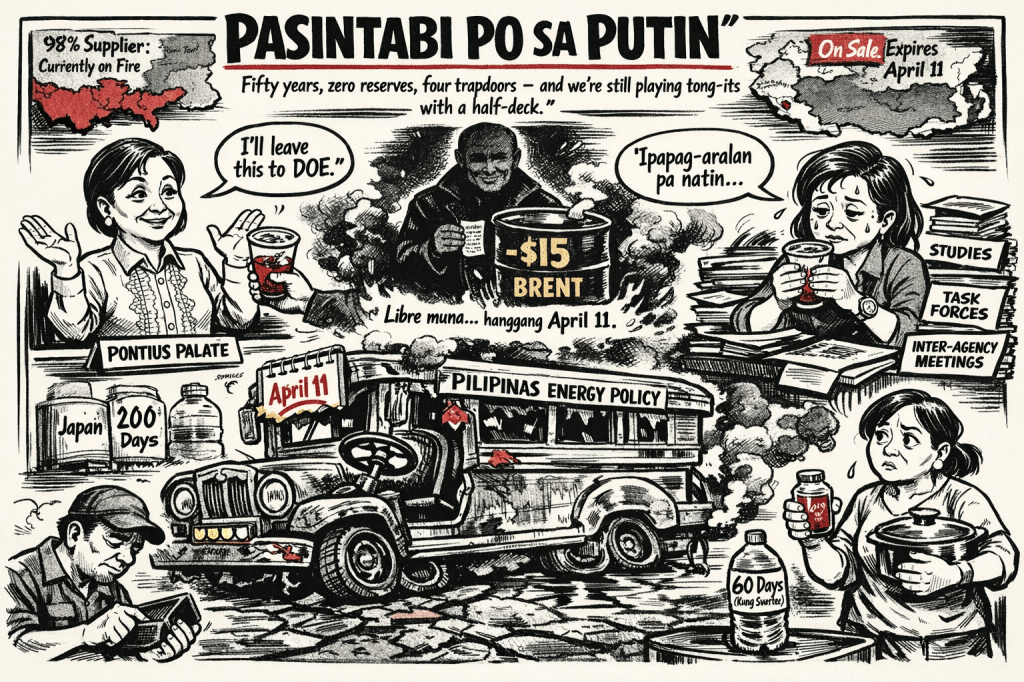
98% Middle East Junkie – Now Eyeing Putin’s Clearance Rack?
By Louis “Barok” C. Biraogo — March 16, 2026
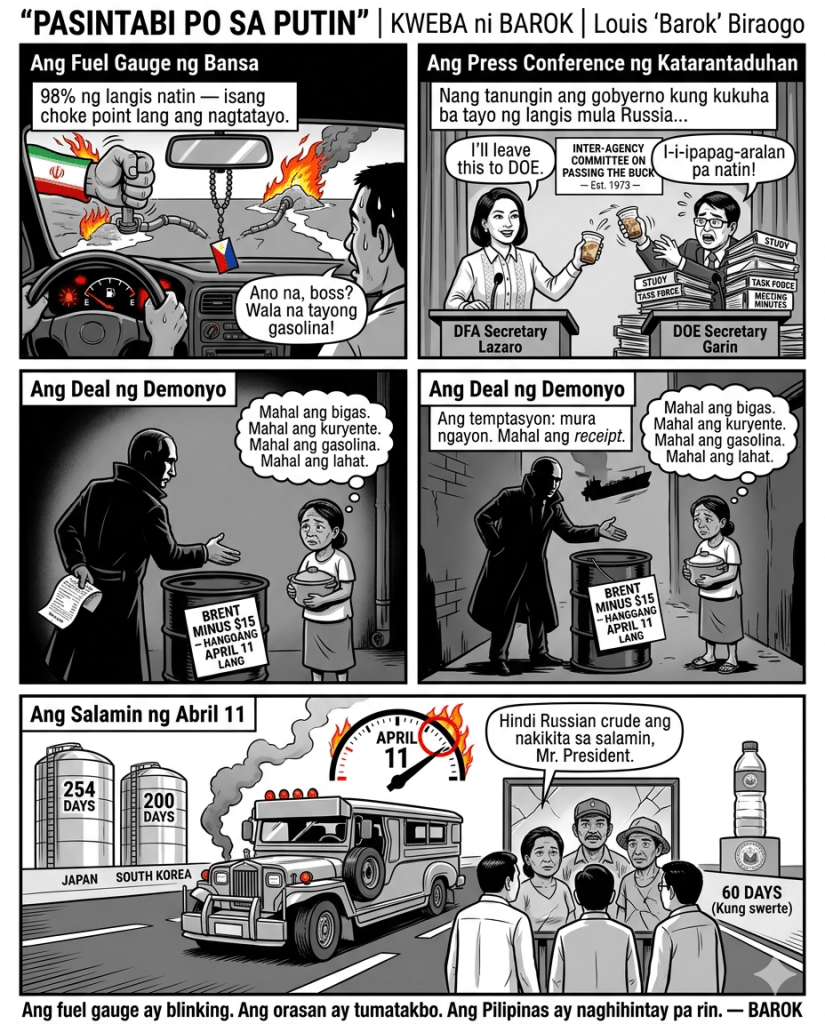
MGA ka-kweba, pull up a chair. Another day, another masterclass in Philippine statecraft: the tragicomedy where we treat energy security like a game of tong-its played with a deck missing half the cards. Exhibit A, hot off the Philippine News Agency wire: Foreign Affairs Secretary Ma. Theresa Lazaro, fresh from an ASEAN huddle, tells the world we are “considering” Russian crude. Why? Because 98 percent of our oil still sloshes through the Strait of Hormuz, now Iran-blocked amid the U.S.-Israel mess, and Washington, in a fit of temporary sanity, waived sanctions on Russian cargoes already at sea—until April 11 only. Secretary Lazaro’s mic-drop? “I’ll leave this to the Department of Energy.”
Translation: Pasintabi po, spirits of geopolitics, please don’t curse us while we pass the buck like a hot taho cup.
This is not policy. This is a nation that has spent five decades since the 1973 oil shock learning exactly nothing, now caught with its pants around its ankles, eyeing the devil’s discount rack. We are not strategic geniuses suddenly discovering diversification. We are addicts who let our supplier (the Middle East) hold the only vein, and now we’re haggling with the neighborhood loan shark because the regular dealer’s shop is on fire.
Devil’s Bargain: Why the Discounted Barrels Are Whispering “Yes, But…”
Let’s be adults for five seconds. The pragmatic case is realpolitik, not romance. Russian crude has been peddled at $12–17 below Brent because of sanctions—India pocketed billions in savings from 2022–2025 alone. Lower pump prices mean jeepney drivers can still ferry passengers without eating their children’s baon. Inflation cools. Electricity bills don’t trigger riots. And with Hormuz choked, any barrel is better than no barrel. India and China did it without becoming vassals of Moscow; ASEAN non-alignment gives us cover. Energy Secretary Sharon Garin’s statistic is a screaming siren—over-reliance on one volatile neighborhood is systemic suicide.
Fine. The devil’s offer is tempting. But every Faustian bargain comes with a receipt written in invisible ink. Those discounts evaporate the moment the April 11 waiver dies. Shadow-fleet tankers jack up insurance. Refineries tuned for sweeter Middle Eastern crude may cough. And the moment Washington tightens the screws again—as it did with 25 percent extra tariffs on India—our “smart hedge” becomes a diplomatic hand grenade.
Virtue-Signaling While the Pump Runs Dry
Now the pearl-clutchers will wail: “Buying Russian oil funds Putin’s war in Ukraine!” “It undermines sanctions!” “We’re betraying our American allies!”
Spare me the luxury indignation. The real moral obscenity is the status quo we defend with such pious fury. We already fund instability—98 percent dependence on a region where Iran can flip the Hormuz switch like a light. Every peso we send to Saudi, UAE, and Iraq props up the very volatility now threatening us. At least Russian oil comes with a temporary U.S. blessing; the Middle East route comes with permanent geopolitical Russian roulette.
“Secondary sanctions risk!” cry the DFA desk warriors. Yet the same U.S. that imposed tariffs on India just issued the waiver. Our treaty ally is literally waving us through the door for one month. If Washington wants to punish us later, it can—because we gave it the excuse by having zero strategic depth. The ethical high ground is a luxury Filipinos queuing for diesel cannot afford when the alternative is economic strangulation.
Buck-Passing Olympics: Where DFA & DOE Play Hot Potato with Our Future
But the deepest cut isn’t Russia. It’s us.
Watch the sleight of hand: DFA Secretary Lazaro washes her hands faster than Pontius Pilate and tosses the grenade to DOE. “Inter-agency consideration,” they call it. I call it the national sport of paasa—endless meetings, commissioned studies, task forces with impressive acronyms, while the country’s collective fuel gauge hovers at “E.” This is governance by evasion, drafted, it seems, on the back of a taho vendor’s receipt.
And the central, unforgivable sin? Our “strategic” reserves.
Japan sits on 254 days of supply. South Korea, around 200 days. The Philippines? A pathetic 50–60 days, and that’s not even government-controlled—it’s private-sector goodwill. Private firms whose first duty is profit, not nation. We face Category 5 energy typhoons with a single half-empty water bottle and call it prudence. After every global shock—1973, 1979, 1990, 2008, 2022—the same headlines, the same hand-wringing, the same promise to “study.” The lesson never learned is the definition of insanity.
Four Trapdoors, Zero Adults in the Room
So what are our “choices”?
- Russian Roulette – Grab the discounted barrels while the waiver lasts. Short-term relief, long-term diplomatic bruises.
- Head-in-the-Sand – Cling to Middle East crude and pray Hormuz reopens. Hope is not a strategy; it’s a prayer mat for the desperate.
- The Mosaic Mirage – Diversify to Brazil, U.S., Nigeria, whatever. Commendable on paper, ruinously slow and expensive when you have no reserves to bridge the gap. President Marcos Jr. has talked the talk; the barrels have not followed.
- The Adult Option Nobody Wants – Build real stockpiles and sprint toward renewables. The only sane path. The one we have ignored since Martial Law.
We keep choosing doors 1–3 because Door 4 requires political spine and actual money. Easier to debate Russian oil than to tax, borrow, or legislate the reserves we should have built decades ago.
When the Price Spike Hits Grandma’s Rice Pot
This isn’t abstract geopolitics. When prices spike, jeepney drivers skip meals so their families can eat. Fishermen tie up their boats because diesel costs more than the catch. Tricycle operators charge double, strangling the informal economy that feeds half the country. Inflation doesn’t just hit the CPI—it hits the mother in Tondo deciding between rice and medicine. A nation that cannot fuel its own economy cannot pretend to sovereignty. We are vassals to whoever controls the chokepoints.
Energy Security or Bust: The Only Flag Worth Dying For
Energy security is not a niche concern for technocrats. It is the bedrock of national independence—more vital than any VFA, more existential than any SCS arbitration. A country held hostage by foreign oil is a country that can never truly say “no.”
The solution is brutal but obvious:
- Mandate a government-owned strategic petroleum reserve targeting 90 days minimum (IEA standard) within three years—financed by a modest energy-security levy on fuel imports, ring-fenced like the Malampaya fund was supposed to be.
- Force the private sector to maintain 30 days commercial stocks or lose import licenses.
- Accelerate LNG terminals, geothermal expansion, and solar mandates so that by 2035 we are not still 98 percent addicted to any single region.
- Stop the paasa inter-agency circus: create a single Energy Security Council under the President with real power and real deadlines.
Anything less is dereliction of duty bordering on criminal negligence.
We have been burned by every oil crisis since 1973. The Filipino people have paid in blood, sweat, and piso. The only question left is whether our leaders will finally grow a spine or continue playing tong-its while the nation’s engine sputters.
The clock is ticking. April 11 is not a deadline—it’s a mirror. Look into it, Mr. President, Madame Secretaries. What stares back is not Russian crude. It’s the face of a nation that deserves better than endless desperation dressed up as deliberation.
Enough pasintabi po. Time to build the damn reserves.
Barok has spoken. The fuel gauge is blinking. Act.
Key Citations
A. News Articles
- Rocamora, Joyce Ann L. “Oil imports from Russia ‘being considered’ – DFA chief.” Philippine News Agency, 13 March 2026.
- Paunan, Jerome Carlo. “Marcos: PH fuel supply stable for 60 days.” Philippine Information Agency, 4 Mar. 2026.
- GMA Network. “PH, other Asian countries move to limit impact of oil price hike amid Middle East conflict.” GMA News, 10 March 2026.
- Shakil, Ismail and Bryanski, Gleb. “US issues 30-day sanctions waiver for purchase of sanctioned Russian oil at sea.” Reuters, March 13, 2026.
- Reuters. “US dropping 25% separate tariff on Indian imports after pledge to cut Russian oil.” Reuters, February 3, 2026.
B. Reports & Studies
- International Energy Agency (IEA). Various reports on member countries’ emergency oil stockpiles.
- Slav, Irina. “India Saves $12.6 Billion on Oil Import Bill With Russian Crude.” OilPrice.com, September 2, 2025.
- Yonhap News Agency. “S. Korea involved in oil reserve release discussions with IEA.” Yonhap News Agency, 11 Mar. 2026.
- Mukul, Sushim. “How much did India gain from Russian oil? Numbers show savings of $17 billion.” India Today, September 2, 2025.
- ₱75 Million Heist: Cops Gone Full Bandit

- ₱6.7-Trillion Temptation: The Great Pork Zombie Revival and the “Collegial” Vote-Buying Circus

- ₱1.9 Billion for 382 Units and a Rooftop Pool: Poverty Solved, Next Problem Please

- ₱1.35 Trillion for Education: Bigger Budget, Same Old Thieves’ Banquet

- ₱1 Billion Congressional Seat? Sorry, Sold Out Na Raw — Si Bello Raw Ang Hindi Bumili

- “We Will Take Care of It”: Bersamin’s P52-Billion Love Letter to Corruption

- “Skewed Narrative”? More Like Skewered Taxpayers!

- “Scared to Sign Vouchers” Is Now Official GDP Policy – Welcome to the Philippines’ Permanent Paralysis Economy

- “Robbed by Restitution?” Curlee Discaya’s Tears Over Returning What He Never Earned

- “My Brother the President Is a Junkie”: A Marcos Family Reunion Special

- “Mapipilitan Akong Gawing Zero”: The Day Senator Rodante Marcoleta Confessed to Perjury on National Television and Thought We’d Clap for the Creativity

- “Just Following Orders” Is Dead: How the Hague Just Turned Tokhang’s Finest Into International Fugitives



 KWEBA ni BAROK
Leave a comment