Vendors “Cooperating,” Families Starving — Welcome to Presidential Semantics
By Louis ‘Barok‘ C. Biraogo — March 18, 2026
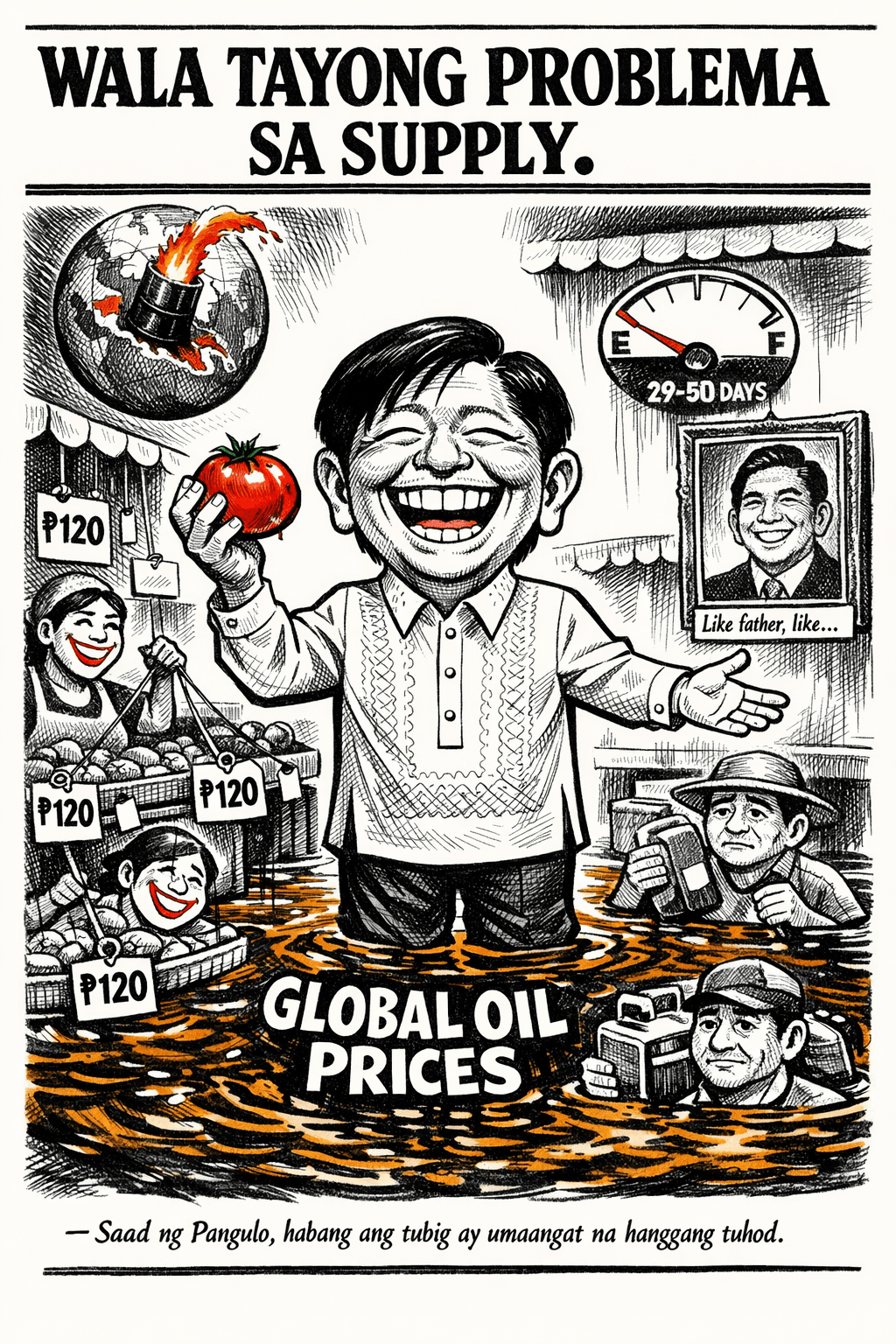
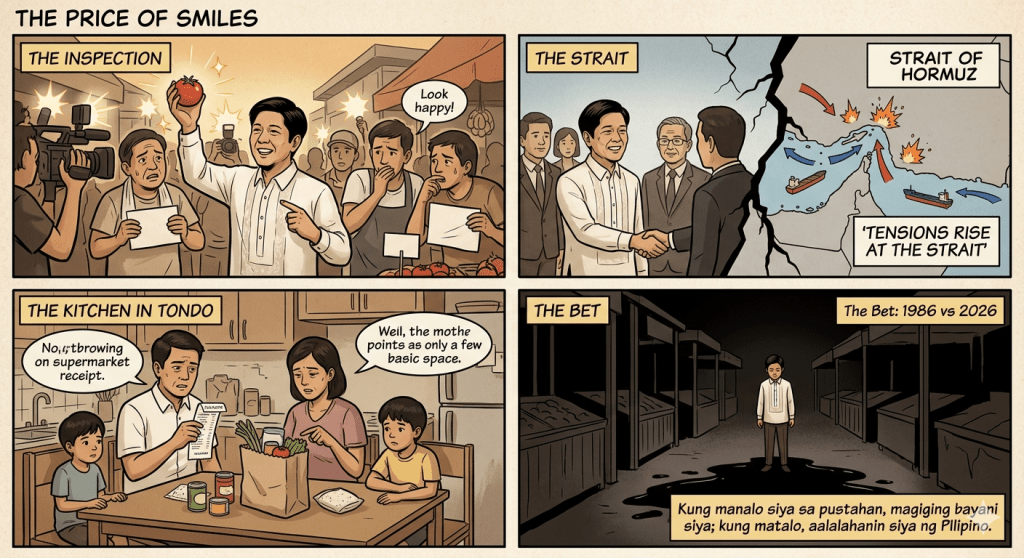
MGA ka-kweba, picture this: President Ferdinand “Bongbong” Marcos Jr. strolling the aisles of Agora Market, vendors flashing practiced smiles for the cameras, price tags frozen in obedient normalcy. He declares,
Our vendors, he assures the nation, “are cooperating and they are keeping the prices at normal.”
It is a perfect photo-op. It is also a perfect lie of omission.
While the president inspects tomatoes and poses with smiling tindera, the Strait of Hormuz — the narrow throat through which roughly 20 percent of the planet’s oil passes trembles under Iranian threats. Global crude has already punched past $100 a barrel. The International Energy Agency warns of a possible 8-million-barrel-per-day loss if the US-Israel-Iran conflict escalates.
The Philippines, an oil-importing nation with 98.8 percent dependence on foreign crude, mostly Middle Eastern, is one spark away from feeling the heat in every jeepney fare, every sack of rice, every bottle of LPG that keeps a family’s dinner cooking.
And yet the government is already in full scramble mode: cash and fuel subsidies rolling out to drivers (Metro Manila this week, nationwide by April), urgent certification of excise-tax suspension bills, amendments to the Biofuels Act, frantic talks with alternative suppliers. “No problem,” the President says. The dissonance is deafening.
This is not a slip of the tongue. This is a deliberate strategy of reassurance colliding head-on with the machinery of mitigation. It reveals the classic Marcos communication playbook: project calm to prevent panic buying, while quietly preparing the safety nets that only become necessary when the situation is, in fact, far from “normal.”
The result? Ordinary Filipinos are left wondering whether their president is bravely steadying the ship or simply refusing to acknowledge that the water is already rising around their ankles.
The Technical Distinction That Comforts No One
Marcos and his allies insist the statement is “technically accurate.” The country has 50–67 days of fuel buffer (diesel at 50.5 days, LPG at 29 days), shipments in transit, no physical outages.
The issue, they say, is price, not supply. In energy economics textbooks, that distinction matters. In a mother’s kitchen in Tondo or a farmer’s field in Nueva Ecija, it is meaningless.
Because when diesel jumps, jeepney fares jump. When jeepney fares jump, vegetables and rice jump. When fertilizer jumps, the price of the next harvest jumps.
The poorest 60 percent of Filipinos — those who spend the largest share of their income on food and transport — feel every ripple immediately. Subsidies and tax suspensions are already being rushed out precisely because the administration knows the price shock is coming.
If there is truly “no problem,” why the sudden nationwide cash assistance to drivers? Why the frantic diversification talks? Why the show-cause orders to oil stations suspected of profiteering?
The semantic precision is cold comfort. It is the rhetorical equivalent of telling a drowning man, “Technically, you still have air in your lungs.”
Calming Leadership or Dangerous Denial?
Supporters will argue that reassurance prevents panic. History is littered with examples where presidential calm averted self-inflicted shortages. Malacañang explicitly warned against hoarding. Fair enough.
But there is a line between preventing panic and enabling denial. That line was crossed the moment the president stood in a market and declared “normal” while transport groups were already drafting strike notices and inflation had hit a 13-month high (2.4% Feb).
The optics are brutal. A photo-op of market normalcy while the same government admits the Middle East war will have an “inevitable effect” on goods.
Vendors “cooperating” to keep prices normal — as if small stallholders can defy global commodity spikes through sheer patriotism. Basic economics says otherwise. Supply chains do not run on national spirit; they run on dollars and barrels.
This is not steady leadership. This is a credibility gamble. Marcos is betting his presidency that the conflict will de-escalate before Philippine stocks run dry.
If he wins the bet, he emerges as the cool hand who prevented panic. If he loses — and Hormuz snaps shut — the same Filipinos who voted for him will remember the man who smiled in the market while their lives became unaffordable.
The Structural Absurdities We Refuse to Name
Let us speak plainly about the elephant in the oil tank: the Philippines is an oil-importing nation pretending it can whistle past a global energy crisis. RA 8479 — the 1990s Oil Deregulation Law — was sold as neoliberal liberation.
What it delivered was a government stripped of teeth while the Big Three (Petron, Shell, Caltex, controlling roughly 45 percent of the market) post record profits and face nothing stronger than polite “show-cause” orders.
The regulatory spectacle is tragicomic. The Department of Energy “monitors.” The Palace threatens closure of stations. Intelligence agencies check warehouses for hoarding.
All while the law itself forbids meaningful price caps or forced margin disclosure. We have created a system where the government can scold but cannot control, lecture but cannot compel transparency.
And the ultimate irony? The son of the man who presided over the devastating 1970s oil shocks — when the Philippines was crippled by the very same Middle East volatility — now finds himself in the identical vise. History does not repeat; it rhymes with cruel precision.
The Human Cost Behind the Headlines
Let us leave the abstractions for a moment and meet the people the statistics are too polite to name.
Maria, a market vendor in Quiapo, wakes at 3 a.m. to buy vegetables. Every extra peso in diesel is a peso less she can feed her three children.
Juan, a farmer in Central Luzon, watches urea prices climb and wonders whether he can afford to plant next season. Tito, the jeepney driver in Quezon City, already owes money on his franchise; another fare hike means he parks the vehicle and his family skips meals.
These are not “vulnerable sectors.” These are the backbone of the economy. When fuel prices spike, the pain is regressive: the poor pay the highest proportion of their income.
The subsidies now being rolled out are welcome, but they are targeted bandaids on a systemic hemorrhage. And they come with a fiscal bill that will eventually be paid by the same taxpayers whose purchasing power is already eroding.
Whispers, Crony Deals, and the Great Blackout of Truth
The whispers are growing louder. Hoarding? Government points fingers at middlemen and stations; critics point at the absence of audited inventories.
Cronyism? The sudden diversification push includes rumored deals linked to billionaire allies — Colombian oil, anyone? Is this genuine hedging or a quiet carve-up among the usual suspects?
Geopolitically, the intrigue deepens. The Philippines publicly aligns with Western partners yet quietly explores Russian or alternative sources. Diplomatic tightrope walking is understandable; secrecy breeds suspicion.
Worst of all is the transparency void. Oil company costs and margins remain commercial secrets shielded by “national security” redactions.
We are asked to trust an oligopolized industry that has every incentive to maximize profit within the generous loopholes of RA 8479. Filipinos are not children. We deserve the books opened — every import contract, every pricing formula, every margin.
The Paths Forward — and Their Price Tags
The administration faces four broad paths, each with its own rationale, risks, and political math.
Minimal intervention
Continue monitoring + targeted aid (e.g., cash/fuel subsidies for drivers, farmers, fisherfolk).
- Rationale: Preserves fiscal discipline, avoids market distortion.
- Risks: Public anger if prices spike uncontrollably; relies heavily on quick de-escalation in the Middle East.
- Political calculus: Safe bet if conflict cools fast — Marcos looks prudent, not panicky.
Emergency declaration + price controls
Invoke powers for temporary oil sector direction, mandatory disclosures, or caps where legally feasible.
- Rationale: Dramatic, visible leadership; signals the government is taking charge.
- Risks: Constitutional questions, potential investment chill, legal challenges from oil firms.
- Political calculus: Appeals to nationalist sentiment and frustrated voters; high-reward if it works, high-blame if it backfires.
Full subsidy regime + tax suspensions
Expand cash aid nationwide, push through excise tax cuts/suspensions (as in the urgent bills certified by Marcos and now advancing in Congress).
- Rationale: Immediate relief for consumers and key sectors; politically popular.
- Risks: Fiscal unsustainability (billions in lost revenue), IMF/credit rating concerns, long-term budget strain.
- Political calculus: Strong preparation for 2028 — buys goodwill among jeepney drivers, farmers, and the middle class now hurting most.
Accelerated energy transition
Mandate renewables acceleration, local drilling incentives, strategic petroleum reserve buildup (e.g., proposals for 90-day national stocks), deregulation review/amendment of RA 8479.
- Rationale: Long-term solution; builds genuine energy security and international goodwill.
- Risks: Short-term pain (higher transition costs), fierce opposition from vested oil interests.
- Political calculus: Legacy play — positions Marcos as the president who finally broke the cycle of import dependence, but demands courage few administrations have shown.
The opposition must also choose: ritual outrage or real alternatives?
Parliamentary probes matter only if they birth legislation.
Mass actions like transport strikes pressure but can alienate the public they claim to defend.
Credible offers — revived national oil company with transparency, mandatory reserves, windfall taxes funding transition — separate gadflies from governors-in-waiting.
Every path has a price tag. The question is who pays — and for how long.
Four Possible Tomorrows
Scenario A: De-escalation dividend.
Tensions cool, prices retreat, stocks hold. Marcos is hailed as the steady hand. Critics are dismissed as alarmists. Structural vulnerabilities remain untouched — guaranteeing the next crisis.
Scenario B: Protracted grind.
Volatility persists, subsidies and tax measures cap inflation at 4–6 percent. The country muddles through. Public trust erodes one peso at a time. Reform is postponed again.
Scenario C: Perfect storm.
Hormuz closes. Stocks deplete. Transport strikes paralyze cities. Protests erupt. The administration is forced into emergency measures under duress. Opposition gains ground. Reform finally arrives — but born of pain, not foresight.
Scenario D: Transformation.
The crisis becomes the catalyst. Congress passes genuine energy security legislation — renewables targets, drilling incentives, reserve requirements, deregulation overhaul. Pain today buys resilience tomorrow. Marcos claims the legacy; critics claim they forced the change.
The Moral Reckoning
Economic consequences are clear: accelerated inflation, peso pressure, GDP drag. Social consequences are crueler: the heaviest burden falls on the bottom 60 percent, trust in government frays further, collective action either mobilizes or demoralizes depending on whether relief feels fair.
Politically, this is a defining moment for the Marcos presidency. Competence confirmed or exposed? The 2028 election will remember who smiled in the market while families tightened belts.
Historically, the parallels with the senior Marcos’s 1970s debacle are impossible to ignore. The son now has the chance to break the cycle — or repeat it with better public relations.
A Call for Accountability — With Teeth
Enough rhetoric. Here is what must happen, immediately:
- Weekly public disclosure of fuel inventories, import schedules, and real-time stock levels — no more “national security” excuses for commercial data.
- A live, regional price-monitoring dashboard so every Filipino can see what their government sees.
- An emergency hotline for hoarding reports backed by rapid-response teams that actually respond.
- A tripartite dialogue — government, oil companies, transport groups — convened within 30 days, with binding commitments.
This year: emergency legislation forcing oil companies to justify every price increase with audited cost data. Creation of a strategic petroleum reserve with legally mandated minimums. Windfall profit tax on oil firms to fund an energy transition trust.
Long-term: independent review of RA 8479 with a clear timeline for amendment or repeal. A comprehensive energy independence roadmap with enforceable 5-, 10-, and 20-year targets. An independent consumer protection agency with real enforcement powers — not another toothless monitor.
The Question Every Official Must Answer
When was the last time you rode a jeepney at rush hour? Bought vegetables in a wet market with minimum-wage money in your pocket? Calculated a household budget knowing that one fuel spike could erase a month’s savings?
The nation is watching. History is taking notes.
This is not merely about one statement in one market. This is about whether a presidency that inherited both enormous privilege and enormous expectation will finally choose the Filipino family over the optics of calm.
Whether we will keep pretending an oil-dependent nation can survive on reassurance alone.
Or whether, at long last, we will demand the structural honesty our survival requires.
The market smile was charming. The coming months will reveal whether it was also cruel.
Key Citations
A. News Articles
- Cabato, Luisa “Marcos: ‘We don’t have a problem’ in supplies of food, fuel products.” Inquirer.net, 18 Mar. 2026.
- De Leon, Nyah Genelle C. “Philippine inflation hits 13-month high of 2.4% in February.” Inquirer.net, 5 Mar. 2026.
- Nieves, Alicia andDelandro, Taylor. “Iran war triggers historic global oil supply disruption, IEA says.” NewsNation, Mar. 2026.
- Sigales, Jason. “Fwd: Marcos says PH looking for other oil supply sources.” Inquirer.net, Mar. 2026.
B. Reports and Official Sources
- U.S. Energy Information Administration. “Amid regional conflict, the Strait of Hormuz remains critical.” Today in Energy, 16 June 2025.
- “Republic Act No. 8479.” Official Gazette of the Republic of the Philippines, 10 Feb. 1998.
C. Data Sources

- “Forthwith” to Farce: How the Senate is Killing Impeachment—And Why Enrile’s Right (Even If You Can’t Trust Him)
- “HINDI AKO NAG-RESIGN!”
- “I’m calling you from my new Globe SIM. Send load!”
- “Mahiya Naman Kayo!” Marcos’ Anti-Corruption Vow Faces a Flood of Doubt
- “Meow, I’m calling you from my new Globe SIM!”
- “No Special Jail for Crooks!” Boying Remulla Slams VIP Perks for Flood Scammers
- “PLUNDER IS OVERRATED”? TRY AGAIN — IT’S A CALCULATED KILL SHOT
- “Several Lifetimes,” Said Fajardo — Translation: “I’m Not Spending Even One More Day on This Circus”
- “Shimenet”: The Term That Broke the Internet and the Budget
- “We Did Not Yield”: Marcos’s Stand and the Soul of Filipino Sovereignty
- “We Gather Light to Scatter”: A Tribute to Edgardo Bautista Espiritu
- $150M for Kaufman to Spin a Sinking Narrative

 KWEBA ni BAROK
Leave a comment