The Loophole That Lets You Buy Votes Before You’re Even a Candidate
By Louis “Barok” C. Biraogo — March 19, 2026
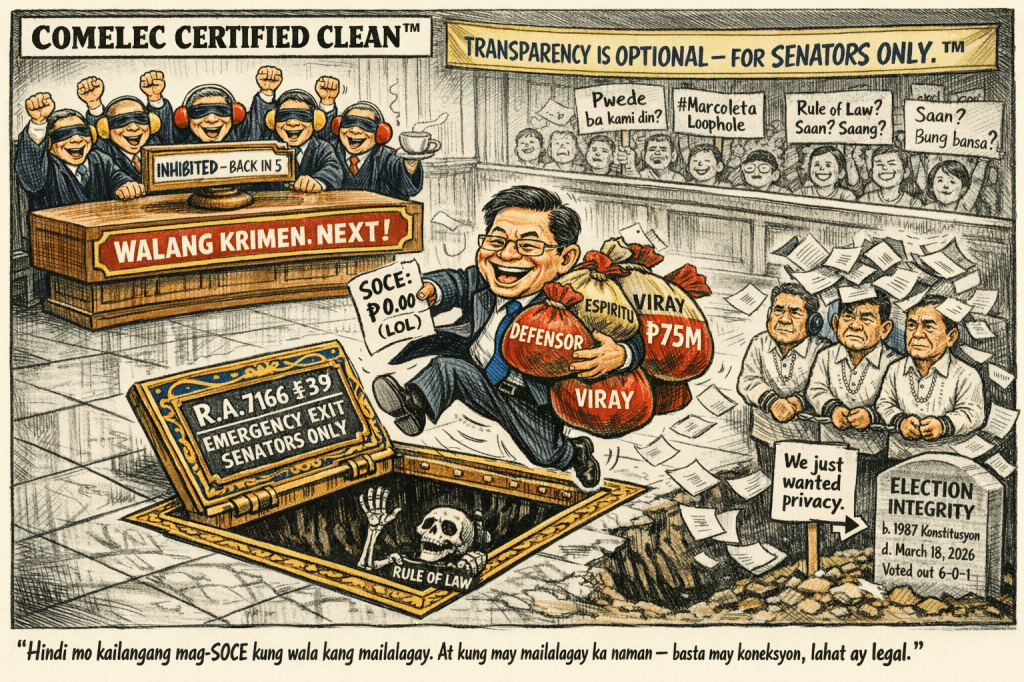
THE Commission on Elections (COMELEC) just looked at a senator who admitted pocketing P75 million in anonymous cash, filed a Statement of Contributions and Expenditures (SOCE) declaring zero contributions, and said, with a straight face: “No crime here, folks. Move along.”
Six commissioners voted 6-0-1 (Chair Garcia conveniently inhibited). The Political Finance and Affairs Department (PFAD) shrugged and blamed Republic Act No. 7166 (Synchronized Elections Law), Section 39. The donors? They get the bill. The public? We get the middle finger.
Welcome to the Marcoleta Loophole—the newest, shiniest escape hatch for every future trapo with rich, shy friends. Let’s eviscerate this abomination, section by section, law by law, hypocrisy by hypocrisy.
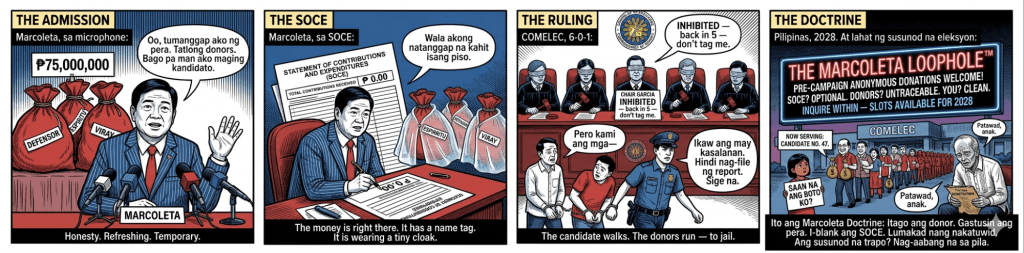
The Phantom Donations Paradox: Admission Meets Zero Disclosure
Here is the naked, screaming contradiction that COMELEC pretends isn’t there:
Marcoleta admits receiving P75 million from three donors (Michael Tan Defensor, Joseph Varias Espiritu, Aristotle Baluyut Viray) in three separate pre-campaign “gifts.” He used the money for campaign expenses that dwarfed his SALN. Yet his SOCE declares zero contributions.
Batas Pambansa Blg. 881 (Omnibus Election Code) Section 98 demands the “true name” of every contributor—no anonymity allowed. OEC Section 109 requires the SOCE to itemize every single centavo: date, amount, full name and address of donor. OEC Section 262 makes violation an election offense punishable by 1-6 years imprisonment, fine, and perpetual disqualification.
COMELEC’s answer? “Republic Act No. 7166 Section 39 repealed the criminal penalty for candidates.” Translation: the law still requires disclosure, but we’re just not going to punish you for ignoring it.
This is not a “legal gap.” This is a black hole that swallows transparency, spits out dark money, and laughs while the public is told to eat cake. Systemic failure? Try systemic surrender.
The Usual Suspects: Comelec Gymnastics, Marcoleta’s Dodge & Everyone Else
The Comelec: Legal Gymnastics Hall of Fame
They acknowledge the violation, then declare it non-criminal because of an implied repeal from a 1991 law. They cite Republic Act No. 7166 Section 39 as if it were the Ten Commandments handed down by Moses himself. Never mind the doctrine that implied repeals are disfavored (a principle older than most of these commissioners). Never mind that they are the very body tasked under Article IX-C, Section 2(1) of the 1987 Constitution to “enforce and administer all laws relative to the conduct of elections.”
Instead, they create the ultimate loophole: candidates can now take anonymous millions, spend them, and walk away. Donors get prosecuted. Classic COMELEC—selective enforcement so sharp it could slice salami. Institutional credibility? Buried somewhere under the P75 million.
Rodante Marcoleta: Lawyer, Senator, Master of the “Anonymity Request” Dodge
A practicing lawyer and sitting senator who invokes the Penera v. COMELEC (G.R. No. 181613) doctrine like a get-out-of-jail-free card. “I wasn’t a candidate yet!” he cries, while his campaign war chest magically appeared before the campaign period even started.
His SALN says one thing, his admitted receipts say another, his SOCE says nothing. As a member of the bar, he is bound by Canon 1 of the Code of Professional Responsibility: uphold the law. As a senator, he swore to Article XI, Section 1 of the 1987 Constitution—public office is a public trust.
Instead, he hides behind donor “privacy requests.” Sir, the law doesn’t give donors veto power over the people’s right to know who bought your seat. Your ethics are as transparent as your SOCE—non-existent.
The Critics (Kontra Daya et al.): Thank You for the Headache
They dragged this into the open. They referred it to the Ombudsman. They forced COMELEC to at least pretend to investigate. Their motivation? Clean elections. Their effectiveness? They made the powerful sweat for five months. Imperfect warriors, but warriors nonetheless. Keep swinging.
The Donors: The Ironic Scapegoats
They wanted anonymity. Now they’re facing criminal complaints for failing to file their own contribution reports within 30 days (Republic Act No. 7166 and COMELEC rules). The candidate who spent their money walks. They get the rap sheet. Poetic justice or selective prosecution? Both. Next time, gentlemen, maybe don’t hide behind a senator’s skirt.
Other Actors
The Ombudsman has yet to act decisively on the related referrals. Media coverage has been limited, with Net25 providing some of the more pointed questioning. The public erupted in outrage on X and Facebook for a time, before attention shifted elsewhere—as tends to happen in these cycles of Philippine political discourse.
Constitutional Autopsy: Where COMELEC Buried the Rule of Law
This ruling doesn’t just bend the law—it violates the Constitution in broad daylight.
- Article IX-C, Section 2(1) of the 1987 Constitution: COMELEC’s solemn duty is to enforce election laws. Declaring a clear violation “decriminalized” by implication is the textbook definition of grave abuse of discretion.
- Article III, Section 1 of the 1987 Constitution (Equal Protection): Candidates get a free pass; donors face jail. Two classes of actors, one set of rules. Unconstitutional on its face.
- Article II, Section 27 & Article XI, Section 1 of the 1987 Constitution: The State policies on transparency, accountability, and graft prevention are now optional for rich senators.
Supreme Court precedents they conveniently ignored:
- The Penera v. COMELEC (G.R. No. 181613) protects pre-campaign acts—but SOCE still covers all funds used in the election.
- PDP-Laban v. COMELEC (G.R. No. 225152) (2019): COMELEC cannot rewrite liabilities by resolution. Yet here they are, rewriting criminality.
- Doctrine of implied repeal? Only when irreconcilable. Republic Act No. 7166 Section 39 never explicitly repealed OEC Section 262 penalties.
This is not interpretation. This is judicial legislation by an administrative body—the very evil the Supreme Court exists to crush.
Prosecution Roadmap: Every Charge, Every Venue
Against Marcoleta
- Administrative liability under Republic Act No. 7166 Section 14 (fine + cannot assume office—moot now, but record it).
- Perjury (Revised Penal Code (Act No. 3815), Article 183)—SOCE under oath with willful falsehood.
- Republic Act No. 3019 (Anti-Graft and Corrupt Practices Act)—unexplained wealth + undue advantage.
- Tax evasion (NIRC)—P75M unreported income. Venue: Ombudsman or BIR, then Sandiganbayan/RTC.
Against the Donors
Criminal election offense for failure to file individual contribution reports. COMELEC Law Department preliminary investigation → Regional Trial Court. Straight from the PFAD recommendation.
Against COMELEC
Petition for Certiorari (and Mandamus) under Rule 65, Rules of Court, for grave abuse of discretion amounting to lack or excess of jurisdiction. Supreme Court, direct. Fast-track it. Certiorari to annul the resolution; mandamus to compel any neglected ministerial enforcement duties.
Chess Moves on the Battlefield: Strategic Options for the Liars
- COMELEC: Issue clarificatory resolution (too late), fast-track donor cases to look balanced, or pray the Supreme Court doesn’t notice.
- Marcoleta: Voluntary supplemental SOCE + damage-control presser, or double down and dare critics to sue.
- Donors: Late filing + plea bargain, or challenge the asymmetry in court.
- Critics: File the petition for certiorari and mandamus under Rule 65 today, lobby the Senate Blue Ribbon Committee, and amplify #MarcoletaLoophole online.
This is endgame. The next move decides whether the loophole becomes permanent law.
Future Scenarios: From SC Reversal to Permanent Loophole
- Best case: Supreme Court grants certiorari and mandamus, strikes down the ruling as grave abuse of discretion, remands for criminal prosecution, and compels enforcement of any neglected ministerial duties (unlikely but glorious).
- Likely case: Donors fined, Marcoleta cleared, everyone forgets by 2028.
- Worst case: This becomes the “Marcoleta Doctrine.” Every future candidate takes anonymous millions pre-campaign. Transparency dies quietly.
The Rotting Impacts: Trust, Integrity & the End of Fair Elections
Election integrity? Gutted. Public trust in COMELEC? Lower than a snake’s belly. Political landscape? Now officially for sale to shy billionaires. Legal precedent? A loaded gun pointed at every future SOCE. Campaign finance? Officially optional.
The message to every trapo: “Hide your donors, spend the cash, file a blank SOCE, and walk away laughing.”
Call to Arms: File Now or Forever Hold Your Peace
This is not an academic debate. This is a constitutional emergency.
Citizens, lawyers, journalists—take immediate action:
- File the Supreme Court petition for certiorari and mandamus
under Rule 65 before the 60-day window closes. - Demand a full Senate inquiry through the Blue Ribbon Committee.
- Drag every actor into the light with sustained public pressure.
Public pressure is the only thing COMELEC fears more than the Constitution itself.
The time for polite outrage is over. Act now, or watch the loophole become permanent doctrine.
Fixes That Matter: Immediate, Short-Term & Systemic Overhaul
Immediate (0-30 days):
- File Rule 65 petition against the COMELEC resolution.
- Ombudsman fast-tracks perjury/graft complaints.
- BIR audits Marcoleta’s P75M.
Short-term (1-6 months):
- Senate inquiry under Blue Ribbon.
- COMELEC Law Department issues administrative sanctions against Marcoleta.
Long-term (legislative & systemic):
- Amend Republic Act No. 7166 to explicitly restore criminal penalties for SOCE violations and ban pre-campaign anonymity.
- Pass a genuine Campaign Finance Reform Act with public funding of elections and real-time digital disclosure.
- Constitutional amendment strengthening Art. IX-C enforcement powers.
The Marcoleta Loophole is not a bug. It is the feature of a rotten system. Today we expose it. Tomorrow we destroy it.
The rule of law is not optional. Not for senators. Not for their rich friends. Not for the COMELEC.
Go ahead, hide the money, hide the truth. But remember: the darkness you built is the same light that will burn you. Watch your back.
Kweba ni Barok—still uncaged.
Key Citations
A. Legal & Official Sources
- The 1987 Constitution of the Republic of the Philippines. Official Gazette of the Republic of the Philippines, 1987.
- Act No. 3815. Revised Penal Code. 1930.
- Batas Pambansa Blg. 881. Omnibus Election Code of the Philippines. 1985.
- Partido Demokratiko Pilipino-Lakas ng Bayan (PDP-Laban) v. COMELEC. G.R. No. 225152, 5 Oct. 2021.
- Penera v. COMELEC. G.R. No. 181613, 11 Sept. 2009.
- Republic Act No. 3019. Anti-Graft and Corrupt Practices Act. 1960.
- Republic Act No. 7166. An Act Providing for Synchronized National and Local Elections and for Electoral Reforms. 1991.
B. News Reports
- Sampang, Dianne. “Comelec: Marcoleta Didn’t Commit Poll Offense in Campaign Contributions.” Philippine Daily Inquirer, 18 Mar. 2026.
- “Forthwith” to Farce: How the Senate is Killing Impeachment—And Why Enrile’s Right (Even If You Can’t Trust Him)
- “HINDI AKO NAG-RESIGN!”

- “I’m calling you from my new Globe SIM. Send load!”

- “Mahiya Naman Kayo!” Marcos’ Anti-Corruption Vow Faces a Flood of Doubt

- “Meow, I’m calling you from my new Globe SIM!”

- “No Special Jail for Crooks!” Boying Remulla Slams VIP Perks for Flood Scammers

- “PLUNDER IS OVERRATED”? TRY AGAIN — IT’S A CALCULATED KILL SHOT

- “Several Lifetimes,” Said Fajardo — Translation: “I’m Not Spending Even One More Day on This Circus”

- “Shimenet”: The Term That Broke the Internet and the Budget

- “We Did Not Yield”: Marcos’s Stand and the Soul of Filipino Sovereignty

- “We Gather Light to Scatter”: A Tribute to Edgardo Bautista Espiritu

- $150M for Kaufman to Spin a Sinking Narrative



 KWEBA ni BAROK
Leave a comment