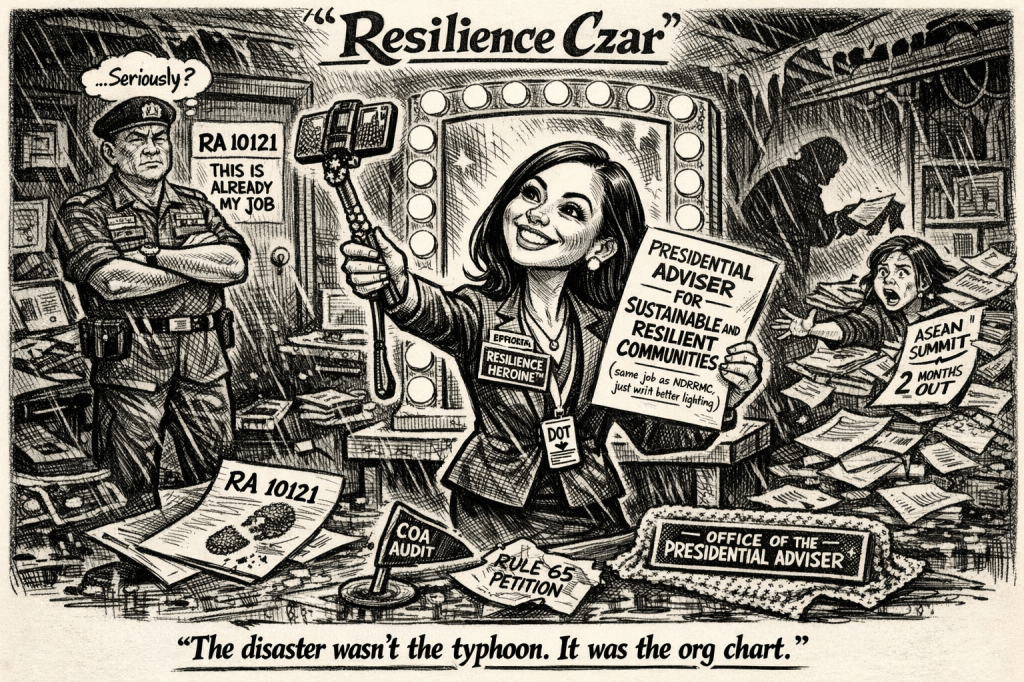
Tourism Photos Out, Ghost Adviser Salary In
By Louis ‘Barok‘ C. Biraogo — March 20, 2026
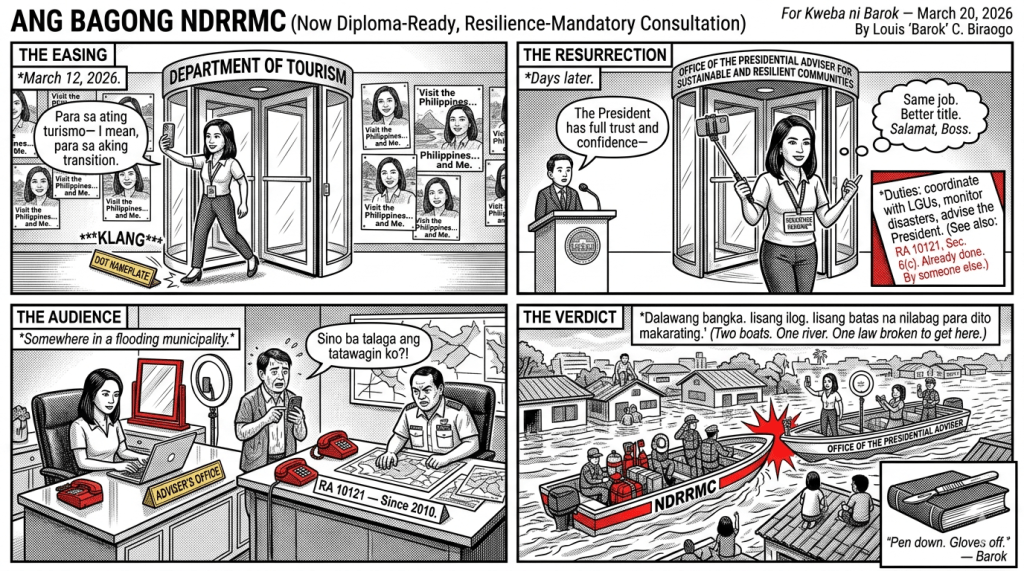
MGA ka-kweba, let us pause to appreciate the sheer theatrical genius here. On March 12, 2026, Christina Garcia Frasco is quietly eased out of the Department of Tourism after turning its social-media feed into her personal billboard. Days later—boom—she resurfaces as Presidential Adviser for Sustainable and Resilient Communities. Palace spokesperson Claire Castro swears the President still trusts her “to handle coordination with local governments” and “alleviate the suffering our countrymen may experience when disasters… occur.” I invite you to play a game I call “Spot the Difference.” Spoiler alert: there isn’t any. The National Disaster Risk Reduction and Management Council (NDRRMC), chaired by no less than Defense Secretary Gilberto “Gibo” Teodoro Jr., has been doing exactly that since Republic Act No. 10121 (Philippine Disaster Risk Reduction and Management Act of 2010) was passed in 2010. The gods of irony have outdone themselves.
In Philippine politics, there are no coincidences—only coincidences with press releases. And this one comes with perfect timing: two months before the ASEAN Summit lands in Cebu, the Garcia-Frasco political machine’s home turf. We’ve seen this movie before. We know how it ends—with taxpayers footing the bill for another layer of bureaucracy that exists mainly to keep a dynasty player in the game.
Constitutional Shell Game: Prerogative or Faithful Execution Fail?
Article VII, Section 16 of the 1987 Constitution of the Republic of the Philippines gives the President the power to appoint “all other officers of the Government whose appointments are not otherwise provided for by law.” Section 17 adds the control power: “The President shall have control of all the executive departments, bureaus, and offices.” Sarmiento v. Mison (1987) and Pimentel v. Ermita (2005) are trotted out by Malacañang defenders to say advisers need no Commission on Appointments consent. Villena v. Secretary of the Interior (1939) supplies the alter-ego doctrine: Frasco is supposedly just an extension of the President’s will.
Hahahahaha. No. The same Constitution’s Faithful Execution Clause in Section 17 demands that the President “ensure that the laws be faithfully executed.” Republic Act No. 10121 (Philippine Disaster Risk Reduction and Management Act of 2010) Sections 2, 5, and 6 spell out—in excruciating statutory detail—that the NDRRMC is the central body for exactly the integration, coordination, monitoring, and LGU-stakeholder alignment Frasco is now tasked to do. Section 2 declares the policy of “comprehensive, integrated, and proactive” disaster risk reduction. Section 6(c) gives the NDRRMC the explicit duty to advise the President on preparedness, recommend calamity declarations, and propose rehabilitation funding. Executive Order No. 292 (Administrative Code of 1987), Book III, Title I, Chapter 10, Section 31 allows reorganization for “simplicity, economy and efficiency”—not for creating parallel echo chambers.
Precedents against? Drilon v. Lim (1994) reminds us control power is not absolute. Buklod ng Kawaning EIIB v. Zamora (2000) upheld reorganization only when it served efficiency—not when it duplicated existing law. Araullo v. Aquino III (2014) struck down executive creativity that bypassed statutory frameworks. This appointment doesn’t reorganize; it duplicates. It doesn’t streamline; it bloats. And when the President uses control power to render RA 10121’s centralized architecture inutile, he is not faithfully executing the law—he is politely ignoring it.
Spin vs. Substance: Defenses That Dissolve Under Scrutiny
Arguments FOR the appointment
- Presidential discretion
- Alter-ego doctrine
- “Coordination gap” theory
- Political necessity
Frasco’s local-government experience (former Liloan mayor, on-ground after the 2025 Cebu quake and Typhoon Tino) supposedly fills a niche the defense-led NDRRMC lacks. Palace line: she’ll “integrate” tourism recovery into resilience—whatever that means when DOT already sits on the NDRRMC.
Arguments AGAINST the appointment
- Ultra vires
- Statutory circumvention
- Redundancy as inefficiency
- Waste of public funds
This isn’t coordination; it’s the bureaucratic equivalent of hiring two Grab drivers for the same car. Creating a presidential adviser outside the statutory council is classic executive overreach—exactly what Araullo condemned.
Christina Frasco
Defense — local ties, disaster-response record, Instagram gratitude post.
Criticism — DOT self-promotion scandal that turned tourism marketing into Frasco fanfic, Garcia dynasty politics (daughter of Gov. Gwen Garcia, wife of Rep. Duke Frasco), zero disaster-management expertise beyond ribbon-cutting.
The woman who left the World Travel Market to attend to her constituents now gets a national role because… reasons.
President Marcos Jr.
Political motivations — paying Cebu dynasty debts ahead of the ASEAN Summit, avoiding outright dismissal fallout, keeping the Garcia machine loyal for 2028 calculations.
Governance failures — patronage over merit, institutional erosion masked as “trust.”
This isn’t Bagong Pilipinas; it’s the same old recycling program.
Other actors
- Defense Secretary Teodoro and NDRRMC — turf war incoming; the council that actually runs operations now has a civilian adviser “monitoring” it.
- DOT OIC Verna Buensuceso — left holding the tourism bag with ASEAN delegates two months away.
- Garcia political clan — quietly triumphant.
- Congress and civil society — yawning until the next scandal.
Graft Highway: Pathways to Accountability That Malacañang Hopes Stay Closed
Republic Act No. 3019 (Anti-Graft and Corrupt Practices Act) Section 3(e) is tailor-made: causing undue injury to the government or giving unwarranted benefits through manifest partiality or gross inexcusable negligence. Creating a redundant office with salary, staff, and operating budget while RA 10121 already assigns the work? That’s textbook waste. Republic Act No. 6713 (The Code of Conduct and Ethical Standards for Public Officials and Employees) violations—failure to act with efficiency, professionalism, and commitment to public interest—are practically gift-wrapped. Ombudsman complaints under Republic Act No. 6770 (Ombudsman Act of 1989) can target Frasco, the appointing officials, and anyone who signs the budget release.
COA disallowance is the low-hanging fruit: every peso spent on this echo chamber is an irregular expenditure. Criminal escalation—Plunder (Republic Act No. 7080 (An Act Defining and Penalizing the Crime of Plunder)) or Malversation (Revised Penal Code Art. 217)—is remote unless the numbers get truly creative, but the paper trail for “advisory” expenses will make for delicious audit theater. The real hammer? Rule 65 certiorari petitions to the Supreme Court on grave abuse of discretion. Taxpayers and civil-society groups have standing; the duplication is the smoking gun.
Political Calculus Exposed: Motivations of Marcos, Frasco, and the Rest
- Marcos Jr.: Why create this position instead of integrating Frasco into the NDRRMC? Because embedding her would require actual accountability and sharing the spotlight with Teodoro. This way he pays the Cebu political debt, keeps the Garcia clan happy for the ASEAN photo-ops, and avoids the optics of firing a controversial ally. Endgame: 2028 Visayas machinery intact.
- Frasco: Why accept? To stay nationally visible post-DOT humiliation, leverage her LGU network for a future gubernatorial or congressional run, and rebrand from “selfie secretary” to “resilience heroine.” Her Instagram post was the polite way of saying “I’m not going away.”
- Teodoro/NDRRMC: They can either wage quiet turf war via memos or pretend accommodation. Expect the former—defense officials hate civilian interlopers in their lane.
- Congress/Public: Oversight hearings, budget cuts, or just another shrug until election season. The public’s option? Outrage on social media until the next typhoon exposes the confusion.
Disaster in the Making: Impacts on Governance and the ASEAN Summit
- Bureaucratic: instant duplication, conflicting directives, LGUs not knowing whether to call NDRRMC or “the adviser’s office.” Disaster governance: slower response times when seconds count—who declares calamity, who releases funds? Political: loud signal that loyalty trumps merit, dynasty consolidation in Cebu, and “Bagong Pilipinas” credibility in the toilet.
- Fiscal: another salary, staff, vehicles, and consultants amid supposed tight budgets. International/ASEAN Summit: DOT leadership vacuum turns Cebu into a last-minute scramble; diplomatic guests will notice the disarray.
- This isn’t X; it’s the bureaucratic equivalent of hiring your cousin to “advise” the family business while the actual manager is still on payroll.
Verdict and Verdict: Courts, Congress, and COA—Your Cue to Strike
The appointment is constitutionally colorable but substantively grotesque—a patronage parachute disguised as policy innovation. The Supreme Court should entertain a Rule 65 petition yesterday. The Ombudsman must open a 3019/6713 probe. Congress must haul the Palace to Blue Ribbon hearings and threaten to defund the ghost office. COA should pre-emptively flag every peso.
Recommendations:
- Administration: Issue an Executive Order folding Frasco into the NDRRMC with zero new budget, or abolish the role. Anything less is governance theater.
- Critics: File the certiorari case. Demand COA audit. Flood the Ombudsman with complaints.
- Frasco herself: Resign gracefully, define measurable outputs, or admit this is a holding pattern. The public is tired of dynastic musical chairs.
We’ve seen this movie before. We know how it ends—with another layer of bureaucracy, another wasted budget, and the same powerful people pretending they’re solving problems instead of protecting their own. Enough. The scalpel is out. The law books are loaded. The target is the entire apparatus that treats governance as a family business and the public as an inconvenience.
Pen down, gloves off. The apparatus of accommodation has been dissected once again. Now let the courts, the COA, and the people finish the autopsy.
++ Barok
Key Citations
A. Legal & Official Sources
- The 1987 Constitution of the Republic of the Philippines. Official Gazette of the Republic of the Philippines, 1987.
- Araullo v. Aquino III. G.R. No. 209287, Supreme Court of the Philippines, 1 July 2014.
- Buklod ng Kawaning EIIB v. Zamora. G.R. Nos. 142801-802, Supreme Court of the Philippines, 10 July 2001.
- Drilon v. Lim. G.R. No. 112497, Supreme Court of the Philippines, 4 Aug. 1994.
- Philippines. Executive Order No. 292: Administrative Code of 1987. Official Gazette of the Republic of the Philippines, 25 July 1987.
- Philippines. Republic Act No. 3019: Anti-Graft and Corrupt Practices Act. Official Gazette of the Republic of the Philippines, 17 Aug. 1960.
- Philippines. Republic Act No. 6713: The Code of Conduct and Ethical Standards for Public Officials and Employees. Official Gazette of the Republic of the Philippines, 20 Feb. 1989.
- Philippines. Republic Act No. 6770: Ombudsman Act of 1989. Lawphil.net, 17 Nov. 1989.
- Philippines. Republic Act No. 7080: An Act Defining and Penalizing the Crime of Plunder. Official Gazette of the Republic of the Philippines, 12 July 1991.
- Philippines. Republic Act No. 10121: Philippine Disaster Risk Reduction and Management Act of 2010. Official Gazette of the Republic of the Philippines, 27 May 2010.
- Philippines. The Revised Penal Code: Act No. 3815. Lawphil.net, 8 Dec. 1930.
- Rules of Court. Rule 65, Certiorari, Prohibition, and Mandamus. Supreme Court of the Philippines, effective May 1, 2020 (as amended by A.M. No. 19-10-20-SC).
- Pimentel v. Ermita. G.R. No. 164978, Supreme Court of the Philippines, 13 Oct. 2005.
- Sarmiento v. Mison. G.R. No. L-79974, Supreme Court of the Philippines, 17 Dec. 1987.
- Villena v. Secretary of the Interior. G.R. No. L-46570, Supreme Court of the Philippines, 21 Apr. 1939.
B. News Reports
- “Forthwith” to Farce: How the Senate is Killing Impeachment—And Why Enrile’s Right (Even If You Can’t Trust Him)

- “HINDI AKO NAG-RESIGN!”

- “I’m calling you from my new Globe SIM. Send load!”

- “Mahiya Naman Kayo!” Marcos’ Anti-Corruption Vow Faces a Flood of Doubt

- “Meow, I’m calling you from my new Globe SIM!”

- “No Special Jail for Crooks!” Boying Remulla Slams VIP Perks for Flood Scammers

- “PLUNDER IS OVERRATED”? TRY AGAIN — IT’S A CALCULATED KILL SHOT

- “Several Lifetimes,” Said Fajardo — Translation: “I’m Not Spending Even One More Day on This Circus”

- “Shimenet”: The Term That Broke the Internet and the Budget

- “We Did Not Yield”: Marcos’s Stand and the Soul of Filipino Sovereignty

- “We Gather Light to Scatter”: A Tribute to Edgardo Bautista Espiritu

- $150M for Kaufman to Spin a Sinking Narrative

 KWEBA ni BAROK
Leave a comment