Due Process Weaponized: Why the Constitution Now Protects Plunderers Better Than the Plundered
By Louis ‘Barok‘ C. Biraogo — March 21, 2026
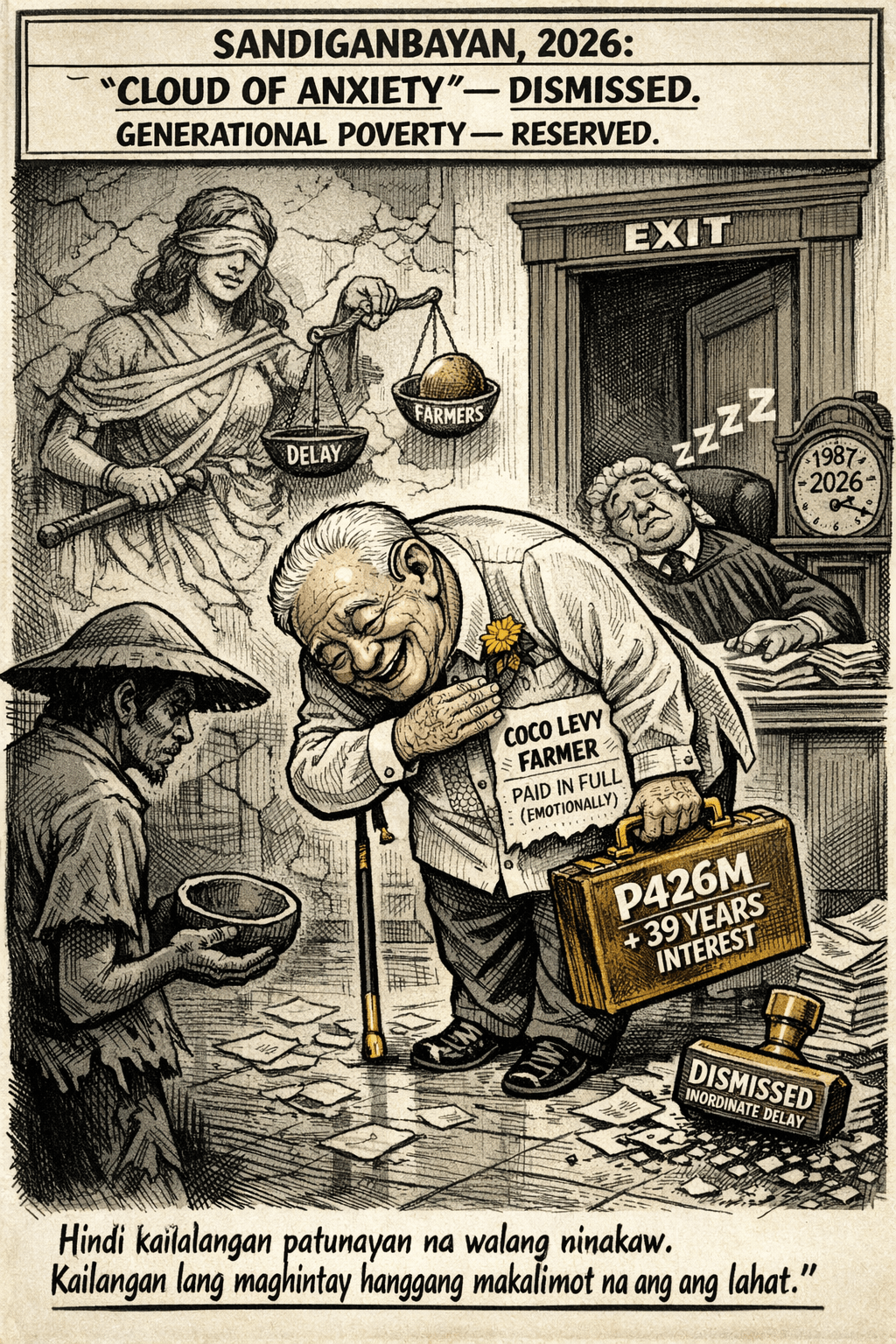
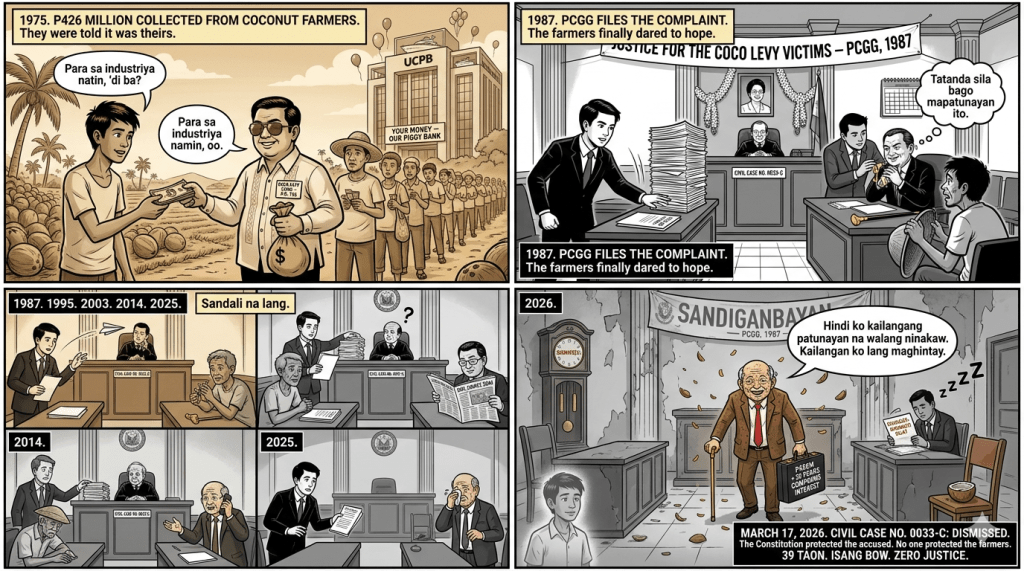
WELL, well, well. Another “ill-gotten wealth” case bites the dust—not because the Marcos-era cronies proved their innocence, but because the Philippine government proved, once again, that it is constitutionally incapable of tying its own shoelaces in under four decades. On March 17, 2026, the Sandiganbayan 2nd Division quietly euthanized Civil Case No. 0033-C, the last surviving fragment of the 1987 coco levy complaint that once dragged in Ferdinand Marcos, Imelda, Danding Cojuangco, Juan Ponce Enrile, and the rest of the coconut mafia. The remaining defendants— Enrique M. Cojuangco, Marcos O. Cojuangco, Rafael Abello, and Agricultural Investors Inc.—walk away laughing while the actual victims, the coconut farmers who were fleeced to the tune of P426 million (now worth billions in today’s pesos), get to keep their generational poverty as a souvenir.
This isn’t justice. This is a quiet legal earthquake that just swallowed another chunk of the post-EDSA accountability project. And I, Barok, am here to dissect the corpse.
I. Speedy Disposition Farce: Elite “Anxiety” Shield Trumps Real Victims
At the center of this farce sits Article III, Section 16 of the 1987 Constitution: “All persons shall have the right to a speedy disposition of their cases before all judicial, quasi-judicial, or administrative bodies.”
The Sandiganbayan, applying the bible of delay jurisprudence—Cagang v. Sandiganbayan (G.R. No. 206438, 2018)—ruled that 30+ years (actually closer to 39) of government dithering, repeated motions for extension, and zero meaningful prosecution created “inordinate delay” that prejudiced the defendants with that dreaded “cloud of anxiety, suspicion, and often, hostility.”
Let me translate the legalese into plain Filipino: the court looked at the cronies’ penthouse lifestyles and said, “Aba, these poor souls suffered!” Meanwhile, the farmers who actually paid the levy—taxed 10-25% of their copra income under Marcos decrees Presidential Decree No. 755, Presidential Decree No. 961, and Presidential Decree No. 1468—got nothing but worthless certificates and bullets in Daet and Guinayangan. Their anxiety wasn’t a “cloud”; it was hunger, landlessness, and children who never tasted the industry their taxes were supposed to build.
The ruling mirrors the Supreme Court’s 2021 smackdown in Eduardo M. Cojuangco, Jr. v. Sandiganbayan (G.R. No. 247982), which already torched related 0033 sub-cases for the exact same reason. Stare decisis at work—except when it works against the people, it suddenly becomes sacred.
II. Sandiganbayan Sympathy Fail: Protecting Cronies’ “Cloud” Over Farmers’ Plunder
The 2nd Division (Econg, Caldona, Gito) wrote a technically flawless decision. Complexity? Voluminous records? Not enough to justify 39 years at pre-trial. Government lawyers kept asking for more time? Their fault.
Fair enough on paper. But substantive justice? Gone. This is the same Sandiganbayan that was created precisely to pierce the veil of Marcos plunder. Instead, it has become the final resting place of accountability, where due process is weaponized to bury the very cases it was meant to decide.
The court’s pearl-clutching over the defendants’ “cloud of anxiety” is peak satire. These were the men who turned UCPB into a private piggy bank, let a conflicted arbitration board (Cojuangco wearing two hats) award P532 million in liquidated damages to AII, and walked away with control of 97% of the coconut oil industry and 51% of San Miguel. Their “anxiety” was probably just the mild stress of wondering when the next yacht payment was due.
III. PCGG’s Institutional Incompetence: 39 Years of Prosecutorial Snoozing
This dismissal is not a defeat for the Republic; it is an indictment of the Presidential Commission on Good Government (PCGG). The agency created by Executive Order No. 1 (s. 1986) to recover ill-gotten wealth has instead perfected the art of self-sabotage:
- Fragmented the original omnibus complaint into eight derivative cases
- Filed third-amended complaints decades later
- Kept asking for extensions like a student begging for deadline mercy
- Failed to present evidence until a perfunctory 2025 hearing
This is prosecutorial sloth elevated to high art. The PCGG didn’t lose on the merits; it lost because it treated the case like a retirement plan. While farmers waited for restitution, PCGG lawyers played patintero with the calendar.
IV. Paralysis by Litigation Masterclass: Defense Weaponizes Rules to Evade Justice
Let’s give credit where it’s due: the defense lawyers turned the Rules of Court into a shield. Jurisdictional challenges, endless motions, appeals, suspensions—the classic “death by a thousand postponements.” They didn’t need to prove the P426 million wasn’t stolen; they just needed to outlive the witnesses, the records, and the political will.
This is exactly what Tatad v. Sandiganbayan (1988) and Angchangco v. Ombudsman (2012) warned against: procedural rules cannot become a license for impunity. Yet here we are.
V. Dangerous Precedent Domino Effect: One Dismissal Dooms the Rest
This isn’t isolated. The 2021 Cojuangco ruling already gutted multiple 0033 sub-cases. Six more coco levy cases were dismissed in December 2024. Under the current administration, at least nine family-linked PCGG cases have vanished. The message to every remaining ill-gotten wealth case is crystal clear: wait long enough, file enough motions, and the Constitution will eventually set you free.
VI. Political Narrative Shift: Apologists Declare “Vindication”
Watch the Marcos apologists and Cojuangco heirs declare this a “vindication.” Social media will explode with “Danding was right all along!” Never mind that a dismissal for delay is not an acquittal on the merits. Never mind that the Supreme Court has repeatedly ruled coconut levy funds are public funds impressed with public trust (Republic v. COCOFED and the entire 2012-2014 SMC share saga).
History is being rewritten in real time, and the Sandiganbayan just handed them the eraser.
Legal & Constitutional Framework: Rule of Law That Failed the Farmers
The case was built on Republic Act No. 3019 (Anti-Graft and Corrupt Practices Act) Sec. 3(e) (gross negligence causing undue injury to government), breach of fiduciary duty, and Articles 19-21 of the Civil Code of the Philippines (abuse of rights). The PCGG’s mandate under Executive Order No. 1 (s. 1986) was clear. Yet the court correctly noted that even complex cases require diligence—Cagang v. Sandiganbayan demands it.
Republic Act No. 6713 (The Code of Conduct and Ethical Standards for Public Officials) screams ethical failure here. Canon 12 and 18 of the Code of Professional Responsibility for the government lawyers? Also violated. But who’s going to prosecute the prosecutors?
Calls to Action: Enough With the Farce – Pivot Now or Perpetuate Impunity
- Pivot to Civil Recovery Now
Stop chasing quasi-criminal PCGG cases. File straight civil actions for unjust enrichment under the Civil Code. Rule 35 summary judgment exists for a reason. The Republic can still go after the assets—SMC shares, UCPB holdings, whatever remains—without the “speedy trial” trap. - Legislative Guillotine for PCGG
Abolish or radically restructure the agency. Create a time-bound task force under the Office of the Solicitor General with strict statutory deadlines. Enact a “Fast-Track Ill-Gotten Wealth Act” with presumptive timelines and severe sanctions for prosecutorial delay. - Judicial Reforms at Sandiganbayan
Mandatory case management orders. Strict limits on pre-trial motions. Judicial continuity—no more musical chairs with divisions. Administrative penalties for judges who let cases rot. - Full Implementation of the Coconut Farmers Trust Fund (Republic Act No. 11524 (Coconut Farmers and Industry Trust Fund Act))
The farmers have waited long enough. Disburse the remaining funds, enforce the 24-27% SMC shares already awarded, and stop treating their levy as a political football.
Final Reflection: Constitution Won for Defendants – Justice Lost for Filipinos
The tragedy is not that the Constitution protected the accused. The tragedy is that the State—through sheer incompetence, inertia, and occasional political convenience—betrayed the very people it claimed to liberate in 1986.
The coconut farmers were robbed twice: first by Marcos and his cronies in the 1970s, then by the Republic’s own paralysis in the 21st century.
This dismissal is not the end of the story. It is a screaming alarm that the post-EDSA promise of accountability is on life support. If we do not act—civilly, legislatively, relentlessly—the next generation of farmers will inherit nothing but the same empty shells their grandparents received.
The Constitution won for the defendants today.
But justice lost for the Filipino people—again.
Stay cynical. Stay vigilant.
The fight for the coconut levy isn’t over until the last peso is returned to those who actually earned it.
— Barok
Key Citations
A. Legal & Official Sources
- The 1987 Constitution of the Republic of the Philippines. The LawPhil Project.
- Cagang v. Sandiganbayan. G.R. No. 206438, July 31, 2018. The LawPhil Project.
- Eduardo M. Cojuangco, Jr. v. Sandiganbayan. G.R. No. 247982, April 28, 2021. The LawPhil Project.
- Tatad v. Sandiganbayan. G.R. Nos. L-72335-39, March 21, 1988. The LawPhil Project.
- Angchangco v. Ombudsman. G.R. No. 122728, February 13, 1997. The LawPhil Project.
- Republic v. COCOFED. G.R. Nos. 147062-64, December 14, 2001. The LawPhil Project.
- Republic Act No. 3019. An Act to Prevent and Penalize Graft and Corrupt Practices. 1960, The LawPhil Project.
- Republic Act No. 6713. An Act Establishing a Code of Conduct and Ethical Standards for Public Officials and Employees. 1989, The LawPhil Project.
- Executive Order No. 1. Creating the Presidential Commission on Good Government. 1986, The LawPhil Project.
- Presidential Decree No. 755. Approving the Credit Policy for the Coconut Industry. 1975, The LawPhil Project.
- Presidential Decree No. 961. Codifying Laws on Coconut and Other Palm Oil Industry Development. 1976, The LawPhil Project.
- Presidential Decree No. 1468 (Revising Presidential Decree Numbered Nine Hundred Sixty-One [Revised Coconut Industry Code]), June 11, 1978. Supreme Court E-Library.
- Republic Act No. 11524. Coconut Farmers and Industry Trust Fund Act. 2021, The LawPhil Project.
B. News Reports
- “Forthwith” to Farce: How the Senate is Killing Impeachment—And Why Enrile’s Right (Even If You Can’t Trust Him)
- “HINDI AKO NAG-RESIGN!”

- “I’m calling you from my new Globe SIM. Send load!”

- “Mahiya Naman Kayo!” Marcos’ Anti-Corruption Vow Faces a Flood of Doubt

- “Meow, I’m calling you from my new Globe SIM!”

- “No Special Jail for Crooks!” Boying Remulla Slams VIP Perks for Flood Scammers

- “PLUNDER IS OVERRATED”? TRY AGAIN — IT’S A CALCULATED KILL SHOT

- “Several Lifetimes,” Said Fajardo — Translation: “I’m Not Spending Even One More Day on This Circus”

- “Shimenet”: The Term That Broke the Internet and the Budget

- “We Did Not Yield”: Marcos’s Stand and the Soul of Filipino Sovereignty

- “We Gather Light to Scatter”: A Tribute to Edgardo Bautista Espiritu

- $150M for Kaufman to Spin a Sinking Narrative


 KWEBA ni BAROK
Leave a comment