When “Discipline” Becomes a Revenue Stream and the Constitution Becomes Collateral Damage
By Louis ‘Barok‘ C. Biraogo — March 22, 2026
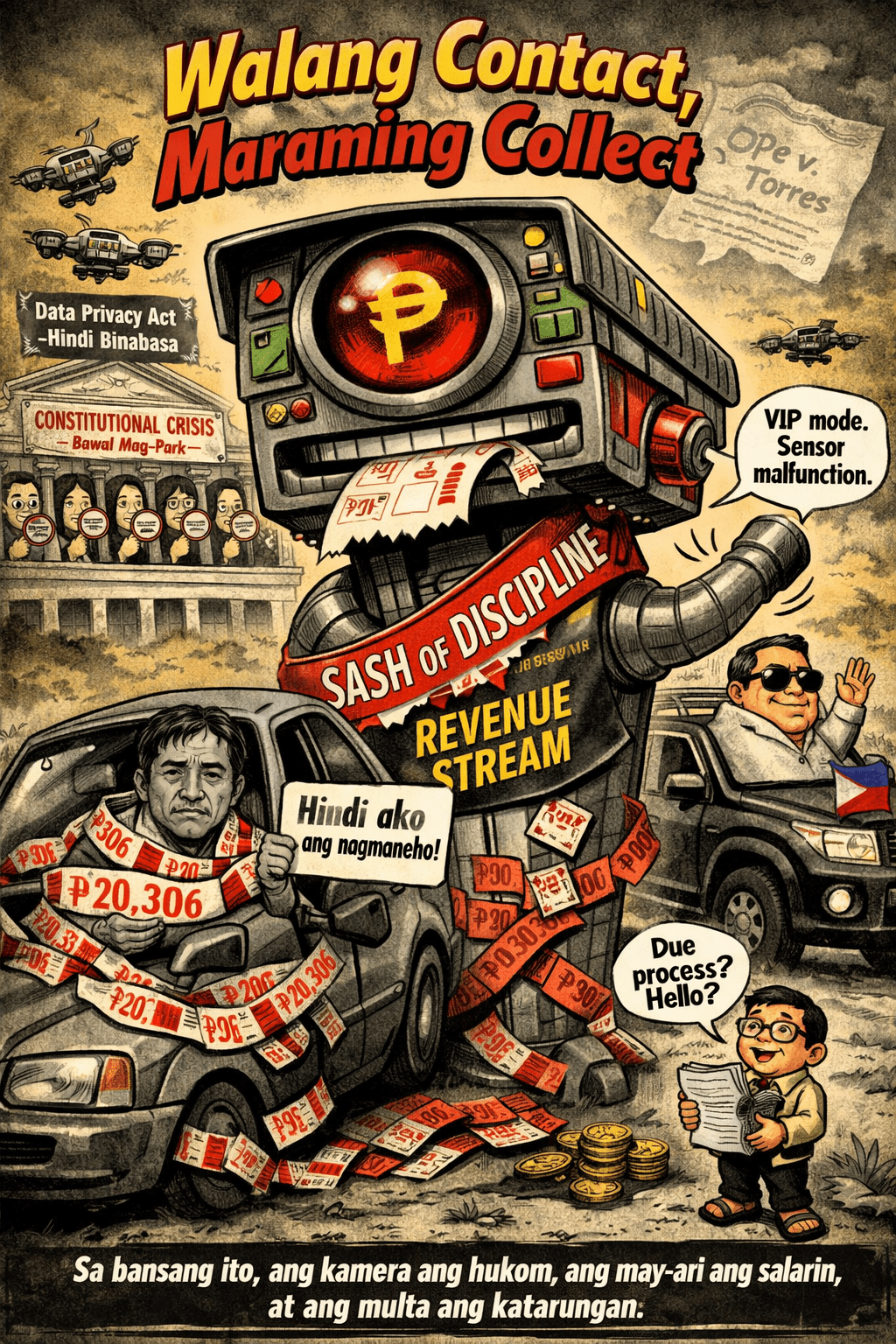
WHAT the hell is going on in this country? A constitutional crisis sparked by… traffic cameras? That’s right, folks. While Metro Manila chokes on its own exhaust, the Supreme Court is refereeing a cage match between five local government units (Manila, Quezon City, Valenzuela, Parañaque, Muntinlupa) and lawyer Juman Paa plus a chorus of transport groups. At stake: the No Contact Apprehension Policy (NCAP), that glittering algorithmic revenue machine masquerading as “discipline.”
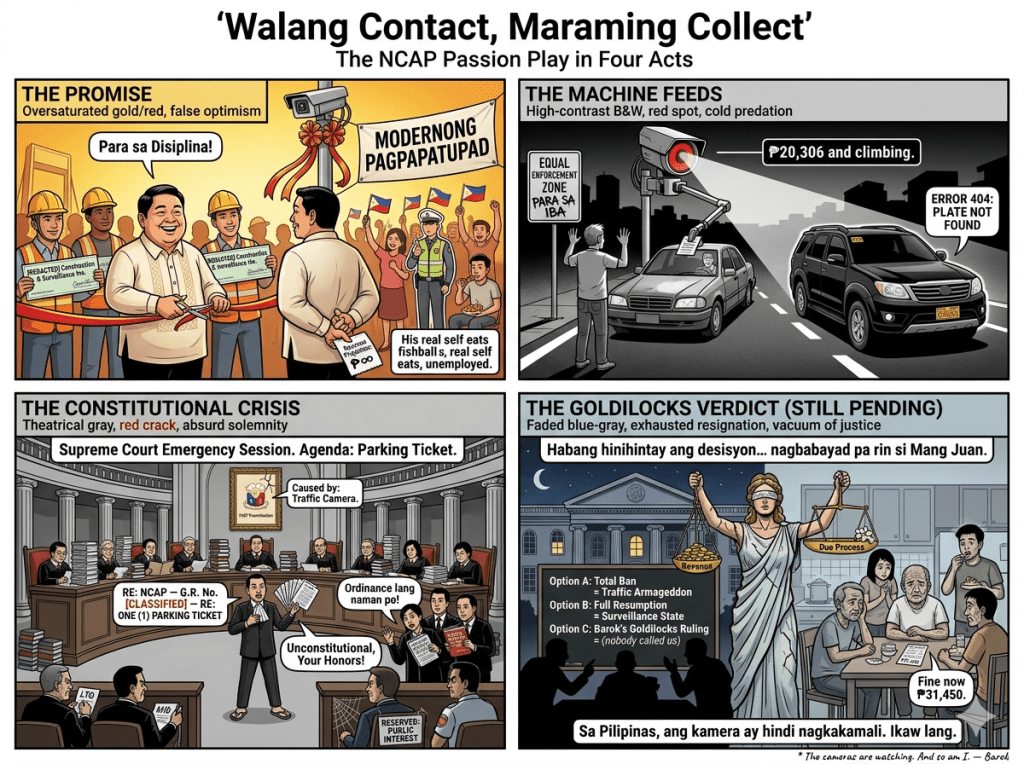
The LGUs want their TRO lifted so they can resume ticketing via CCTV on city roads. Paa says “over my dead registration renewal.” The Court partially lifted the 2022 TRO in May 2025 for MMDA’s major arteries, rendering Paa’s city-level ban “futile” (his word, not mine—40% of Manila roads already back under the no-contact boot). Now Paa’s 18-page opposition (filed March 17, 2026, late but graciously accepted) screams unconstitutionality while the LGUs wave the Metro Manila Traffic Code of 2023 like a get-out-of-jail-free card.
Welcome to the Philippines, where even a parking ticket can trigger separation-of-powers Armageddon.
Let’s be brutally honest before we dive into the legalese. Metro Manila traffic isn’t a “challenge.” It’s a dystopian stress test designed by sadists. You sit in a “parking lot” that moves at 7 kph on a good day, inhaling enough PM2.5 to qualify as passive smoking. Jeepneys swerve like drunk bumper cars, tricycles treat sidewalks as auxiliary lanes, and private cars play Frogger with pedestrians. The crisis is real. The LGUs have that much going for them. But turning that nightmare into a justification for constitutional shortcuts? That’s where the satire writes itself.
Enter NCAP—the “Automated Revenue Machine.” No cop, no confrontation, just a camera, an AI, and a bill mailed to the registered owner. Brilliant on paper. In practice? A cartoon-villain playbook.
First, the registered owner rule. The LGUs’ ordinances (and Manila’s beloved No. 8676) say: “Your car did it, you pay—driver? Who cares?” Paa’s ₱20,306 ballooned fines are Exhibit A. This isn’t discipline; it’s collective punishment with extra surcharges. It violates substantive due process (Article III, Section 1 of the 1987 Constitution) because it’s arbitrary—punishing the innocent owner to “instill discipline” on the actual violator is like fining the getaway car instead of the bank robber. Equal protection? Laughable. The middle-class salaryman who lent his car to his nephew gets hammered; the VIP with a chauffeur? Probably has a fixer.
Second, the privacy farce. CCTV everywhere, LTO database linkage, automated data mining. Who watches the watchers? And more importantly, who got the juicy PPP contract to install the cameras and split the fines? Republic Act No. 10173 (Data Privacy Act of 2012) exists for a reason—proportionality, legitimate purpose, transparency. Blanket surveillance for revenue disguised as safety fails every Ople v. Torres smell test. Remember Ople? The Court slapped down a national ID scheme as a surveillance state in sheep’s clothing. NCAP is that same sheep, now with traffic fines and a revenue-sharing tail.
Third, the quasi-judicial power grab. Here’s where the LGUs really expose their fiefdom fantasies. They set up Traffic Adjudication Boards to hear and decide NCAP cases. Newsflash: LTO holds the statutory monopoly on quasi-judicial functions over traffic violations (Republic Act No. 4136 (Land Transportation and Traffic Code), Secs. 8 & 60). Republic Act No. 7160 (Local Government Code of 1991) gives police power for regulation, sure—but not adjudication. Enter the precedents the LGUs are desperately ignoring:
- MMDA v. Bel-Air Village (G.R. No. 135962, 2000): MMDA has no inherent police power, let alone judicial.
- Federation of Jeepney Operators v. Manila et al. (2024): MMDA has exclusive enforcement authority; LGUs get deputized roles only. No independent confiscations, no rogue boards.
Yet here we are in 2026, with cities citing the Metro Manila Traffic Code 2023 as holy writ to circumvent a pending Supreme Court case. Cute. Separation of powers and checks and balances just called—they want their dignity back.
Now, let’s eviscerate the petitioners, because nobody gets a free pass in Barok’s court. Atty. Juman Paa isn’t exactly a sainted crusader descending from Olympus. His ₱20,306 fine was the spark—personal grievance dressed up as constitutional jihad. Fair? The man has a point. But let’s call it what it is: a vendetta that stumbled into noble cause territory. The transport groups and taxi operators? Their “LTO monopoly” argument is legally sound (RA 4136 is crystal), but politically tone-deaf in a metropolis that can’t even agree who controls a single traffic light. And their TRO “victory”? Pyrrhic at best. The partial lift turned city roads into a Swiss-cheese enforcement zone. Strategic genius, gentlemen. You halted the cameras on side streets while the major arteries kept bleeding fines. Brilliant.
Let’s build the Matrix of Cynicism™—because everyone’s motives are as transparent as Manila’s air:
- LGUs: Stated—“public safety and discipline.” Unstated—“revenue augmentation and political optics.” Fines fund roads (or pockets?), and mayors get to look tough while outsourcing enforcement to private contractors. Classic “gotcha” governance.
- MMDA: Stated—“single-ticketing harmony.” Unstated—“institutional survival and turf protection.” They hate sharing the pie.
- LTO: Stated—“centralized adjudication.” Unstated—“preserve our rice bowl.”
- Petitioners: Stated—“due process and privacy.” Unstated—“stop the revenue bleed that hurts our livelihoods and wallets.” Paa’s ballooned fines weren’t exactly abstract.
The real question isn’t who’s right; it’s whose cynicism wins.
Weaponizing the legal framework, as only Barok can: NCAP fails the White Light Corp. v. City of Manila reasonableness test—overbroad, oppressive, and not narrowly tailored. It flunks Ang Tibay v. CIR due-process fundamentals for administrative bodies (notice, hearing, evidence). Republic Act No. 7160 (Local Government Code of 1991)’s general welfare clause isn’t a blank check to create local kangaroo courts. And the “privilege” argument (road use isn’t a right) collapses when the penalty is automatic deprivation of property without contestation.
The Supreme Court now faces the Goldilocks dilemma. Total ban? Unrealistic—traffic hell will only worsen. Unfettered resumption? Unconstitutional—hello, surveillance state lite.
Here’s the only sane path (my “Barok Goldilocks” ruling, free of charge):
- Kill the “registered owner rule” for administrative penalties. Make it a rebuttable presumption with mandatory driver identification and a real contestation window.
- Mandate pre-penalty notice and hearing to the actual driver—not just the owner. Ang Tibay demands it.
- Clarify jurisdiction: No more patchwork Traffic Adjudication Boards. Centralize final adjudication under LTO or a unified MMDA body (per the 2024 Jeepney ruling). LGUs regulate; they don’t adjudicate.
- Impose strict Data Privacy Act compliance: retention limits, audit trails, no revenue-sharing opacity with private contractors.
Anything less is constitutional malpractice.
Genuine public service would look radically different: uniform signage that actually exists, driver education instead of “gotcha” fines, proportional penalties scaled to violation severity, and enforcement that targets behavior, not wallets. Congress and LTO should stop hiding behind ordinances and enact a national NCAP framework—driver-focused, transparent, privacy-respecting. Until then, this remains revenue extraction with a traffic-discipline fig leaf.
The Final Barok Verdict:
The Supreme Court has a choice. It can be remembered as the institution that finally disciplined Metro Manila traffic… or as the one that saved the Constitution from a parking ticket.
Choose wisely, Your Honors. The cameras are watching. And so am I.
Key Citations
A. Legal & Official Sources
- Philippines, Supreme Court. Ang Tibay v. Court of Industrial Relations. G.R. No. L-46496, 27 Feb. 1940. Lawphil.
- Philippines, Supreme Court. Federation of Jeepney Operators and Drivers Association of the Philippines v. Government of Manila City et al. G.R. No. 209479, 11 July 2023. Lawphil.
- Philippines, Supreme Court. Metropolitan Manila Development Authority v. Bel-Air Village Association, Inc. G.R. No. 135962, 27 Mar. 2000. Lawphil.
- Philippines, Supreme Court. Ople v. Torres. G.R. No. 127685, 23 July 1998. Lawphil.
- Philippines, Congress. Republic Act No. 4136: An Act to Compile the Laws Relative to Land Transportation and Traffic Rules, to Create a Land Transportation Commission and for Other Purposes. 20 June 1964. Official Gazette.
- Philippines, Congress. Republic Act No. 7160: An Act Providing for a Local Government Code of 1991. 10 Oct. 1991. Official Gazette.
- Philippines, Congress. Republic Act No. 10173: An Act Protecting Individual Personal Information in Information and Communications Systems in the Government and the Private Sector. 15 Aug. 2012. Official Gazette.
- Philippines. The 1987 Constitution of the Republic of the Philippines. 2 Feb. 1987. Official Gazette.
- Philippines, Supreme Court. White Light Corporation v. City of Manila. G.R. No. 122846, 20 Jan. 2009. Lawphil.
B. News Reports
- ₱8B BBM Pork: CCTV for Every Captain’s Kumpare?
- ₱75 Million Heist: Cops Gone Full Bandit

- ₱6.7-Trillion Temptation: The Great Pork Zombie Revival and the “Collegial” Vote-Buying Circus

- ₱1.9 Billion for 382 Units and a Rooftop Pool: Poverty Solved, Next Problem Please

- ₱1.35 Trillion for Education: Bigger Budget, Same Old Thieves’ Banquet
- ₱1 Billion Congressional Seat? Sorry, Sold Out Na Raw — Si Bello Raw Ang Hindi Bumili

- “We Will Take Care of It”: Bersamin’s P52-Billion Love Letter to Corruption
- “Skewed Narrative”? More Like Skewered Taxpayers!

- “Scared to Sign Vouchers” Is Now Official GDP Policy – Welcome to the Philippines’ Permanent Paralysis Economy
- “Robbed by Restitution?” Curlee Discaya’s Tears Over Returning What He Never Earned
- “No Pressure” Luistro? The House Pork Bazaar Exposed
- “My Brother the President Is a Junkie”: A Marcos Family Reunion Special


 KWEBA ni BAROK
Leave a comment