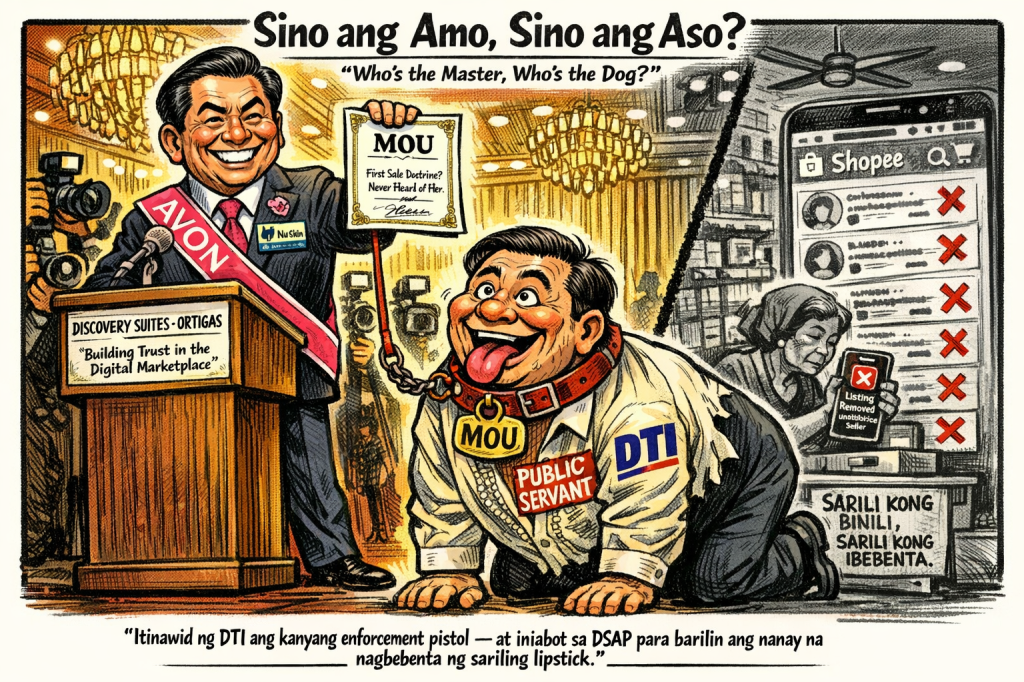
Regulatory Capture 101: DTI Hands the Keys to the Digital Marketplace to Mary Kay & Friends
By Louis ‘Barok‘ C. Biraogo — March 24, 2026
The March 17, 2026 Memorandum of Understanding (MOU) turns the DTI’s E-Commerce Bureau into Avon’s personal attack dog—because nothing screams “building trust in the digital marketplace” like unleashing coordinated government takedowns on your neighbor’s Shopee listing of genuine Mary Kay lipstick she legitimately bought, paid for, and owns outright.
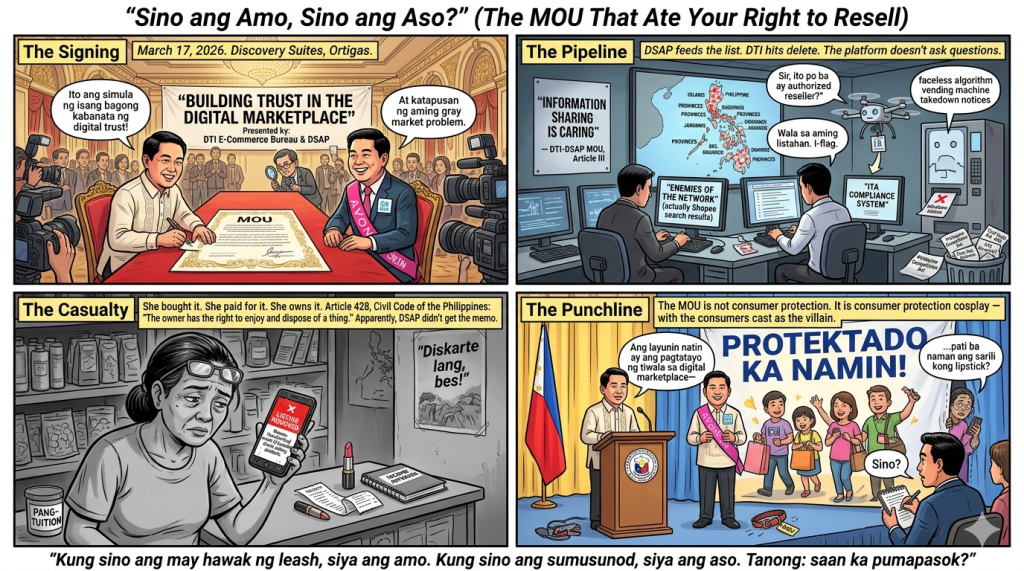
Signed with fanfare at Discovery Suites in Ortigas, this deal creates a direct pipeline: DSAP feeds intel, DTI monitors listings in real time, and platforms enforce takedowns against anyone selling without the direct-selling giants’ blessing—all under the Internet Transactions Act banner.
Meanwhile, the provincial side-hustle mom who bought surplus from an authorized distributor suddenly sees her listing vanish and account flagged. “Unauthorized” now conveniently includes perfectly legal secondary-market resale of authentic goods—if it threatens the official network’s prices and recruitment model.
If this isn’t regulatory capture in a consumer-protection mask, it’s giving a flawless performance.
The “So What?”: Who Owns the Product After Sale – You or the Corporation?
Let’s cut the regulatory perfume: this isn’t “cooperation.” This is a corporate-state shotgun wedding where the Department of Trade and Industry (DTI) hands its enforcement pistol to the Direct Selling Association of the Philippines (DSAP) so that Avon, Mary Kay, Nu Skin and the rest of the multi-level-marketing mafia can finally crush the pesky online resellers who dare commit the mortal sin of… reselling what they lawfully own.
The central, unresolved question that DTI and DSAP are desperately hoping nobody asks out loud: Who owns the damn product after the sale—the consumer or the corporation?
Because if the answer is “the corporation forever,” then the Philippines just quietly abolished the First Sale Doctrine and replaced it with corporate feudalism dressed up as consumer protection. Spoiler: that’s exactly what this MOU is doing.
DTI’s Corporate Leash: DSAP’s Sweetheart Deal Exposed
Textbook regulatory capture, served with a side of “government cannot do this alone” cop-out. DSAP—whose members include those charming direct-selling giants that have been turning Filipino living rooms into recruitment pyramids for decades—now gets to outsource its dirty work to a public agency. Information sharing? Joint monitoring? Coordinated takedowns? Translation: DSAP files the complaint, DTI hits “delete listing” on Shopee and Lazada, and the small reseller eats the ban while Avon keeps its fat margins intact.
This isn’t partnership. This is a corporate leash with a government collar. The DTI just volunteered to be the debt-collection arm for an industry terrified of the gray market, the secondary market, and—God forbid—actual competition.
Legal Indictment: Dismantling the DTI-DSAP Overreach
Let’s get prosecutorial.
Against the DTI–DSAP Axis:
Per Se Violation of Republic Act No. 10667 (Philippine Competition Act)
Horizontal restraint of trade, anyone? DSAP members are competitors. They just sat down with a government agency and agreed to restrict supply channels and limit market access for anyone outside their anointed circle. That’s not “raising standards.” That’s a per se violation of Section 14. The Philippine Competition Commission should be crawling all over this MOU like ants on spilled sugar. Instead, the DTI is actively facilitating the cartel. Cute.
Against the DTI:
Bait-and-Switch with Republic Act No. 11967 (Internet Transactions Act)
The DTI keeps waving the ITA like a magic shield. Sections 4, 5, 12, 19–21 supposedly give them god-like powers to police e-commerce. Funny how they skipped the part where the ITA is about consumer protection and fair competition, not turning the government into DSAP’s private bounty hunter for post-sale resale.
And let’s talk about that convenient C2C carve-out the Act explicitly recognizes. Pure consumer-to-consumer resale of legitimately acquired goods? Not even in their jurisdiction. Yet here we are—DTI pretending the ITA grants them sheriff’s stars to enforce private contractual restrictions that the law never authorized. Bait-and-switch much?
For the Resellers:
Defending Ownership Under Republic Act No. 386 (Civil Code of the Philippines) and Republic Act No. 8293 (Intellectual Property Code)
Article 428: “The owner has the right to enjoy and dispose of a thing.”
Article 559: Ownership is transferred upon delivery.
Once you buy the lipstick, the lipstick is yours. Full stop. The First Sale Doctrine (also called the doctrine of exhaustion), as embodied in Section 72 of Republic Act No. 8293 (Intellectual Property Code), seals it—manufacturer control ends at the first lawful sale. This MOU is a direct assault on the First Sale Doctrine.
If you buy a car, can Ford Motor Company stop you from selling it on Facebook Marketplace? According to DTI-DSAP logic, yes. If you buy a refrigerator, can Samsung police your Carousell listing? Apparently. Absurdity level: Philippine.
Supreme Court Precedent: Shields, Not Corporate Veto Power
Mirpuri v. Court of Appeals (G.R. No. 114508, 1999) and Air Philippines v. Pennswell (G.R. No. 172835, 2007) are being twisted into pretzels here. Both cases protect against consumer confusion and promote fair competition—they do not grant manufacturers eternal veto power over every subsequent resale. The Supreme Court has never said “once you buy it, you’re our serf forever.” DTI and DSAP are trying to invent that doctrine out of thin air.
Motivations Exposed: The Unholy Corporate-State Alliance
DTI: Bureaucratic laziness wrapped in virtue-signaling. “We can’t do this alone” is bureaucratese for “we’d rather let corporations write our enforcement playbook.” Classic capture—why build your own capacity when Avon will hand you the list of enemies?
DSAP: Pure terror of the gray market and the free market. Their entire business model—high margins, recruitment-driven, controlled distribution—is being gutted by moms in the provinces selling genuine products at 30% less on TikTok Shop. So they slap “consumer protection” lipstick on price-fixing and call it a day.
The critics? The disorganized, loud, small-time resellers who are actually keeping the digital economy alive. They’re the modern sari-sari store owners. And this MOU is trying to put them out of business.
Digital Power Grab: Unreasonable Restraint on Property and Trade
This isn’t about counterfeits. It’s about who gets to play in the digital sandbox. DSAP wants to decide who is a “legitimate” merchant; DTI is happily deputizing them. The Platform Economy (Shopee, Lazada) versus the Corporate Oligopoly (Avon et al.), and the government just picked the side with the better lobbyists.
Constitutional rights to property (Article III, Section 1 of the 1987 Constitution) and livelihood? Apparently optional when corporate feelings are hurt. This is an unreasonable restraint of trade dressed in the emperor’s new clothes of “trust and accountability.”
Call to Arms: Judicial Intervention or Corporate Feudalism Wins
Time for judicial intervention. This MOU creates a live “case or controversy” ripe for Supreme Court review via petition for certiorari or declaratory relief. Someone—any reseller with a banned listing—needs to drag DTI and DSAP into the High Court and force it to answer the ownership question once and for all.
DTI should scrap this MOU tomorrow. Its actual job under the law is fighting counterfeits and pyramid schemes, not playing hall monitor for corporate profit margins.
And to the government in general: stop cosplaying as protectors of the people while acting as enforcers for multinational direct-sellers. The resellers you’re crushing are the same Filipinos keeping families afloat in the gig economy. They are not the enemy.
They are the economy.
Treat them as such—or prepare for the backlash when the digital sari-sari stores fight back.
Kweba ni Barok has spoken. The MOU is not just bad policy. It’s a legal and moral disgrace.
Key Citations
A. Legal & Official Sources
- Republic Act No. 10667. Philippine Competition Act. Official Gazette of the Republic of the Philippines, 21 July 2015, http://www.officialgazette.gov.ph/2015/07/21/republic-act-no-10667/.
- Republic Act No. 11967. Internet Transactions Act. Official Gazette of the Republic of the Philippines, 5 December 2023, http://www.officialgazette.gov.ph/2023/12/05/republic-act-no-11967/.
- Republic Act No. 8293. Intellectual Property Code of the Philippines. Official Gazette of the Republic of the Philippines, 6 June 1997, http://www.officialgazette.gov.ph/1997/06/06/republic-act-no-8293/.
- Republic Act No. 386. Civil Code of the Philippines. 1949, lawphil.net/statutes/repacts/ra1949/ra_386_1949.html.
- The 1987 Constitution of the Republic of the Philippines. Official Gazette of the Republic of the Philippines, 1987, http://www.officialgazette.gov.ph/constitutions/1987-constitution/.
- Mirpuri v. Court of Appeals. G.R. No. 114508, 19 November 1999, lawphil.net/judjuris/juri1999/nov1999/gr_114508_1999.html.
- Air Philippines Corporation v. Pennswell, Inc. G.R. No. 172835, 13 December 2007, lawphil.net/judjuris/juri2007/dec2007/gr_172835_2007.html.
B. News Reports
- Zapanta, Logan Kal-El M. “DTI cracks down on unauthorized online resellers.” Business Inquirer, 20 March 2026.

- ₱75 Million Heist: Cops Gone Full Bandit

- ₱6.7-Trillion Temptation: The Great Pork Zombie Revival and the “Collegial” Vote-Buying Circus

- ₱1.9 Billion for 382 Units and a Rooftop Pool: Poverty Solved, Next Problem Please

- ₱1.35 Trillion for Education: Bigger Budget, Same Old Thieves’ Banquet

- ₱1 Billion Congressional Seat? Sorry, Sold Out Na Raw — Si Bello Raw Ang Hindi Bumili

- “We Will Take Care of It”: Bersamin’s P52-Billion Love Letter to Corruption

- “Skewed Narrative”? More Like Skewered Taxpayers!

- “Scared to Sign Vouchers” Is Now Official GDP Policy – Welcome to the Philippines’ Permanent Paralysis Economy
- “Robbed by Restitution?” Curlee Discaya’s Tears Over Returning What He Never Earned

- “My Brother the President Is a Junkie”: A Marcos Family Reunion Special

- “Mapipilitan Akong Gawing Zero”: The Day Senator Rodante Marcoleta Confessed to Perjury on National Television and Thought We’d Clap for the Creativity

- “Just Following Orders” Is Dead: How the Hague Just Turned Tokhang’s Finest Into International Fugitives

 KWEBA ni BAROK
Leave a comment