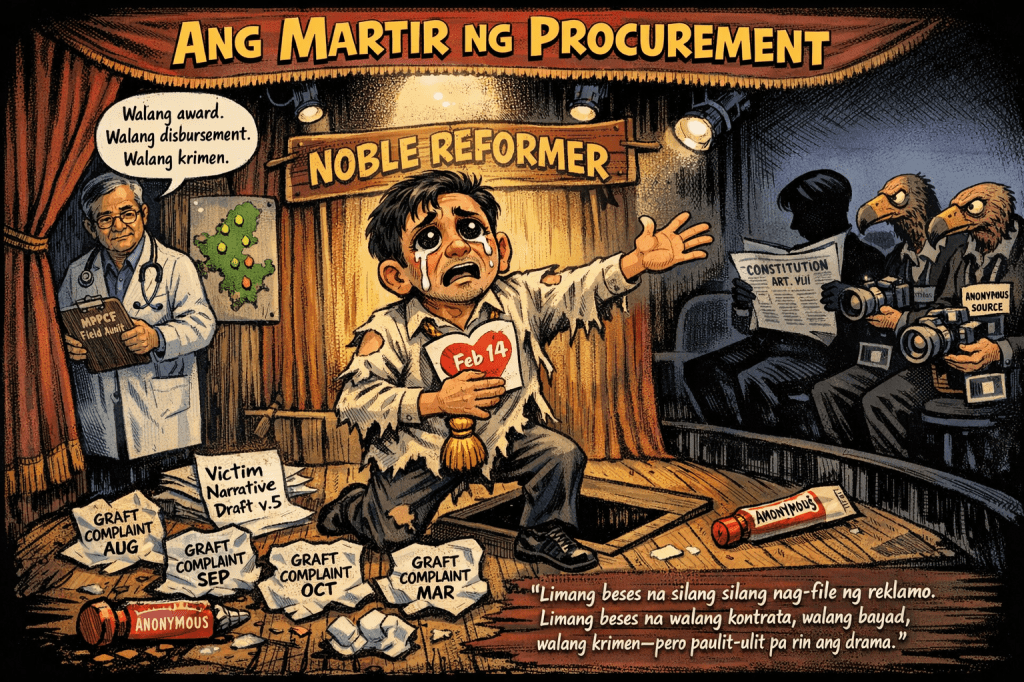
Murillo’s Martyrdom Play Exposed
By Louis ‘Barok‘ C. Biraogo — March 23, 2026
ANOTHER day, another leaked letter from a former undersecretary clutching his pearls and crying “retaliation.” Gregorio T. Murillo Jr.’s February 14, 2026, missive to President Marcos—conveniently surfacing in Manila Bulletin on March 21—paints him as the lone noble soul slain for daring to demand “upgraded” Mobile Primary Care Facilities (MPCFs) in a P1.8-billion program plagued by a reported 25% functionality rate. Cue the anonymous graft complaint filed March 6 by “concerned DOH employees” against Secretary Teodoro “Ted” Herbosa and his team. This isn’t whistleblowing; it’s bureaucratic kabuki theater, a coordinated hit job by procurement mafia remnants desperate to preserve their defective status quo. As in my March 11 piece on the same circus, the pus flows from phantom affidavits, not from Herbosa’s desk. Let’s eviscerate this farce with the scalpel of law, facts, and cold governance reality.
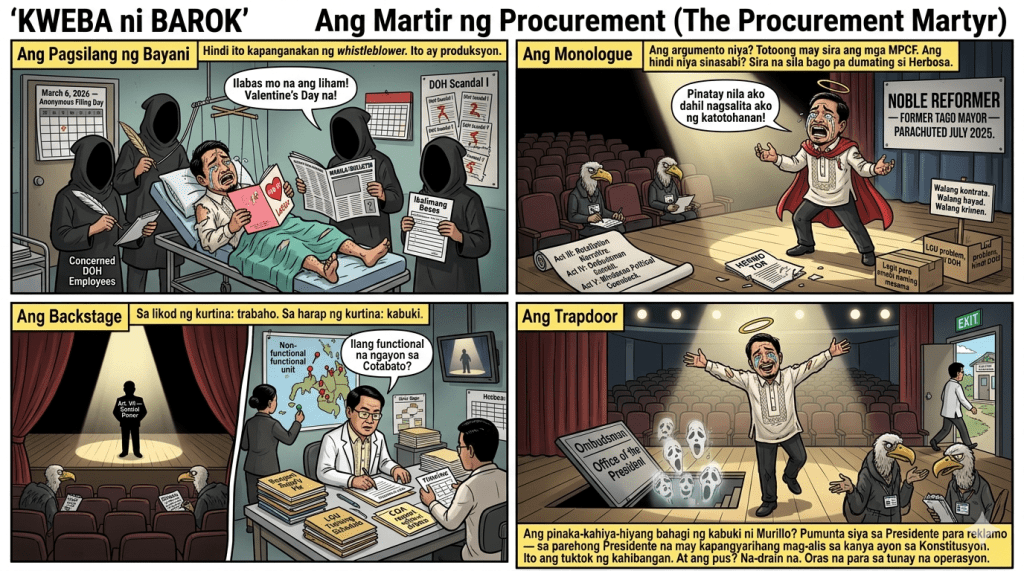
Disgruntled Ex vs. Reformer in the Trenches
Murillo’s arguments? A litany of field reports, an October 10, 2025, memo flagging non-functional units in Cotabato, Davao provinces, and beyond, plus complaints of unused equipment in Siquijor and Zamboanga del Norte due to missing reagents and training. He claims he transmitted proper Terms of Reference (TOR), Purchase Requests, and PPMPs, only for “market studies” and postponements to sabotage upgrades proposed by the Health Facility Enhancement Program Management Office (HEPMO). Noble, until you scrutinize: these are implementation gaps—training, logistics, LGU handoffs—not procurement sabotage. As a non-career presidential appointee (former Tago mayor, parachuted in July 2025), Murillo had zero security of tenure. His “advocacy” reads less like principled reform and more like insubordination dressed as martyrdom: resisting directives to expedite rollout in a post-COVID health access crisis.
Credibility? Shaky. No personal corruption alleged against him, but his public bypass of the chain—leaking to media instead of exhausting internal remedies—reeks of career positioning for a Mindanao political comeback or future appointment. Motive: self-preservation via victim narrative. Consistency: he admits the program inherited massive dysfunction (75% non-functional units per broader DOH context), yet frames Herbosa’s fixes as the crime.
His critics—Herbosa, Usec. Glenn Mathew Baggao, aides Brigida Romualdez-Aquino and Allan Tope, plus anonymous filers—fare better under scrutiny. Herbosa, the physician-administrator, inherited a mess of delayed projects (P11.5B in COA-noted backlogs predating him). His team’s “intervention”? Standard supervisory prerogative under the Administrative Code: forwarding market studies for viable specs (e.g., child-friendly X-rays, reagent guarantees) isn’t “rigging”—it’s prudence to avoid locking in suppliers for another round of lemons. Anonymous complainants? Ghosts hiding behind retaliation fears, filing the fifth such hit piece since August 2025. Their credibility: nil. Motive: factional turf war or supplier protection racket. Consistency: selective outrage ignoring that no contract was awarded, no funds disbursed, and the pre-procurement conference was legitimately postponed. Herbosa’s side prioritizes outcomes—functional clinics for underserved provinces—over Murillo’s perfectionist delays that would balloon costs and timelines.
Rumors, Intrigues & Manufactured Outrage
The echo chamber thrives on unverified noise: Murillo’s letter “obtained” by media, anonymous affidavits alleging TOR tampering and Murillo’s ouster to clear the path for “tailor-fitted” specs. Separate fact from fiction—the October memo and field reports are real, but they indict implementation failures (LGUs short on personnel, reagents), not bad-faith procurement. The “market study” endorsed November 12, 2025? Legitimate GPPB-endorsed research, not conspiracy. Strategic leaks? Classic: anonymous cabals weaponize the Ombudsman while Murillo times his citizen-advocate pose for maximum sympathy post-removal. No supplier communications, no bid awards, no COA disallowance—yet the narrative screams “scandal.” This is information warfare by entrenched interests, not evidence. Herbosa’s silence? Wise; no need to dignify ghosts when the truth is far from “what anonymous groups can easily allege without accountability.”
Legal Framework: Bad Faith? Not Even Close
Republic Act No. 3019 (Anti-Graft and Corrupt Practices Act) Sec. 3(e) demands manifest partiality, gross negligence, or bad faith causing undue injury or unwarranted benefits. Sec. 3(g) requires grossly disadvantageous contracts. Here? Zero. No award, no disbursement—postponement reflects prudence, not injury. Republic Act No. 12009 (New Government Procurement Act) Sec. 92(c) and (g), plus IRR 7.7.1, 11, and 42, mandate competitive specs and end-user primacy—but supervision by the Head of Procuring Entity (Herbosa) is explicitly allowed under the Administrative Code. TOR revisions? Normal, not “manipulation.” Republic Act No. 6713 (Code of Conduct and Ethical Standards for Public Officials and Employees) Sec. 4 demands public interest and competence; Herbosa delivers by fixing inherited waste, not preserving it.
Standards for bad faith? Absent. Arias v. Sandiganbayan (G.R. No. 81563, 1989) shields reliance on subordinates and technical staff—precisely Herbosa’s lane. Navales v. People and Jomadiao v. Arboleda (G.R. No. 230322) downgrade procurement lapses to simple neglect absent malice; no “gross disadvantage” when specs evolve to ensure functionality. Villena v. Secretary of the Interior and Carpio v. Executive Secretary affirm executive control. The anonymous complaint collapses: no dolus malus, no quantifiable loss, just policy debate.
Appointing Authority: Presidential Control Isn’t Retaliation
Article VII of the 1987 Constitution vests the President with control over the executive branch. Undersecretaries? Alter egos, co-terminous, serving at pleasure—no security of tenure for non-career appointees like Murillo (Administrative Code, CSC rules). Removal power equals appointment power: Villena and Carpio cement this. Herbosa didn’t “fire” Murillo; presidential prerogative (via reassignment or loss of confidence) did. Claims of “retaliation”? Legally immaterial—Murillo’s complaint to the Office of the President is the height of absurdity. He runs to the very authority that exercised lawful discretion to sideline him, demanding redress from the same hand that showed him the door? Please. Doctrine of control renders such theatrics moot.
Motivations: Principled? Or Positioning for the Spotlight
Murillo: “Citizen committed to welfare.” Translation—disgruntled ex-appointee leveraging a public letter for hero status, Mindanao base-building, or future gigs. His timing? Post-removal, pre-Ombudsman escalation. Herbosa and team: urgent rollout amid health gaps, cost control, loyalty to Marcos priorities. Anonymous filers? Factional payback or supplier protection. No graft conspiracy—just reformers clashing with status-quo defenders. The real motive behind the noise? Sabotage accountability that actually delivers clinics, not drama.
Options: Murillo’s Weak Hand vs. Herbosa’s Strong Defense
Murillo’s options—Ombudsman testimony, media blitz, mandamus on removal (doomed), political run on martyr vibes—are all theatrics yielding slim returns. Herbosa/DOH: counter-affidavits proving good faith, reliance on HEPMO, market studies; accelerate fixes (reagents, training); full cooperation with probes. Administration: fast-track independent verification, no preventive suspension absent ironclad evidence (Republic Act No. 6770 (The Ombudsman Act of 1989)). Senate/House? Risky for opposition fishing expeditions. Best path: evidence over affidavits.
Impacts & Consequences: Drama Delays Real Health Gains
Public health suffers most: non-functional units in rural Mindanao already waste P1.8B potential; prolonged probes halt rollout, breeding morbidity in underserved areas. Fiscal governance: endless complaints chill reform, inflate costs via delays. Political: embarrasses the administration, boosts opposition theater. Legal precedent: if baseless complaints stick, whistleblower protection erodes into harassment tools—yet stronger RA 12009 enforcement and COA audits emerge as silver lining. Systemic: cynicism in procurement deepens unless transparency reigns. Long-term? This exposes gaps in end-user vs. supervisory balance but affirms governance over purity.
Evisceration: Murillo’s House of Cards Crumbles
Murillo’s legal position? Swiss cheese—policy disagreement masquerading as graft, with zero proof of bad faith or injury under RA 3019/12009. His martyrdom narrative? Self-serving fiction; as at-will appointee, removal was lawful exercise of presidential control, not punishment. “Retaliation” claims? Irrelevant noise. Strategic timing of his public letter? Calculated spectacle post-ouster, bypassing hierarchy for headlines. And complaining to the Office of the President? Peak absurdity—he petitions the very President whose constitutional “control” doctrine (Villena, Carpio) authorized his exit. Herbosa’s side? Vindicated by prudence, not persecuted.
Call to Action: Real Service, Not Theater—Transparency Now
Enough with the kabuki. Demand genuine public service over political theater: outcomes for patients, not narratives for ex-appointees. Pro-people governance must prioritize functional clinics over flawless paperwork. Immediate independent investigation—Ombudsman, apply rigor per Arias and Administrative Order No. 07; dismiss with prejudice if ghosts fail to materialize. Radical transparency: release every TOR draft, market study, email, and acceptance report—real-time audits, public COA special review of MPCFs. Enforce RA 12009 oversight strictly. Strengthen whistleblower shields (beyond Republic Act No. 6981 (Witness Protection, Security and Benefit Act) drafts) but punish harassment. Congress: probe Ombudsman weaponization, not the Secretary. Herbosa: keep delivering. The rule of law protects reformers as fiercely as it punishes frauds—and right now, the real threat to Philippine health isn’t “upgraded specs.” It’s tailor-fitted complaints from the procurement mafia.
The pus has been drained. Time for surgery on governance itself.
Key Citations
A. Legal & Official Sources
- The 1987 Constitution of the Republic of the Philippines. Official Gazette of the Republic of the Philippines, 1987.
- Philippines. Republic Act No. 3019: Anti-Graft and Corrupt Practices Act. 1960, The LawPhil Project.
- Philippines. Republic Act No. 12009: An Act Revising Republic Act No. 9184, Otherwise Known as the “Government Procurement Reform Act”, and for Other Purposes. 2024, The LawPhil Project.
- Philippines. Republic Act No. 6713: An Act Establishing a Code of Conduct and Ethical Standards for Public Officials and Employees. 1989, The LawPhil Project.
- Philippines. Republic Act No. 6770: The Ombudsman Act of 1989. 1989, The LawPhil Project.
- Philippines. Republic Act No. 6981: An Act Providing for a Witness Protection, Security and Benefit Program and for Other Purposes. 1991, The LawPhil Project.
- Philippines, Supreme Court. Arias v. Sandiganbayan. G.R. No. 81563, 19 Dec. 1989, The LawPhil Project.
- Philippines, Supreme Court. Navales v. People. G.R. No. 219598, 7 Aug. 2024, The LawPhil Project.
- Philippines, Supreme Court. Jomadiao v. Arboleda. G.R. No. 230322, 19 Feb. 2020, The LawPhil Project.
- Philippines, Supreme Court. Villena v. Secretary of the Interior. G.R. No. L-46570, 21 Apr. 1939, The LawPhil Project.
- Philippines, Supreme Court. Carpio v. Executive Secretary. G.R. No. 96409, 14 Feb. 1992, The LawPhil Project.
B. News Reports
- Santos, Jel “Ex-DOH Official Says He Was Removed After Raising Concerns on Mobile Clinic Program.” Manila Bulletin, 21 Mar. 2026.
- Biraogo, Louis “Barok” C. “Procurement Mafia’s Latest Hit Job: Why Herbosa Can’t Catch a Break.” KWEBA ni BAROK, 11 Mar. 2026.
- “Forthwith” to Farce: How the Senate is Killing Impeachment—And Why Enrile’s Right (Even If You Can’t Trust Him)
- “HINDI AKO NAG-RESIGN!”

- “I’m calling you from my new Globe SIM. Send load!”

- “Mahiya Naman Kayo!” Marcos’ Anti-Corruption Vow Faces a Flood of Doubt

- “Meow, I’m calling you from my new Globe SIM!”

- “No Special Jail for Crooks!” Boying Remulla Slams VIP Perks for Flood Scammers

- “PLUNDER IS OVERRATED”? TRY AGAIN — IT’S A CALCULATED KILL SHOT

- “Several Lifetimes,” Said Fajardo — Translation: “I’m Not Spending Even One More Day on This Circus”

- “Shimenet”: The Term That Broke the Internet and the Budget

- “We Did Not Yield”: Marcos’s Stand and the Soul of Filipino Sovereignty

- “We Gather Light to Scatter”: A Tribute to Edgardo Bautista Espiritu

- $150M for Kaufman to Spin a Sinking Narrative

 KWEBA ni BAROK
Leave a comment