
“I had nothing to do with the bids,” says the Undersecretary. His brother’s company says “thank you” with P567 million in contracts.
By Louis ‘Barok‘ C. Biraogo — March 25, 2026
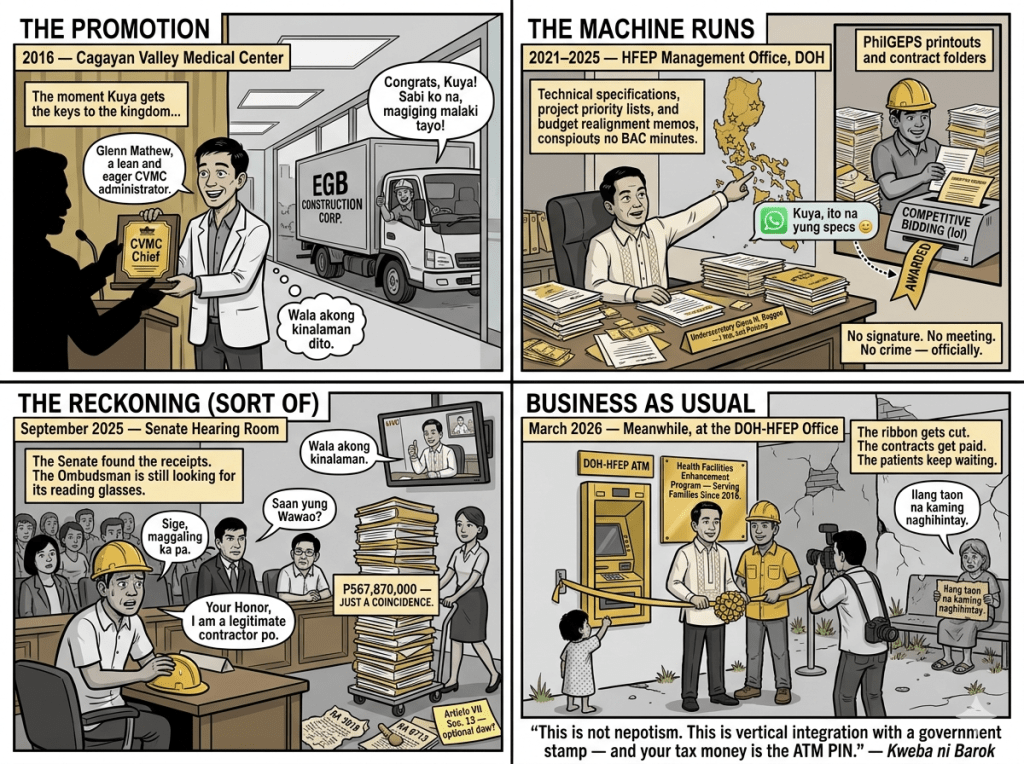
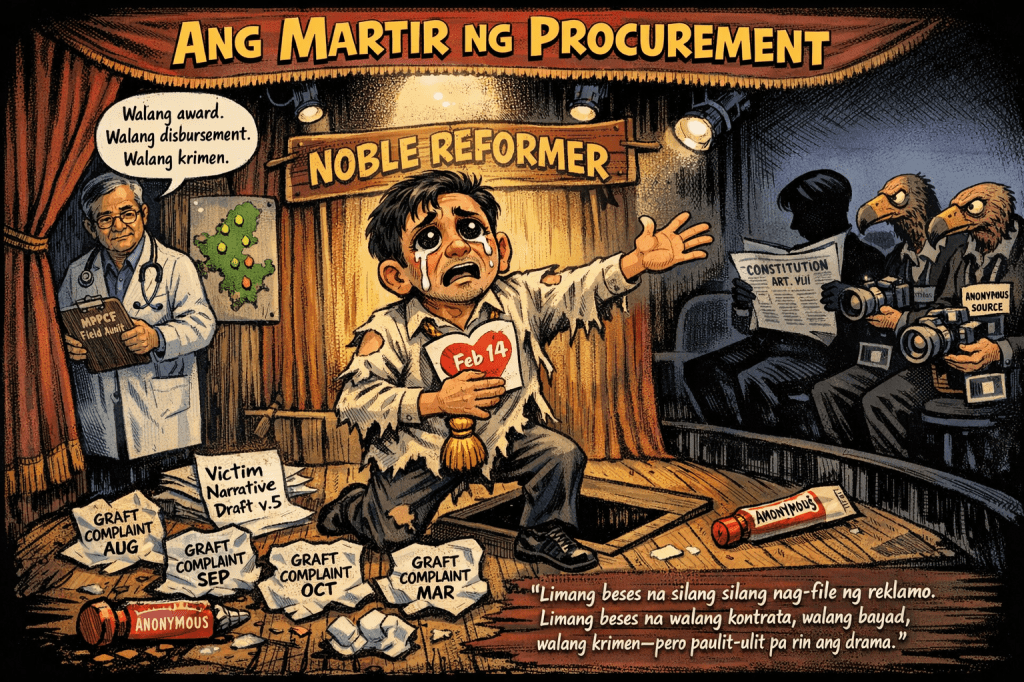
LISTEN up, Republic. While the rest of the country is still digesting the latest Marcosian promise of “good governance,” Rappler just dropped the receipts on the dynamic duo who turned the Department of Health into a family ATM: Undersecretary Glenn Mathew Baggao and his brother, contractor Erni Baggao of EGB Construction Corp. Between them they’ve vacuumed up P567.87 million in health infrastructure contracts since 2016 — P408 million while Glenn was still running Cagayan Valley Medical Center, another P140.99 million in 2025 alone after he became the national HFEP overlord.
This isn’t nepotism. This is vertical integration with a government stamp. One brother writes the wish list, the other cashes the check. And the best part? They insist it’s all “coincidence.” Darling, in Philippine politics “coincidence” has a higher success rate than the lotto.
The Architect and the Cash-Grabbing Contractor
Let’s start with Glenn Mathew, the “passive” undersecretary who somehow keeps getting promoted while his brother’s company keeps winning. The man who now heads the Health Facilities Enhancement Program (HFEP) Management Office — the very office that monitors, evaluates, and technically oversees every single health infra project in Luzon — swears he never sat on any Bids and Awards Committee.
Oh please. The defense is the Philippine version of “I was just holding the flashlight.” You don’t need to sign the BAC minutes when you control the technical specifications, the project prioritization, the budget realignments, and the post-award monitoring. That’s not “no direct participation”; that’s architectural intervention dressed up in bureaucratic drag. His career arc is a textbook case of regulatory capture by bloodline: CVMC chief (contracts start flowing), then national Undersecretary for Public Health Services, then reassigned to Universal Health Care–Health Services Cluster, then HFEP czar. Every rung of the ladder coincides with EGB’s sudden expertise in “health facilities.”
Now Erni. The “legitimate contractor” who was simultaneously on the Philippine Contractors Accreditation Board (PCAB) until the Senate forced him to resign in September 2025. The same Erni named by President Marcos himself as one of the 15 “dominant” flood-control contractors, later accused by Sen. Raffy Tulfo of ghost projects via Wawao Builders (which he denies owning, of course). The same Erni whose company pivoted from flood control to health centers faster than a congressman switches parties.
The façade of the “self-made businessman” collapses the moment you notice the joint ventures with the Salazar-Guillen clan in Ilocos and the Diaz family in Isabela — the very political dynasties that delivered the votes and the appointments. Sister Joji Baggao-Borromeo sitting as Ilagan councilor on the Diaz slate? Come on. This isn’t construction; this is franchise politics with concrete.
Soft Capture Exposed: The Invisible Hand of Family Power
Here is the real genius of the Baggao operation: they perfected the art of paperless, signaturless, receiptless influence. No brown envelope, no text message saying “padala ng 10%,” no BAC minutes with Glenn’s signature. Just overlapping functions, shared family WhatsApp groups, and the gentle pressure of “kuya, tulungan mo naman ang proyekto sa Isabela.”
This is what political scientists call “soft capture” and what normal people call the new normal of Philippine corruption. The old-school trapos needed signatures; the new breed needs only proximity. DOH shapes the Health Facility Enhancement Program priorities; DPWH implements; EGB bids. Glenn “monitors.” Erni “wins.” Everyone smiles for the ribbon-cutting. No crime, just “family business.”
The scandal is not the contracts. The scandal is that this is now considered acceptable. Influence without a trace. Power without a paper trail. Corruption that laughs at the Ombudsman because there is literally nothing to photocopy.
Legal Labyrinth: Fig Leaves, Bad Faith, and Constitutional Jokes
Defense’s Fig Leaf: “No Direct Participation” Excuse
Defense lawyers are already polishing the “no direct participation” gospel. “He wasn’t in the BAC! DPWH handled everything! Projects predated his appointment!” Cute. Republic Act No. 3019 (Anti-Graft and Corrupt Practices Act) Section 3(h) doesn’t require you to be the signatory; it requires you to intervene or take part in a transaction in which you have interest. Teves v. Sandiganbayan already buried the “direct ownership only” myth decades ago — indirect interest is enough to invalidate. Arias v. Sandiganbayan adds the kicker: when circumstances scream “this is fishy,” reliance on “good faith” becomes unreasonable.
The prosecution’s case is stronger than they admit. Section 3(e) of RA 3019 — manifest partiality, evident bad faith, gross inexcusable negligence causing undue injury or unwarranted benefit — was written for exactly this pattern. Add Section 4(a): public officers shall not allow relatives within the third degree to capitalize on their official position. Brother = third degree. Capitalized = P567 million. Math is hard for some people.
Constitutional Middle Finger: Article VII, Sec. 13 Ignored
Article VII, Section 13 of the 1987 Constitution of the Republic of the Philippines (1987 Constitution) is not a suggestion. Cabinet undersecretaries “shall strictly avoid conflict of interest” and are explicitly barred from “direct or indirect financial interest in any government contract.” The Baggaos treat this like optional reading.
Ethics Code Violation: RA 6713 Ignored
Section 7(a): no direct or indirect interest in any transaction requiring approval of their office.
Section 7(b)(1): no ownership of an enterprise regulated by their office (hello, Erni on PCAB).
Section 9: divest or resign within 60 days. They did neither.
Procurement Rules Bent: RA 9184 and RA 12009
Republic Act No. 9184 (Government Procurement Reform Act) / Republic Act No. 12009 (New Government Procurement Act) – The negotiated COVID project and the alleged MPCF bid-rigging (already the subject of an Ombudsman complaint filed March 6, 2026) scream violation of competitive bidding principles.
Prosecution Pathways: Graft, Forfeiture, and More
Ombudsman can file graft under RA 3019. Sandiganbayan loves pattern evidence. Civil forfeiture under Republic Act No. 1379 (An Act Declaring Forfeiture of Illegally Acquired Property) if lifestyle doesn’t match salary. Anti-Money Laundering Act (AMLA) lifestyle check because unexplained wealth is the new black. Administrative cases for grave misconduct are slam dunks even if criminal proof is “only” circumstantial.
Possible Outcomes: Whitewash or Accountability?
Whitewash (most likely under this administration). Quiet reassignment. Or — miracle of miracles — actual prosecution that sets precedent. The latter would actually help the Marcos reform narrative. The former buries it.
The Indictment: Time to Prosecute and Reform
Lifestyle Checks and Asset Seizure: Open the Books
I am formally demanding — right now — that the Anti-Money Laundering Council and the Ombudsman open a full financial investigation into the entire Baggao clan and EGB Construction. RA 1379 exists precisely to forfeit property unlawfully acquired. Let them explain the jump from flood control to health centers with a P260 million capitalization in 2021.
Cases to File: Graft Charges for the Brothers
- Glenn Mathew Baggao: RA 3019 Sections 3(e) and 3(h), Republic Act No. 6713 (Code of Conduct and Ethical Standards for Public Officials and Employees) violations.
- Erni Baggao: RA 6713 (PCAB conflict), conspiracy under RA 3019, possible bid-rigging.
- Joint venture partners and approving officials: as co-conspirators.
Senate Subpoena Power: Drag Out the Enablers
Senators Tulfo and Lacson already started the party. Finish it. Subpoena every contract, every joint venture agreement, every family donation record. Drag the Salazar-Guillen and Diaz networks into the light.
Resign or Be Suspended: Clean House Now
Glenn Baggao must resign or be suspended immediately. Review every EGB contract. Blacklist where performance is substandard (four of thirteen projects already delayed, per Rappler).
Systemic Reforms: Ban the Bloodline Contracts for Good
- Absolute ban on relatives (up to third degree) of Cabinet-level officials securing government contracts.
- Mandatory real-time public disclosure of family business interests on PhilGEPS.
- Algorithm-driven, AI-monitored bidding with zero human intervention on technical specs for HFEP and similar programs.
- Permanent DTI-style prohibition on regulator-contractor overlap.
Final Indictment: Patronage or Progress?
This is not about two brothers from Cagayan. This is about whether the Philippines will continue to be governed by bloodlines and backroom nods or by actual rules. The Baggaos are not the disease; they are the most visible symptom of a patronage system that has metastasized into every infrastructure pipeline.
The Marcos administration can either treat this as the canary in the coal mine and cauterize the wound — or it can do what every previous administration has done: issue a tepid statement, reassign the undersecretary sideways, and hope the public forgets.
We will not forget. The contracts have names. The delays have consequences. The public health budget has been gamed.
The court of public opinion has already rendered its verdict. The only question left is whether the Sandiganbayan will finally grow a spine and make it official.
Barok has spoken.
The ink is dry. The rot is exposed. Now the Republic must decide: excise the tumor or let it spread until the entire patient dies.
Kweba ni Barok — still refuses to look away.
Key Citations
A. Legal & Official Sources
- The 1987 Constitution of the Republic of the Philippines. Official Gazette of the Republic of the Philippines, 1987.
- Republic Act No. 3019. Anti-Graft and Corrupt Practices Act. 1960, The LawPhil Project.
- Republic Act No. 6713. An Act Establishing a Code of Conduct and Ethical Standards for Public Officials and Employees. 1989, The LawPhil Project.
- Republic Act No. 9184. Government Procurement Reform Act. 2002, The LawPhil Project.
- Republic Act No. 12009. New Government Procurement Act. 2024, The LawPhil Project.
- Republic Act No. 1379. An Act Declaring Forfeiture of Illegally Acquired Property. 1955, The LawPhil Project.
- Republic Act No. 9160. Anti-Money Laundering Act of 2001. 2001, The LawPhil Project.
Pascual v. Board of Medical Examiners. Supreme Court of the Philippines, 26 May 1969, The LawPhil Project.- Teves v. Sandiganbayan. G.R. No. 154182, Supreme Court of the Philippines, 17 Dec. 2004, The LawPhil Project.
- Arias v. Sandiganbayan. Supreme Court of the Philippines, 19 Dec. 1989, The LawPhil Project.
B. News Reports
- “Forthwith” to Farce: How the Senate is Killing Impeachment—And Why Enrile’s Right (Even If You Can’t Trust Him)
- “HINDI AKO NAG-RESIGN!”

- “I’m calling you from my new Globe SIM. Send load!”

- “Mahiya Naman Kayo!” Marcos’ Anti-Corruption Vow Faces a Flood of Doubt

- “Meow, I’m calling you from my new Globe SIM!”

- “No Special Jail for Crooks!” Boying Remulla Slams VIP Perks for Flood Scammers

- “PLUNDER IS OVERRATED”? TRY AGAIN — IT’S A CALCULATED KILL SHOT

- “Several Lifetimes,” Said Fajardo — Translation: “I’m Not Spending Even One More Day on This Circus”

- “Shimenet”: The Term That Broke the Internet and the Budget

- “We Did Not Yield”: Marcos’s Stand and the Soul of Filipino Sovereignty

- “We Gather Light to Scatter”: A Tribute to Edgardo Bautista Espiritu

- $150M for Kaufman to Spin a Sinking Narrative



 KWEBA ni BAROK
Leave a comment