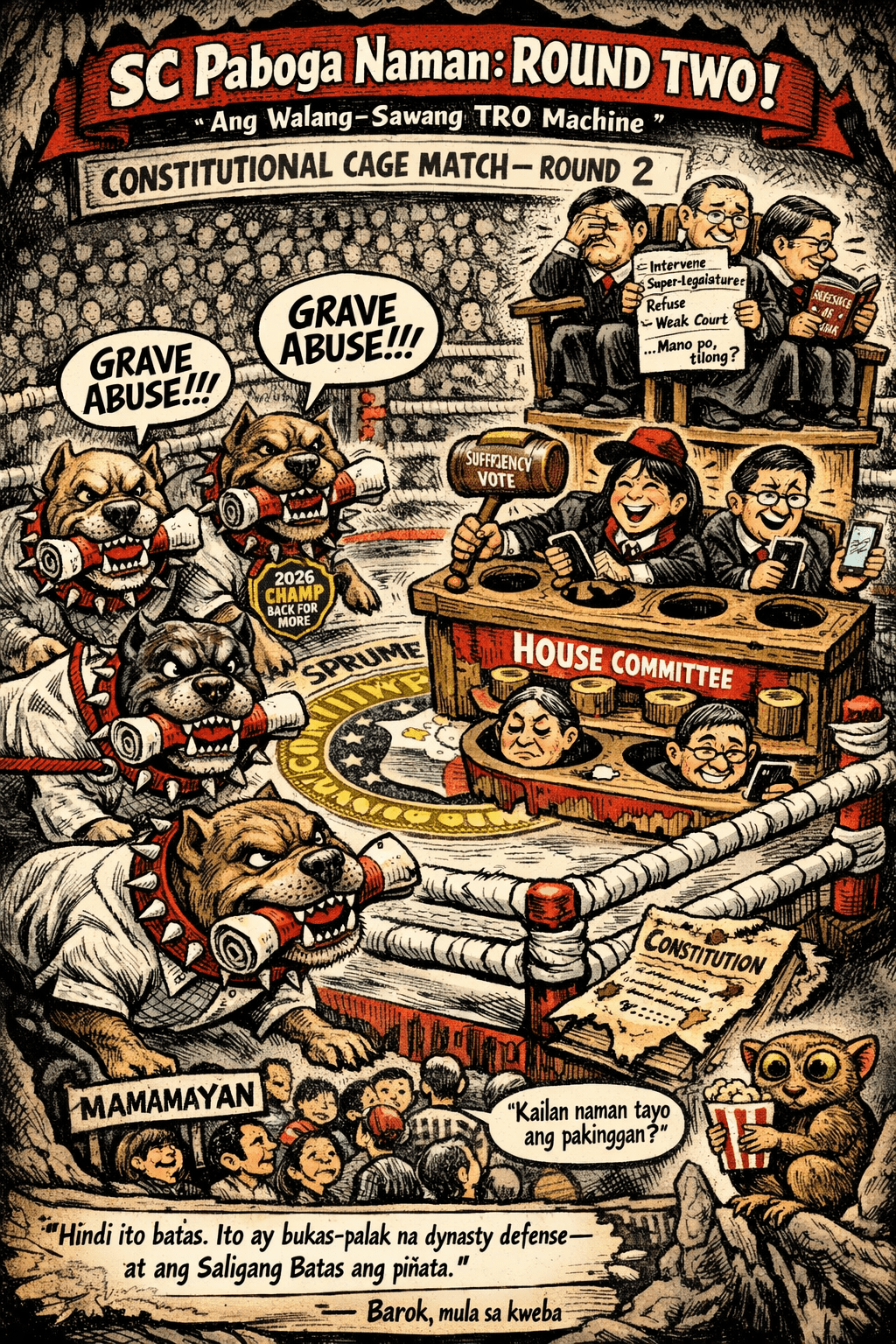
From 2025 win to 2026 replay: How Duterte allies are turning the one-year bar into Sara’s ultimate legal shield.
By Louis ‘Barok‘ C. Biraogo — March 28, 2026
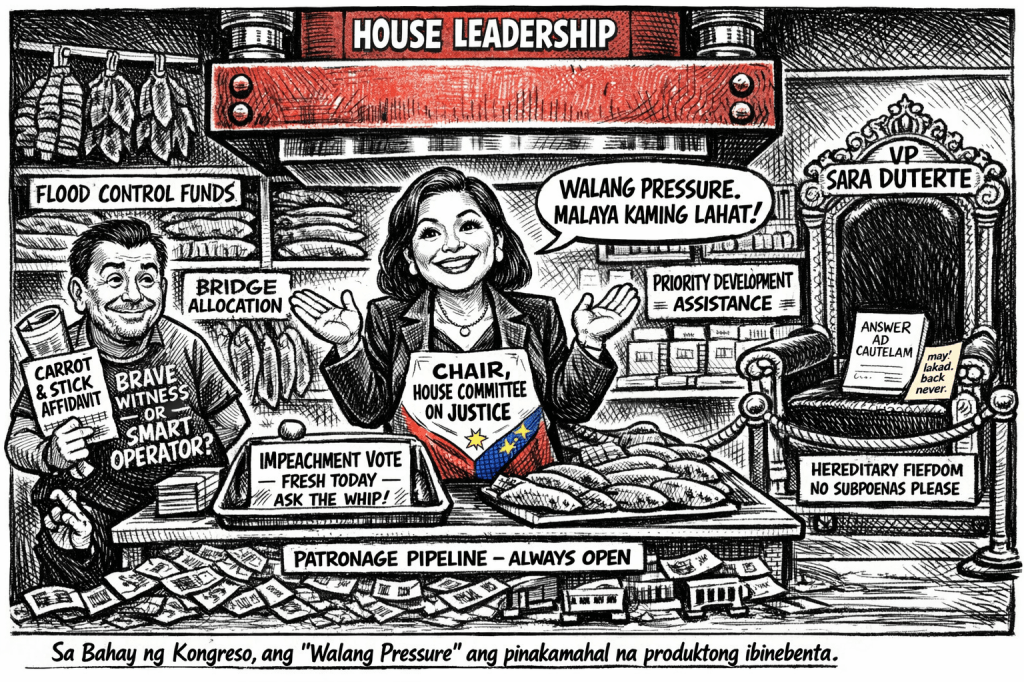
MGA ka-kweba, ladies and gentlemen of the peanut gallery we call Philippine democracy, grab your popcorn and your copy of the 1987 Constitution of the Republic of the Philippines. Yesterday—March 27, 2026—Israelito Torreon, Vic Rodriguez, Martin Delgra, and Wendel Avisado, the Duterte family’s favorite legal attack dogs, trotted back to the Supreme Court with yet another petition to slap a TRO on the House Committee on Justice’s latest attempt to impeach Vice President Sara Duterte. Same song, different verse: “grave abuse of discretion,” “insufficiency in form and substance,” “one-year bar rule,” and the usual pious bleating about due process.
This isn’t a legal skirmish. This is a full-blown constitutional cage match, a stress test that exposes how the 1987 Constitution’s vaunted “accountability mechanism” has devolved into a procedural demolition derby between two warring dynasties. The Marcos camp wants Sara’s scalp (or at least her political castration) over confidential funds, COA fabrications, and alleged threats. The Duterte camp wants the Supreme Court to play goalie—again—because heaven forbid a political process actually be allowed to play out. Welcome to the Philippines, where impeachment isn’t about public trust; it’s about public theater, and the Constitution is the script nobody bothered to read.
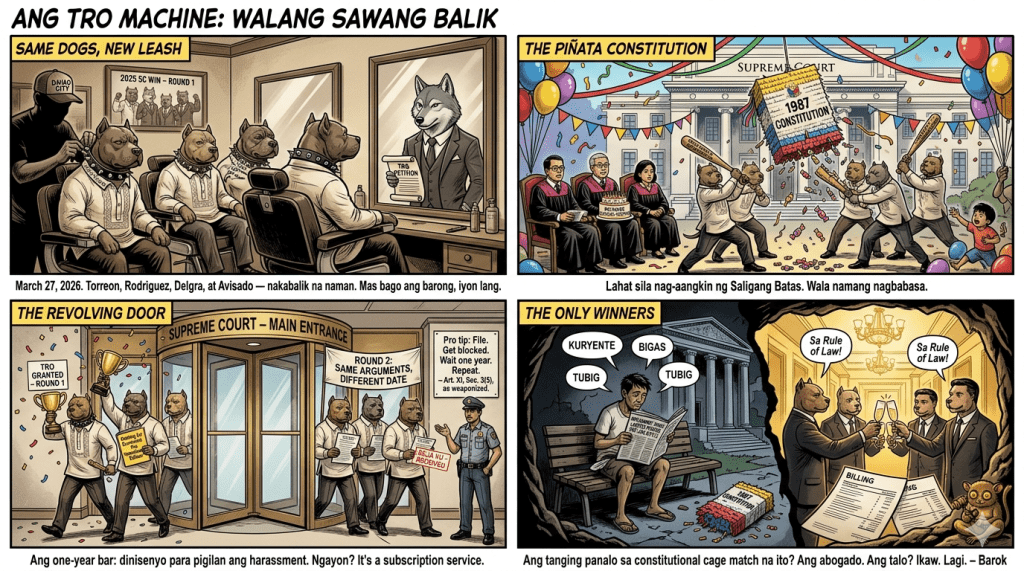
Duterte’s Loyal Pit Bulls: Not Guardians, Just Dynasty Defenders
Let’s start with the petitioners. Torreon et al. aren’t “concerned citizens” or “constitutional watchdogs.” They’re the same crew that won the 2025 SC ruling blocking the first impeachment. Now they’re back, demanding the Court declare the House committee’s sufficiency vote “gravely abusive” and the complaints “constitutionally infirm.” Their arguments? The two pre-bar complaints taint everything; the post-bar ones are still somehow radioactive; the allegations are vague; due process is being trampled.
Spare me the sanctimony. This is naked forum shopping dressed in due-process drag. The one-year bar (Article XI, Section 3(5) of the 1987 Constitution) exists to prevent harassment, not to create a permanent force field around impeachable officers. Francisco Jr. v. House of Representatives (G.R. No. 160261, November 10, 2003) already told us initiation = filing + referral. The House says only the third and fourth complaints were referred after the bar lapsed. Petitioners scream “taint!” as if the Constitution comes with a retroactive curse. It’s not law; it’s legal jujitsu to shield a political ally. These are Duterte-time officials and lawyers whose primary client is not the Republic but the dynasty. Their petition isn’t about form and substance; it’s about buying time until the 2028 circus. High-stakes legal shielding operation? Check. Brazenness? Off the charts.
House Justice Committee: Buzzsaw of Vendetta, Not Accountability
Now the other side—the House Committee on Justice, that august body of Marcos allies and progressive filers who voted the complaints sufficient faster than you can say “political vendetta.” They treated the process like a conveyor belt: refer, vote sufficiency, schedule hearings, watch Sara snub them, rinse, repeat. Is this “accountability”? Or is it the legislative branch playing whack-a-mole with the opposition while the energy crisis and inflation chew up the rest of the country?
The speed is suspicious, the optics worse. Impeachment is supposed to be a solemn political act (Article XI, Section 3(1) gives the House exclusive power), not a cudgel in the Marcos-Duterte blood feud. The complaints allege misuse of ₱612.5 million in confidential funds, COA discrepancies, and threats—serious enough on paper to pass the low “ultimate facts” threshold under House Rules. But when the process reeks of score-settling, the “democratic accountability” mantra rings hollow. The House isn’t a court; it’s a political arena. Treating it as one is fine—until you pretend it isn’t.
Expanded Review vs. Political Question: SC Caught in the Dynastic Crossfire
Here’s the real constitutional porn: the collision between Francisco’s political-question doctrine and the Court’s post-1987 expanded judicial power (Article VIII, Section 1 of the 1987 Constitution) to smack down “grave abuse.” The petitioners love the latter; the House hates it when it’s aimed at them. The 2025 ruling already intervened once, voiding the prior complaints for bar violation and due-process defects. Now petitioners want round two.
The Court is trapped. Intervene and it becomes the super-legislature, turning every sufficiency vote into certiorari fodder. Refuse and it looks like it’s backpedaling from its own precedent, letting the House run roughshod. Mockery of the highest order: the judiciary, designed as constitutional guardian, reduced to refereeing a dynastic brawl. Francisco warned us impeachment is political; Gutierrez v. House of Representatives Committee on Justice (G.R. No. 193459, February 15, 2011) said sufficiency is largely non-justiciable. The 2025 Duterte decision blew the door open wider by applying due process at the preliminary stage. The Court now owns this mess.
2025 Ruling: Due Process Hero or Stalling Manual?
Let’s be brutally honest about the July 2025 decision (affirmed 2026). It was unanimous, it protected due process (Ang Tibay v. Court of Industrial Relations (G.R. No. 46496, February 27, 1940) standards in a sui generis proceeding), and it enforced the one-year bar. Noble? Sure. But it also handed every impeachable officer—and their lawyers—a how-to manual for stalling. File, get referred, get struck down on technicalities, wait a year, repeat. The Court wanted to prevent harassment; it may have created a safe harbor for the powerful. Now it faces the institutional dilemma: stick to its guns and look partisan, or pivot and look weak. Either way, the public sees a judiciary picking sides in a political knife fight.
Constitutional Framework: Article XI’s Beautiful Procedural Disaster
Article XI is a beautiful mess. Section 2 lists the offenses; Section 3 gives the House the power and the one-year bar as a shield. The framers wanted accountability without paralysis. What they got was a procedural minefield where “sufficiency” is a political call, yet the SC can always cry “GAD.” The one-year bar was meant to stop serial harassment; it has become a get-out-of-jail-free card for anyone with good lawyers. The low threshold for substance (“ultimate facts,” not evidence) invites fishing expeditions. House Rules try to cabin it, but politics laughs. The 1987 Constitution didn’t prevent tyranny of the majority or the minority—it just gave both sides better lawyers.
Hypocrisy Olympics: Weaponizing the Constitution for Power Plays
Petitioners preach “sanctity of due process” and “rule of law.” Critics scream “public accountability” and “no one is above the law.” Both are right—and both are lying through their teeth. Separation of powers? Petitioners invoke it when the Court blocks the House; the House invokes it when the Court tries. Due process? Sacred when it shields Sara, flexible when the House wants to move fast. The same Constitution is cited by both camps as holy writ while they treat it like a bargaining chip. It’s not principle; it’s power in drag.
Motivations Laid Bare: No Saints, Just Power Brokers
- Petitioners: Protect the dynasty, preserve the 2025 win, delay until 2028.
- House bloc: Weaken the Dutertes, consolidate Marcos power, score points with civil society.
- Supreme Court: Navigate the minefield without losing face or institutional dignity.
- Sara: Snub and delegitimize.
Pure motives? Please. This is a power struggle wearing legal robes. Public trust is the fig leaf.
Options Galore: All Cynical, None Noble
- SC grants TRO? Political “get out of jail free.”
- SC dismisses? Green light for legislative harassment.
- Partial ruling or compromise? Judicial punt that solves nothing.
- House proceeds anyway? Contempt theater.
- Political backroom deal? Constitution as bargaining chip—exactly what the framers feared.
Impacts: Prophecy of a Cynic – Democracy Takes the Hit
This circus doesn’t strengthen democracy; it wounds it. A weakened presidency, a politicized judiciary, a public that sees the law as just another weapon. The 2028 race will be fought on impeachment scars, not issues. Real problems—energy crisis, inflation, poverty—get sidelined while lawyers bill hours and dynasties posture. The rule of law doesn’t die with a bang; it dies by a thousand procedural delays and cynical petitions.
A Better Path: Sincerity Break Amid the Satire
Enough. Democratic institutions must be more than arenas for dynastic war. The rule of law must apply equally—not as a shield for the powerful or a sword for the rival. Public office is a public trust, not a family heirloom or a political Excalibur.
Recommendations: Sarcasm-Free Fixes (Mostly)
- The Supreme Court should expedite this petition, issue a clear, narrow ruling that reaffirms Francisco and Gutierrez without turning every impeachment into a judicial pre-trial. Stop being the super-prosecutor.
- Congress should amend the House Rules and push for constitutional tweaks: tighten the one-year bar’s reckoning, raise the substance threshold slightly, and mandate faster timelines to prevent endless rounds.
- Everyone—petitioners, House, SC—should remember that the best resolution is the one that reminds public officials the people, not the dynasties, are the boss. Perhaps the ultimate recommendation is the simplest: govern honestly, spend public funds transparently, and stop treating the Constitution like a piñata at a family feud.
Because right now, the only winners are the lawyers. The losers? The Republic. Again.
— Barok
Key Citations
A. Legal & Official Sources
- The 1987 Constitution of the Republic of the Philippines. Official Gazette of the Republic of the Philippines, 1987.
- Sara Z. Duterte v. House of Representatives et al. and Israelito P. Torreon et al. v. House of Representatives et al. G.R. Nos. 278353 and 278359, Supreme Court of the Philippines, 25 July 2025, The LawPhil Project.
- Francisco, Jr. v. House of Representatives. G.R. No. 160261, Supreme Court of the Philippines, 10 Nov. 2003, The LawPhil Project.
- Gutierrez v. House of Representatives Committee on Justice. G.R. No. 193459, Supreme Court of the Philippines, 15 Feb. 2011, The LawPhil Project.
- Ang Tibay v. Court of Industrial Relations. G.R. No. 46496, Supreme Court of the Philippines, 27 Feb. 1940, The LawPhil Project.
B. News Reports
- ₱75 Million Heist: Cops Gone Full Bandit

- ₱6.7-Trillion Temptation: The Great Pork Zombie Revival and the “Collegial” Vote-Buying Circus

- ₱1.9 Billion for 382 Units and a Rooftop Pool: Poverty Solved, Next Problem Please

- ₱1.35 Trillion for Education: Bigger Budget, Same Old Thieves’ Banquet

- ₱1 Billion Congressional Seat? Sorry, Sold Out Na Raw — Si Bello Raw Ang Hindi Bumili

- “We Will Take Care of It”: Bersamin’s P52-Billion Love Letter to Corruption

- “Skewed Narrative”? More Like Skewered Taxpayers!

- “Scared to Sign Vouchers” Is Now Official GDP Policy – Welcome to the Philippines’ Permanent Paralysis Economy

- “Robbed by Restitution?” Curlee Discaya’s Tears Over Returning What He Never Earned

- “No Pressure” Luistro? The House Pork Bazaar Exposed

- “My Brother the President Is a Junkie”: A Marcos Family Reunion Special

- “Mapipilitan Akong Gawing Zero”: The Day Senator Rodante Marcoleta Confessed to Perjury on National Television and Thought We’d Clap for the Creativity





 KWEBA ni BAROK
Leave a comment