From 12-Year Parking Lot to 90-Day Dash: Is This Reform or Just a Faster Way to Bury Cases?
By Louis “Barok” C. Biraogo | March 29, 2026
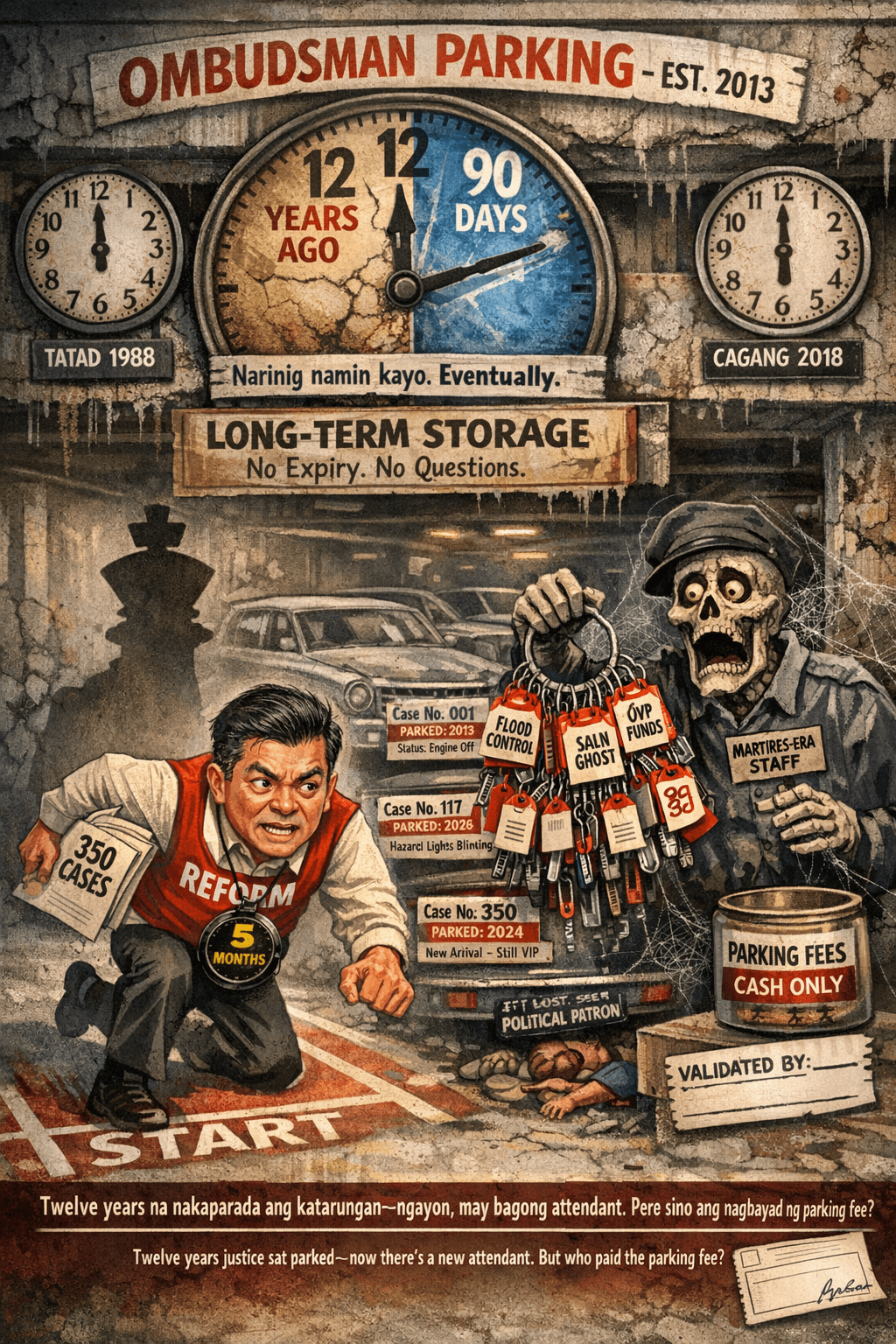
MGA ka-kweba, ladies and gentlemen of the peanut gallery we call the Philippine justice system, grab your popcorn and your copy of the 1987 Constitution of the Republic of the Philippines. The Office of the Ombudsman just dropped a press release that sounds like a reformer’s wet dream: “We’re ending the parking of 350 high-profile graft cases that have been gathering dust since before Jesus Crispin ‘Boying’ Remulla took the wheel in October 2025.” Assistant Ombudsman Mico Clavano, bless his heart, admitted some cases have been idling for 12 years. Twelve. Years. That’s not a docket; that’s a parking lot for political cadavers.
Welcome to the Core Controversy, mga ka-kweba. “Parking” isn’t some innocent bureaucratic fender-bender. It’s systemic sabotage dressed up as discretion. It’s the quiet, genteel way the powerful get to keep their titles, their salaries, and their golf memberships while complainants rot in legal purgatory. A 12-year pendency isn’t delay—it’s a constitutional middle finger to Article III, Section 16 of the 1987 Constitution’s promise of “speedy disposition.” It’s the living, breathing proof that the Ombudsman, that supposed “protector of the people,” has been running a valet service for the elite. Red flags? Try a red carpet.

Parking Lot of Impunity: 12 Years of Systemic Sabotage
Let’s call it what it is: a deliberate constitutional crisis of inaction. The Ombudsman’s own inventory—350 complaints against high-ranking officials—didn’t just materialize like Manila’s legendary traffic. These cases were parked, engine off, hazard lights blinking, while the rest of us paid the meter. Simple cases taking a year? Complex ones dragging for 12? That’s not overload; that’s institutional malpractice with a side of plausible deniability.
For complainants, it’s justice denied. For respondents, it’s justice weaponized—hanging like a Sword of Damocles over their heads, impairing their “ability to serve the public,” as Clavano piously noted. But the real scandal? The suspicion that some cars were parked on purpose: to shield allies, to pressure enemies, or simply because no one in the Martires-era Ombudsman wanted to touch the third rail of Marcos-Duterte dynastic politics.
Bribery in the form of so-called ‘parking fees’—payments to investigators or officials to deliberately delay or shelve cases—has long been alleged as a classic tactic inside the Ombudsman. Incoming Ombudsman Samuel Martires himself pledged in 2018 to prioritize probes into these schemes, following claims by lawyer Edna Batacan that she had paid such fees to keep cases dormant. While the recent backlog of high-profile cases points strongly to political shielding and risk aversion amid the Marcos-Duterte rift, petty or mid-level corruption via bribes could have compounded the delays, especially in lower-profile matters within the office. In practice, the two often overlap: political protection provides cover, while cash incentives grease the wheels of inaction.
Velvet Bars of Discretion: The Legal Cage Cracks
The 1987 Constitution of the Republic of the Philippines and Republic Act No. 6770 (Ombudsman Act of 1989) were supposed to be the steel bars of accountability. Article XI, Section 12 commands the Ombudsman to “act promptly on complaints filed in any form or manner.” Section 13 gives it the teeth to investigate, prosecute, and recommend sanctions. RA 6770, Sections 15 and 16, echo the same: “prompt action,” no indefinite hibernation allowed.
Yet the cage was built with velvet bars. No statutory deadlines. Rule-making power under Section 27 lets the Ombudsman rewrite the game mid-match. Enter the new 90-day fact-finding / 60-day preliminary investigation caps—total five months, cribbed from the DOJ’s playbook and turbocharged by “digitization and capacity-building.” Sounds efficient, right?
Hold the applause. Contrast this with the constitutional ideal versus the institutional reality: dockets that make the Sandiganbayan look like a model of Swiss punctuality. Supreme Court precedents are screaming in the background. Tatad v. Sandiganbayan (1988) already warned that inordinate delay violates the right to speedy disposition. Cagang v. Sandiganbayan (2018) gave us the four-factor test: length of delay, reasons, assertion of the right, and prejudice. Twelve years? That’s not “inordinate”—that’s a constitutional felony unless you can prove the delay was caused by a meteor strike and the respondent’s prayer for more time.
The new timelines? Necessary exercise of rule-making power, or a Due Process grenade (Article III, Section 1) waiting to explode? In complex graft cases—think forensic audits of flood-control billions or SALN black holes—90/60 days risks “rushed justice”: half-baked resolutions, acquittals on technicalities, and a new cottage industry of certiorari petitions. The cage of discretion just got a fresh coat of paint. Will it hold, or will it collapse into selective acceleration?
Reform Pitch vs. Critics’ Fire: The Ombudsman’s High-Stakes Bet
For Remulla & the Reformists: Finally, someone is doing the job the Constitution demands. This is institutional cleanup, not cosmetic surgery. The 350-case inventory is transparency in action. Clavano’s line about officials needing to “perform their duties” is legally bulletproof—prolonged limbo is de facto punishment without conviction, a violation of Republic Act No. 6713 (Code of Conduct and Ethical Standards for Public Officials and Employees)’s ethical standards. Digitization makes the timelines feasible. This isn’t politics; it’s the Ombudsman finally remembering it’s an independent constitutional body, not a parking garage for the powerful. Credibility restored. Deterrence enhanced. Public service protected. Cue the slow clap.
Optics Matter: Addressing the Doubts: Oh please. Rushed justice is still injustice. Complex graft isn’t a traffic ticket; it’s a documentary’s worth of paper trails. Five months flat? You’ll get mass dismissals on “insufficient evidence,” not merit-based resolutions. And the optics? Remulla, Marcos appointee with his own pre-appointment baggage, suddenly cracking the whip on cases parked under the Duterte-aligned Martires era? Selective speed smells like a political weapon. Who gets the fast lane? Who gets quietly buried? And the elephant in the room: accountability for the 12-year delinquents? Zero mention of sanctions under RA 6713 for gross neglect. Digitization won’t fix a crisis of institutional will—it just gives the valet a faster app.
Dynastic Intrigue: The Unseen Hands Pulling the Strings
Let’s not pretend this is happening in a vacuum. The transition from Martires (Duterte’s Ombudsman) to Remulla (Marcos 2.0) isn’t just administrative—it’s dynastic musical chairs. “Parking” under the old regime? Plausible tool to protect allies or keep leverage over high-ranking holdovers. New regime’s “reset”? Equally plausible power consolidation and pre-2028 electoral housekeeping. Clear the board now, and the 2028 candidates enter the race with lighter legal luggage.
Motivations everywhere: Ombudsman leadership wants legitimacy and Marcos brownie points; critics scream due process while shielding their patrons; respondents pray for dismissal or speedy clearance; complainants fear their cases will be the first sacrificed on the altar of efficiency. The Marcos-Duterte cold war simmers beneath every press briefing. Flood-control scandals, OVP confidential funds, Paolo and Sara’s SALN woes—none of this is coincidence.
Justice Chessboard: Legal Gambits, Dirty Tricks, and Election-Year Blowback
Options: Ombudsman can enforce with an iron fist or carve out “reasonable extensions” for complexity. Critics will file Rule 65 certiorari/mandamus petitions faster than you can say “grave abuse.” Respondents will invoke speedy disposition and move to dismiss. Complainants will scream to Congress and the media.
Resolutions: Best case—genuine reform: backlog cleared, accountability enforced, precedents set. Worst case—cosmetic cover-up: quiet dismissals, no sanctions for past parking attendants. Most likely—politicized muddle or SC intervention striking down the timelines as Due Process violators.
Impacts: Legally, a flood of speedy-disposition motions. Politically, it reshapes the 2028 battlefield. Institutionally, the Ombudsman either regains teeth or deepens the cynicism. Public perception? Either “finally, justice moves” or “same circus, faster clowns.”
Evisceration Time: Burying the Parking Scam, Saluting Remulla’s Dangerous Dash
“Parking” is nothing less than a cowardly, corrupt abuse of process that makes a mockery of the people’s faith in the rule of law. It is the velvet glove on the iron fist of impunity. Those who availed of it—past Ombudsman officials, political operators, and the high-ranking ghosts who benefited—deserve the full glare of RA 6713 sanctions and public contempt.
Yet credit where it is due: under Remulla, the Ombudsman is finally trying to break free from the shackles of inertia and political pressure. This move is necessary, risky, and long overdue. It is not flawless, but it is a step toward an institution that actually protects the people instead of parking their grievances.
The process must now be speedy and just—transparent, without fear or favor. To make it real, the Ombudsman should immediately:
- Publicly disclose the inventory of the 350 cases (redacted only as privacy laws strictly require).
- Launch an internal investigation into the officials responsible for the 12-year delays, with administrative sanctions under RA 6713.
- Create a multi-sectoral advisory body (civil society, bar, academe) to monitor the new timelines and guard against bias.
- Build in a clear, appealable mechanism for reasonable extensions in complex cases.
- Submit the new rules to prompt judicial scrutiny to preempt constitutional challenges.
The ultimate test is not how fast cases move—but whether they move fairly, transparently, and without fear or favor. If not, “parking” may simply evolve into a more sophisticated form: not delay—but selective acceleration.
Key Citations
A. Legal & Official Sources
- Philippines. The 1987 Constitution of the Republic of the Philippines. 1987. Official Gazette of the Republic of the Philippines.
- Philippines. Republic Act No. 6770: An Act Providing for the Functional and Structural Organization of the Office of the Ombudsman, and for Other Purposes. 17 Nov. 1989. The LawPhil Project.
- Philippines. Republic Act No. 6713: An Act Establishing a Code of Conduct and Ethical Standards for Public Officials and Employees. 20 Feb. 1989. The LawPhil Project.
- Philippines, Supreme Court. Tatad v. Sandiganbayan. G.R. No. 72331, 26 Feb. 1988. The LawPhil Project.
- Philippines, Supreme Court. Cagang v. Sandiganbayan. G.R. Nos. 206438 et al., 31 July 2018. The LawPhil Project.
B. News Reports
- Panti, Llanesca T. “Ombudsman moves to end ‘parking’ of cases involving high-ranking officials.” GMA News Online, GMA Network, 28 Mar. 2026.
- Buan, Lian “Martires’ Priority: Probe ‘Parking Fee’ for Ombudsman Cases.” Rappler, 30 July 2018.

- ₱75 Million Heist: Cops Gone Full Bandit

- ₱6.7-Trillion Temptation: The Great Pork Zombie Revival and the “Collegial” Vote-Buying Circus

- ₱1.9 Billion for 382 Units and a Rooftop Pool: Poverty Solved, Next Problem Please

- ₱1.35 Trillion for Education: Bigger Budget, Same Old Thieves’ Banquet

- ₱1 Billion Congressional Seat? Sorry, Sold Out Na Raw — Si Bello Raw Ang Hindi Bumili

- “We Will Take Care of It”: Bersamin’s P52-Billion Love Letter to Corruption

- “Skewed Narrative”? More Like Skewered Taxpayers!

- “Scared to Sign Vouchers” Is Now Official GDP Policy – Welcome to the Philippines’ Permanent Paralysis Economy

- “Robbed by Restitution?” Curlee Discaya’s Tears Over Returning What He Never Earned

- “No Pressure” Luistro? The House Pork Bazaar Exposed
- “My Brother the President Is a Junkie”: A Marcos Family Reunion Special

- “Mapipilitan Akong Gawing Zero”: The Day Senator Rodante Marcoleta Confessed to Perjury on National Television and Thought We’d Clap for the Creativity



 KWEBA ni BAROK
Leave a comment