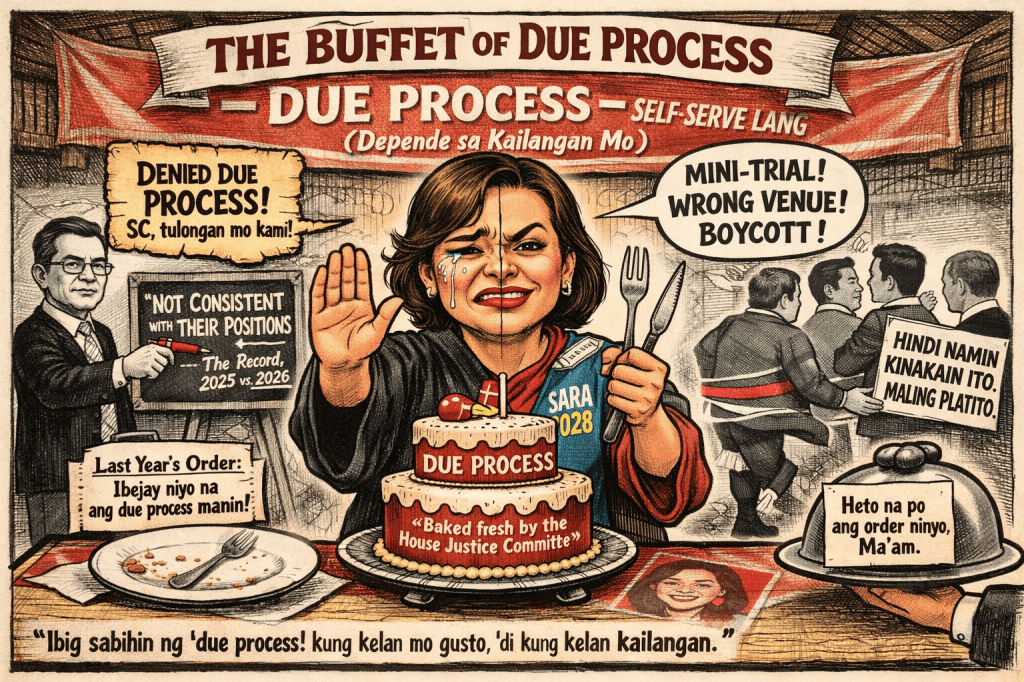
From “Denied Due Process” to “Too Much Process”: The VP’s Stunning 180-Degree Turn
By Louis ‘Barok‘ C. Biraogo — March 29, 2026
Manila, March 2026: When “denied due process” magically morphs into “too much process, wrong venue.”
The House Justice Committee dusts off its subpoena pads, slaps a “mini-trial” label on the proceedings like it’s a discount supermarket promo, and invites Vice President Sara Duterte’s camp to the party. Their response? A polite press-conference middle finger: “No jurisdiction, thank you very much—only the Senate gets to play judge.” Cue UP Law Associate Dean Paolo Tamase, dropping the mic with surgical precision: they are not consistent with their positions. You demanded due process last year when the Supreme Court was your best friend. Now that the House is handing it to you on a silver platter—witnesses, evidence, the whole evidentiary circus—you suddenly discover it’s a “trial” and you’re allergic to the venue.
Welcome to the rot, folks. This isn’t law. This is dynastic lawfare, Philippine edition—where due process is a tactical nuke you deploy only when it suits the 2028 presidential timetable. Let’s eviscerate this spectacle with the cold scalpel it deserves.
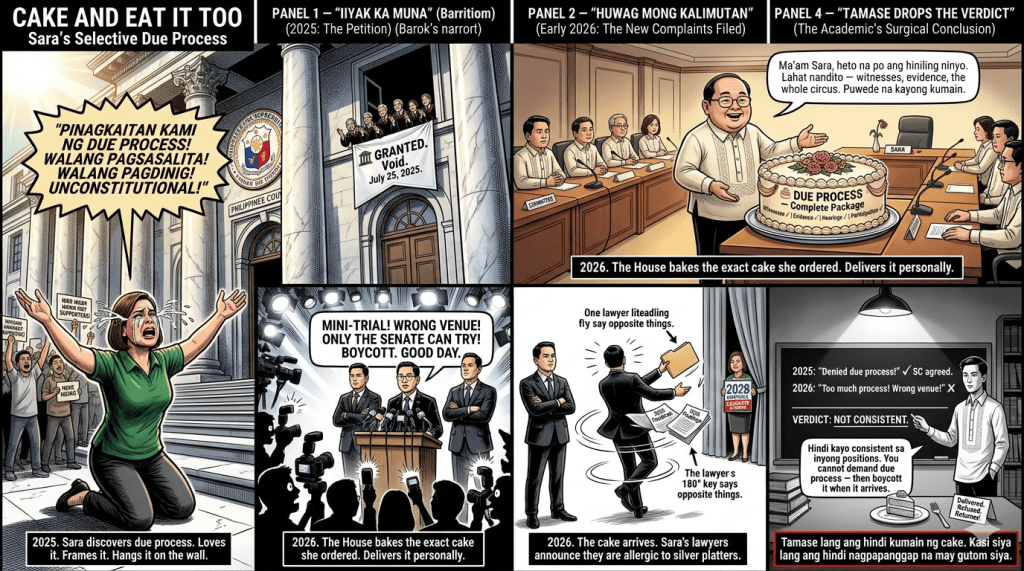
The Players: Tamase’s Truth Bomb vs. Sara’s Selective Due Process
First, Paolo Tamase. Credit where it’s due: the man has the intellectual honesty of a tenured professor who hasn’t sold his soul to any camp yet. He’s not grandstanding; he’s just reading the room—and the record. Sara’s 2025 petition to the Supreme Court screamed denial of due process—no chance to be heard, no proper deliberation, the works. SC obliged unanimously (July 25, 2025, MR denied January 28, 2026), voiding the articles for violating the one-year bar (Art. XI, Section 3(5)) and Article III fairness. Fast-forward to fresh complaints post-February 6, 2026: House invites participation in exactly the “extensive hearings” every prior impeachment (Corona, Sereno) has featured. Sara’s lawyers? Boycott city. “Mini-trial” is Senate turf only, they sniff. Tamase’s verdict: you can’t have your cake and eat it too. Spot on. He’s the rare academic who calls procedural hypocrisy by its name without needing a Malacañang grant to do it.
Now, Sara Duterte and her legal camp—Atty. Michael Poa and company. This is peak “zealous advocacy” devolving into gamesmanship. Last year: We were deprived! Due process or death! This year: Too much process! Wrong forum! The inconsistency isn’t subtle; it’s neon-lit. Their jurisdictional objection—House can initiate (Art. XI, Sec. 3(2)) but never “try”—sounds constitutional until you remember Gutierrez v. House Committee on Justice (2011) and decades of House precedent. The lower chamber has always run evidentiary marathons to decide probable cause. “Mini-trial” is just layman’s shorthand for what the rules have always allowed. Refusing to show up doesn’t scream principled stand; it screams delay until the political winds shift. The confidential funds scandal—₱612.5 million in OVP/DepEd ghost expenses, cash envelopes, fabricated receipts—won’t vanish because you skip the hearing. It festers.
Motivations? Crystal. Sara’s camp wants to frame this as Marcos vendetta (South China Sea, drug war ghosts, Romualdez power plays). Boycott preserves the “victim” narrative for the base. It also buys time—2028 is the prize, and a full Senate trial is unpredictable even with allies. Classic dynastic playbook: weaponize procedure to outlast accountability.
The Meta-Game: Forum Control, 2028 Calculus, and the Legitimacy Heist
This isn’t about evidence; it’s about who owns the arena. House controls initiation and investigation—broad discretion per Francisco v. House of Representatives (2003), which nailed down “initiation” as filing plus referral to stop harassment. Senate alone tries and decides (Art. XI, Sec. 3(6)). SC? Only for grave abuse of discretion. But the real referee is public opinion and the election clock.
Duterte camp’s strategy: force the fight into SC (again) or the press, portraying House overreach. House’s counter: build the record ex parte, refer to plenary, keep the optics of “giving her every chance.” Winner? The side that controls the timeline before 2028. Delay favors the frontrunner who’d rather campaign than answer for confidential funds. Legitimacy? Whoever convinces the public this is rule-of-law theater, not power theater.
The For & Against Gauntlet: Inconsistency, Delay, Jurisdiction—Barok’s Brutal Verdict
Inconsistency (Tamase’s core charge):
- For: SC explicitly held due process applies “during all stages” (2025 ruling). Demanding it, then rejecting the exact remedy granted? That’s not advocacy; that’s selective amnesia. Gutierrez and House rules affirm the committee’s role.
- Against: Context differs—prior complaints were void ab initio; this is a fresh post-bar filing. They’re not rejecting “hearing”; they’re rejecting House turning gatekeeping into de facto trial.
- My verdict: Tamase wins. Legally sound? The inconsistency is glaring and manipulative. You don’t get to cherry-pick due process like it’s a buffet.
Delay Tactics:
- For: Boycott + presser + hinted SC petition = classic attrition. Pattern matches high-stakes impeachments where procedure becomes the weapon. 2028 calculus is obvious.
- Against: Jurisdiction is non-waivable; challenging it is defensive lawyering 101.
- Verdict: Delay wins. Politically manipulative as hell. Rights aren’t infinite shields against scrutiny.
Jurisdiction (“Mini-Trial” Overreach):
- For Duterte: Art. XI, Sec. 3(6) is clear—Senate tries. House is stretching into adversarial litigation.
- For House: Precedent (Corona, Sereno, Gutierrez) shows extensive evidentiary hearings are standard at committee stage to establish probable cause. “Mini-trial” is descriptive, not jurisdictional.
- Verdict: House’s position is more legally sound. Francisco and Gutierrez give the chamber wide latitude in its investigatory phase. The boycott is theater.
Scenarios & Projections: Duterte’s Escape Routes and the Institutional Rot Ahead
Duterte Camp Options:
- Full boycott → House goes ex parte, builds damning record anyway. SC petition risks another loss if Court sees no grave abuse.
- Selective participation (written only) → Preserves objections but looks weak.
- Full engagement → Risks exposing funds mess; kills victim narrative.
Likely: Escalate to SC for TRO, drag it out.
House Options:
- Proceed ex parte, subpoena witnesses, and refer to plenary.
- Soften language, avoid “trial” talk.
- Accelerate for political points.
Likely: Grind forward; optics of fairness play better than looking vindictive.
Resolutions & Fallout:
- House impeaches → Senate trial (acquittal probable; alliances hold). Institutional trust erodes further.
- SC intervenes again → Judicialization complete; Francisco warned against this.
- Dismissal at House Level: Sara walks free, setting a dangerous precedent for endless procedural dodges and forum-shopping in future impeachments.
Impacts and Implications:
- Legal: Clarifies (or further muddies) the boundaries between House investigatory powers and the Senate’s sole power to try impeachment cases.
- Political: Deepens the Marcos-Duterte rift and poisons the 2028 electoral landscape.
- Institutional: Turns the impeachment process into just another dynastic dodge rather than a genuine tool for accountability.
- Normative: Creates dangerous precedent where impeachable officials can endlessly game the Constitution—while the public foots the bill for the entire spectacle.
Legal Grounding: Black-Letter Law vs. Dynastic Sophistry
Anchor this in black letter: 1987 Constitution of the Republic of the Philippines, Art. XI, Secs. 2-3 (impeachable offenses, House exclusive initiation, Senate sole trial power, one-year bar). Francisco v. House of Representatives (2003): Initiation = filing + referral; bar prevents harassment. Gutierrez (2011): House has procedural discretion; judicial review only for grave abuse. 2025-2026 SC rulings: Due process applies at every stage—but that cuts both ways. You can’t demand it then boycott it. Code of Professional Responsibility and Accountability (CPRA) (Canon 10—candor; Canon 12—no delays; Canon 1—uphold Constitution): Zealous advocacy stops at bad-faith obstruction. This smells like the latter.
The Call to Principle: Rule of Law Over Dynastic Kabuki—Or the Rot Wins
Rule of law is not a suggestion. It is the only firewall between dynastic ambition and public service. When impeachable officers treat due process as a toggle switch—on when convenient, off when dangerous—the entire accountability machinery becomes a joke. Sara’s camp isn’t defending the Constitution; they’re defending a narrative that lets them run for 2028 unbloodied. The House isn’t always pure either—political vendettas dressed as oversight are just as corrosive. Supremacy of law over expediency. Genuine pro-people governance over legal sophistry and procedural gamesmanship. Dynasties don’t get to rewrite the rules because the polls look good.
Actionable Recommendations: How to Kill This Constitutional Circus Before It Kills Us
- House Leadership: Proceed with maximum transparency. No grandstanding subpoenas without substance. Let the evidence speak—ghost funds don’t vanish in a boycott. Refer promptly; let the Senate own the trial.
- Supreme Court: Exercise restraint. Intervene only for clear grave abuse—not every procedural whine. Stop turning impeachment into a judicial sandbox; Francisco drew that line for a reason.
- Legal Profession (including Tamase’s colleagues): Enforce CPRA with teeth. Call out forum-shopping and selective due process. The bar’s credibility dies when lawyers treat the Constitution like a get-out-of-accountability card.
- Voting Public: Wake up. Stop rewarding dynastic theater with votes. Demand substance over spectacle. In 2028, remember who treated impeachment as a delay tactic instead of an opportunity for truth. Loyalty to clan is not patriotism. Accountability is.
This scandal isn’t about Sara Duterte alone. It’s about whether the 1987 Constitution survives as parchment or principle. Right now, it’s looking awfully fragile. The cake is stale, the players are inconsistent, and the public is the one left holding the bill.
Barok has spoken. The rot continues—unless we stop pretending it’s normal.
Key Citations
A. Legal & Official Sources
- The 1987 Constitution of the Republic of the Philippines. Official Gazette of the Republic of the Philippines, 1987.
- Francisco v. House of Representatives. G.R. No. 160261, Supreme Court of the Philippines, 10 Nov. 2003, The LawPhil Project.
- Gutierrez v. House of Representatives Committee on Justice. G.R. No. 193459, Supreme Court of the Philippines, 15 Feb. 2011, The LawPhil Project.
- Duterte v. House of Representatives. G.R. No. 278353, Supreme Court of the Philippines, 25 July 2025, LawPhil.
- Philippines, Supreme Court. Code of Professional Responsibility and Accountability. Administrative Matter No. 22-09-01-SC, 11 Apr. 2023.
B. News Reports
- “Forthwith” to Farce: How the Senate is Killing Impeachment—And Why Enrile’s Right (Even If You Can’t Trust Him)
- “HINDI AKO NAG-RESIGN!”

- “I’m calling you from my new Globe SIM. Send load!”

- “Mahiya Naman Kayo!” Marcos’ Anti-Corruption Vow Faces a Flood of Doubt

- “Meow, I’m calling you from my new Globe SIM!”

- “No Special Jail for Crooks!” Boying Remulla Slams VIP Perks for Flood Scammers

- “PLUNDER IS OVERRATED”? TRY AGAIN — IT’S A CALCULATED KILL SHOT

- “Several Lifetimes,” Said Fajardo — Translation: “I’m Not Spending Even One More Day on This Circus”

- “Shimenet”: The Term That Broke the Internet and the Budget
- “We Did Not Yield”: Marcos’s Stand and the Soul of Filipino Sovereignty

- “We Gather Light to Scatter”: A Tribute to Edgardo Bautista Espiritu

- $150M for Kaufman to Spin a Sinking Narrative





 KWEBA ni BAROK
Leave a comment