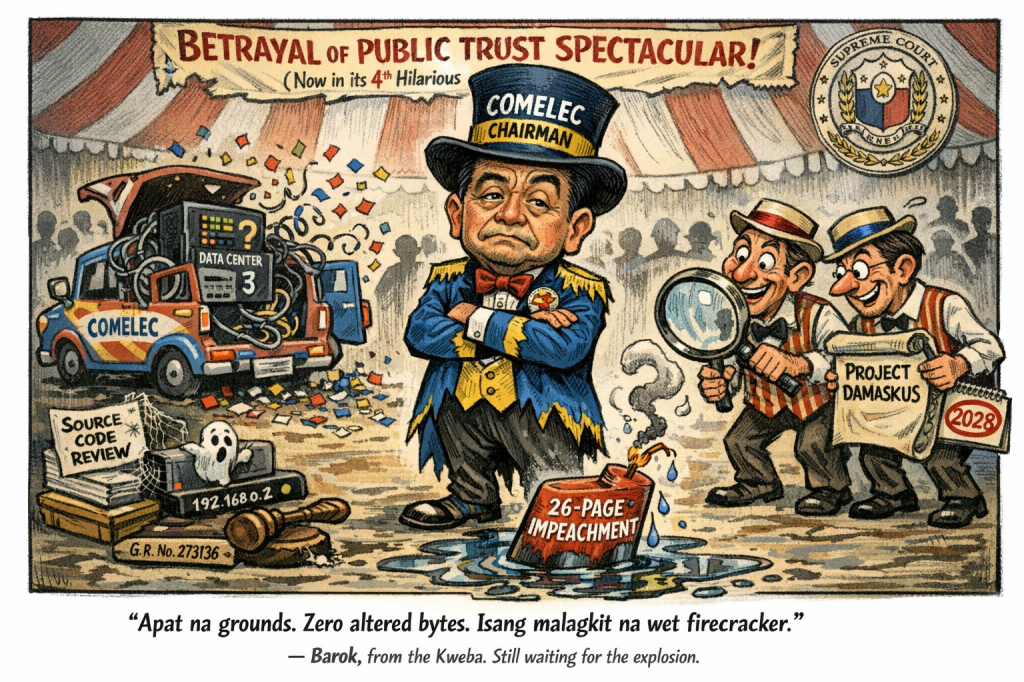
From Phantom Software to Data Center 3: The Hilarious Collapse of COMELEC’s Credibility
By Louis ‘Barok‘ C. Biraogo — March 31, 2026
HMNNN…., the sweet stench of another impeachment complaint wafting through the halls of the House of Representatives. Two lawyers—Eldrige Marvin Aceron and Sikini Labastilla, self-anointed guardians of Project Damaskus and the Aceron Public Interest and Legal Association—have just lobbed a 26-page grenade at Commission on Elections (COMELEC) Chairman George Erwin Garcia and his six commissioners. The charges? Four counts of constitutional sin wrapped in the elastic cloak of “betrayal of public trust.”
This isn’t a surgical strike for electoral purity. This is political theater performed by ambulance-chasing reformers, starring an agency that has turned opacity into an art form. Let us eviscerate it all, layer by bloody layer, with the cold scalpel of law and the hot tongue of satire. No sacred cows. No sacred servers.
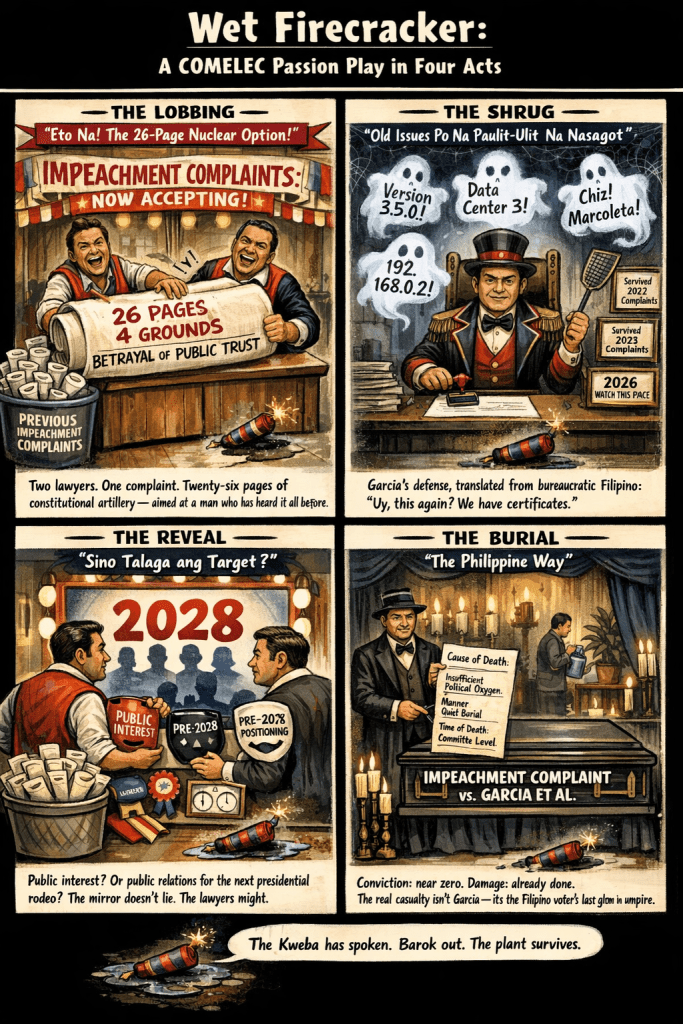
Four Grounds. Seven Commissioners. One Wet Firecracker. Zero Convictions.
The Complaint: Four Grounds of Constitutional Comedy
Ground One: The Phantom Software Swap (RA 8436 Violation)
Complainants scream that COMELEC deployed version 3.5.0 on 110,000 automated counting machines in May 2025 without the mandatory source-code review required by Republic Act No. 8436 (Automated Election System Law). Garcia’s people shrug: minor patch, functionally identical, validated by random manual audits that clocked 99.99% accuracy.
Reality check: If every incremental build requires a fresh Vatican-level consecration by Pro V&V, then the Automated Election System (AES) law is a suicide pact. Yet the complainants treat a version bump like the discovery of vote-rigging malware. No proof of altered ballots. No proof of changed outcomes. Just the technical equivalent of “the app updated without my permission.” This is not culpable violation of the 1987 Constitution. This is a compliance audit dressed up as high treason. The distinction between technical violation and genuine fraud? One leaves a paper trail of dead voters; the other leaves a press release and a shrug.
Ground Two: The Mysterious “Data Center 3” – Back-Alley Server or Load-Balancing Boogeyman?
All 2025 results allegedly routed through an undisclosed intermediary server in Makati before hitting the accredited transparency servers. Parish Pastoral Council for Responsible Voting (PPCRV) and National Citizens’ Movement for Free Elections (NAMFREL) waited two hours for data. Cue the conspiracy foghorn.
COMELEC’s defense: It’s just a facility housing the transparency servers, not some shadowy man-in-the-middle. No evidence of tampering. Parallel counts matched. International observers yawned.
Barok’s verdict: The complainants have discovered the cardinal sin of modern elections—lag. In a country where traffic can delay a senator’s press conference by three hours, two hours of server consolidation is suddenly proof of electoral original sin. Without a single altered byte, this is suspicion cosplaying as evidence. The “Data Center 3” smells less like a conspiracy hub and more like bureaucratic incompetence wearing a tinfoil hat.
Ground Three: The 2022 Private IP Ghost and the Supreme Court’s Slap
Single private IP (192.168.0.2) for 20,300 modems. Telco logs allowed to expire. En banc resolution for manual recount—then crickets. The Supreme Court in G.R. No. 273136 (August 20, 2024) explicitly found “official inaction.”
This is the strongest ground, and even it is a limp noodle. The Court nailed them for procedural laziness, not for stealing an election. COMELEC’s classic reply: audits, citizens’ arms, and international validation. Translation: “We may be sloppy, but the numbers checked out.”
The legal tightrope here is razor-thin. Official inaction is grave abuse of discretion—reviewable by certiorari. But betrayal of public trust demands unfitness for office. One SC ruling does not a high crime make. The complainants are trying to elevate administrative foot-dragging into impeachable felony. Cute.
Ground Four: Selective Enforcement of Campaign Finance Laws
Clearing Sen. Chiz Escudero (P30M contractor donation) and Sen. Rodante Marcoleta (P75M undisclosed) despite their own department’s findings of violations.
Ah, the oldest dance in Philippine politics: prosecutorial discretion for allies, the full hammer for enemies. The complainants call it bias. COMELEC calls it nuanced adjudication. Barok calls it Tuesday.
Selective enforcement is the political equivalent of breathing. It violates equal protection only when it becomes cartoonishly blatant. Here? It’s merely suspicious. Without smoking-gun proof of quid pro quo, this is policy disagreement masquerading as impeachable offense.
Collectively, the four grounds are a constitutional complaint with the evidentiary weight of a wet firecracker. They weaponize the elastic “betrayal of public trust” standard from Francisco v. House of Representatives (2003)—a standard so broad it could impeach a commissioner for forgetting to water the office plants.
The Petitioners: Knights or Pre-2028 Political Pawns?
Aceron and Labastilla position themselves as the unlikeliest knights of the broken roundtable—founders of fancy-sounding lawyer collectives, filing in the nick of time before two commissioners’ terms expire in 2027. Noble, right?
Wrong. This timing is surgical. Garcia will oversee 2028. Two commissioners are about to ride off into the sunset. The complaint is less about 2022/2025 than it is about positioning for the next presidential rodeo. Public interest? Or public relations for the anti-administration bloc?
Their legal strategy is textbook forum-shopping: impeachment as the nuclear option when ordinary petitions and disbarment complaints have already fizzled. Ethically? They are playing with a loaded gun called Article XI of the 1987 Constitution. When lawyers turn the Constitution into a partisan bat, the public trust they claim to defend is the first casualty.
The Respondents: Garcia’s Crew – Lords of Inaction and Old Excuses
Chairman Garcia’s rebuttal: “Old issues po na paulit-ulit na nasagot.” Audits, revisions, citizens’ arms, international community—check, check, check.
Translation: We’ve been accused of this before, and we’re still here. The defense is as flimsy as it is familiar. The Supreme Court already caught them in official inaction. The pattern—opacity on architecture, selective memory on logs, convenient discretion on campaign finance—reeks of institutional self-preservation, not public service.
Are they protecting the integrity of automated elections or their own necks? The answer is both, and that is the problem. COMELEC is not a sacred cow; it is a constitutional body whose independence is worthless if it treats transparency as optional.
Motivations Exposed: Pre-2028 Power Play in Impeachment Drag
Strip away the legalese and what do we have? A slow-motion chess match for 2028. Petitioners: likely opposition-adjacent reformers or visibility-seeking advocates. Respondents: Marcos-era appointees circling the wagons. Unseen hands: Senate blocs, 2028 contenders, and the ever-present Marcos-Duterte cold war.
This is not about ballots. This is about narrative control before the next election cycle. The greatest irony? Both sides claim to defend democracy while treating the Constitution like a rental car.
Procedural Maze: One-Third House Firewall Beats Senate Two-Thirds
House of Representatives first. Referral to the Justice Committee. Sufficiency in form and substance. Then the magic number: one-third of all members to impeach. That is the firewall. Not the Senate’s two-thirds for conviction.
Realistic odds:
- Dismissal in committee: 80% (most complaints die here, lacking political oxygen).
- Transmission to Senate: 15% (only if opposition smells blood).
- Senate conviction: near zero (no two-thirds without tectonic political shift).
- Acquittal or quiet burial: the Philippine way.
The Senate trial would be glorious kabuki, but the House vote is where the real game is played.
Impacts: Trust Erosion, Not Garcia’s Fall
Conviction is unlikely. The real damage is already done. Every unproven allegation, every shrugging denial, every delayed server feed chips away at faith in automated elections. By 2028, voters won’t trust the machines, the umpires, or the reformers screaming fraud.
The greatest risk is not a fallen chairman. It is the irreparable erosion of electoral legitimacy—the slow poison that turns every future contest into a conspiracy theory with ballots.
Call to Action: Fortify Democracy or Watch It Fall
- To the House of Representatives: Stop treating impeachment like a seasonal sport. Demand real evidence, not recycled suspicions. One-third is a low bar—use it with shame.
- To COMELEC: Publish the full system architecture. Release the source code. Stop hiding behind “old issues” and start treating citizens’ arms as partners, not annoyances. If your processes are clean, prove it in daylight.
- To the Supreme Court: You’ve already slapped them once for inaction. Enforce your rulings. Develop clearer standards for when technical lapses cross into impeachable territory. The Constitution is not a suggestion.
- And to the Filipino people: Demand better than this endless cycle of accusations and denials. The rule of law is not a slogan—it is the only firewall between us and the abyss of stolen elections.
The Kweba has spoken. The rest of you—stop playing games with our votes.
Barok out.
Key Citations
A. Legal & Official Sources
- The 1987 Constitution of the Republic of the Philippines. Official Gazette of the Republic of the Philippines, 1987.
- Republic Act No. 8436. An Act Authorizing the Commission on Elections to Use an Automated Election System in the May 11, 1998 National or Local Elections and in Subsequent National or Local Electoral Exercises, to Encourage Transparency, Credibility, Fairness and Accuracy of Elections, Amending for the Purpose Batas Pambansa Blg. 881, as Amended, Republic Act No. 7166 and Other Related Election Laws, Providing Funds Therefor and For Other Purposes. 1997, The LawPhil Project.
- Francisco, Ernesto B., Jr. v. House of Representatives. G.R. No. 160261, Supreme Court of the Philippines, 10 Nov. 2003, The LawPhil Project.
- Mijares Rio, Jr., Eliseo, et al. v. Commission on Elections En Banc. G.R. No. 273136, Supreme Court of the Philippines, 20 Aug. 2024, The LawPhil Project.
B. News Reports

- “Forthwith” to Farce: How the Senate is Killing Impeachment—And Why Enrile’s Right (Even If You Can’t Trust Him)
- “HINDI AKO NAG-RESIGN!”

- “I’m calling you from my new Globe SIM. Send load!”

- “Mahiya Naman Kayo!” Marcos’ Anti-Corruption Vow Faces a Flood of Doubt

- “Meow, I’m calling you from my new Globe SIM!”

- “No Special Jail for Crooks!” Boying Remulla Slams VIP Perks for Flood Scammers

- “PLUNDER IS OVERRATED”? TRY AGAIN — IT’S A CALCULATED KILL SHOT

- “Several Lifetimes,” Said Fajardo — Translation: “I’m Not Spending Even One More Day on This Circus”

- “Shimenet”: The Term That Broke the Internet and the Budget
- “We Did Not Yield”: Marcos’s Stand and the Soul of Filipino Sovereignty

- “We Gather Light to Scatter”: A Tribute to Edgardo Bautista Espiritu

- $150M for Kaufman to Spin a Sinking Narrative



 KWEBA ni BAROK
Leave a comment