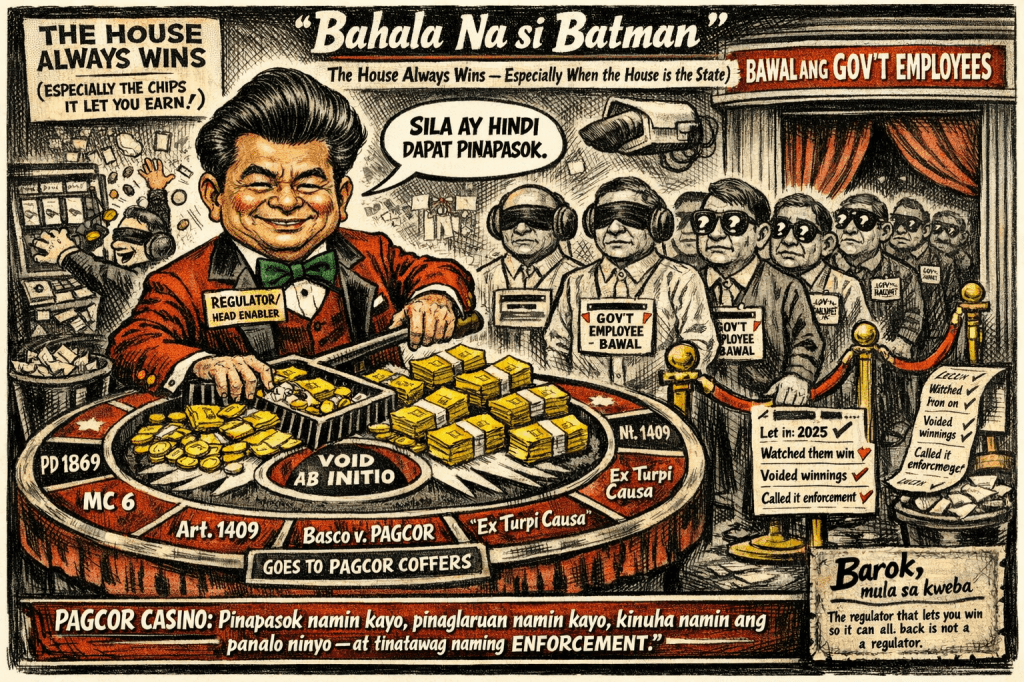
PAGCOR Lets Them In, Watches Them Win, Then Calls It All “Illegal”
By Louis “Barok” C. Biraogo — April 1, 2026
HOW perfectly absurd, the exquisite, face-palming poetry of Philippine governance. The Philippine Amusement and Gaming Corporation (PAGCOR)—our very own state-run casino monopoly, born under Presidential Decree No. 1869 (PD 1869) to “minimize, if not totally eradicate, the evils, malpractices and corruptions” of unregulated gambling—has just voided P310 million in winnings raked in by government officials and local government unit (LGU) personnel throughout 2025. PAGCOR Chair Alejandro Tengco, fresh from signing a Department of Justice (DOJ) data-sharing pact to keep bureaucrats out of the gaming floor, now crows that these public servants “should not have been allowed entry.”
Translation: We let them in, watched them play, then pocketed their chips like a casino bouncer with a selective memory.
This isn’t enforcement. This is the State tripping over its own regulatory dick and calling it a moral victory.
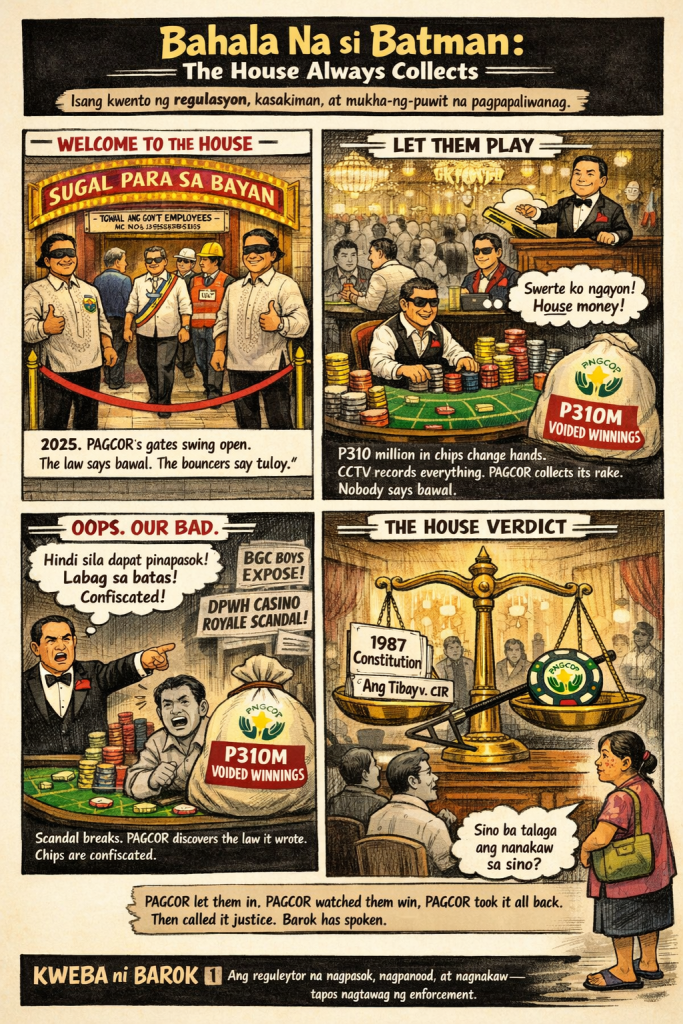
PAGCOR’s Self-Made Trap: The Regulator That Can’t Regulate
Here’s the delicious paradox that PAGCOR refuses to confront: the same government entity empowered to centralize and sanitize gambling is now confiscating winnings from the very officials its own gatekeepers waved through. PD 1869 and Memorandum Circular No. 6, Series of 2016 (MC No. 6) scream that government employees are banned from casinos. Yet hundreds allegedly breezed past ID checks, CCTV, and “secondary screening.”
PAGCOR’s response? “Oops, our bad—hand over the cash.”
Is this a crackdown or a frantic cover-up for years of regulatory failure? The State created the playground, installed the velvet ropes, then acts shocked when its own employees treat the casino like a government canteen. PAGCOR isn’t cleaning house; it’s mopping up the mess it helped spill while keeping the revenue spigot open for everyone else.
Legal Fiction Exposed: “Void Ab Initio” as PAGCOR’s Confiscation Scam
PAGCOR leans on the hoary doctrine that “no right arises from an illegal act”—echoing Article 1409 of the Civil Code of the Philippines (Republic Act No. 386) and the Latin chestnut ex turpi causa non oritur actio. Their winnings, they claim, are “void ab initio” because entry itself was prohibited. Cute.
But here’s the rub: PD 1869 contains zero explicit authority for outright forfeiture of winnings. Section 14(4)(a) bans certain officials from playing. MC 6 brands their presence “conduct prejudicial to the service.” Nowhere does the law say PAGCOR may unilaterally seize cash like some administrative Robin Hood. This is regulatory improvisation dressed up as divine right.
The officials’ counter? “We won fair and square—due process, please.” They invoke Article III, Section 1 of the 1987 Constitution and the ultra vires doctrine: PAGCOR exceeded its charter by inventing a forfeiture power that Congress never granted.
They’re half-right. Gambling in a PAGCOR casino isn’t criminal for civilians; it’s a regulated privilege. Turning an administrative prohibition into automatic property extinction is exactly the kind of shortcut that makes constitutional lawyers reach for their blood-pressure meds.
The core question that should keep the Supreme Court up at night: Does a mere regulatory ban automatically extinguish property rights, or is this an unconstitutional shortcut to forfeiture? PAGCOR wants you to believe the former. The Constitution demands the latter.
Kickback Laundromat Unmasked: Who’s Really Playing Who?
Let’s drop the sanctimonious theater and talk motives.
- PAGCOR/Tengco: Is this a genuine anti-corruption crusade, or a desperate PR pivot after the DPWH “Casino Royale” scandal and FATF grey-list trauma? Voided winnings conveniently flow back into state coffers while the agency touts inter-agency MOAs. Revenue stream meets virtue signal—beautiful.
- The Officials: Hapless gamblers or professional launderers? The timing with the “BGC Boys” exposé—DPWH engineers allegedly burning ₱950 million in casino chips from anomalous flood-control kickbacks—is no coincidence. Cash in, minimal play, “winnings” out. Clean as a whistle… or as dirty as a POGO hub. Public office as private ATM, with PAGCOR as unwitting (or complicit) teller.
- DOJ and the rest: Selective cooperation at its finest. Data-sharing pacts sound noble until you notice the high-ranking fish swimming free while mid-level sharks get netted.
- Selective Enforcement: The net always catches the minnows. Hundreds of officials? Yet the “two secretaries” Tengco mentioned remain nameless. How convenient.
- Internal Collusion: Let’s be real—how do scores of government IDs waltz past casino security, floor managers, and PAGCOR’s own watchdogs without a wink and a nod? Either PAGCOR’s screening is comically incompetent, or someone higher up was greasing the wheels. Pick your poison.
Constitutional Showdown: Due Process Crushes Police Power Overreach
PD 1869, MC 6, Republic Act No. 3019 (Anti-Graft and Corrupt Practices Act), Republic Act No. 6713 (The Code of Conduct and Ethical Standards for Public Officials and Employees), and the Anti-Money Laundering Act (AMLA) (Republic Act No. 9160) paint a clear picture: public servants must not gamble; casinos must sniff out dirty money. But enforcement cannot swallow the Constitution.
Basco v. PAGCOR (1991) upheld the State’s police power to regulate gambling for revenue and public welfare. Fine. It does not authorize summary confiscation without process.
Chavez v. PCGG slams the door on arbitrary state seizures. Property rights aren’t optional.
Ang Tibay v. CIR demands administrative due process—notice, hearing, evidence. PAGCOR’s “we confiscated because you shouldn’t have been there” is the administrative equivalent of “because I said so.”
This isn’t police power. This is police overreach.
Courtroom Gamble: PAGCOR’s Big Bet vs. Officials’ Hail Mary
PAGCOR’s Gamble: Frame confiscation as a “regulatory sanction” flowing automatically from illegal entry. Weakness? Zero statutory forfeiture clause. They’ll scream public policy until the Supreme Court reminds them that even police power has limits.
The Officials’ Counter-Suit: Civil recovery action plus constitutional challenge. They’ll wave due process and ultra vires. Their Achilles’ heel? In pari delicto—they knew the ban. Courts hate rewarding rule-breakers.
Most Likely Outcome: The classic Philippine judicial split-the-baby. Confiscation gets struck down for lack of due process (no explicit authority, no hearing). Officials still eat administrative sanctions—suspension, dismissal, maybe RA 3019 if kickbacks surface. PAGCOR keeps its “deterrent” policy but must now play by the rules. Everyone claims partial victory and the public loses.
Systemic Rot Exposed: This Scandal Is No Accident
This isn’t an isolated oopsie. It’s a feature, not a bug, of a system where public office is a revenue stream, casinos are laundromats, and accountability is for the little guy. From POGOs to DPWH flood-control ghosts to this latest “Casino Royale,” the pattern is identical: public funds → kickbacks → chips → “winnings” → rinse, repeat.
PAGCOR’s P310M voiding is merely the State admitting its own institutions are rotten—then confiscating the evidence instead of prosecuting the rot.
Reckoning Time: Investigations, Transparency, or Just Another Cover-Up?
Quiet settlements? A legislative patch granting PAGCOR explicit forfeiture powers? Or—miracle of miracles—actual justice?
Impacts are clear: rule of law takes another hit, public trust evaporates, and corruption simply migrates underground.
My unequivocal demand:
- Immediate Investigation by the Ombudsman, AMLC, and Congress into every single name behind the P310M—no rank too high.
- Full Transparency: Publish the full list. No more “two secretaries” whispers.
- Accountability & Prosecution: RA 3019, AMLA, and administrative charges—zero mercy.
- Reforms: Amend PD 1869 to spell out penalties and due process. Mandate real-time biometric verification. Strengthen casino AML controls.
- The Supremacy of the Rule of Law: No more administrative shortcuts, no more selective enforcement, no more treating public office as a private casino.
Public office is a public trust. If PAGCOR and its errant patrons can’t grasp that, then perhaps the real winnings that need voiding are the careers of everyone who turned the People’s Republic of Gambling into their personal piggy bank.
The floor is open, Mr. Tengco. The chips are down.
Barok has spoken.
Kweba ni Barok — where accountability is the only house rule that matters.
Key Citations
A. Legal & Official Sources
- The 1987 Constitution of the Republic of the Philippines. Official Gazette of the Republic of the Philippines, 1987.
- Philippines. Presidential Decree No. 1869. Official Gazette of the Republic of the Philippines, 11 July 1983.
- Philippines. Republic Act No. 386: An Act to Ordain and Institute the Civil Code of the Philippines. 1949, The LawPhil Project.
- Philippines. Republic Act No. 3019: Anti-Graft and Corrupt Practices Act. Official Gazette of the Republic of the Philippines, 1960.
- Philippines. Republic Act No. 6713: An Act Establishing a Code of Conduct and Ethical Standards for Public Officials and Employees. Official Gazette of the Republic of the Philippines, Official Gazette of the Republic of the Philippines, 1989.
- Philippines. Republic Act No. 9160: Anti-Money Laundering Act of 2001. Official Gazette of the Republic of the Philippines, 2001.
- Memorandum Circular No. 06. Enjoining All Government Officials and Employees to Strictly Observe and Comply with the Prohibition Against Going to Gambling Casinos. 20 Sept. 2016. The LawPhil Project.
- Philippines, Supreme Court. Basco v. PAGCOR. G.R. No. 91649, 14 May 1991, The LawPhil Project.
- Philippines, Supreme Court. Chavez v. PCGG. G.R. No. 130716, 9 Dec. 1998, The LawPhil Project.
- Philippines, Supreme Court. Ang Tibay v. CIR. G.R. No. L-46496, 27 Nov. 1940, The LawPhil Project.
B. News Reports

- “Forthwith” to Farce: How the Senate is Killing Impeachment—And Why Enrile’s Right (Even If You Can’t Trust Him)

- “HINDI AKO NAG-RESIGN!”

- “I’m calling you from my new Globe SIM. Send load!”

- “Mahiya Naman Kayo!” Marcos’ Anti-Corruption Vow Faces a Flood of Doubt

- “Meow, I’m calling you from my new Globe SIM!”

- “No Special Jail for Crooks!” Boying Remulla Slams VIP Perks for Flood Scammers

- “PLUNDER IS OVERRATED”? TRY AGAIN — IT’S A CALCULATED KILL SHOT

- “Several Lifetimes,” Said Fajardo — Translation: “I’m Not Spending Even One More Day on This Circus”

- “Shimenet”: The Term That Broke the Internet and the Budget

- “We Did Not Yield”: Marcos’s Stand and the Soul of Filipino Sovereignty

- “We Gather Light to Scatter”: A Tribute to Edgardo Bautista Espiritu

- $150M for Kaufman to Spin a Sinking Narrative


 KWEBA ni BAROK
Leave a comment