
While energy crises rage and flood funds vanish, Manila green-lights a munitions factory. Is this sovereign defense or a one-way ticket to someone else’s war?
By Louis ‘Barok‘ C. Biraogo — April 1, 2026
LISTEN up, mga ka-kweba.
Last week, the Pentagon dropped its latest bombshell: the Partnership for Indo-Pacific Industrial Resilience (PIPIR) is eyeing a major ammunition assembly line right here in the Philippines.
Japan, under its ultra-hawkish PM Sanae Takaichi, will supply the propulsion systems for guided weapons.
Our own Defense Secretary Gilberto Teodoro is off charming NATO brass in Europe.
And Beijing, predictably, is snarling about “conflict and the chaos of war” coming to the Asia-Pacific.
Cue the headline from Modern Diplomacy: “Philippines path to ASEAN’s Ukraine? The move toward a regional military hub.”
Rhetorically delicious. Terrifyingly sloppy.
The analogy packs a punch—tiny nation on the edge of a superpower’s red line, flooded with foreign weapons, turned into a forward base for someone else’s war.
But let’s not kid ourselves.
This isn’t Ukraine 2.0.
Ukraine had Russian tanks rolling across a land border after eight years of civil war and NATO flirtation.
We have gray-zone ramming boats, a 2016 arbitral award China ignores, and a government that can’t even build honest flood-control projects without pocketing the budget.
The real story—the one the article dances around but never quite names—is uglier and more precise: the Philippines is no longer just a logistical partner.
We are being quietly, deliberately upgraded into a frontline military-industrial node.
A war-sustaining hub.
Subic Bay isn’t a port anymore; it’s becoming the ASEAN version of a prepositioned war reserve stock.
And the Golden Triangle—Subic-Clark-Manila—is the shiny new target painted on our economic heart.
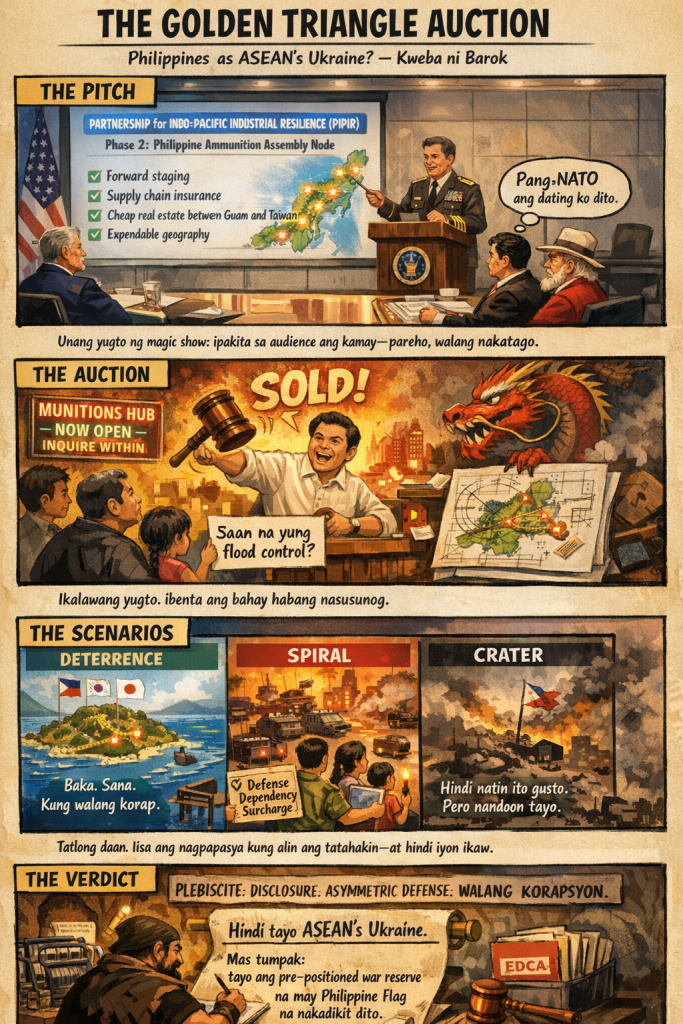
The Analogy: Warning Siren or Convenient Smoke Screen?
Let’s autopsy the “ASEAN’s Ukraine” claim with the cold scalpel it deserves.
The Warning Signs (Why the Analogy Bites)
Northern Luzon’s EDCA sites—Lal-lo Airport, Camilo Osias Naval Base—are a stone’s throw from Taiwan.
Batanes’ new Forward Operating Base (opened 2025) is practically a radar and missile porch overlooking the flashpoint.
Palawan’s Antonio Bautista and Balabac are perfect for anti-ship missiles staring down the South China Sea.
Add the Subic-Clark ammo plant, massive U.S. prepositioned stocks of vehicles, armories, and maintenance depots, and the picture is clear: we are no longer hosting exercises.
We are hosting sustainment for the next big one.
Under international targeting doctrine (the same one used in Ukraine, Gaza, and every U.S. war game), production facilities and prepositioned war stocks are high-value, high-priority targets.
A single Chinese salvo or naval blockade on the Golden Triangle and our “regional munition hub” becomes a smoking crater that also paralyzes Manila’s supply chain.
Limited air defense, civilian-adjacent bases, energy crisis, corruption scandal—everything screams vulnerability.
The article is right: we are upgrading from warehouse to war factory while our own house is on fire.
The Counter-Narrative (Why the Analogy is Alarmist Theater)
Yet the pro-alliance crowd screams “deterrence!”
Sovereign choice!
No active invasion!
Unlike Ukraine, we invited this.
EDCA is constitutional, troops are rotational, and Marcos himself shrugs: “Are we not already a target?”
Fair enough.
China’s militia swarms, water-cannon ramming, and rejection of the arbitral ruling are not imaginary.
A stronger posture can raise the cost of gray-zone coercion.
But here’s the biting truth the think-tankers at Center for a New American Security (CNAS) (the same shop that blessed Biden’s Ukraine and Gaza playbooks) don’t want you to notice: deterrence is the sales pitch.
The cargo is entrapment.
Once the ammo lines hum and the prepositioned stocks arrive, our “agency” shrinks.
We become a node in someone else’s Taiwan contingency plan.
The Mutual Defense Treaty becomes a one-way ticket.
And the moment Beijing decides the cost of a limited strike is worth sending a message, our “deterrence” becomes the spark.
Who’s Really Pulling the Strings? A Rogues’ Gallery of Motivations
Let’s stop pretending stated intentions are gospel.
The Marcos Jr. Administration:
Desperate legitimacy play dressed up as nationalism. While “ghost” flood-control projects bleed billions and an energy crisis darkens the grid, the Palace green-lights an ammunition factory. Irony so thick you could load it into a HIMARS. Corruption scandals erode public trust; a shiny new defense partnership distracts with flags and fighter jets. Teodoro’s NATO roadshow is less about Philippine security than about burnishing the dynasty’s “strongman modernizer” image while the budget for real resilience—sea denial drones, dispersed logistics, civilian bunkers—remains an afterthought.
United States & Japan:
Spare me the “rules-based order” sermon. This is about supply-chain insurance and forward staging for a Taiwan fight. CNAS didn’t invent the strategy; it merely laundered it into respectable policy papers. Japan, under Takaichi, is shedding its pacifist skin and using us as the test bed for missile tech and export markets. The U.S. wants munitions closer to the fight so it doesn’t have to ship everything from the other side of the Pacific. We are the cheap, expendable real estate between Guam and the First Island Chain. Period.
China:
Hypocrisy with Chinese characteristics. Beijing’s “chaos of war” warnings are less principled pacifism than a demand to keep its own sphere uncontested. It militarized artificial islands, ignored an international tribunal, and now lectures us about destabilization? Please. But its threats are also a mirror: every new EDCA site, every missile system, every ammo plant gives the PLA a fresh excuse to tighten the noose.
ASEAN:
Silent, self-serving hedgers. They watch Manila take the heat, secretly relieved we’re the buffer while they keep their billion-yuan trade deals intact. Partners in stability? More like spectators hoping the arena stays on our side of the ring.
Scenarios: From Stable Deterrence to Crisis Trigger
The trajectories are brutally clear.
- Best case—Stable Deterrence: We become a fortified but sane node like South Korea or Japan. China blinks, sea lanes stay open, and the ammo plant actually creates jobs instead of craters.
- Likely case—Escalatory Spiral: Arms race accelerates. China matches every deployment with more militia swarms, cyber probes, and gray-zone pressure. ASEAN fractures. We sink deeper into debt and dependency.
- Worst case—Crisis Trigger: Taiwan or Scarborough sparks it. Subic-Clark gets hit early. The “Golden Triangle” chokes. Our economy—already wheezing—takes a body blow that makes Ukraine’s blackouts look quaint. Civilians in the crosshairs. And the U.S. calibrates its response according to its own calculus, not ours.
We are not on the path to “ASEAN’s Ukraine.”
We are on the path to becoming a pre-positioned war reserve with a Philippine flag on it.
Kweba ni Barok Verdict: The Metaphor is a Distraction—the Reality is Servitude
The “ASEAN’s Ukraine” label is half-right and wholly misleading. It’s not yet a shooting gallery, but it is a deliberate transformation into someone else’s forward operating platform. The real scandal isn’t the analogy; it’s the grotesque spectacle of a nation drowning in energy blackouts and corruption scandals while its leaders auction our territory as the next great munitions hub.
My demand is simple and non-negotiable:
- A national plebiscite on any permanent foreign basing or war-production facilities. Let the people whose children will die in the crossfire decide.
- Full, unredacted public disclosure of all EDCA annexes and PIPIR agreements—now.
- Redirect defense funds toward genuine asymmetric capabilities—sea-denial drones, mobile coastal missile batteries, dispersed logistics—not land-attack toys that scream “strike me first.”
- Ruthless anti-corruption enforcement so that every peso spent on “deterrence” actually deters instead of lining pockets.
The Philippines must be a sovereign balancer, not a sacrificial frontline. Deterrence without becoming a target. Alliances without abdication. Economic resilience that survives the first missile, not collapses under it.
Because if we keep sleepwalking into this role—ghost projects at home, war factories for our “allies”—then the next Modern Diplomacy headline won’t be a question. It will be an obituary.
And the Kweba will still be here, calling the bluff.
— Barok
Key Citations
A. News Articles
- Steinbock, Dan. “Philippines Path to ASEAN’s Ukraine? The Move Toward a Regional Military Hub.” Modern Diplomacy, 30 Mar. 2026.
- Mendoza, Red, and Reuters. “US, Allies Push Ammo Production in PH.” The Manila Times, 22 Mar. 2026.
- “China Warns U.S. Against Building Ammunition Facility in Philippines.” Channel News Asia, 26 Mar. 2026.
- Punongbayan, Michael. “Philippines Eyes Defense Cooperation with NATO, EU.” Philstar, 27 Mar. 2026.
- Mendoza, John Eric. “Navy Opens New Forward Operating Base on Strategic Batanes Island.” Inquirer, 29 Aug. 2025.
B. Official Reports & Government Sources
- Vergun, David. “New EDCA Sites Named in the Philippines.” DOD News, U.S. Department of Defense, 3 Apr. 2023.
- Curtis, Lisa and Claffey, Ryan. “U.S.-Japan-Philippines Trilateral Cooperation.” Center for a New American Security, 17 Mar. 2026.
- Takenaka, Harukata. “Takaichi’s Security Agenda After the Landslide Election.” Carnegie Endowment for International Peace, 19 Mar. 2026.

- ₱75 Million Heist: Cops Gone Full Bandit

- ₱6.7-Trillion Temptation: The Great Pork Zombie Revival and the “Collegial” Vote-Buying Circus

- ₱1.9 Billion for 382 Units and a Rooftop Pool: Poverty Solved, Next Problem Please

- ₱1.35 Trillion for Education: Bigger Budget, Same Old Thieves’ Banquet

- ₱1 Billion Congressional Seat? Sorry, Sold Out Na Raw — Si Bello Raw Ang Hindi Bumili

- “We Will Take Care of It”: Bersamin’s P52-Billion Love Letter to Corruption

- “Skewed Narrative”? More Like Skewered Taxpayers!

- “Scared to Sign Vouchers” Is Now Official GDP Policy – Welcome to the Philippines’ Permanent Paralysis Economy
- “Robbed by Restitution?” Curlee Discaya’s Tears Over Returning What He Never Earned

- “No Pressure” Luistro? The House Pork Bazaar Exposed
- “My Brother the President Is a Junkie”: A Marcos Family Reunion Special

- “Mapipilitan Akong Gawing Zero”: The Day Senator Rodante Marcoleta Confessed to Perjury on National Television and Thought We’d Clap for the Creativity




 KWEBA ni BAROK
Leave a comment