
Strategic Hedging or Desperate Survival? PH Asks Iran Not to Sink Its Oil Tankers
By Louis ‘Barok‘ C. Biraogo — April 2, 2026
MGA ka-kweba, let’s call this what it is: the Republic of the Philippines, formal treaty ally of the United States since 1951, has just dispatched Foreign Secretary Maria Theresa Lazaro and Energy Secretary Sharon Garin to the Iranian Ambassador’s office to plead, hat in hand, that Tehran please, pretty please, declare us a “nonhostile” nation so our oil tankers don’t get turned into floating piñatas in the Strait of Hormuz.
Claire Castro, the Palace’s designated spinner-in-chief, described the meeting as “exceptionally warm and open.”
Of course it was.
Nothing warms the heart of a regime under aerial bombardment like a U.S. ally showing up to ask for a special exemption from the very blockade Tehran imposed in retaliation for the U.S.-Israeli strikes that began February 28.
Iran’s Ambassador Yousef Esmaeil Zadeh reportedly “reaffirmed strong willingness to assist” and revealed that Tehran had been “awaiting our outreach.”
Translation: they smelled desperation from across the Indian Ocean and were delighted to exploit it.
This is not diplomacy.
This is strategic prostitution dressed up in diplomatic language.
And every actor in this farce — Marcos, Lazaro, Garin, Iran, the United States, and Israel — deserves the evisceration they have so richly earned.
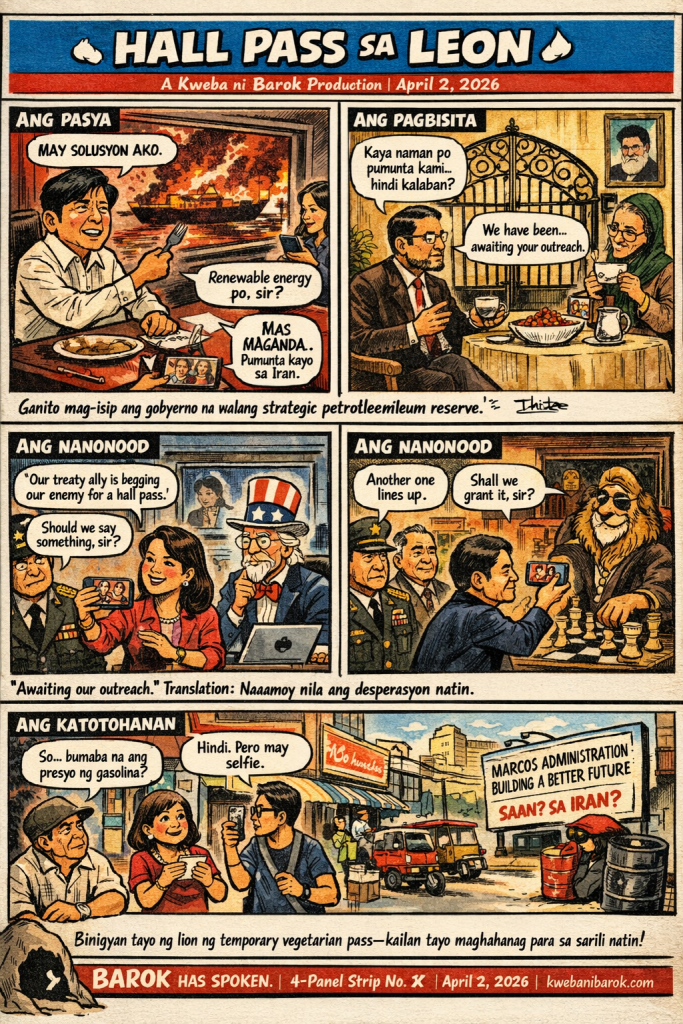
The Core Absurdity: A U.S. Ally Begging Its Ally’s Enemy for a Hall Pass
Here is the central clown show: the Philippines hosts U.S. troops under the Enhanced Defense Cooperation Agreement, benefits from the Mutual Defense Treaty, and joined the chorus (however meekly) when Washington and Jerusalem decided to turn Iran into a smoking crater.
Yet the moment the Strait of Hormuz — which carries 20 percent of the world’s oil — gets weaponized by Tehran, Malacañang activates Executive Order 110, declares a national energy emergency, convenes the UPLIFT committee, and sends its top diplomats to beg the very adversary for safe passage.
It is the geopolitical equivalent of a toddler tugging the lion’s mane and whispering, “Mr. Lion, sir, could you please consider me a vegetarian for the next tanker or two?”
The lion, naturally, smiles and says yes — because nothing legitimizes its illegal chokehold better than former friends lining up for exemptions.
The Legal Farce: UNCLOS, Self-Defense, and the Art of Selective Blockade
Let us dissect the legal gymnastics with the contempt they deserve.
Under UNCLOS, the Strait of Hormuz qualifies for transit passage rights.
Ships are supposed to sail through without arbitrary interference.
Iran, which signed but never fully ratified the convention in its current form, now claims the right to decide who is “hostile” and who is not. This is not self-defense under Article 51 of the UN Charter; this is economic warfare with a PowerPoint presentation. Iran is not merely protecting itself — it is holding the global economy hostage to force recognition of its blockade as legitimate.
And what does the Philippines do? We tacitly accept the premise. By negotiating “nonhostile” status, we legitimize Tehran’s violation of freedom of navigation. We become complicit in the very precedent that could one day be used against us in the South China Sea. The same government that screams about UNCLOS when China harasses our fishermen is now bending the knee when Iran does the same thing to our oil supply.
Worse, we are courting secondary sanctions. Any “deepening cooperation” on energy — as Lazaro gushed on social media while posting selfies with the Iranian ambassador — risks exposing Philippine banks and companies to the U.S. sanctions machine. But hey, fuel prices are already at historic highs and reserves are reportedly scraping bottom. Who has time for legal niceties when the tricycles might stop running?
Diplomatic Hedging: The Art of Betraying Everyone Just a Little
This “multi-vector” strategy the Marcos administration loves to brag about is not sophistication — it is the foreign policy of a nation that has no spine. We want U.S. military protection when China flexes in the West Philippine Sea, but we want Iranian goodwill when the oil stops flowing. We want to be seen as a reliable ally in Washington and a pragmatic partner in Tehran. In the end, we will be trusted by neither.
Iran, for its part, is playing chess while we play patty-cake. By granting selective passage, Tehran fractures the U.S.-led coalition, normalizes its control over a global chokepoint, and buys itself diplomatic breathing room. “See?” it tells the Global South, “we’re not monsters — we just need you to stop pretending you’re on Team America when your lights are about to go out.”
And the United States? The great silent partner in this humiliation. Washington has said nothing publicly because it faces its own dilemma: crack down on Philippine hedging and risk looking like an unreliable patron, or tolerate it and watch its Asian alliance system slowly dissolve into transactional deal-making. The Biden-to-Trump transition has left a policy vacuum, and the Philippines is filling it with groveling.
Motivations Laid Bare: Self-Interest in All Its Naked Glory
Let’s stop pretending this is about “protecting our seafarers.” Filipino seafarers are cannon fodder in every conflict that touches maritime trade — that is tragic, but it is not new. This is about preventing domestic political and economic collapse. Fuel at record prices means inflation, transport paralysis, food riots, and a Marcos administration that looks as incompetent as the ones it replaced. EO 110 and the UPLIFT committee are not statesmanship; they are panic buttons.
Iran’s “willingness to assist”? Cynical theater. It gets to portray itself as the reasonable power while using the strait as leverage to break isolation.
And let us not forget the original sinners: the United States and Israel, who launched Operation Epic Fury on February 28 without a viable plan for the inevitable Hormuz retaliation. They started the fire, then acted shocked when the global oil supply went up in smoke. Now their treaty ally is forced to negotiate with the arsonist. Brilliant.
The Philippines’ Energy Non-Security: Decades of Criminal Neglect
This crisis did not begin on February 28. It began decades ago when successive Philippine governments treated energy policy like a game of musical chairs — always someone else’s problem. We remain addicted to imported fossil fuels with no strategic petroleum reserve worth the name, no serious renewable acceleration, and no diversification that matters. When the strait sneezes, we catch pneumonia. This is not geopolitics. This is self-inflicted national stupidity.
The “Options” Are a Joke — Here’s Why They’re All Terrible
The usual suspects will now trot out the usual nonsense:
- “Formal neutrality!” — Politically impossible. We have U.S. bases on our soil. Neutrality is a joke when your “neutral” territory is hosting the other side’s aircraft.
- “Full alignment with the U.S.!” — Economic suicide. Washington is not shipping us free oil. It is offering more weapons and lectures.
- The current path — begging for “nonhostile” status — is the most humiliating temporary band-aid imaginable. It solves nothing beyond next week’s tanker schedule.
The Only Logical Path Forward — Demands, Not Prayers
- Iran should grant the request. Not as a favor to the Philippines, but to prove it is not a reckless pirate state. But mark my words: every exemption it grants today buys it legitimacy for the next escalation tomorrow. Its strategy will backfire when the world decides chokepoints cannot be privatized.
- The United States should allow the arrangement — and treat it as a humiliating wake-up call. If your allies must beg your enemies for basic energy survival, maybe stop selling them only military hardware and start helping them build actual energy security.
- And to the Philippine government: stop begging and start building. Use this crisis to ram through genuine renewable programs, strategic reserves, and diversification — not another round of selfies with foreign ambassadors. Prioritize long-term sovereignty over short-term photo-ops.
This entire episode is a failure of governance. Leaders who panic instead of plan do not deserve the trust of 116 million Filipinos. The Strait of Hormuz did not break us. Decades of short-sighted, self-serving policy did.
The lion has offered us a temporary vegetarian pass. The real question is whether we will keep crawling on our bellies — or finally learn to hunt for ourselves.
Barok has spoken. The cave is open.
Key Citations
A. News Articles
- Inquirer.net. “Iran Asked to Count PH as ‘Nonhostile’ Nation.” Newsinfo.inquirer.net, 2 Apr. 2026, https://newsinfo.inquirer.net/2205481/iran-asked-to-count-ph-as-nonhostile-nation.
- Marcos, Ferdinand R., Jr. “Remarks by President Ferdinand R. Marcos Jr. at the Foreign Policy Address Hosted by the Observer Research Foundation.” Presidential Communications Office, 6 Aug. 2025.
B. Reports & Studies
- U.S. Energy Information Administration. “Amid Regional Conflict, the Strait of Hormuz Remains Critical to Global Oil Supply.” Today in Energy, 16 June 2025, https://www.eia.gov/todayinenergy/detail.php?id=65504.
C. Official Documents
- Avalon Project. “Mutual Defense Treaty Between the United States and the Republic of the Philippines; August 30, 1951.” Yale Law School, https://avalon.law.yale.edu/20th_century/phil001.asp.
- United Nations. “Chapter VII: Article 51 — Charter of the United Nations.” Repertory of Practice of the Security Council, https://legal.un.org/repertory/art51.shtml.
- United Nations. “United Nations Convention on the Law of the Sea, Part III: Straits Used for International Navigation.” https://www.un.org/depts/los/convention_agreements/texts/unclos/part3.htm.
- ₱75 Million Heist: Cops Gone Full Bandit

- ₱6.7-Trillion Temptation: The Great Pork Zombie Revival and the “Collegial” Vote-Buying Circus

- ₱1.9 Billion for 382 Units and a Rooftop Pool: Poverty Solved, Next Problem Please

- ₱1.35 Trillion for Education: Bigger Budget, Same Old Thieves’ Banquet
- ₱1 Billion Congressional Seat? Sorry, Sold Out Na Raw — Si Bello Raw Ang Hindi Bumili

- “We Will Take Care of It”: Bersamin’s P52-Billion Love Letter to Corruption

- “Skewed Narrative”? More Like Skewered Taxpayers!

- “Scared to Sign Vouchers” Is Now Official GDP Policy – Welcome to the Philippines’ Permanent Paralysis Economy
- “Robbed by Restitution?” Curlee Discaya’s Tears Over Returning What He Never Earned

- “No Pressure” Luistro? The House Pork Bazaar Exposed
- “My Brother the President Is a Junkie”: A Marcos Family Reunion Special

- “Mapipilitan Akong Gawing Zero”: The Day Senator Rodante Marcoleta Confessed to Perjury on National Television and Thought We’d Clap for the Creativity


 KWEBA ni BAROK
Leave a comment