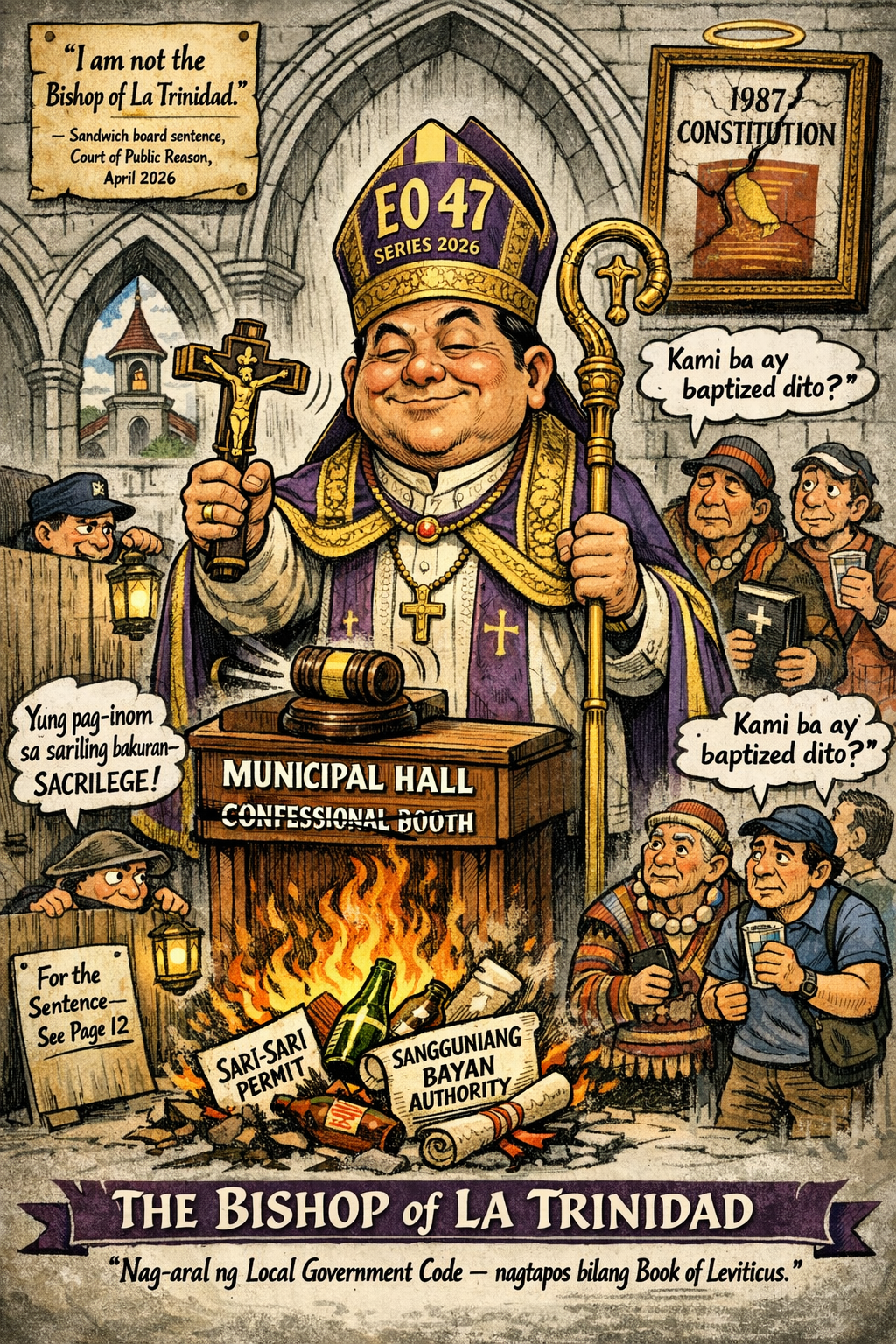
When Police Power Meets Religious Dog-Whistle: Mayor Awingan’s Textbook Violation of Church-State Separation
By Louis ‘Barok’ C Biraogo — April 3, 2026
IN THE name of the Father, the Son, and the Holy Executive Order, Mayor Roderick Awingan of La Trinidad, Benguet, has just nailed a 4-day liquor ban to the municipal cross.
Executive Order No. 47, Series of 2026, signed with the solemnity of a Pharisee counting tithes, slams shut every bar, sari-sari store, grocery, and convenience store from 11:59 p.m. Maundy Thursday (April 2, 2026) until the last second of Easter Sunday.
No sale. No serving. No delivery. No consumption — not even in the privacy of your own damn backyard if a barangay tanod decides your gate counts as “public.”
The pious preamble? To let residents and tourists “peacefully commemorate the death, resurrection and ascension of Jesus Christ” while deterring those pesky “unnecessary crimes.”
Translation: the Mayor has wrapped a secular police power in a liturgical stole, lit a candle, and called it governance. This isn’t public safety; this is moral cosplay with the coercive power of the state. The dog-whistle is so loud it could wake Lazarus. And in the court of public reason, Barok is here to prosecute.
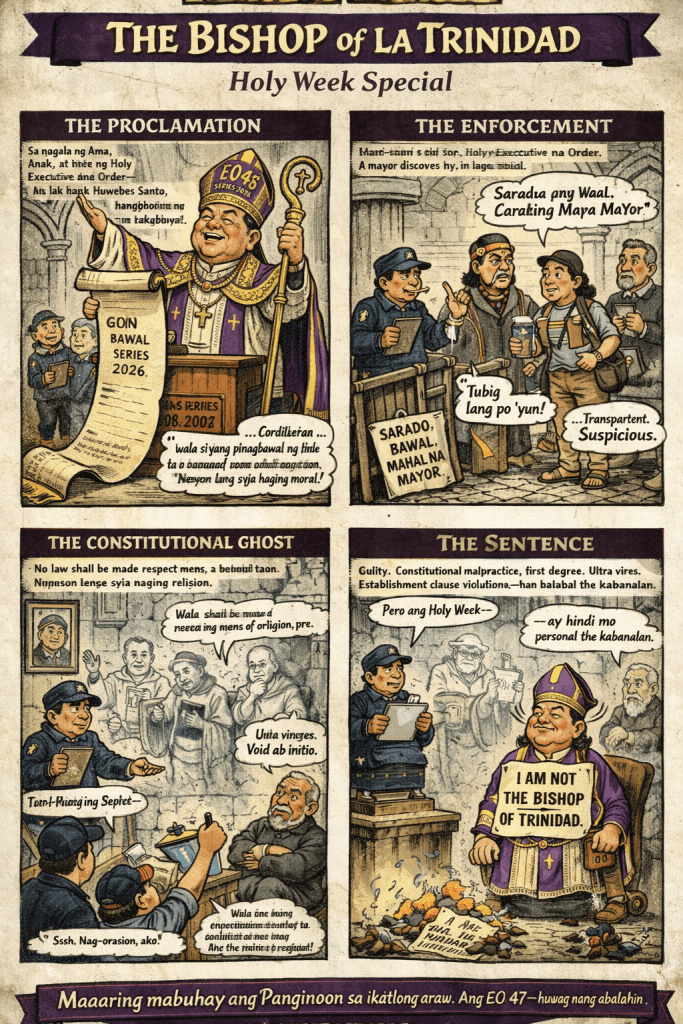
Constitutional Corpse on the Table: Legal Malpractice 101
Let us begin with the constitutional corpse on the table.
Non-Establishment Carnage: Church-State Separation Crucified
The 1987 Constitution of the Republic of the Philippines is crystal clear: “No law shall be made respecting an establishment of religion, or prohibiting the free exercise thereof.” Mayor Awingan’s EO doesn’t even pretend neutrality. It explicitly declares its purpose is to ensure a “solemn, safe and meaningful” observance of Christian Holy Week. That is not accommodation; that is establishment by fiat.
Estrada v. Escritor (G.R. No. 154705, 2003) gave us benevolent neutrality — the State may bend toward religion when it does not coerce. Aglipay v. Ruiz (64 Phil. 201, 1937) allowed a postage stamp with a religious image because it was cultural, not compulsory. Here? Compulsory. The EO coerces every non-Christian, every agnostic, every atheist, and every hungover Protestant into observing Catholic solemnity under threat of permit revocation and criminal complaint. The religious dog-whistle is not subtle; it is the entire siren. This is textbook entanglement, and courts should strike it down faster than Judas cashed his silver.
Police Power Fig Leaf Exposed: Drunk on Authority
Awingan clutches Section 16 of Republic Act No. 7160 (Local Government Code of 1991) like a drunk clings to a lamppost — both for support and illumination. “General welfare,” he intones. Sure. White Light Corp. v. City of Manila (G.R. No. 122846, 2009) is the controlling doctrine: police power requires (1) a lawful subject and (2) lawful means. Lawful subject? Public safety during Holy Week. Maybe. Lawful means? A total, blanket, four-day prohibition on every drop of alcohol in every corner of the municipality, including private consumption in public-adjacent spaces? That is not regulation; that is prohibition dressed in a cope.
Compare City of Manila v. Laguio, Jr. (G.R. No. 118127, 2005): even a city ordinance closing an entire red-light district was struck for overbreadth and oppressiveness. Tano v. Socrates (G.R. No. 110249, 1995) gave LGUs wide berth, but never a blank check to play ayatollah. The means here are neither reasonable nor necessary. A targeted ban on public intoxication near churches or processions? Fine. A municipal-wide crucifixion of commerce? Judicially fatal.
Ultra Vires Autopsy: Mayor as One-Man Legislature
Here is the structural homicide. Liquor regulation is legislative. RA 7160, Section 447(a)(1)(v) explicitly reserves to the Sangguniang Bayan the power to “regulate the sale… of any intoxicating… liquors.” Section 444(b)(1)(vi) lets the mayor issue emergency measures, not four-day moral quarantines. Pelaez v. Auditor General (15 SCRA 569, 1965) is merciless: delegated powers must have clear legislative basis. No enabling ordinance is cited. None exists. The Mayor has legislated by decree, imposed penalties (permit suspension/revocation) without statutory authority, and dared the courts to stop him. Ultra vires. Void ab initio. Next case.
Liability Menu: Awingan’s Personal Bill of Indictment
Administrative Overreach: Ombudsman Special
Grave abuse of discretion amounting to lack or excess of jurisdiction — the classic Ombudsman fodder. Oppression under RA 7160. Conduct prejudicial to the best interest of the service under Republic Act No. 6713 (The Code of Conduct and Ethical Standards for Public Officials and Employees), Section 4 (public officials must uphold public interest with fairness and good faith). The EO is arbitrary, discriminatory, and economically punitive. Administrative complaint before the Ombudsman writes itself.
Criminal Irony: The Mayor’s Own Order Bites Back
Article 131 of the Revised Penal Code (RPC) — prohibition, interruption, or dissolution of a peaceful meeting or religious worship? The irony is delicious. If enforcement harasses non-Christian gatherings or private observances, the Mayor’s own order could boomerang into a criminal charge. Article 124 (arbitrary detention) if overzealous cops start cuffing people for a beer in their own yard. Republic Act No. 3019 (Anti-Graft and Corrupt Practices Act), Section 3(e) — if selective enforcement spares connected businesses while gutting independents, that is giving “undue injury” to the public. Weak on paper, but the optics are courtroom gold.
Motivations Autopsy: The Holy Corpse Dissected
Let us be brutally honest. Genuine public safety? Laughable. Alcohol-related incidents happen 365 days a year. Why only the four days Jesus is in the tomb? Religious signaling? Obvious. Awingan is pandering to the Catholic majority in Benguet for that sweet, sweet pious voter turnout. Political capital? Check. In a tourism-agriculture town, crushing bars during peak visitor season signals “I am the strong moral leader” while conveniently ignoring that the same tourists fuel the local economy. Administrative laziness? The blanket ban is easier than deploying cops to actual hotspots.
He hides behind Christ while crushing commerce. The same mayor who would never ban lechon during Ramadan or fireworks during Chinese New Year now plays Grand Inquisitor for Easter. Selective morality is the oldest political sin.
Options Squandered: What a Real Mayor Would Have Done
A competent executive had choices:
- Narrow the ban to public consumption and areas within 100 meters of churches and procession routes.
- Limit it to sales after 5 p.m. instead of total prohibition.
- Push an ordinance through the Sangguniang Bayan for proper legislative cover and calibrated penalties.
- Issue a mere appeal for voluntary compliance with heightened PNP presence — the way actual adults govern.
Instead, Awingan chose scorched-earth absolutism. Because nuance is for the weak, and photo-ops with the parish priest are for winners.
Impacts: The Collateral Damage of Pious Overkill
- Legal — Injunction city. A petition for certiorari and prohibition under Rule 65, with TRO and preliminary injunction, will fly. The sample petition in the research materials is already drafted; just change the names.
- Economic — Bars, restaurants, groceries, and sari-sari stores take a four-day bullet to the wallet during what should be a revenue spike from Holy Week travelers. Tourism takes a hit. Property rights are collateral damage.
- Political — Conservative applause from the pulpit; business backlash from the cash register. Precedent for every future mayor to slap a religious flavor on any regulation they fancy. Tomorrow it’s pork, the day after it’s loud music during Ramadan. Slippery slope? It’s already greased.
Call to Arms: Rise Against Theocratic Decrees
The rule of law is not optional. The supremacy of the Constitution is not negotiable. Respect for all religions — and the right to be irreligious — demands that no mayor be allowed to play God with an Executive Order.
Recommendations:
- Affected businesses and citizens — file the Petition for Certiorari and Prohibition immediately. Use the litigation-ready template already prepared. Demand TRO by Holy Friday.
- The Sangguniang Bayan of La Trinidad — pass a resolution repudiating EO 47 and reminding the Mayor he is not a one-man legislature.
- Business owners — sue for injunctive relief and damages. Make the cost of pious overreach hurt.
This is not anti-religion. This is anti-theocracy-by-decree.
Satirical Sentencing: Judgment Day for EO 47
In the Court of Public Reason, presided over by the ghost of Justice Laurel and the living spirit of the 1987 Constitution of the Republic of the Philippines, the accused, Roderick Awingan, Mayor of La Trinidad, is found GUILTY of constitutional malpractice in the first degree.
It is the judgment of this Court that Executive Order No. 47, Series of 2026, be consigned to the bonfire of vanities — right next to every other pious decree that mistook a gavel for a crosier. The Mayor is hereby sentenced to 40 days of remedial constitutional law, to be served in the public square, wearing a sandwich board that reads: “I am not the Bishop of La Trinidad.”
May the rule of law rise on the third day.
Prosecutor’s Postscript: F for Flagrant Failure
Grade: F — Flagrant Abuse of Power. Roderick Awingan has not merely stumbled into constitutional error; he has marched in wearing vestments, trumpet blaring, and declared the separation of Church and State repealed by municipal fiat. This is not governance. This is governance by gospel. In the unforgiving ledger of Philippine public administration, he earns the scarlet letter “A” — for Arrogance, Abuse, and Amateur-hour constitutional lawyering. The people of La Trinidad deserve better than a mayor who mistakes his office for a pulpit and the Local Government Code for the Book of Leviticus. Case closed. The bonfire awaits.
Key Citations
A. Legal & Official Sources
- The 1987 Constitution of the Republic of the Philippines. Official Gazette of the Republic of the Philippines, 1987.
- Republic Act No. 7160. An Act Providing for a Local Government Code of 1991. Official Gazette of the Republic of the Philippines, 10 Oct. 1991.
- Republic Act No. 6713. An Act Establishing a Code of Conduct and Ethical Standards for Public Officials and Employees. The LawPhil Project, 20 Feb. 1989.
- Republic Act No. 3019. Anti-Graft and Corrupt Practices Act. The LawPhil Project, 17 Aug. 1960.
- Act No. 3815. An Act Revising the Penal Code and Other Penal Laws. The LawPhil Project, 8 Dec. 1930.
- Estrada v. Escritor. A.M. No. P-02-1651. Supreme Court of the Philippines, 5 Aug. 2003, The LawPhil Project.
- Aglipay v. Ruiz. G.R. No. 45459. Supreme Court of the Philippines, 13 Mar. 1937, The LawPhil Project.
- White Light Corp. v. City of Manila. G.R. No. 122846. Supreme Court of the Philippines, 20 Jan. 2009, The LawPhil Project.
- City of Manila v. Laguio, Jr. G.R. No. 118127. Supreme Court of the Philippines, 12 Apr. 2005, The LawPhil Project.
- Tano v. Socrates. G.R. No. 110249. Supreme Court of the Philippines, 21 Aug. 1997, The LawPhil Project.
- Pelaez v. Auditor General. G.R. No. L-23825. Supreme Court of the Philippines, 24 Dec. 1965, The LawPhil Project.
B. News Reports
C. Sample Pleadings / Model Documents
- “Forthwith” to Farce: How the Senate is Killing Impeachment—And Why Enrile’s Right (Even If You Can’t Trust Him)
- “HINDI AKO NAG-RESIGN!”

- “I’m calling you from my new Globe SIM. Send load!”

- “Mahiya Naman Kayo!” Marcos’ Anti-Corruption Vow Faces a Flood of Doubt

- “Meow, I’m calling you from my new Globe SIM!”

- “No Special Jail for Crooks!” Boying Remulla Slams VIP Perks for Flood Scammers
- “PLUNDER IS OVERRATED”? TRY AGAIN — IT’S A CALCULATED KILL SHOT

- “Several Lifetimes,” Said Fajardo — Translation: “I’m Not Spending Even One More Day on This Circus”

- “Shimenet”: The Term That Broke the Internet and the Budget

- “We Did Not Yield”: Marcos’s Stand and the Soul of Filipino Sovereignty

- “We Gather Light to Scatter”: A Tribute to Edgardo Bautista Espiritu

- $150M for Kaufman to Spin a Sinking Narrative




 KWEBA ni BAROK
Leave a comment