Dynasties on Notice: When Voters Stop Clapping for Promises and Start Measuring Outcomes
By Louis ‘Barok‘ C. Biraogo -+ April 7, 2026
LISTEN closely, Pilipinas.
It’s April 2026, the rains haven’t even started yet, and already the flood of public disgust is cresting higher than any DPWH “project” ever built.
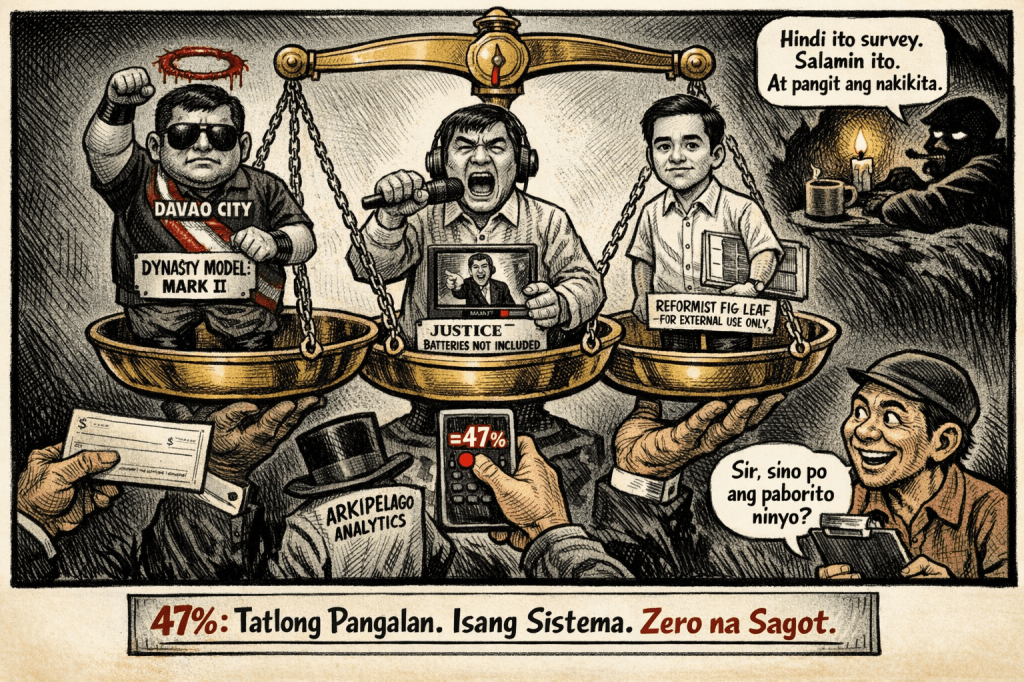
PUBLiCUS Asia’s Pahayag survey—dropped like a live grenade on April 2—has the numbers screaming what every flooded barangay, every empty gas tank, and every impeachment folder already knows: trust in the big two is cratering, and Filipinos have stopped clapping for promises.
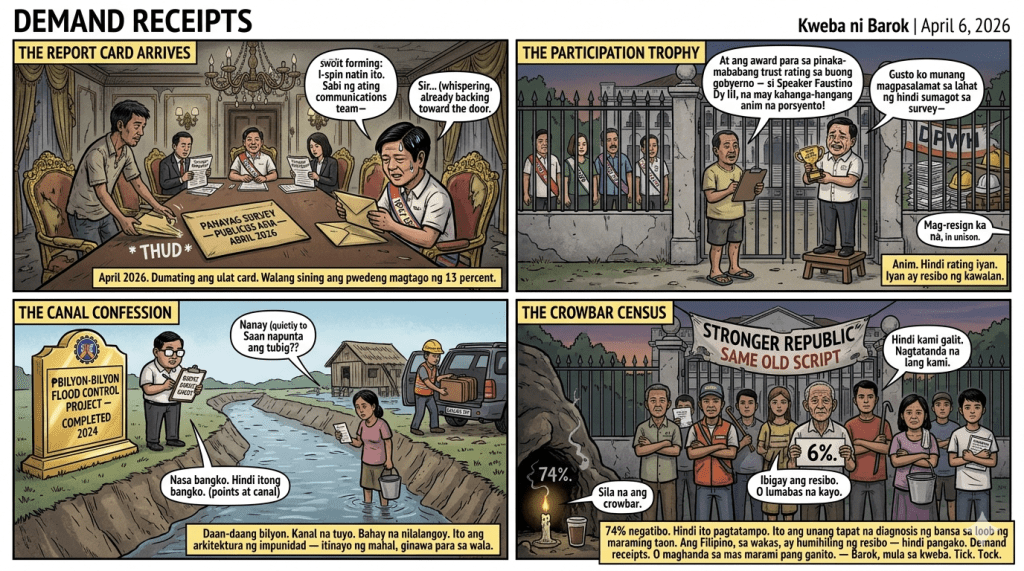
They’re measuring outcomes. With a crowbar.
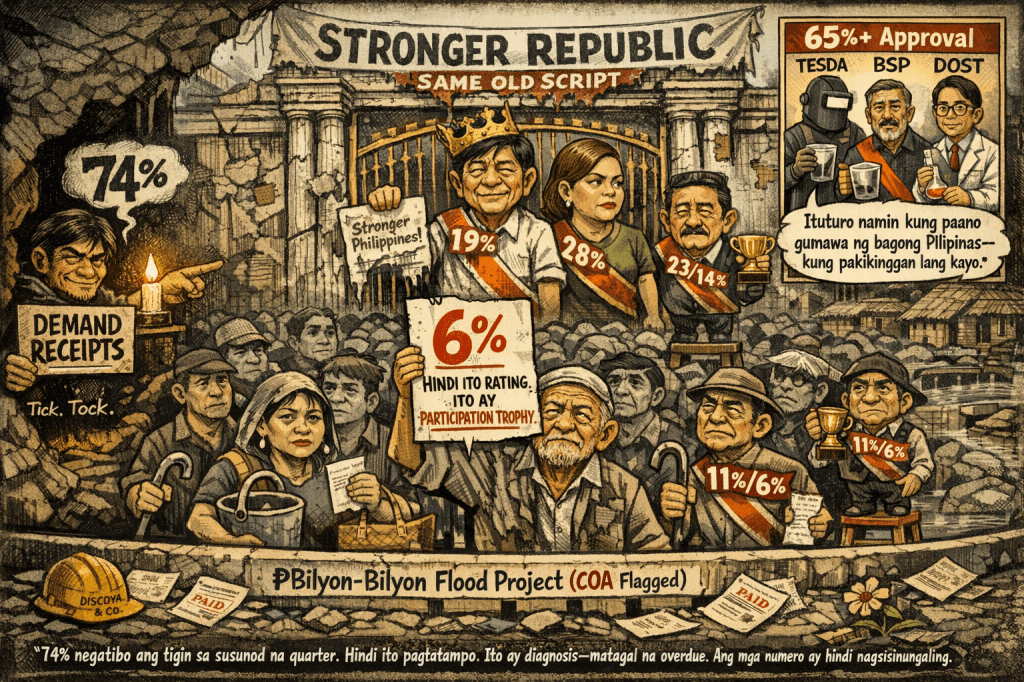
President Ferdinand “BBM” Marcos Jr. approval: 19 percent, trust: 13 percent. Down.
Vice President Sara Duterte: approval 28 percent, trust 26 percent. Also down.
Senate President Sotto barely holding water at 23/14.
House Speaker Faustino Dy III? A majestic 11 percent approval and 6 percent trust.
Six. That’s not a rating; that’s a participation trophy for showing up.
Meanwhile, the Technical Education and Skills Development Authority (TESDA) sits pretty at 65 percent approval.
The Bangko Sentral and DOST are right behind.
Irony so thick you could pave a ghost flood-control canal with it: the agencies that actually teach welding and print money people can trust outperform the political carnival that prints press releases about “stronger Philippines” while the country feels weaker than a wet cardboard jeepney.
And the cherry on this rotting cake? 74 percent negative outlook for the next quarter.
Half the country says we’re “weak.”
Forty-eight percent say wrong direction.
Fifty-six percent expect the economy to slide further.
Thirty-six percent—more than double last year—think their own wallets are about to get thinner.
Corruption still tops the gripe list at 20 percent.
Fuel prices, basic goods, wages that laugh at inflation.
The people aren’t guessing. They’re living it.
74% Negative —Pilipinas Is Done Clapping for Ghosts)”
Eviscerating the Survey: Numbers or Political Grenade?
First, let’s eviscerate the survey itself—because if you’re going to weaponize numbers, at least do it with style.
PUBLiCUS used 1,509 registered voters via purposive panel sampling.
Not face-to-face probability like Pulse Asia’s February-March poll, which had Marcos at 36 percent approval and Sara at 55 percent.
Same quarter, wildly different verdict.
Recency bias? The survey window—March 21-24—sat right on top of fresh fuel spikes (hello, US-Iran oil tantrum), lingering ICC confirmation hearings for Rodrigo Duterte (Feb 23-27), and the fresh stench of flood-control audits still dripping with ghost-project revelations.
Timing is everything when you’re polling a nation that scrolls faster than Congress can refer an impeachment complaint.
Is this a genuine alarm bell or a political grenade lobbed by a think-tank with its own invisible patrons?
Skeptics will scream sample bias—urban, digitally connected panelists more likely to rage-post about flooded kitchens and overpriced diesel.
No full demographic breakdown released.
Narrative framing possible.
And yes, surveys here are often political theater props for coalition poker or opposition fundraising.
But here’s the uncomfortable truth the Palace can’t spin away: the specificity of the gripes.
Respondents didn’t mutter “general dissatisfaction.”
They named flood accountability failures, ICC backlash, and fuel pain.
They distinguished technocrats from politicians.
They want tax relief, infra transparency, and—susmaryosep—a dynasty ban.
That’s not blanket cynicism; that’s surgical judgment.
Pulse Asia may have caught the pre-March hangover; PUBLiCUS caught the post-hangover vomit.
Both matter. Neither flatters the incumbents.
Root Causes: Beyond Fuel and The Hague
Root causes? Let’s stop pretending it’s just fuel and The Hague.
Yes, oil shocks bite.
Yes, ICC hearings and Sara’s four impeachment complaints (filed Feb 2-18, alleging confidential-funds misuse, threats, the usual) spilled political blood onto the family alliance.
But the deeper rot is structural: dynastic entitlement dressed as public service.
Patronage pipelines that turn flood-control budgets into contractor ATM machines.
Wage stagnation while the elite’s SUVs stay flood-proof.
An information ecosystem—social media plus traditional stenography—that amplifies scandal faster than any Ombudsman can file a case.
Flood control? Hundreds of billions spent since 2022, COA flagging ghost projects in Bulacan alone worth hundreds of millions more in 2026 audits, substandard dikes that collapse like wet tissue, contractors (Discaya, Wawao, the usual suspects) laughing all the way to the bank while families bail out living rooms with pails.
Marcos ordered audits and ministerial resignations—cute theater.
No high-profile prosecutions that stick.
Sara’s silence on the funds mess? Deafening.
Congress refers impeachment faster than it can pass real relief.
The opposition times its visibility perfectly—Bam Aquino, Pangilinan, Hontiveros posting strong net favorability—but remains fragmented, still playing the same dynastic chairs game when it suits them.
This isn’t incompetence.
It’s the operating system of Philippine governance: promise the moon, deliver ghost infrastructure, blame external shocks, repeat.
The Revelation: Filipinos Are Measuring Outcomes
The real revelation—the one worth celebrating with a bitter laugh—is that Filipinos are no longer evaluating promises. They are measuring outcomes.
Finally.
After decades of performative governance—EDSA nostalgia, war-on-drugs tough-guy cosplay, “build, build, build” ribbon-cuttings on half-finished projects—voters are demanding receipts.
Why did it take this long?
Because hope is a hell of a drug, and dynasties are excellent pushers.
But learned helplessness is worse.
Seventy-four percent negative is not dissatisfaction; it’s the quiet shrug of a nation that has internalized decline.
“Half say the country is weak.”
That’s not a poll number.
That’s a national therapy session gone public.
The most dangerous outcome of all—because when pessimism becomes baseline, reform feels futile and accountability optional.
The Multi-Layered Crisis Feeding Itself
The multi-layered crisis feeds on itself.
Economic insecurity (56 percent expect decline, 36 percent personal finances worse) breeds political fragmentation (Marcos-Duterte cold war cracking in real time—ICC, impeachment, competing bases).
Institutional distrust (DPWH and House in the gutter) erodes the very tools needed to fix anything.
Each layer poisons the next.
Cabinet half-disapproved.
Opposition senators rising.
The ruling coalition isn’t fracturing; it’s already in pieces, just arguing over who gets the biggest shard.
2028 Already Being Pre-Ordered
2028 is already being pre-ordered.
Opposition resurgence—Aquino, Pangilinan, Hontiveros strong—smells like a real contest.
Or is it just a reordering of dynastic deck chairs?
The public’s loud love for anti-dynasty reforms says they’re tired of both sides of the same bloodline coin.
Fragmentation within the ruling house opens the door.
But without unified opposition strategy, it could just be musical chairs with better soundbites.
Options for the Actors: Delusional to Desperate
Now the options for the actors—ruthlessly ranked from delusional to merely desperate.
Reform pivot? Possible but laughable without prosecutions.
Marcos’s audit theater has produced sound and fury, signifying subpoenas.
Narrative recovery? Spin doctors are already drafting “focus on the work” pressers.
Political escalation—more impeachment, ICC drama—will only deepen the trench.
Economic shock from oil? Already here.
The real choice is painful or performative.
History suggests performative.
Resolutions? Optimistic: swift convictions, targeted subsidies, actual transparency—ratings rebound.
Neutral: muddle through until oil cools.
Pessimistic: 2028 chaos as pessimism hardens into voter apathy or rage.
Structural: anti-dynasty law with teeth, independent anti-corruption body that doesn’t answer to the appointing power, genuine Freedom of Information, transparent bidding that doesn’t start with “kaklase/kamag-anak.”
Don’t hold your breath.
Impacts: Short, Medium, Long
Impacts?
- Short-term: cabinet reshuffles, subsidy theater, policy paralysis.
- Medium: 2025 midterms as early warning, 2028 realignment.
- Long-term: either institutional decay (more learned helplessness) or—if this pain finally births accountability—democratic renewal.
The 23 percent who still expect improvement? They’re not delusional.
They’re the stubborn remnant who remember that hope without teeth is just coping.
The Call from the Jeepney Driver
So here’s the call, straight from the jeepney driver who’s seen every administration’s potholes.
We need reforms that hurt the powerful: an independent anti-corruption commission with prosecutorial teeth and zero Palace appointees.
Transparent, competitive infrastructure bidding—no more favored contractors.
Fuel subsidy reform that actually reaches the tricycle driver, not the cronies.
A dynasty ban that survives Supreme Court dynastic lawyers.
A Freedom of Information law that isn’t toothless parchment.
To the current breed of “public servants” who treat office like an ATM: resign when caught.
Or at least stop calling yourselves servants while your families swim in public funds.
Real service looks like wage adjustments that outpace inflation, flood control that doesn’t dissolve in the first typhoon, and leaders who face the camera and say, “We failed. Here’s how we fix it.”
To voters: Demand receipts.
Reward outcomes, not surnames.
To civil society: sustain the pressure, build alternatives, don’t let fatigue win.
To media: stop stenography, start forensic reporting—follow the ghost projects to the bank accounts.
To the opposition: unify or perish.
The people are watching both sides now.
This pessimism is not the end.
It is the first honest diagnosis in years.
Twenty-three percent still see light.
Start there.
Name the enemy correctly—entitlement, patronage, impunity—and the fierce, clear-eyed hope that follows is the only kind worth fighting for.
The Palace can spin.
The numbers don’t.
And the Filipino, finally measuring outcomes, is done clapping for ghosts.
Time to build something real.
Or get out of the way.
Barok signing off.
The numbers don’t lie, and neither do the ghosts in the canals. Demand receipts, or prepare for more of the same.
Key Citations
A. News Articles
B. Reports & Studies
C. Official Websites and Organizations
- Pulse Asia Research, Inc. Official Website.
- Technical Education and Skills Development Authority. Official Website.
- Bangko Sentral ng Pilipinas. Official Website.
- Department of Public Works and Highways. Official Website.
- ₱75 Million Heist: Cops Gone Full Bandit

- ₱6.7-Trillion Temptation: The Great Pork Zombie Revival and the “Collegial” Vote-Buying Circus

- ₱1.9 Billion for 382 Units and a Rooftop Pool: Poverty Solved, Next Problem Please

- ₱1.35 Trillion for Education: Bigger Budget, Same Old Thieves’ Banquet

- ₱1 Billion Congressional Seat? Sorry, Sold Out Na Raw — Si Bello Raw Ang Hindi Bumili

- “We Will Take Care of It”: Bersamin’s P52-Billion Love Letter to Corruption

- “Skewed Narrative”? More Like Skewered Taxpayers!

- “Scared to Sign Vouchers” Is Now Official GDP Policy – Welcome to the Philippines’ Permanent Paralysis Economy

- “Robbed by Restitution?” Curlee Discaya’s Tears Over Returning What He Never Earned

- “No Pressure” Luistro? The House Pork Bazaar Exposed
- “My Brother the President Is a Junkie”: A Marcos Family Reunion Special

- “Mapipilitan Akong Gawing Zero”: The Day Senator Rodante Marcoleta Confessed to Perjury on National Television and Thought We’d Clap for the Creativity




 KWEBA ni BAROK
Leave a comment