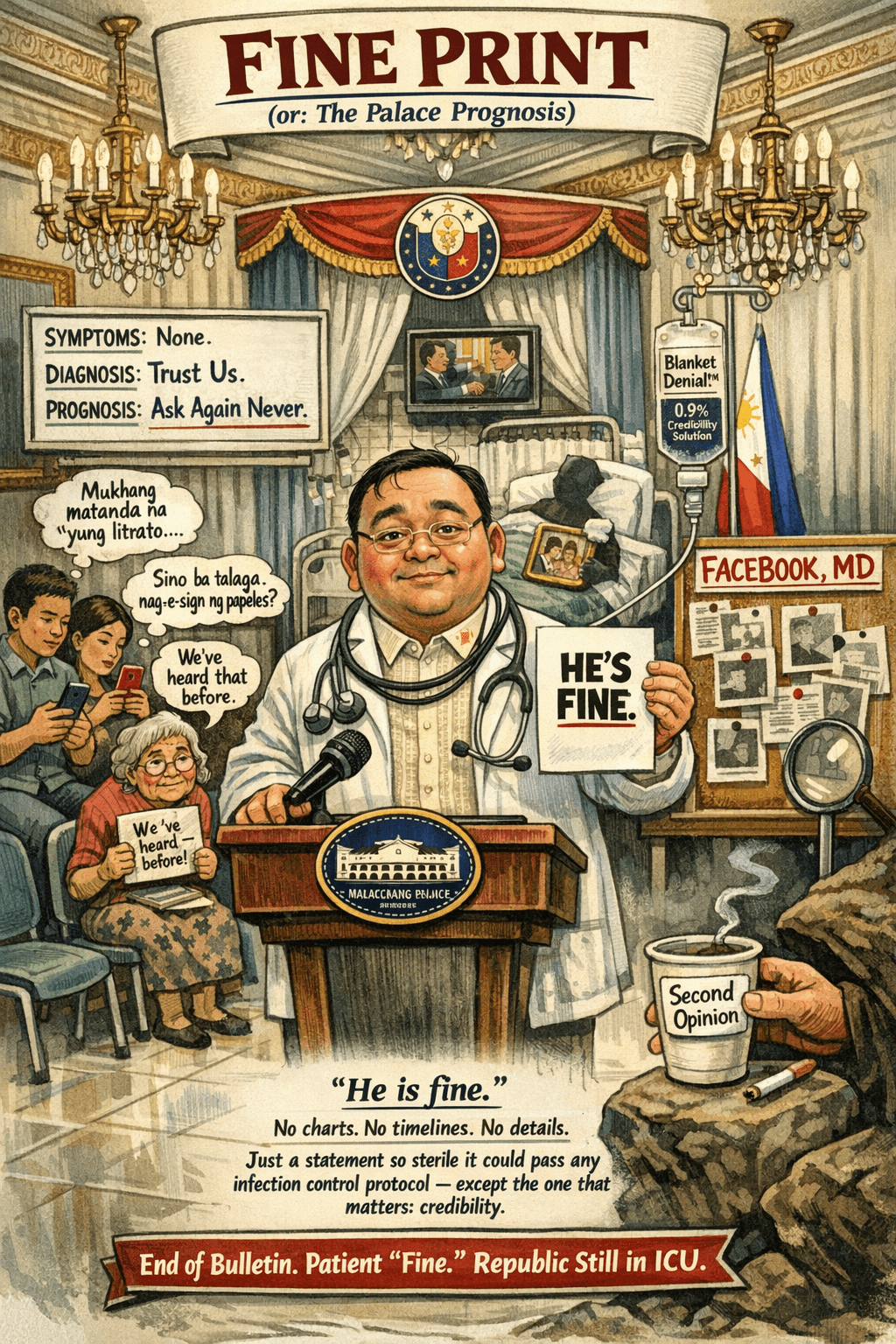
From skipped events to recycled photos: The official diagnosis is trust issues.
By Louis ‘Barok‘ C. Biraogo — April 7, 2026
THERE are illnesses that attack the body.
And then there are illnesses that attack the truth.
Malacañang insists that is “definitely well.” Which, in the Philippine political lexicon, is a phrase with a long and distinguished medical history—usually uttered moments before the nation discovers otherwise.
“Definitely well,” they say, as the President skips a morning event, resurfaces in the afternoon, and posts what appears to be a family photo that has aged more gracefully than the public’s patience.
But perhaps we are being unfair. After all, the Palace has a point. The President did attend an oath-taking. And nothing says peak physical condition like standing upright, shaking hands, and smiling for cameras calibrated to optimism.
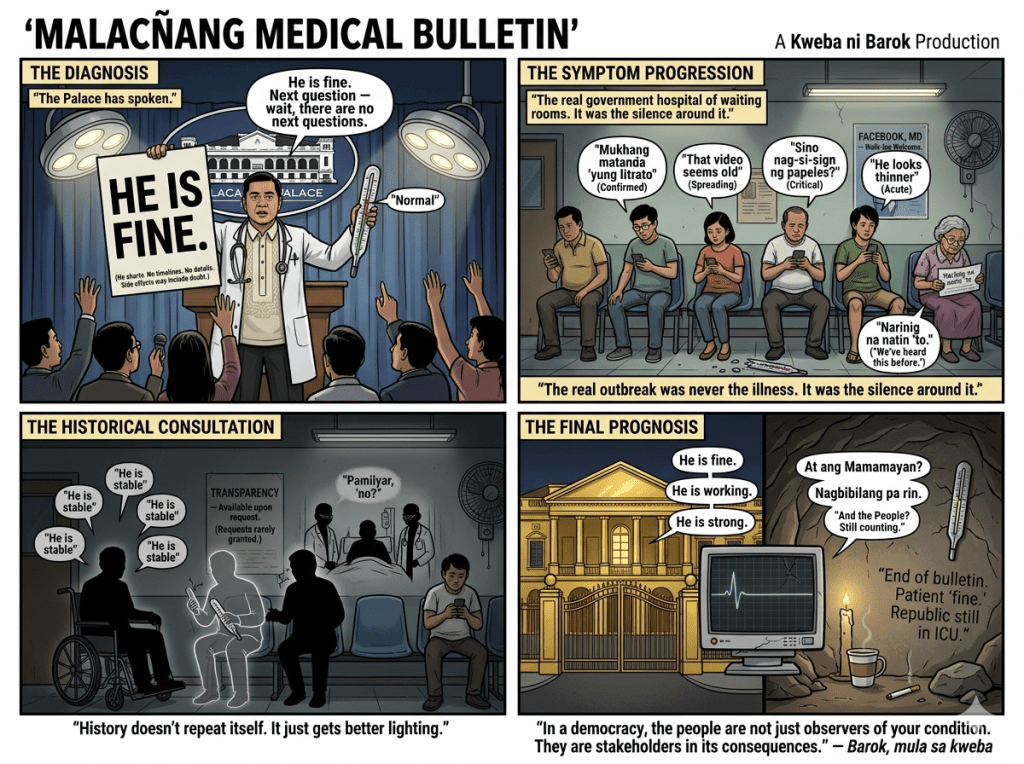
The Palace reports normal vitals. The monitor disagrees.
THE DIAGNOSIS: ACUTE PUBLIC SKEPTICISM
The real outbreak here is not . That, as the President himself assures us, is common—like traffic, corruption, and press briefings that answer everything except the question asked.
No, the spreading condition is something far more contagious: institutional disbelief.
It begins innocently:
- A missed event here
- A recycled photo there
- A hospitalization quietly filed under “routine”
Soon, the symptoms worsen:
- “He looks thinner.”
- “That video seems old.”
- “Who’s really in charge?”
And before long, the entire republic is self-medicating on rumor.
THE PRESCRIPTION: TRUST US (SIDE EFFECTS MAY INCLUDE DOUBT)
Enter the Palace, armed with its most potent pharmaceutical: the Blanket Denial™.
“He is fine.”
No charts. No timelines. No details. Just a statement so sterile it could pass any infection control protocol—except the one that matters: credibility.
Because in this country, “He is fine” has historically meant:
- He is not fine
- We will not say why
- You will find out eventually
Ask , whose medical records were treated like state secrets until they became historical footnotes during the .
Ask anyone who has lived long enough to know that in Philippine politics, transparency is often administered only post-mortem.
THE SECOND OPINION: FACEBOOK, MD
Of course, the Palace is correct about one thing: social media is a cesspool.
Unfortunately, it is also where many Filipinos now go for second opinions—because official channels have a habit of diagnosing trust as the problem rather than its absence.
So the public scrolls:
- Grainy screenshots become X-rays
- Old photos become forensic evidence
- Comment sections become medical boards
And somewhere between hysteria and intuition, a question lingers:
If everything is normal, why does nothing feel normal?
THE SILENT SYMPTOM: POWER VACUUM
Here is the part they won’t put in the bulletin.
Health rumors are never just about health. They are about power.
When a president disappears—even briefly—people don’t just ask “Is he okay?”
They ask:
- Who is making decisions?
- Who benefits from silence?
- Who is rehearsing for succession?
Because in a system built on personalities rather than institutions, the body of the president is not just flesh and bone—it is infrastructure.
And when infrastructure cracks, even slightly, everyone hears it.
THE LAB RESULTS: HISTORY REPEATING, WITH BETTER LIGHTING
We have seen this film before.
A leader falls ill.
The Palace denies.
The public doubts.
The truth leaks—slowly, reluctantly, inevitably.
The only thing that changes is resolution. The cameras are sharper now. The denials more polished. The rumors faster.
But the script?
Unchanged.
THE FINAL PROGNOSIS
Perhaps the President is, in fact, perfectly healthy.
But here is the uncomfortable truth:
In the Philippines, a healthy president can still produce a sick system—one where information is rationed, trust is brittle, and transparency is treated like an optional supplement rather than a constitutional requirement.
So the Palace may continue its updates:
“He is fine.”
“He is working.”
“He is strong.”
And the public will continue its own quiet diagnosis:
“We’ve heard that before.”
POSTSCRIPT: DISCHARGE INSTRUCTIONS
For the Palace:
- Sunlight is not fatal. Try it.
For the public:
- Not every rumor is true.
- But not every denial is either.
For the patient:
- Rest, if needed. Lead, if able.
- But above all, remember:
In a democracy, the people are not just observers of your condition.
They are stakeholders in its consequences.
End of bulletin. Patient “fine.” Republic still in ICU.
— Barok
- “Forthwith” to Farce: How the Senate is Killing Impeachment—And Why Enrile’s Right (Even If You Can’t Trust Him)
- “HINDI AKO NAG-RESIGN!”

- “I’m calling you from my new Globe SIM. Send load!”

- “Mahiya Naman Kayo!” Marcos’ Anti-Corruption Vow Faces a Flood of Doubt

- “Meow, I’m calling you from my new Globe SIM!”

- “No Special Jail for Crooks!” Boying Remulla Slams VIP Perks for Flood Scammers

- “PLUNDER IS OVERRATED”? TRY AGAIN — IT’S A CALCULATED KILL SHOT

- “Several Lifetimes,” Said Fajardo — Translation: “I’m Not Spending Even One More Day on This Circus”

- “Shimenet”: The Term That Broke the Internet and the Budget

- “We Did Not Yield”: Marcos’s Stand and the Soul of Filipino Sovereignty

- “We Gather Light to Scatter”: A Tribute to Edgardo Bautista Espiritu

- $150M for Kaufman to Spin a Sinking Narrative


 KWEBA ni BAROK
Leave a comment