Press Briefing as Legislation: Remulla’s Dangerous Dance with the Constitution
By Louis ‘Barok‘ C. Biraogo — April 9, 2026
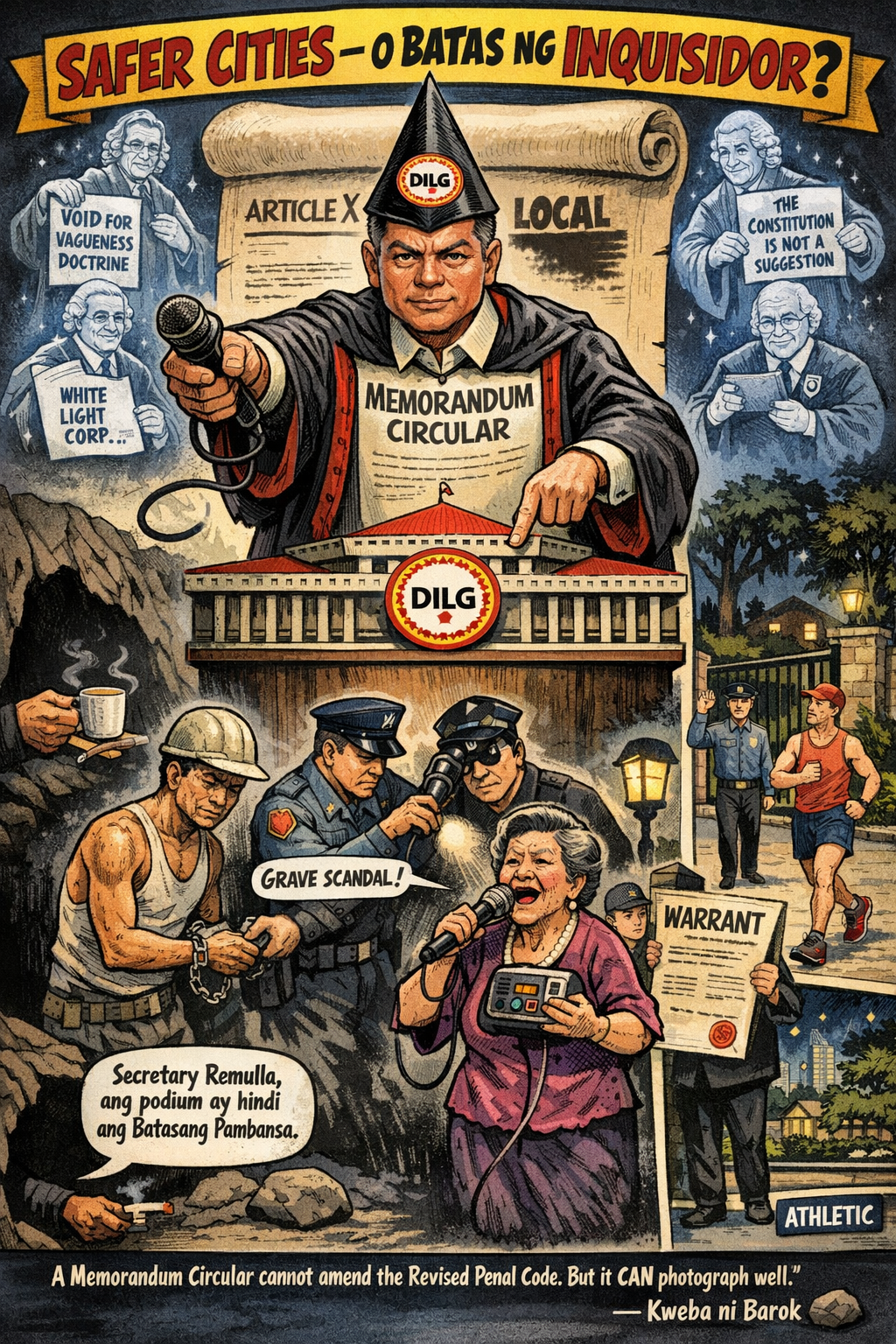
MGA ka-kweba, padies and gentlemen of the Republic, grab your Revised Penal Code (Act No. 3815)s and your copies of Republic Act No. 7160 (Local Government Code). Secretary Jonvic Remulla just held a press briefing and declared war on male nipples, midnight videoke, and the great unwashed of Tondo—all in the name of “Safer Cities.” He did it without a single new law, without a single Sanggunian vote, and with the casual menace of a man who thinks a podium in Quezon City is the Batasang Pambansa.
Let us perform the autopsy.
Under RA 7160, Section 16 (the General Welfare Clause), it is the local government units—not the Department of the Interior and Local Government (DILG) Secretary—who may enact ordinances to promote safety, morals, and public order. Section 25 is even clearer: the DILG’s role is supervision, not control. Supervision means reminding LGUs to do their job. Control means dictating what that job is. Remulla’s impending Memorandum Circular is not supervision; it is a velvet-gloved decree. A Memorandum Circular cannot create new crimes. It cannot amend the Revised Penal Code. It cannot turn “act of civility” into a penal statute.
This is not hyperbole. This is White Light Corporation v. City of Manila (G.R. No. 122846, 2009) staring us in the face. The Supreme Court struck down Manila’s anti-short-time ordinance because police power, however noble its purpose, cannot be exercised in a manner that is oppressive, arbitrary, or unduly infringes on personal liberty. “Civility,” Secretary Remulla, is not a lawful subject if it means the state gets to police fashion choices in 35-degree heat.
Ynot v. Intermediate Appellate Court (G.R. No. 74457, March 20 1987) supplies the coup de grâce: police power must not be “arbitrary or oppressive.” A blanket national edict masquerading as “guidance” to LGUs fails that test on its face. Remulla’s pronouncement is not policy. It is performative governance—a unilateral memorandum masquerading as legislation.
Topless Tyranny & Videoke Vendetta: The Law’s Embarrassing Demise
Nipple Offense 101: Remulla’s Invented Crime of Bare Chests
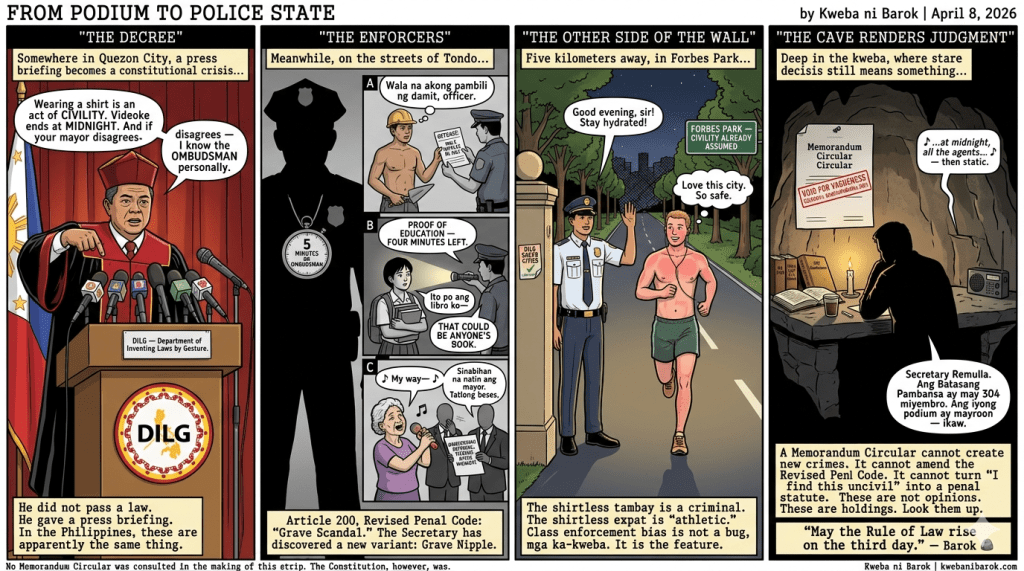
Remulla declares that “wearing a shirt is an act of civility.” Where, pray tell, is this crime codified? Not in the Revised Penal Code. Article 200 (Grave Scandal) requires conduct that is “highly scandalous” and “offends decency or good customs.” A man walking shirtless in humid Manila is not scandalous; he is simply surviving. The Secretary has invented the crime of “male nipples offending Jonvic Remulla.”
Apply the Void-for-Vagueness Doctrine from Estrada v. Sandiganbayan (G.R. No. 148560, 2001). A law must give a person of ordinary intelligence fair notice of what is prohibited. “Roaming topless” does not. Is jogging in BGC topless allowed because the runner is an expat? Is the construction worker in Tondo a criminal because he cannot afford air-conditioning? The doctrine does not care about your class; it cares about clarity. Here, there is none.
Videoke After Dark: Nuisance Law as Executive Bludgeon
This one has the thinnest patina of legality. Civil Code Articles 694–707 define nuisance, and local noise ordinances exist. But Remulla does not stop at enforcement. He threatens LGUs with Ombudsman cases if they fail to pass his version of the ordinance. That is not nuisance law; that is extortion by press conference. The only thing more dangerous than a videoke singer at midnight is a Cabinet Secretary who confuses a press briefing for a legislative session.
Minor Curfew Roulette: SPARK Precedent Turned Warning Label
SPARK v. Quezon City (G.R. No. 225442, August 8, 2017) upheld the Quezon City curfew ordinance precisely because it contained adequate exemptions and was narrowly tailored under strict scrutiny — a standard that broad, proof-on-demand enforcement risks failing. Remulla’s version demands that a 17-year-old produce “proof of education or employment” at 10:01 p.m. on a dark street while being questioned by a policeman who has five minutes to respond or face investigation. This is not the SPARK exception; this is the SPARK warning label. The Supreme Court required precision. Remulla offers police discretion and a stopwatch.
Ombudsman Guillotine: DILG’s Chilling Threat to LGU Autonomy
Remulla warns that non-compliant local executives will face cases before the Ombudsman for neglect of duty under Republic Act No. 6713 (The Code of Conduct and Ethical Standards for Public Officials and Employees) and Republic Act No. 6770 (Ombudsman Act). Translation: “Pass my ordinance or I’ll have the anti-graft court investigate you for being soft on videoke.”
Article X of the 1987 Constitution of the Republic of the Philippines enshrines local autonomy. The DILG cannot use the threat of administrative prosecution to compel Sanggunians to legislate on cue. This is not supervision. This is the administrative equivalent of a gun to the head. It chills the very independence the Local Government Code was designed to protect.
Cynical Optics & Class Warfare: Remulla’s “Dare” Rings Hollow
Why now? Because “Safer Cities” photographs well. Rugby boys and geng-geng make excellent villains for a dynasty-friendly strongman narrative. Forbes Park remains untouched; Islang Puting Bato in Tondo gets the full treatment. Class enforcement bias is not a bug; it is the feature. The shirtless tambay is a criminal. The shirtless expat in BGC is merely “athletic.”
The 5-minute response mandate is worse. It is a prelude to extortion, abuse, and the weaponization of 911. History shows us what happens when police are given impossible timelines and vague standards: “areglo” becomes the real enforcement mechanism.
Options for the rest of us:
- LGUs: Pass tailored ordinances with exemptions or dare the Ombudsman.
- Citizens: File Rule 65 petitions for certiorari and Rule 63 actions for declaratory relief the moment the Memorandum Circular drops.
- The Supreme Court: Do what it does best—remind the executive that the 1987 Constitution still exists.
Final Verdict: Informal Law’s Fatal Flaws – Courts Must Strike Back
This is not a policy. This is a regime of informal law—loud in rhetoric, weak in legal footing, and dangerous in execution.
- Judicial Intervention is mandatory. Challenge the Memorandum Circular the second it is issued. The Supreme Court must draw the line between guidance and command.
- Legislative Anchors or bust. If the executive wants these bans, let them go to Congress. Stop governing by press release.
- Policy Retraction/Refinement. Distinguish between a gated subdivision and a public street. “Civility” is not a one-size-fits-all straightjacket.
- Strengthening Democratic Institutions. The independence of the Judiciary and the autonomy of the Sanggunian must be defended against DILG bullying.
Secretary Remulla, the High Inquisitor has spoken. Your “Safer Cities” is not safer; it is simply louder. The Constitution is not a suggestion. And the next time you feel the urge to issue a nationwide moral code from a podium, remember: the Republic has courts, not just 911.
Barok has left the bench.
Kweba ni Barok — where sarcasm meets stare decisis.
Key Citations
A. Legal & Official Sources
- 1987 Constitution of the Republic of the Philippines. Official Gazette of the Republic of the Philippines, 1987.
- Philippines. Republic Act No. 386. An Act to Ordain and Institute the Civil Code of the Philippines, 18 June 1949, The LawPhil Project, (arts. 694–707).
- Philippines. Republic Act No. 6713: An Act Establishing a Code of Conduct and Ethical Standards for Public Officials and Employees. 20 Feb. 1989, The LawPhil Project.
- Philippines. Republic Act No. 6770: An Act Providing for the Functional and Structural Organization of the Office of the Ombudsman, and for Other Purposes. 17 Nov. 1989, The LawPhil Project.
- Philippines. Republic Act No. 7160: An Act Providing for the Local Government Code of 1991. 10 Oct. 1991, The LawPhil Project.
- Philippines. The Revised Penal Code (Act No. 3815). 8 Dec. 1930, The LawPhil Project.
- Philippines, Supreme Court. Estrada v. Sandiganbayan. G.R. No. 148560, 19 Nov. 2001, The LawPhil Project.
- Philippines, Supreme Court. Samahan ng mga Progresibong Kabataan (SPARK) v. Quezon City. G.R. No. 225442, 8 Aug. 2017, The LawPhil Project.
- Philippines, Supreme Court. White Light Corporation v. City of Manila. G.R. No. 122846, 30 Jan. 2009, The LawPhil Project .
- Philippines, Supreme Court. Ynot v. Intermediate Appellate Court. G.R. No. 74457, 20 Mar. 1987, The LawPhil Project.
B. News Reports

- ₱75 Million Heist: Cops Gone Full Bandit

- ₱6.7-Trillion Temptation: The Great Pork Zombie Revival and the “Collegial” Vote-Buying Circus

- ₱1.9 Billion for 382 Units and a Rooftop Pool: Poverty Solved, Next Problem Please

- ₱1.35 Trillion for Education: Bigger Budget, Same Old Thieves’ Banquet

- ₱1 Billion Congressional Seat? Sorry, Sold Out Na Raw — Si Bello Raw Ang Hindi Bumili

- “We Will Take Care of It”: Bersamin’s P52-Billion Love Letter to Corruption

- “Skewed Narrative”? More Like Skewered Taxpayers!

- “Scared to Sign Vouchers” Is Now Official GDP Policy – Welcome to the Philippines’ Permanent Paralysis Economy

- “Robbed by Restitution?” Curlee Discaya’s Tears Over Returning What He Never Earned

- “No Pressure” Luistro? The House Pork Bazaar Exposed
- “My Brother the President Is a Junkie”: A Marcos Family Reunion Special

- “Mapipilitan Akong Gawing Zero”: The Day Senator Rodante Marcoleta Confessed to Perjury on National Television and Thought We’d Clap for the Creativity



 KWEBA ni BAROK
Leave a comment