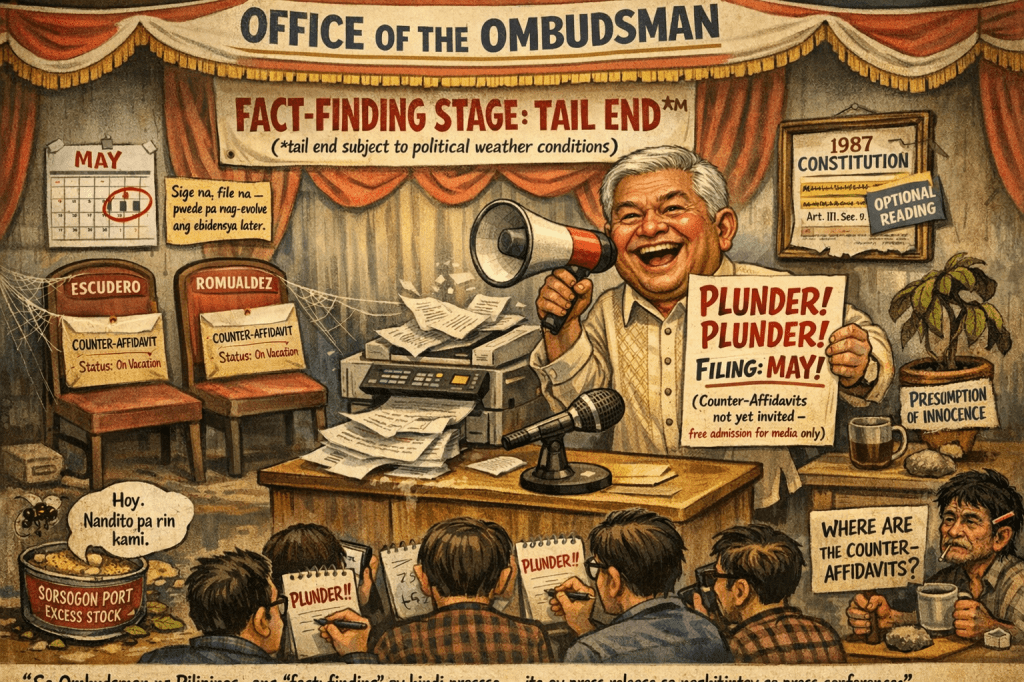
May Filing Date Announced While Counter-Affidavits Are Still on Vacation
By Louis ‘Barok‘ C. Biraogo — April 8, 2026
IN THE sweltering theater of Philippine “justice,” where fact-finding stages are treated like dress rehearsals for media circuses, the Office of the Ombudsman has perfected the art of the premature verdict. While excess sardines rot at Sorsogon port—symbol of bureaucratic incompetence on steroids—Ombudsman Jesus Crispin Remulla and his crew are “seriously preparing a case of plunder” against Sen. Chiz Escudero and Rep. Martin Romualdez, complete with a May filing date, before any counter-affidavits see the light of day. As Kweba ni Barok’s grizzled legal griper, I say: enough with the headlines; let’s eviscerate this farce with the cold scalpel of law and a generous dash of snark.
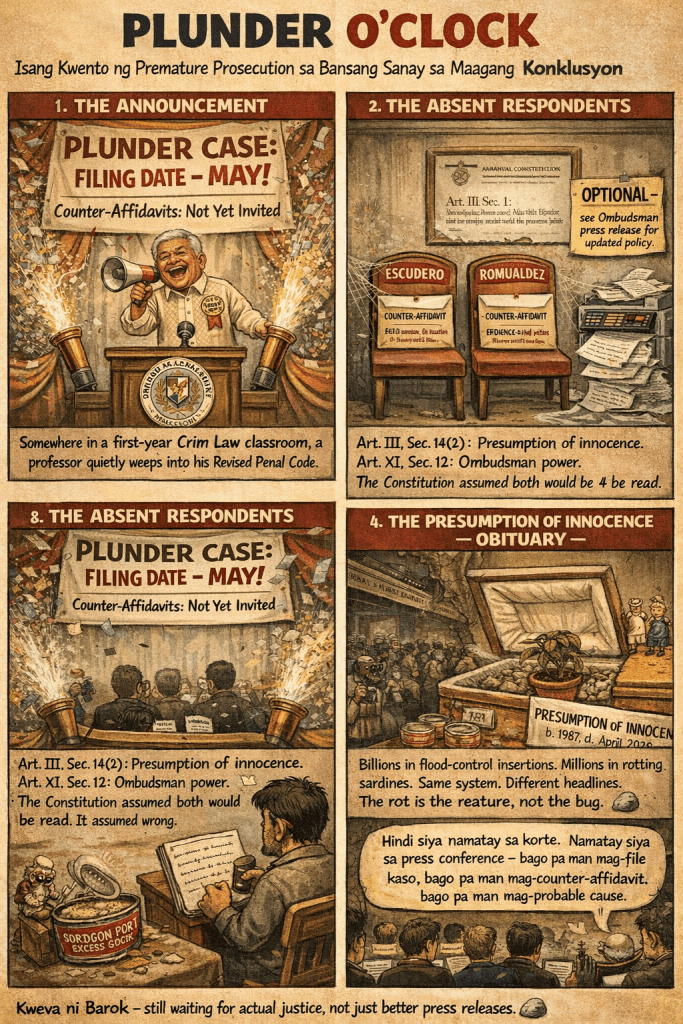
The Ombudsman’s Guide to Scheduling Justice Like a Dental Appointment
Prejudgment Paradox: How to Announce a Case You Haven’t Filed Yet
Let’s cut through the Ombudsman’s press-conference fog like a rusty bolo through a sack of rotting sardines: the core dispute here isn’t some noble “duty to inform the public.” It’s the naked spectacle of an Office of the Ombudsman that can’t decide whether it’s a fact-finder, a headline-writer, or a political exorcist. Assistant Ombudsman Mico Clavano, channeling his boss Jesus Crispin Remulla, tells us on April 7-8, 2026, that the fact-finding stage on the flood-control plunder allegations against Sen. Chiz Escudero and Rep. Martin Romualdez is at the “tail end,” the “allegations are becoming a bit more clear,” and—oh look—a formal complaint is teed up for May. Remulla himself had already dropped the B-word the day before: “we have been seriously preparing a case of plunder.”
Critics (and any lawyer who survived first-year Crim Law without developing a drinking problem) scream that at the fact-finding stage, there are no definite charges, no docketed complaint, no counter-affidavits, and therefore no lawful basis to name the crime, the accused, or the filing month like it’s a damn concert ticket. They are right, and the Ombudsman’s defenders are peddling performative nonsense.
For the critics’ howl of outrage: Fact-finding under RA 6770, Sec. 18, is not adversarial. It is the bureaucratic equivalent of a blindfolded kid poking a piñata with a pool noodle. No respondents have been summoned. No probable cause has been tested. Announcing “plunder” is the legal equivalent of shouting “guilty” while the evidence is still in the Xerox machine. It violates the spirit—if not the black letter—of due process under Art. III, Sec. 1 of the 1987 Constitution of the Republic of the Philippines. Cagang v. Sandiganbayan (2018) already scolded the Ombudsman for letting fact-finding drag on while respondents twist in the wind; this is the opposite sin—preemptive branding before the wind even starts blowing.
Against the critics’ howl of outrage (and why it deserves to be savaged): The Ombudsman’s people insist they’re just “updating” the public and letting the evidence “evolve.” Sure. And I’m just “seriously preparing” a case against the entire Philippine political class for existing. The moment you name the crime (“plunder”), the amount threshold (₱50 million under RA 7080), the accused, and the filing window, you have crossed from “fact-finding” into “fact-faking” the narrative. Prosecutorial discretion is real; turning it into a presser is just cheap theater.
The Plunder Pronouncement itself: Remulla’s May declaration is not purely “proactive.” It carries risks of appearing presumptuous and opens the door to accusations of narrative control. Possible motivations include: (1) demonstrating institutional resolve—though critics note this is the same office that has sometimes moved slowly on smaller cases; (2) political signaling, as Remulla, a Marcos appointee, is now investigating the President’s cousin and a former Senate President shortly after their ousters; (3) applying strategic pressure on witnesses—naming the exact crime early can encourage cooperation or disclosures; (4) generating public attention, since high-profile announcements tend to dominate headlines while everyday issues, like the rotting sardines at Sorsogon port, continue to linger.
Is it actionable prejudgment? Legally, no—Estrada v. Sandiganbayan (2001) and Presidential Ad Hoc Fact-Finding Committee v. Desierto (1999) still allow investigators to form theories. But Republic Act No. 6713 (The Code of Conduct and Ethical Standards for Public Officials and Employees) demands “justness and sincerity” and “political neutrality.” Publicly anointing the charge before the respondents even get their counter-affidavits is the antithesis of neutrality. It is prejudgment wearing a transparency fig leaf.
Legal Farce Framework: Constitution, Statutes, and the Presser Problem
Let us now drag the statutes into the light like evidence from a DPWH warehouse.
The 1987 Constitution of the Republic of the Philippines: Art. XI, Secs. 12-13 gives the Ombudsman the power to investigate and prosecute. Art. III, Sec. 1 (due process) and Sec. 14(2) (presumption of innocence) say the accused aren’t guilty until proven. The Ombudsman wants to live in Art. XI while pretending Art. III is optional reading.
Republic Act No. 7080 (The Anti-Plunder Act) requires a public officer amassing at least ₱50 million “by a combination or series of overt acts.” At the tail end of fact-finding, the Ombudsman has zero counter-affidavits, no formal respondents, and a file built on Senate Blue Ribbon hearsay, contractor whispers, and budget-insertion spreadsheets. That is not a “series of overt acts.” That is a PowerPoint deck with red arrows.
Republic Act No. 6770 (The Ombudsman Act of 1989), Sec. 15, grants investigative power; Sec. 18 allows fact-finding. Nowhere does it authorize turning the preliminary stage into a press blitz that prejudices the entire Sandiganbayan docket. The unwritten duty of prosecutorial discretion includes the duty not to sound like a carnival barker.
Precedents: Cagang v. Sandiganbayan (2018) already warned that fact-finding delays prejudice respondents—imagine the prejudice when the Ombudsman accelerates the publicity instead. Ombudsman v. Valeroso (2007) stressed that early stages are non-adversarial; Remulla just made them adversarial on live television.
Actors & Options: A Menu of Miseries
Ombudsman Remulla’s Options:
He faces three main paths forward:
- (a) File the plunder case in May — and hope the evidence eventually materializes.
- (b) Downgrade to Republic Act No. 3019 (Anti-Graft and Corrupt Practices Act) graft charges and quietly save face.
- (c) Quietly extend the fact-finding stage while the headlines cool off.
Option (a) maximizes political theater but carries the highest risk of acquittal.
Option (b) effectively admits the plunder announcement was overstated.
Option (c) admits the May timeline was overly optimistic. True justice would likely favor (c).
Theater, of course, strongly prefers (a).
Romualdez & Escudero:
Smart legal move—file a certiorari petition if the publicity reaches “grave abuse of discretion” levels, or at minimum a motion to inhibit on appearance of bias. Smart political move—dignified silence now, savage counter-affidavits later, and remind the public that budget insertions were congressional tradition long before these two warmed the chairs. Public outrage is for amateurs; strategic lawyering is for survivors.
Civil Society:
Demand the full fact-finding file under RA 6713 transparency rules, or file an ethics complaint with the Ombudsman’s own internal affairs (good luck with that). Or just pop popcorn and watch the circus—Philippine civil society’s default setting since 1986.
Impacts & Implications: The Fallout Files
If a half-baked plunder case lands in Sandiganbayan, the court becomes a garbage disposal for political detritus—dismissals, quashals, and endless motions to inhibit. Congressional-executive relations? Already toxic; now every budget realignment becomes a potential conspiracy. Precedent? Every future Ombudsman will feel entitled to drop “plunder” pressers during fact-finding, turning the preliminary stage into a reality-TV show. The presumption of innocence doesn’t die in the courtroom; it dies in the Inquirer headline.
The Core Rot: Institutional Discipline & Political Signaling
This isn’t an isolated gaffe; it is the absence of institutional discipline laid bare. The Ombudsman’s office leaks like a 20-year-old DPWH flood-control project. The accused—former leaders of both chambers—helped write the rules that let insertions flourish. The media laps it up because “plunder” sells better than “possible violations of RA 3019.”
The timing and wording are the tell: Why “plunder” and not the safer “possible graft”? Why “May” like it’s a dental appointment? Because specificity sells resolve while vagueness invites scrutiny. Remulla isn’t trading fairness for perceived resolve—he’s trading actual fairness for the perception of resolve, which is the oldest trick in the Philippine prosecutorial playbook. The cliché that “perception of fairness is as important as fairness itself” is true; this scandal weaponizes the perception while hollowing out the reality.
The Sardinian Elephant in the Room
While Remulla’s office preps its May spectacle, excess sardines—imported or donated or whatever bureaucratic miracle produced them—are literally rotting at the Sorsogon port. Millions of pesos worth of canned fish, destined for the hungry, turning into maggot soup because of “procedural issues.” Parallel that to the billions in flood-control insertions that allegedly flowed through DPWH ghost projects, kickbacks, and realignments blessed (or at least not blocked) by the two chambers. The sardines are not an aberration. They are the feature. The same system that lets fish rot while people flood is the system that lets budget insertions become “plunder” fodder only when the political winds shift. Rot is rot—whether in tin cans or in the national budget.
Call to Arms: Recommendations for a Less Theatrical Republic
The Ombudsman must reframe his public communication immediately: no more “we are seriously preparing plunder” pressers. Try this instead: “Fact-finding is ongoing pursuant to RA 6770; no conclusions have been reached; respondents will be afforded full due process at the proper stage.” Radical, I know.
Stronger institutions do not depend on one Remulla’s personality. Congress should pass genuine budget transparency laws with mandatory public dashboards for insertions and realignments. Whistleblower protections that actually work. The Supreme Court should issue clearer rules on pre-preliminary-investigation publicity—call it the “No More Presser Doctrine.”
Concrete recommendations:
- Ombudsman’s office—adopt internal comms protocols banning naming of specific crimes or timelines during fact-finding.
- Congress—mandatory real-time disclosure of all budget insertions above ₱10 million.
- Supreme Court—en banc guidelines treating premature public declarations as potential due-process violations.
Final Evisceration: Obituary for the Presumption of Innocence
In the end, this is not about whether Escudero or Romualdez did or did not amass ₱50 million through a series of overt acts. It is about the Philippine justice system’s incurable habit of performing accountability while the presumption of innocence is quietly strangled in the fact-finding room. The Ombudsman’s office has every right to investigate the flood-control rot. It does not have the right to turn the investigation into a press conference before the respondents have even been served.
The sardines keep rotting at Sorsogon. The budget insertions keep flowing like the floods they were supposed to stop. And the presumption of innocence—once a proud constitutional principle—now lies in state like those canned fish: bloated, forgotten, and slowly decomposing under the tropical sun of Philippine procedural purgatory.
Kweba ni Barok closes the ledger — still waiting for actual justice, not just better press releases.
Key Citations
A. Legal & Official Sources
- Philippines. The 1987 Constitution of the Republic of the Philippines. 1987. Official Gazette of the Republic of the Philippines.
- Philippines. Republic Act No. 3019: Anti-Graft and Corrupt Practices Act. 17 Aug. 1960. The LawPhil Project.
- Philippines. Republic Act No. 6713: An Act Establishing a Code of Conduct and Ethical Standards for Public Officials and Employees. 20 Feb. 1989. The LawPhil Project.
- Philippines. Republic Act No. 6770: The Ombudsman Act of 1989. 17 Nov. 1989. The LawPhil Project.
- Philippines. Republic Act No. 7080: An Act Defining and Penalizing the Crime of Plunder. 12 July 1991. The LawPhil Project.
- Philippines, Supreme Court. Cagang v. Sandiganbayan. G.R. Nos. 206438 & 206458, 31 July 2018. The LawPhil Project.
- Philippines, Supreme Court. Estrada v. Sandiganbayan. G.R. No. 148560, 19 Nov. 2001. The LawPhil Project.
- Philippines, Supreme Court. Presidential Ad Hoc Fact-Finding Committee on Behest Loans v. Desierto. G.R. No. 130140, Supreme Court of the Philippines, 25 Oct. 1999, The Lawphil Project.
- Philippines, Supreme Court. People of the Philippines v. Molina. 5 Oct. 1999. The Lawphil Project, Arellano Law Foundation.
- Philippines, Supreme Court. Ombudsman v. Valeroso. G.R. No. 167828, 2 Apr. 2007. The LawPhil Project.
B. News Reports
- Manahan, Job, and Agatha Gregorio. “Ombudsman Preparing Plunder Raps vs Romualdez, Escudero over National Budget Issues.” ABS-CBN News, 6 Apr. 2026.
- Mendoza, John Eric. “Ombudsman: Possible Plunder Raps vs Escudero, Romualdez Gaining Clarity.” Inquirer.net, 7 Apr. 2026.
- Michael.Jaucian, “Excess Sardines Rot at Sorsogon Port.” Inquirer.net, 2026.

- “Forthwith” to Farce: How the Senate is Killing Impeachment—And Why Enrile’s Right (Even If You Can’t Trust Him)

- “HINDI AKO NAG-RESIGN!”

- “I’m calling you from my new Globe SIM. Send load!”

- “Mahiya Naman Kayo!” Marcos’ Anti-Corruption Vow Faces a Flood of Doubt

- “Meow, I’m calling you from my new Globe SIM!”

- “No Special Jail for Crooks!” Boying Remulla Slams VIP Perks for Flood Scammers

- “PLUNDER IS OVERRATED”? TRY AGAIN — IT’S A CALCULATED KILL SHOT

- “Several Lifetimes,” Said Fajardo — Translation: “I’m Not Spending Even One More Day on This Circus”

- “Shimenet”: The Term That Broke the Internet and the Budget

- “We Did Not Yield”: Marcos’s Stand and the Soul of Filipino Sovereignty

- “We Gather Light to Scatter”: A Tribute to Edgardo Bautista Espiritu

- $150M for Kaufman to Spin a Sinking Narrative




 KWEBA ni BAROK
Leave a comment