Marcos Vendetta or Genuine Accountability? House Plays Politics While Sara Runs to SC
By Louis ‘Barok‘ C. Biraogo — April 9, 2026
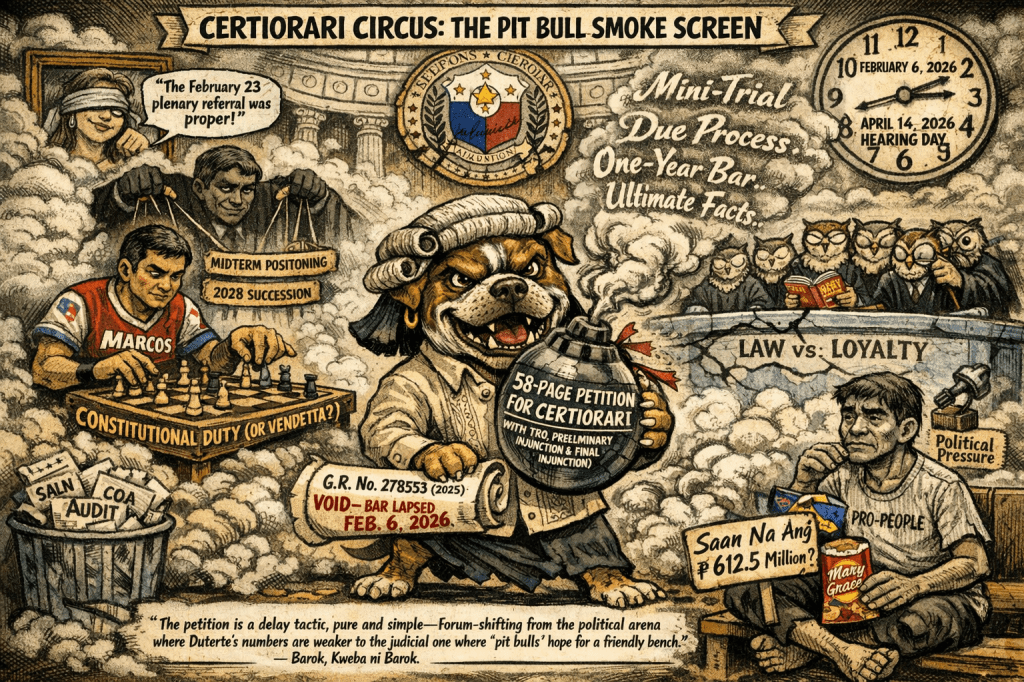
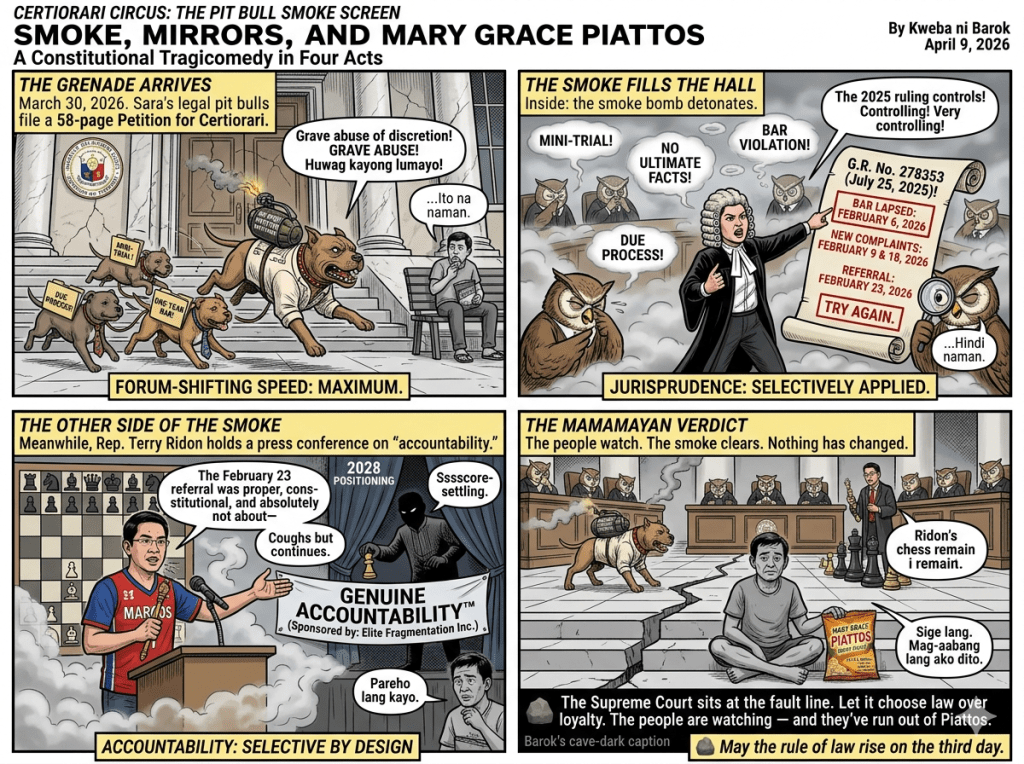
Ah, the familiar scent of desperation wafting from the Supreme Court’s halls once more. Barely a month after my last dispatch—“Duterte Pit Bulls Unleashed: SC Petition to Save Sara from Impeachment—Again”—Vice President Sara Duterte’s legal attack dogs have filed their March 30, 2026, 58-page Petition for Certiorari (with the obligatory TRO, preliminary injunction, and final injunction prayers) against the House of Representatives, its Committee on Justice, the Senate, and the two surviving complainants (Saballa et al. and Cabrera). Speaker Faustino Dy III, Rep. Gerville Reyes-Luistro, and Senate President Vicente Sotto III are all named. The GMA News report lays it bare: Sara wants the Court to freeze the proceedings cold, branding them a “mini-trial,” a due process violation, a one-year bar breach, and an evidentiary fishing expedition devoid of “ultimate facts.”
As the acerbic voice of Kweba ni Barok, I shall do what the petition itself refuses to do: ground every jab in black-letter law and cold fact. The Duterte camp’s petition is a procedural smoke bomb—cleverly packaged delay tactics masquerading as constitutional heroism. But the House’s response, fronted by the ever-quotable Rep. Terry Ridon, is no purer. It reeks of Marcos-aligned score-settling dressed up as “accountability.” Both sides are playing constitutional chess with loaded dice. Let us eviscerate them all, shall we?
Constitutional Chess, Loaded Dice, and One Very Tired Filipino
Duterte’s Hail Mary Smoke Bomb: Mini-Trial Myths and Fairy-Tale Bars Shredded
Sara’s lawyers invoke Rule 65 of the Rules of Court, demanding the Court find “grave abuse of discretion amounting to lack or excess of jurisdiction” on the part of the House. Article VIII, Section 1 of the 1987 Constitution of the Republic of the Philippines (1987 Constitution) grants the expanded judicial power—but the threshold is deliberately sky-high. Disagreement with procedure is not grave abuse. It is politics.
First, the “mini-trial” theory. The petition wails that the House Committee on Justice’s hearings—complete with subpoenas to the Ombudsman, BIR, SEC, and witness Ramil Madriaga (the alleged “bagman” with his November 2025 affidavit)—usurp the Senate’s exclusive power to “try” impeachment cases under Article XI, Section 3. Nonsense. The Constitution never contemplated a House that merely rubber-stamps complaints in a vacuum. Determining “sufficiency in form and substance” (Article XI, Section 3(2)) inherently requires evidence-gathering. Gutierrez v. House of Representatives (G.R. No. 193459, February 15, 2011) explicitly blessed this: the Committee “may conduct hearings, receive evidence, and determine the fate of complaints.” The House does not convict; it merely finds probable cause to send Articles to the Senate. Calling fact-finding a “trial in disguise” is legal theater worthy of a telenovela villain.
Second, the “no ultimate facts” claim. Petitioners clutch Rule 8 of the Rules of Court like a security blanket, insisting the complaints offer only “conclusions” and “speculation” about the ₱612.5 million confidential funds (OVP 2022–2023 and DepEd concurrent tenure), SALN omissions, and alleged threats against the Marcoses. Impeachment complaints are not ordinary civil pleadings. Francisco v. House of Representatives (G.R. No. 160261, November 10, 2003) and Gutierrez make this crystal clear: they need only allege acts that, if true, constitute impeachable offenses under Article XI, Section 2. The complaints cite COA-flagged “ghost expenses,” fictitious names like “Mary Grace Piattos,” and the Madriaga affidavit—more than enough to survive the form-and-substance test. Demanding trial-level proof at the complaint stage would render impeachment a dead letter.
Third, the one-year bar argument (Article XI, Section 3(5): “No impeachment proceedings shall be initiated against the same official more than once within a period of one year”). This was Duterte’s strongest card in 2025—until it wasn’t. In Duterte v. House of Representatives (G.R. No. 278353, July 25, 2025; MR denied), the Court correctly voided the prior Articles because initiation (filing + referral per Francisco) violated the bar. But the clock reset. The bar lapsed February 6, 2026. The two active complaints (Saballa filed ~February 9; Cabrera ~February 18) were consolidated and referred in plenary on February 23, 2026—post-bar, one valid initiation. The earlier Makabayan and Tindig Pilipinas complaints were set aside or withdrawn. No double-dipping. The petition’s attempt to bootstrap 2025 defects into 2026 is legally bankrupt.
Fourth, due process. The petition demands “meaningful opportunity to be heard” and cries foul over “improvised” House Rules (Sections 7 and 8 on evidence and witnesses). Impeachment is sui generis—a political process, not a judicial one (Estrada v. Desierto). Notice was given. A Consolidated Verified Answer ad cautelam was filed March 16, 2026. Counsel appeared. That is due process enough. The House’s plenary rule-making power under Article VI, Section 16(3) is plenary absent patent unconstitutionality. Sara’s lawyers are not seeking fairness; they are seeking a veto.
In short: no grave abuse under Rule 65. The petition is a delay tactic, pure and simple—forum-shifting from the political arena where Duterte’s numbers are weaker to the judicial one where “pit bulls” hope for a friendly bench.
House “Accountability” Charade: Marcos Vendetta in Constitutional Drag
Rep. Terry Ridon’s counter-argument—that the February 23 plenary referral was proper, the Committee’s evidence-gathering (including April 14, 2026 hearings with Madriaga under witness protection) is constitutionally authorized, and the petition “misleads the Court and public”—is technically correct. But spare me the sanctimony. The House’s sudden zeal for “accountability” on confidential funds, SALN discrepancies, and those alleged “contract to kill” threats smells less like constitutional duty and more like payback for the Marcos-Duterte rift.
Article XI, Section 3 vests the House with exclusive initiation power. The political question doctrine, however, has been relaxed by the expanded judicial review of Article VIII, Section 1. Courts intervene only for clear constitutional violations—not to supervise every subpoena. Yet the House cannot pretend it is above scrutiny. The proceedings are turbo-charged by the same elite fragmentation that has defined Philippine politics since 2024: Sara’s resignation from DepEd, the South China Sea policy clashes, the 2024 threat video, and 2028 positioning. Ridon’s “evidence forthcoming” line rings hollow when the real driver is weakening a rival bloc ahead of midterm gains and presidential succession.
Is this accountability? Or selective prosecution? The Constitution demands the former. The political reality delivers the latter.
2025 SC Ruling Overreach: No Freeze Button for This Impeachment
The 2025 precedent (Duterte v. House of Representatives (G.R. No. 278353, July 25, 2025)) is being waved like a talisman by Duterte allies. It is distinguishable on its face. That ruling struck down proceedings tainted by a pre-bar referral. Here, the February 23, 2026, referral occurred after the bar explicitly lapsed on February 6. The Court in 2025 emphasized “the end does not justify the means” and demanded due process at all stages—but it never held that the House is barred from gathering evidence or that every procedural hiccup triggers judicial paralysis. The current process complies with Francisco’s initiation rule. The 2025 case is not a blank check for TROs; it is a narrow corrective for bar violations. Invoking it now is cherry-picking jurisprudence to suit a political emergency.
Systemic Rot Exposed: Slush Funds, SALN Farce, and Elite Graft Festival
Let us not pretend this is about abstract procedure. The underlying stench is the same “widespread, systemic, and institutionalized corruption” that has plagued every administration. Sara’s ₱612.5 million confidential funds—flagged by COA for 11-day spending sprees, incomplete documentation, and ghost recipients—scream Republic Act No. 3019 (Anti-Graft and Corrupt Practices Act, Sec. 3(e)–(g)) violations: undue injury to the government, unwarranted benefits to allies. The SALN omissions and unexplained wealth? Straight Republic Act No. 6713 (The Code of Conduct and Ethical Standards for Public Officials and Employees) breaches—mandatory disclosures treated as optional theater. The alleged threats against the Marcos family add betrayal of public trust.
Yet the Marcos side’s hands are hardly clean. Selective accountability is the Philippine disease: prosecute the rival’s slush funds while your own remain unexamined. Both camps have turned public funds into private war chests and impeachment into a weapon of dynastic warfare. The public is the real victim—watching education budgets evaporate while “pro-people” rhetoric fills the airwaves.
Rule of Law or Pit-Bull Politics? Demand Real Accountability Now
The Supreme Court must deny the TRO and dismiss the petition for lack of grave abuse. Intervention here would cripple the House’s constitutional mandate and invite endless judicial second-guessing. The House must proceed—but with genuine deliberation, not rushed Marcos choreography. Publish the full evidence. Subpoena without fear or favor. The Senate, when the Articles arrive, must conduct a real trial, not a rubber stamp or acquittal-by-alliance. The public must demand transparency: full COA audits, SALN prosecutions without exception, and an end to confidential funds as political slush.
Strengthen democratic institutions by enforcing the one-year bar strictly, codifying clearer House Rules with mandatory publication, and insulating the Ombudsman and COA from political pressure. Uphold the supremacy of the rule of law: impeachment is a political process, but it is not a free-for-all. Demand genuine public service—pro-people governance that spends education funds on classrooms, not “Mary Grace Piattos.”
This is not about saving Sara or burying her. It is about salvaging what remains of constitutional order from the pit bulls on both sides. The Supreme Court sits at the fault line. Let it choose law over loyalty.
Lawyers spin, politicians grin, but the rule of law is gasping for air.
— Barok
Key Citations
A. Legal & Official Sources
- Philippines. The 1987 Constitution of the Republic of the Philippines. Official Gazette of the Republic of the Philippines, 1987.
- Supreme Court of the Philippines. Rules of Court. Rule 65, “Certiorari, Prohibition and Mandamus,” 1997 (as amended), The LawPhil Project.
- Supreme Court of the Philippines. 1997 Rules of Civil Procedure, as Amended. Rule 8, “Manner of Making Allegations in Pleadings,” 8 Apr. 1997, The LawPhil Project.
- Philippines. Republic Act No. 3019: Anti-Graft and Corrupt Practices Act. 1960, The LawPhil Project.
- Philippines. Republic Act No. 6713: Code of Conduct and Ethical Standards for Public Officials and Employees. 1989, The LawPhil Project.
- House of Representatives, 19th Congress. Rules of Procedure in Impeachment Proceedings, 19th Congress. Sections 7 and 8, Congress of the Philippines, 2022–2025.
- Supreme Court of the Philippines. Francisco v. House of Representatives. G.R. No. 160261, 10 Nov. 2003, The LawPhil Project.
- Supreme Court of the Philippines. Gutierrez v. House Committee on Justice. G.R. No. 193459, 15 Feb. 2011, The LawPhil Project.
- Supreme Court of the Philippines. Estrada v. Desierto. G.R. Nos. 146710-15, 2 Mar. 2001, The LawPhil Project.
- Supreme Court of the Philippines. Duterte v. House of Representatives. G.R. No. 278353, 25 July 2025, The LawPhil Project.
B. News Reports
- GMA News. “VP Duterte Supreme Court House Impeachment Proceedings.” GMA Network, 2026.
- Biraogo, Louis ‘Barok’ C. “Duterte Pit Bulls Unleashed: SC Petition to Save Sara from Impeachment—Again.” Kweba ni Barok, 28 Mar. 2026.
- ₱75 Million Heist: Cops Gone Full Bandit

- ₱6.7-Trillion Temptation: The Great Pork Zombie Revival and the “Collegial” Vote-Buying Circus

- ₱1.9 Billion for 382 Units and a Rooftop Pool: Poverty Solved, Next Problem Please

- ₱1.35 Trillion for Education: Bigger Budget, Same Old Thieves’ Banquet

- ₱1 Billion Congressional Seat? Sorry, Sold Out Na Raw — Si Bello Raw Ang Hindi Bumili

- “We Will Take Care of It”: Bersamin’s P52-Billion Love Letter to Corruption

- “Skewed Narrative”? More Like Skewered Taxpayers!

- “Scared to Sign Vouchers” Is Now Official GDP Policy – Welcome to the Philippines’ Permanent Paralysis Economy

- “Robbed by Restitution?” Curlee Discaya’s Tears Over Returning What He Never Earned

- “No Pressure” Luistro? The House Pork Bazaar Exposed
- “My Brother the President Is a Junkie”: A Marcos Family Reunion Special

- “Mapipilitan Akong Gawing Zero”: The Day Senator Rodante Marcoleta Confessed to Perjury on National Television and Thought We’d Clap for the Creativity



 KWEBA ni BAROK
Leave a comment