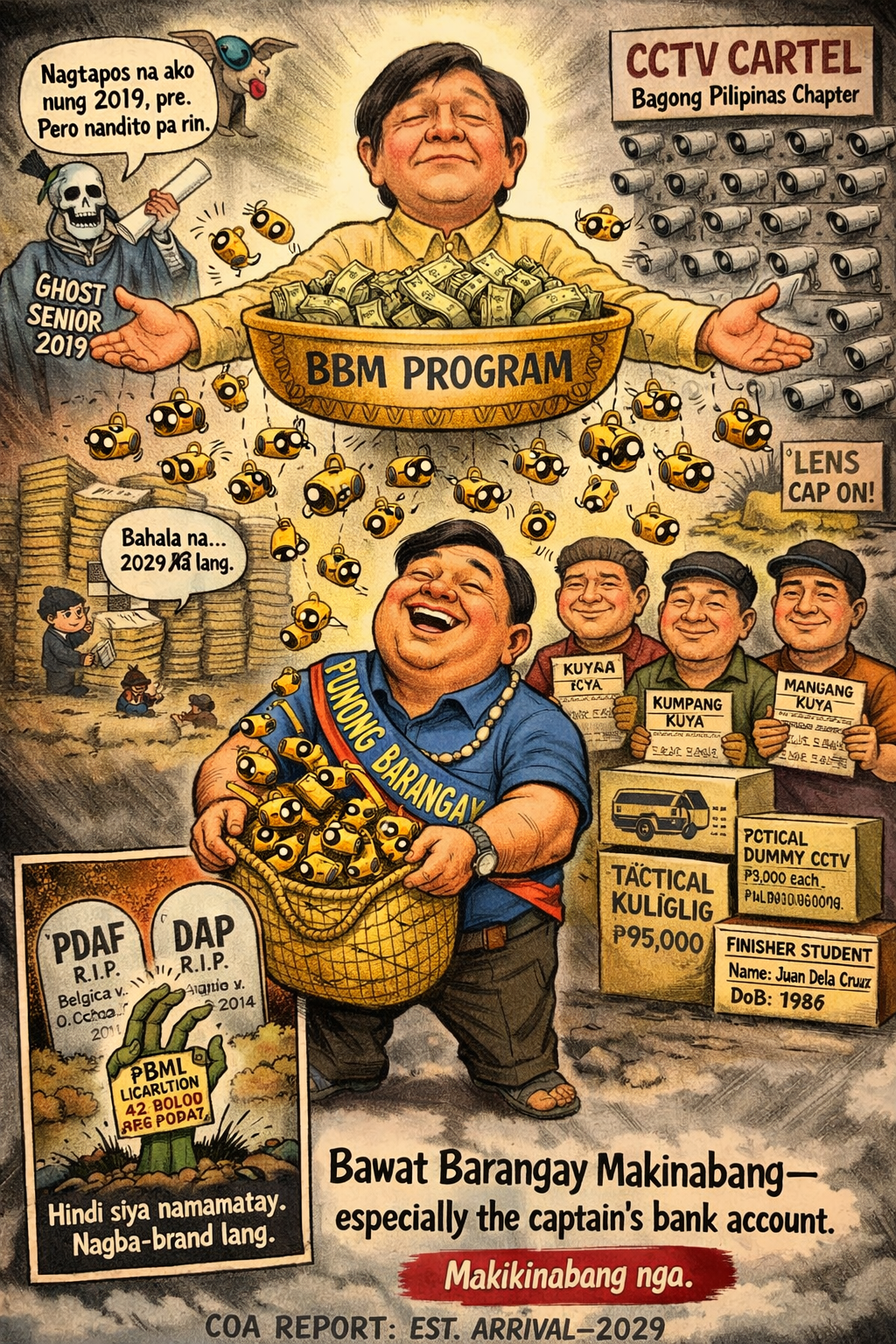
₱200K per barangay for streetlights and “patrol vehicles” — or just the fastest way to line 42,000 pockets?
By Louis ‘Barok’ C Biraogo — April 11, 2026
Middle East Crisis to Barangay Jackpot: ₱8B BBM “Aid” or Pre-Election Pabaon?
LADIES and gentlemen of the jury—er, readers—picture this: the Middle East is on fire, the peso is doing its best impression of a lead balloon, and suddenly, like manna from heaven wrapped in a Malacañang press release, the Marcos administration rolls out the Bawat Barangay Makinabang Program—BBM for short, because of course it is. President Ferdinand R. Marcos Jr. himself spearheaded the distribution in Pilar, Bataan, handing ₱8 billion in crisp taxpayer cash to 42,000 barangays at a cool ₱200,000 apiece. Half for “street lights, patrol vehicles, CCTV cameras, and power generators.” The other half for a “finisher program” to save college seniors from dropping out.
The timing? Immaculate. A crisis in the Gulf, economic jitters everywhere, and poof—CCTV for every barangay captain’s kumpare’s hardware store. Is this a genuine response to geopolitical tremors, or the perfect pre-election pabaon to 42,000 local chieftains who just happen to control the grassroots vote? The acronym BBM being the vehicle for this particular windfall isn’t serendipity; it’s a branding masterclass that would make Don Draper blush.
Thesis: This is a program of terrifying legal and administrative symmetry—perfectly designed for both rapid relief and rapid graft. It is either the most elegant decentralized safety net in Bagong Pilipinas history or the atomized reincarnation of the pork barrel. Spoiler: the cadaver is still twitching, and the knives are already out.
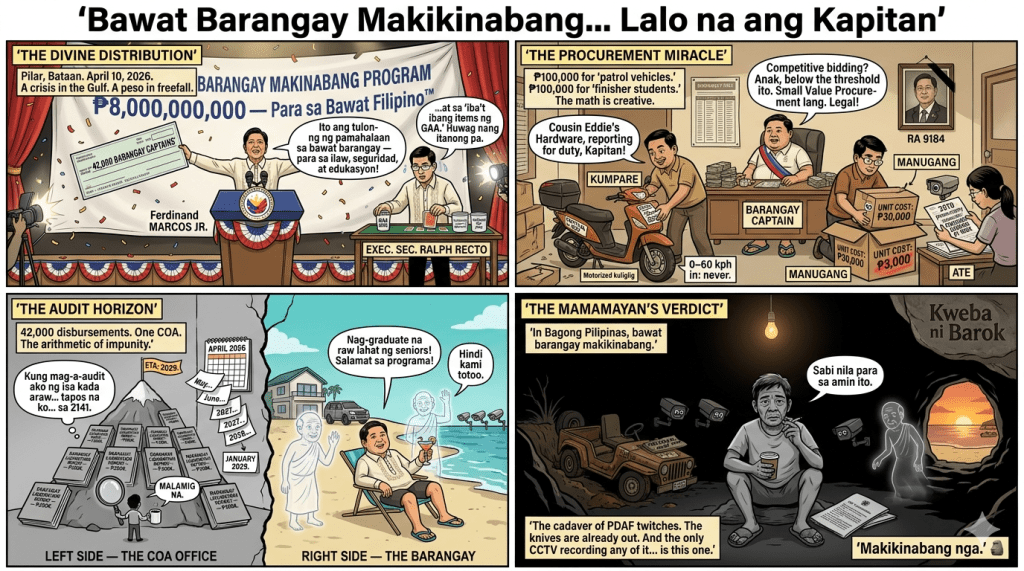
Budgetary Alchemy 2.0: How Marcos Turned Belgica into 42,000 Mini-Pork Barrels
Executive Secretary Ralph Recto, bless his heart, admits the ₱8 billion comes from “different items in the 2026 General Appropriations Act and continuing appropriations.” Translation: Budgetary Alchemy 2.0. This isn’t Congress exercising its power of the purse; this is the Executive playing three-card monte with public funds. Sound familiar? Araullo v. Aquino III (G.R. No. 209287, July 1, 2014) already slapped down the Disbursement Acceleration Program for exactly this kind of post-enactment realignment. You cannot launder executive discretion through “continuing appropriations” and pretend the 1987 Constitution of the Republic of the Philippines, Article VI, Section 29 didn’t just get ghosted.
And then there’s the Belgica elephant in the room. Belgica v. Ochoa (G.R. No. 208566, November 19, 2013) didn’t just kill PDAF; it killed post-enactment legislative discretion. Here we have 42,000 barangay captains—each a legislator in miniature—given blanket, post-enactment discretion over ₱200,000. This isn’t one senator with ₱200 million; this is PDAF atomized. Same constitutional sin, different packaging: unbridled discretion handed to the Executive’s local proxies. The Supreme Court called it “the core of the problem” in Belgica. The Marcos administration just photocopied the problem 42,000 times and called it “decentralization.”
Procurement? Don’t make me laugh. Republic Act No. 9184 (Government Procurement Reform Act) and its IRR demand competitive bidding, planning, and PhilGEPS posting. But ₱100,000 per barangay for “patrol vehicles”? A real patrol vehicle costs more than a barangay captain’s annual salary. What they’ll actually buy is a motorized kuliglig slapped with “tactical SUV” stickers and a receipt from Cousin Eddie’s Hardware. This is splitting of contracts on an industrial scale—the single largest Shopping and Small Value Procurement loophole exploit in Philippine history. RA 9184, Section 54, just filed a missing persons report.
Graft Autopsy 101: Ghost Seniors, CCTV Cartels, and the 2029 Audit Black Hole
Welcome, aspiring public servants, to the BBM Graft 101 syllabus.
The Finisher Program Fiasco
- Step 1: Borrow the 2019 graduate list from the nearest state university.
- Step 2: Photoshop a few dates and call them “2026 seniors at risk of attrition.”
- Step 3: Collect a modest ₱1,000 “processing fee” from real students desperate to graduate, then pocket the difference. The program targets 200,000 students with ₱100,000 per barangay. Do the math: that’s roughly ₱2,000–₱5,000 per “finisher.” Enough to buy a few dreams… or a nice dinner for the captain’s family.
The CCTV Cartel
Overnight, the Philippines develops an insatiable nationwide demand for identical 720p dummy cameras. Expect the Great Philippine CCTV Bubble of 2026—same model, same supplier, same 300% markup, all purchased via “direct contracting” because ₱100,000 is conveniently under the bidding radar. Street lights? Generators? Same playbook. The supplier is always the captain’s brother-in-law’s cousin’s LLC.
The Audit Deficit
Point out the sheer mathematical impossibility of Commission on Audit (COA) auditing 42,000 separate disbursements for small amounts in real time. The COA reports will arrive sometime in 2029—long after the officials have been re-elected or retired to their beach resorts in Boracay. By then the money is gone, the receipts are “recycled,” and the ghost seniors have mysteriously graduated and vanished.
This is not incompetence. This is design. The program is cash-based, barangay-level, rapid-disbursement heaven. Highest-risk corruption layer, meet lowest-oversight environment.
Excuse Shredder: Oil Non-Sequiturs and the Finisher Fallacy Band-Aid
- The Oil Price Non-Sequitur: “Oil prices are high, so let’s buy street lights for Barangay X and hope the college kid in Manila doesn’t notice his jeepney fare doubled.” Brilliant. The causal link is so thin you could use it as dental floss.
- The Finisher Fallacy: Yes, 39% attrition is real—especially in BARMM at 93%. But throwing a one-time ₱2,000–₱5,000 bone to a senior (assuming 200,000 students split ₱4.2 billion) is political palliative care, not education reform. Systemic poverty, K-12 gaps, and employability issues do not get fixed by a band-aid from the Office of the President. It’s like treating a hemorrhage with a Hello Kitty sticker.
Fork in the Road: Barangay Captains Choose Service or Kurakot Express?
- For the Barangay Captain: You stand at a fork in the road.
- Path A: Genuine public service—buy actual lights, install real CCTVs (that actually record), help real students with verifiable needs.
- Path B: Kurakot Express—ghost beneficiaries, overpriced dummy cameras, political patronage projects.
Given the institutional culture of barangay finance (see every COA report since 1991), Path A is the one they’ll tell their mothers they took. Path B is the one that actually gets taken.
- For Commission on Audit (COA)/Department of the Interior and Local Government (DILG): The bureaucracy is already overwhelmed. Recommend a Citizen’s Audit Brigade. Every barangay must post, on a public verifiable portal:
- (1) picture of the installed streetlight/generator,
- (2) receipt for the CCTV/patrol vehicle, and
- (3) the NAME of every “finisher” student with proof of disbursement. No portal? Presume the money is gone.
Barok’s Gavel Drops: Reckless Fiscal Endangerment – Citizen Audit or Bust
The Verdict: Guilty of Reckless Fiscal Endangerment.
This ₱8 billion program sits at the intersection of welfare policy and political finance architecture. Legally defensible if properly appropriated and audited. Constitutionally vulnerable if discretionary and loosely controlled. Operationally high-risk due to barangay-level fragmentation. In blunt terms: it is either a decentralized social safety net—or a 42,000-node corruption network waiting to happen.
Recommendations:
- Immediate post-facto publication: Every barangay posts proof of every purchase and every beneficiary. No exceptions.
- DILG conditional release tied to compliance dashboards.
- COA real-time flagging of high-risk disbursements.
- Congressional oversight hearings—now, not after the money’s gone.
Closing Satirical Jab: In the Bagong Pilipinas, Bawat Barangay Makikinabang. But reading the fine print, it seems the biggest beneficiary is Bawat Barangay Captain’s Bank Account. Makikinabang nga.
In Bagong Pilipinas, every barangay makikinabang — especially the ones with the new bank accounts.
— Barok
Key Citations
A. Legal & Official Sources
- The 1987 Constitution of the Republic of the Philippines. Official Gazette of the Republic of the Philippines, 1987.
- Araullo v. Aquino III. G.R. No. 209287, Supreme Court of the Philippines, 1 July 2014, The LawPhil Project.
- Belgica v. Ochoa. G.R. No. 208566, Supreme Court of the Philippines, 19 Nov. 2013, The LawPhil Project.
- Philippines. Republic Act No. 9184: An Act Providing for the Modernization, Standardization and Regulation of the Procurement Activities of the Government and for Other Purposes. 10 Jan. 2003. Official Gazette of the Republic of the Philippines.
B. News Reports

- “Forthwith” to Farce: How the Senate is Killing Impeachment—And Why Enrile’s Right (Even If You Can’t Trust Him)
- “HINDI AKO NAG-RESIGN!”

- “I’m calling you from my new Globe SIM. Send load!”

- “Mahiya Naman Kayo!” Marcos’ Anti-Corruption Vow Faces a Flood of Doubt

- “Meow, I’m calling you from my new Globe SIM!”

- “No Special Jail for Crooks!” Boying Remulla Slams VIP Perks for Flood Scammers

- “Philippine-Controlled” or Yankee Gas Station? The Davao Fuel Depot Farce Exposed

- “PLUNDER IS OVERRATED”? TRY AGAIN — IT’S A CALCULATED KILL SHOT

- “Several Lifetimes,” Said Fajardo — Translation: “I’m Not Spending Even One More Day on This Circus”

- “Shimenet”: The Term That Broke the Internet and the Budget

- “We Did Not Yield”: Marcos’s Stand and the Soul of Filipino Sovereignty

- “We Gather Light to Scatter”: A Tribute to Edgardo Bautista Espiritu





 KWEBA ni BAROK
Leave a comment