Oil Shock Forces the Pivot, But Can the Philippines Actually Build an EV Industry?
By Louis ‘Barok‘ C. Biraogo — April 11, 2026
THEY didn’t even bother with a decent eulogy.
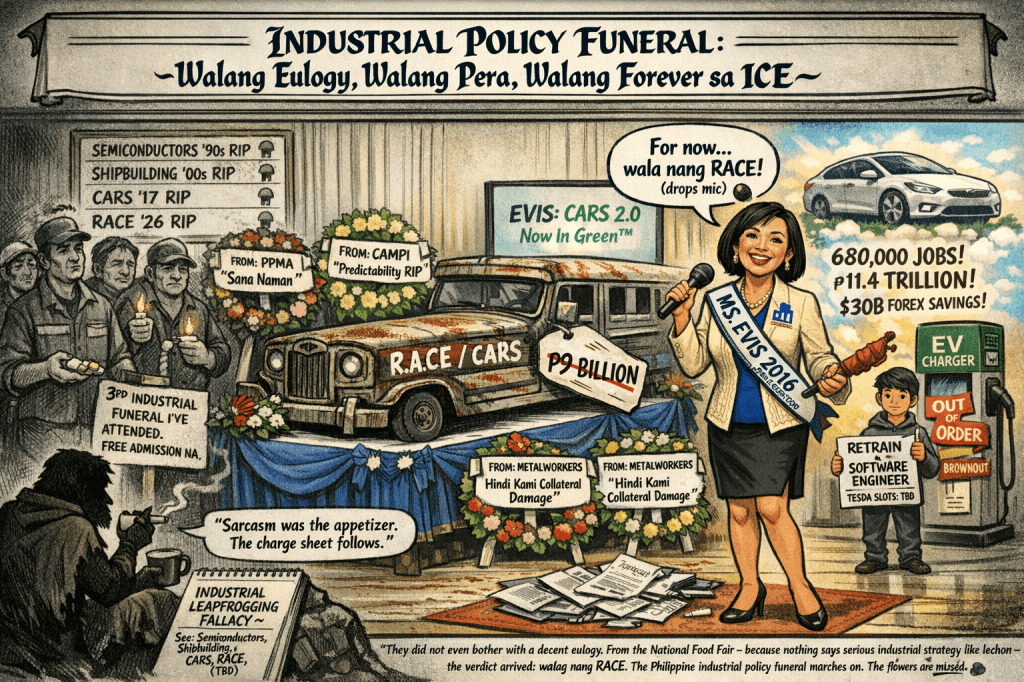
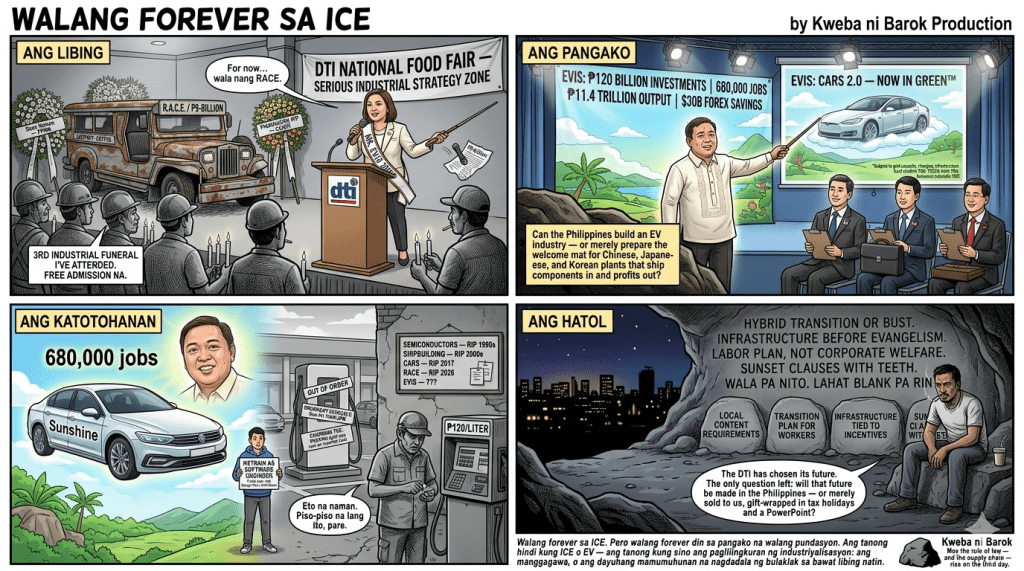
Last Wednesday, on the sidelines of the DTI National Food Fair—because nothing says “serious industrial strategy” like a trade fair for lechon—Trade Secretary Ma. Cristina A. Roque delivered the verdict with the casual finality of a traffic enforcer writing a ticket: “For now, wala nang RACE.”
The Revitalizing the Automotive Industry for Competitiveness Enhancement program—P9 billion in promised fiscal support for domestic ICE vehicle production—is dead.
CARS is finished. Long live the Electric Vehicle Incentives Strategy.
This is not a minor program tweak. It is policy whiplash dressed up as foresight. And it deserves a forensic autopsy, not another PowerPoint slide.
The Pro-DTI Case: Geopolitics, EVIDA, and the Sober Math of Survival
Let us be ruthlessly fair, the way a columnist who has buried too many industrial dreams must be.
The DTI’s pivot is not born of caprice. It rests on three pillars that even a skeptic cannot dismiss out of hand.
First, the geopolitical trigger is real. The Iran war has sent oil prices spiking again. Every additional peso per liter at the pump is another peso ripped from the pockets of jeepney drivers, farmers, and OFW families whose remittances already bleed forex.
The Philippines imports virtually all its oil. Every shock is a national security wound.
EVs—battery, plug-in hybrid, or full electric—offer a structural hedge against that volatility.
Second, the legal and policy scaffolding exists. The Electric Vehicle Industry Development Act (EVIDA, RA 11697) is not some vague aspiration; it is statute.
It mandates the DTI, through the BOI, to craft a competitive incentive package covering both fiscal breaks and non-fiscal support—priority registration, infrastructure alignment, the works.
CREATE Law provides the fiscal guardrails.
The old Comprehensive Automotive Resurgence Strategy (CARS) program (EO 182) was always time-bound; RACE was merely its gentler sequel with a lowered 100,000-unit quota.
When President Ferdinand R. Marcos, Jr. vetoed the P4.32 billion CARS arrears and P250 million RACE money, the message was clear: unprogrammed funds are not sacred. Redirecting toward EVIS is within executive discretion.
Third, the projections are not fantasy. The government is talking ₱120 billion in investments, 680,000 jobs, ₱11.4 trillion in output, ₱400 billion in taxes, $30 billion in forex savings if the full supply chain materializes.
Mitsubishi’s announced dedicated hybrid EV facility in Santa Rosa, Laguna is the first concrete vote of confidence.
Global EV sales are exploding; ASEAN neighbors are racing ahead. To stand still is to become the region’s retirement home for obsolete ICE technology.
That is the strongest, cleanest defense of Secretary Roque’s pivot. It deserves to be stated without strawman sarcasm—because the alternative is worse.
The Anti-DTI Autopsy: Legitimate Expectations, Policy Whiplash, and the Industrial Leapfrogging Fallacy
Now let us eviscerate.
The real crime is not the destination. It is the manner of travel—and the bodies left by the roadside.
RACE was not some idle PowerPoint. It was negotiated, socialized, and built on the legitimate expectations created by CARS.
Automakers and parts suppliers invested time, retooling, and political capital on the promise of continuity.
The Philippine Parts Makers Association (PPMA), the Philippine Metalworkers’ Alliance, and even segments of the Chamber of Automotive Manufacturers of the Philippines, Inc. (CAMPI) warned that abrupt abandonment signals “dangerous policy inconsistency.”
Investors do not price only incentives; they price predictability. The Philippines just raised its own “policy risk premium” again.
Worse, the pivot rests on the Industrial Leapfrogging Fallacy—the seductive lie that we can skip the hard work of building a mature ICE manufacturing base and jump straight to batteries and semiconductors.
History is littered with countries that tried. Most ended up subsidizing imports rather than building supply chains.
Our domestic auto parts ecosystem—already fragile—is now staring at stranded assets in engines, fuel systems, and metal stamping.
The metalworkers who showed up for CARS localization targets did not sign up to be collateral damage in an EV TikTok video.
And then there is the Infrastructure Reality Gap that Reddit users have been screaming about for years: “one charger in one mall… sira ang charger half the time.”
We are promising 680,000 jobs that require battery diagnostics and software engineering while the grid still runs on imported coal and diesel, brownouts remain a feature of provincial life, and EDSA traffic laughs at any notion of “seamless electrification.”
This is not leapfrogging. This is leaping over a cliff and calling it innovation.
Oil Dependence: The Visceral Noose Around the Peso and Every Jeepney Manong’s Neck
Let us speak plainly — not in the language of press releases, but in the language of a jeepney driver counting coins at a fuel station.
The Philippines is addicted to oil the way a jueteng lord is addicted to protection money.
Every global shock—whether Iran, Red Sea, or OPEC theater—translates directly into higher transport costs, higher inflation, and a weaker peso.
That pain is not abstract. It is the manong jeepney driver choosing between pandesal for his kids and paying the boundary.
It is the factory worker whose take-home pay evaporates at the pump.
The EV shift is therefore not environmental piety. It is national security triage. But triage without a plan for the patient on the table is just elegant abandonment.
The Barok Thesis: Can We Build an EV Industry—Or Will We Just Subsidize One Built Elsewhere?
Here is the question that should keep every DTI undersecretary awake at night:
Can the Philippines actually build an EV industry—or are we merely preparing the welcome mat and the tax holidays for Chinese, Japanese, and Korean battery and assembly plants that will ship components in and profits out?
VIDA is a tool. Whether it becomes a genuine instrument of industrial transformation or just another importer’s welcome mat depends on three non-negotiables the current pivot has yet to prove it can deliver: aggressive local content requirements, a credible transition plan for existing supply chains, and iron-clad infrastructure commitments tied to incentives.
Without them, EVIS is simply CARS 2.0 with greener branding—subsidizing someone else’s industrialization while our metalworkers retrain for call-center jobs.
From Mockery to Moral Imperative: A Pro-People Industrialization
Sarcasm was the appetizer. What follows is the charge sheet.
The workers who built the CARS supply chain did not fail. Government policy did—first by promising, then by vetoing, then by pivoting without a bridge.
These are not abstract “stakeholders.” These are families whose livelihoods depend on engine blocks, stamping presses, and wiring harnesses.
A pro-people industrialization does not mean clinging to ICE forever. Walang forever sa ICE, as the meme goes.
It means refusing to repeat the same mistake we made with semiconductors, shipbuilding, and every other “sunrise industry” that became a sunset for Filipino workers.
Concrete recommendations, laced with the sarcasm only repeated government failure can justify:
- Hybrid transition or bust. Make EVIS incentives performance-based on local content and retooling support for existing CARS participants. Hybrids are not betrayal; they are the bridge our grid and our supply chain can actually walk.
- Infrastructure before evangelism. Tie every peso of EV tax break to verifiable charging station rollout and grid upgrades. Perhaps, Madam Secretary, we could ensure the chargers work before we announce 680,000 jobs that require a degree in software engineering.
- Labor transition plan, not corporate welfare. Partner with TESDA and the metalworkers’ unions for retraining funds inside EVIS—not as an afterthought. The same workers who localized ICE parts can localize battery trays and busbars if we give them the runway.
- Sunset clauses with teeth. No open-ended subsidies. Performance reviews every two years. If local value-add does not rise, the incentives evaporate. No more “invest now, localize later.”
The DTI has chosen its future. The only question left is whether that future will be made in the Philippines—or merely sold to the Philippines.
This is not about choosing between ICE nostalgia and EV hype. It is about choosing whether Philippine industrialization will finally serve the Filipino worker, or whether we will keep attending the funerals of our own ambitions while foreign manufacturers send us the flowers.
The choice, as always, is ours to make before the next veto, the next oil shock, or the next PowerPoint buries yet another generation’s shot at dignity.
Barok has spoken. The kweba is open for debate.
Key Citations
A. News Articles
- Cruz, Beatriz Marie D. “RACE Program Abandoned; Incentive Focus Shifts to EVs.” BusinessWorld, 8 Apr. 2026, https://www.bworldonline.com/economy/2026/04/08/741691/race-program-abandoned-incentive-focus-shifts-to-evs/.
- Lagare, Jordeene B. “DTI Drops Race Program, Shifts Focus to EVs.” Inquirer Business, 9 Apr. 2026, https://business.inquirer.net/584232/dti-drops-race-program-shifts-focus-to-evs.
- “Philippines Auto Industry Sales May Breach 500K Units This Year.” Philstar.com, 28 Jan. 2026, https://www.philstar.com/business/2026/01/28/2503910/philippines-auto-industry-sales-may-breach-500k-units-year.
- “EV Strategy Expected to Create 680,000 Jobs.” BusinessWorld, 23 June 2025, https://www.bworldonline.com/economy/2025/06/23/680955/ev-strategy-expected-to-create-680000-jobs/.
- “Breaking News: Mitsubishi Motors PH Confirms That It Will Produce Hybrid Vehicles In Santa Rosa, Laguna.” CarGuide.ph, 6 Apr. 2026, https://www.carguide.ph/2026/04/breaking-news-mitsubishi-motors-ph.html.
B. Official Documents and Programs
- Philippines. Republic Act No. 11697. AN ACT PROVIDING FOR THE DEVELOPMENT OF THE ELECTRIC VEHICLE INDUSTRY. LawPhil, 15 Apr. 2022.
- Philippines, Board of Investments. “Comprehensive Automotive Resurgence Strategy.” Board of Investments Philippines, n.d.

- ₱75 Million Heist: Cops Gone Full Bandit

- ₱6.7-Trillion Temptation: The Great Pork Zombie Revival and the “Collegial” Vote-Buying Circus

- ₱1.9 Billion for 382 Units and a Rooftop Pool: Poverty Solved, Next Problem Please

- ₱1.35 Trillion for Education: Bigger Budget, Same Old Thieves’ Banquet
- ₱1 Billion Congressional Seat? Sorry, Sold Out Na Raw — Si Bello Raw Ang Hindi Bumili

- “We Will Take Care of It”: Bersamin’s P52-Billion Love Letter to Corruption

- “Skewed Narrative”? More Like Skewered Taxpayers!

- “Scared to Sign Vouchers” Is Now Official GDP Policy – Welcome to the Philippines’ Permanent Paralysis Economy
- “Robbed by Restitution?” Curlee Discaya’s Tears Over Returning What He Never Earned

- “No Pressure” Luistro? The House Pork Bazaar Exposed
- “My Brother the President Is a Junkie”: A Marcos Family Reunion Special

- “Mapipilitan Akong Gawing Zero”: The Day Senator Rodante Marcoleta Confessed to Perjury on National Television and Thought We’d Clap for the Creativity





 KWEBA ni BAROK
Leave a comment