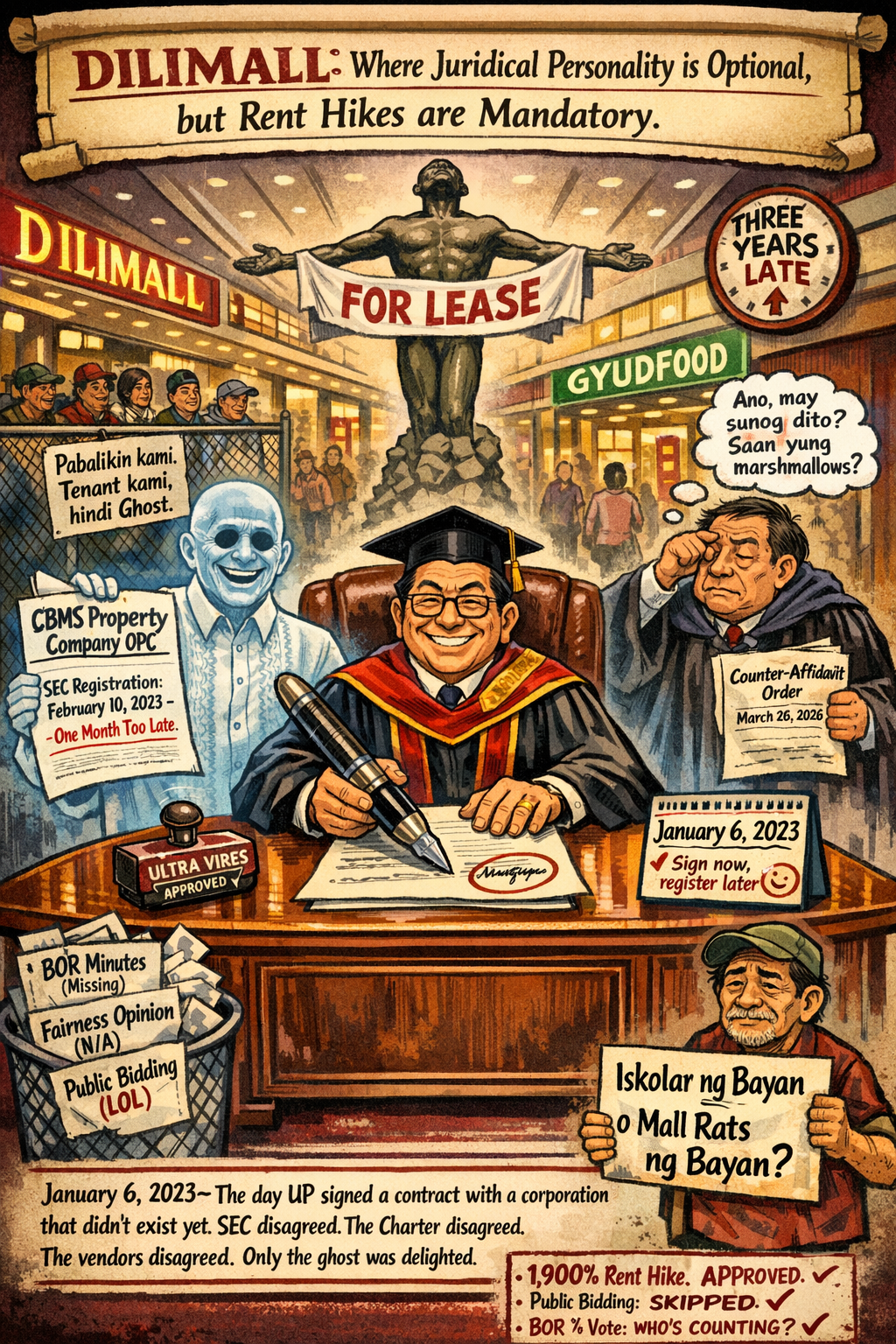
Phantom Corporation, 1,900% Rent Hike, and Evicted Vendors – Dilimall’s Graft Anatomy Finally Under Investigation
By Louis ‘Barok‘ C. Biraogo — April 12, 2026
BEHOLD, the Ivory Tower’s Board of Rental Agreements — that is, the UP Board of Regents — has finally been served. On March 26, 2026—three full years after the ink dried on those master lease agreements that turned the ashes of the old UP Shopping Center into the gleaming altar of Dilimall and the greasy altar of GyudFood—the Office of the Ombudsman remembered it had a job. Two crisp three-page orders landed on the desks of UP President Angelo Jimenez, his predecessor Danilo Concepcion, Vice President for Development Daniel Peckley, former Vice Chancellor Raquel Florendo, and the corporate midwives CBMS Property Company OPC and JoseBizCo Inc. “File your counter-affidavits within 15 non-extendible days,” the orders intone, as if the stench of this deal hadn’t been wafting across the campus since January 6, 2023.
This is not justice arriving fashionably late. This is a brand-new Ombudsman, who only took the oath last October, finally doing the legal equivalent of showing up to a fire three years after the marshmallows were toasted — then politely asking the arsonists for their side of the story. Let us, in the spirit of the Kweba ni Barok, prosecute the narrative with the cold scalpel of law and the hot poker of sarcasm.
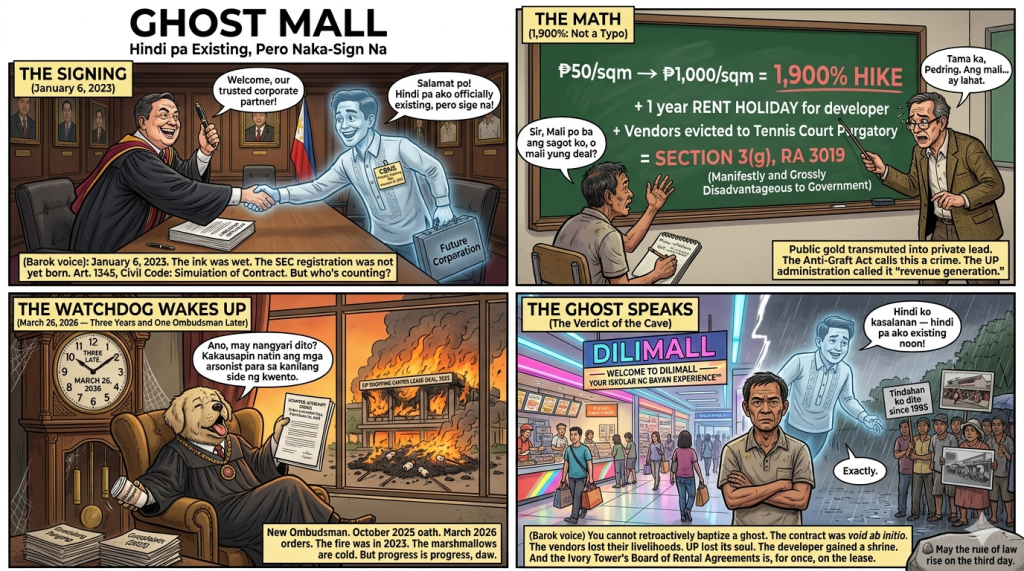
Legal Evisceration: Phantom Contracts, Trampled Charters, and Graft by the Numbers
Let us begin with The Ghost in the Lease. CBMS Property Company OPC—the anointed property management and consultancy firm handed the keys to Dilimall—did not exist when the Master Lease Agreement was signed on January 6, 2023. The Securities and Exchange Commission records are merciless: formal registration occurred on February 10, 2023. Over a month later. Under Section 18 and 19 of Republic Act No. 11232 (Revised Corporation Code of the Philippines), a corporation acquires juridical personality only upon issuance of its Certificate of Incorporation. Before that, it is a legal phantom, a non-entity, a figment of someone’s entrepreneurial imagination.
So what, pray tell, did UP officials sign with? A polite promise? A future tense? A very expensive autograph? This is not a “technicality.” This is textbook Simulation of Contract under Article 1345 of the Civil Code of the Philippines—where the parties appear to enter one agreement but actually intend something else entirely. The contract was stillborn. It never lived. And yet the UP administration treated it like holy writ.
Next, the UP Charter Bludgeon. The defense will undoubtedly trot out the sacred cow of “management prerogative.” Let us take Republic Act No. 9500 (University of the Philippines Charter of 2008) (the UP Charter), Section 23, and hold it up to the light like a counterfeit bill. Long-term leases exceeding five years—or any transaction under Section 22—require:
- prior discussion in a formal Board of Regents meeting at least one month in advance;
- a multi-year comprehensive development plan prepared by qualified urban planners with third-party concurrence;
- competitive public bidding under Republic Act No. 9184 (Government Procurement Reform Act);
- if bidding fails twice, a fairness opinion from an independent body; and
- for contracts over ₱50 million, approval by three-fourths (3/4) of all BOR members.
Where, mga ka-kweba, is the 3/4 vote? Where is the fairness opinion? Where is the democratic consultation with the very constituents the Charter was written to protect? Amending the UP Charter itself requires less paperwork than leasing a hotdog stand on campus, apparently. This was not prudent stewardship. This was ultra vires theater, performed by the Ivory Tower’s Board of Rental Agreements with the enthusiasm of a late-night infomercial.
And now, the Graft Anatomy—Republic Act No. 3019 (Anti-Graft and Corrupt Practices Act). Let us dissect with precision. Section 3(e) requires undue injury caused by manifest partiality, evident bad faith, or gross inexcusable negligence. Section 3(g) targets contracts that are manifestly and grossly disadvantageous to the government. Here we have both. A 1,900% rent hike—from ₱50 per square meter to ₱1,000 per square meter—coupled with a one-year rent holiday for the developer. Public land, public money (or rather, the absence of it), turned into private profit while original vendors were evicted to temporary tennis-court purgatory. This is not a bad deal. This is financial alchemy in reverse: public gold transmuted into private lead.
As the Supreme Court held in Lihaylihay v. People, gross negligence is the want of even slight care. The complainants’ evidence—SEC records, absence of BOR minutes, displacement without safeguards—screams it. Fuentes v. People defines bad faith as a dishonest purpose or some moral obliquity. And Land Bank v. Cacayuran reminds us that ultra vires acts of government instrumentalities are void. The Arias Doctrine (Arias v. Sandiganbayan)—that officials may rely on subordinates—has its limits. When the red flags are the size of the Oblation, reliance becomes complicity.
Motivations Exposed: Revenue Zealots, Slow-Burn Watchdogs, and the Vendor Auditors
The UP officials will wrap themselves in the noble cloak of “revenue generation.” Yes, the university is underfunded. Yes, the 2018 fire left a scar. But turning the Academic Oval into a commercial lease portfolio is not “visionary leadership.” It is bureaucratic pragmatism poisoning public trust. In my previous piece, I warned we were turning Iskolar ng Bayan into Mall Rats ng Bayan. The prophecy has been fulfilled with air-conditioning and a food court.
The Ombudsman’s slow burn is the real scandal within the scandal. The complaints were filed last year. The deal stank in 2023. Yet only now—March 2026, six months after the present Ombudsman finally assumed office last October 2025—do we get this oh-so-polite invitation to counter-affidavit. Progress, I suppose. Is this the Arias Doctrine in slow motion? Can a UP President hide behind his Vice President for Development when the act is so patently ultra vires? The displaced vendors of the old shopping center are not helpless victims. They are the true auditors of the public trust. Their economic displacement is the very “undue injury” Section 3(e) was written to punish. They lost livelihoods. UP lost its soul. The developers gained a shrine.
Call to Arms: Nullify the Ghost Deal or Face Preventive Suspension
Ratification cannot cure a void contract. You cannot retroactively baptize a ghost. This deal must be nullified ab initio. The Board of Regents must release the BOR minutes immediately—if they exist. If they do not, the Ombudsman should impose preventive suspension under the Republic Act No. 6770 (The Ombudsman Act of 1989) pending full investigation. And spare me the inevitable “compromise” where displaced vendors are offered a senior-citizen discount at GyudFood. That is not justice. That is insult with fries.
This is not merely a legal case. It is a moral referendum on the UP Charter. Is UP an institution of higher learning, or a glorified lessor with a basketball team and a food court?
Final Barok Salvo: Due Diligence? Accountability? Or Just Another Monday at the Ivory Tower?
If the law requires due diligence, the Constitution demands accountability, and the UP Charter mandates transparent consultation with the very Iskolars it claims to serve—what do we call it when the nation’s premier university requires none of the above, just a valid SEC registration filed a month late? I believe the legal term is “Monday.” But in the Kweba ni Barok, we call it a crime scene.
The counter-affidavits are due. The ghosts are watching. And the Ivory Tower’s Board of Rental Agreements is, for once, on the lease.
— Barok
Key Citations
A. Legal & Official Sources
- Arias v. Sandiganbayan. G.R. Nos. 81563 & 82512, Supreme Court of the Philippines, 19 Dec. 1989, The LawPhil Project.
- Civil Code of the Philippines. Republic Act No. 386, The LawPhil Project. 1949.
- Fuentes v. People. G.R. No. 186421, Supreme Court of the Philippines, 17 Apr. 2017, The LawPhil Project.
- Land Bank of the Philippines v. Cacayuran. G.R. No. 191667, Supreme Court of the Philippines, 17 Apr. 2013, The LawPhil Project.
- Lihaylihay v. People. G.R. No. 191219, Supreme Court of the Philippines, 31 July 2013, The LawPhil Project.
- Republic Act No. 11232. An Act Providing for the Revised Corporation Code of the Philippines. The LawPhil Project. 2019.
- Republic Act No. 3019. Anti-Graft and Corrupt Practices Act. The LawPhil Project. 1960.
- Republic Act No. 6770. The Ombudsman Act of 1989. The LawPhil Project.1989.
- Republic Act No. 9184. Government Procurement Reform Act. The LawPhil Project 2003.
- Republic Act No. 9500. University of the Philippines Charter of 2008. 2008, The LawPhil Project.
B. News Reports
- Reyes, Dempsey. “Ombudsman Orders UP Officials to Answer Complaints on Mall, Food Hub.” Inquirer.net, 11 Apr. 2026.
- Biraogo, Louis “Barok” C. “DiliMall: The Jimenez Administration’s Masterclass in Turning Iskolar ng Bayan into Mall-Rats ng Bayan.” Kweba ni Barok, 26 Dec. 2025.
- ₱8B BBM Pork: CCTV for Every Captain’s Kumpare?
- ₱75 Million Heist: Cops Gone Full Bandit

- ₱6.7-Trillion Temptation: The Great Pork Zombie Revival and the “Collegial” Vote-Buying Circus

- ₱1.9 Billion for 382 Units and a Rooftop Pool: Poverty Solved, Next Problem Please

- ₱1.35 Trillion for Education: Bigger Budget, Same Old Thieves’ Banquet

- ₱1 Billion Congressional Seat? Sorry, Sold Out Na Raw — Si Bello Raw Ang Hindi Bumili

- “We Will Take Care of It”: Bersamin’s P52-Billion Love Letter to Corruption

- “Skewed Narrative”? More Like Skewered Taxpayers!

- “Scared to Sign Vouchers” Is Now Official GDP Policy – Welcome to the Philippines’ Permanent Paralysis Economy

- “Robbed by Restitution?” Curlee Discaya’s Tears Over Returning What He Never Earned

- “No Pressure” Luistro? The House Pork Bazaar Exposed
- “My Brother the President Is a Junkie”: A Marcos Family Reunion Special


 KWEBA ni BAROK
Leave a comment