No TRO, No Excuse: Why “Judicial Courtesy” Doesn’t Bind a Co-Equal Congress
By Louis ‘Barok‘ C. Biraogo — April 12, 2026
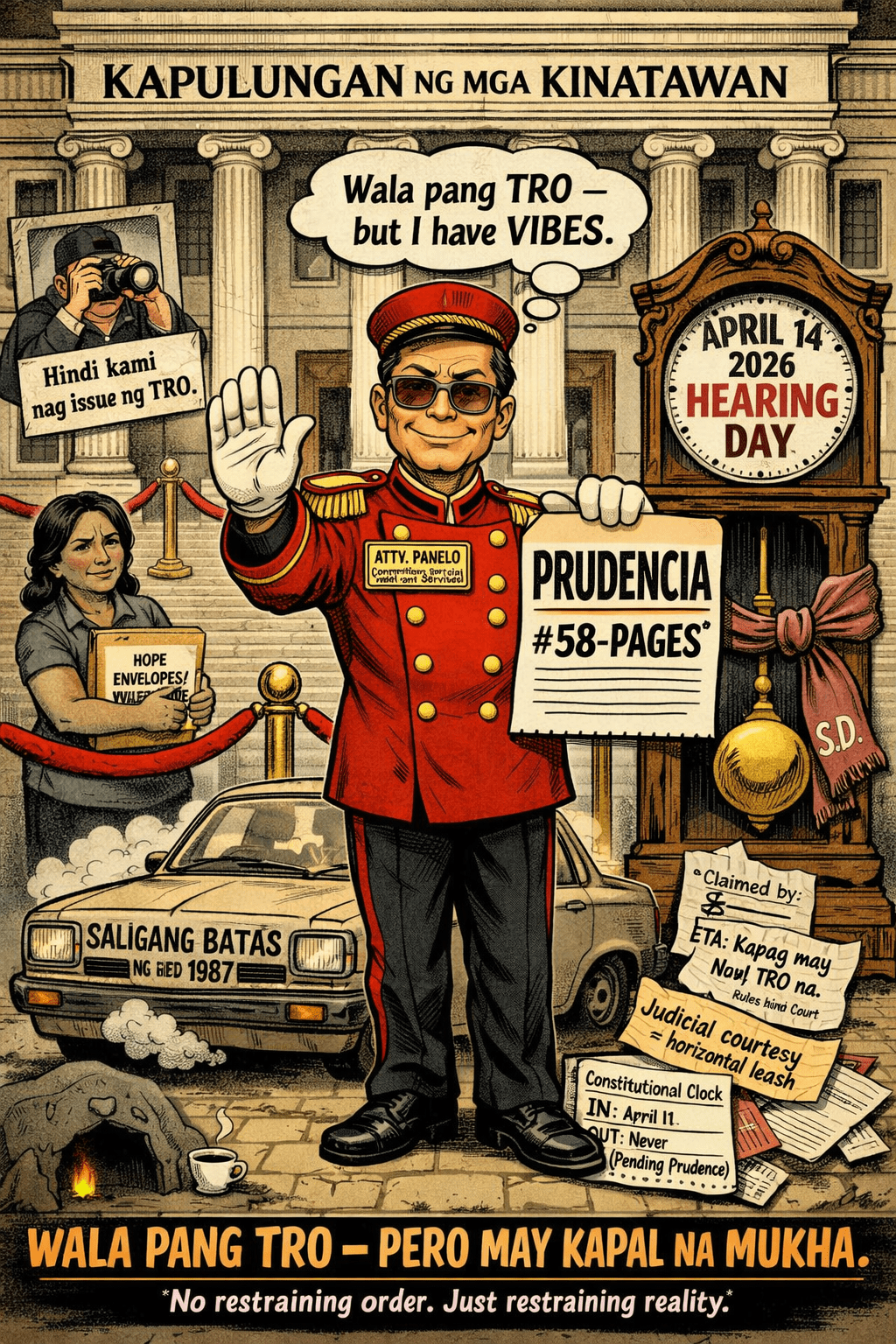
OH, LOOK — Attorney Paolo Panelo has entered the chat, armed with fresh “prudence” and zero TRO.
Fresh from defending his client in the perjury case against her alleged bagman, he has now graced SMNI with pearls of wisdom: the House Committee on Justice should hit the pause button on the April 14, 2026 impeachment hearing against Vice President Sara Duterte. Not because the Supreme Court issued a TRO — it didn’t. Not because the Constitution commands it — it doesn’t. But because… prudence.
You know, that magical legal doctrine that apparently turns co-equal branches into eager interns waiting for the boss to finish his coffee.
Let us dissect this with the cold precision of a ponencia and the warmth of a flamethrower.
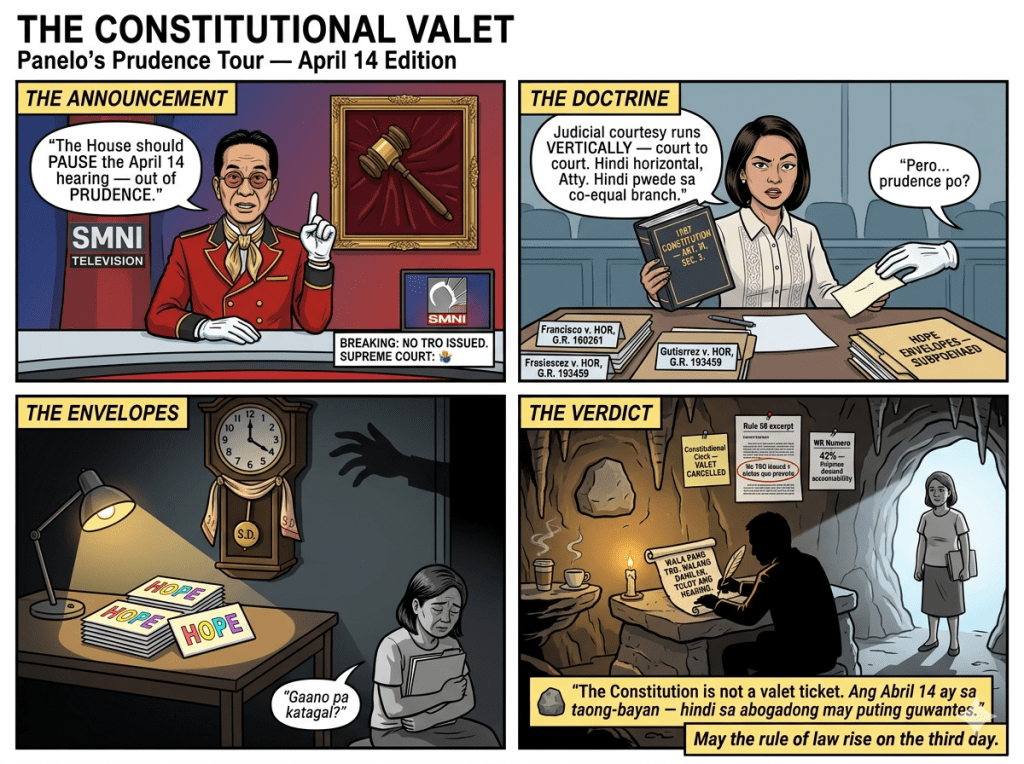
Ang Saligang Batas ay hindi parking stub na hawak ng abogado ng respondente.
Panelo’s “Prudence”: Vertical Doctrine or Horizontal Leash?
Panelo’s pitch, stripped of its velvet glove: even without a temporary restraining order, the House — that “lower court” in his telling — should voluntarily suspend proceedings out of “deference” to the Supreme Court. After all, a litigant has filed a 58-page petition for certiorari and prohibition. Bloodbath rhetoric notwithstanding, the Republic must apparently wait for the valet to bring the car around.
For the sake of intellectual honesty, let us state the argument for Panelo. Judicial courtesy exists. Lower courts routinely defer when the High Court is seized of a matter to avoid conflict, mootness, or constitutional crisis. Efficiency, he says. Due process, he implies. Why risk wasting everyone’s time if the SC might later slap the House’s wrist?
Now watch that flimsy argument go up in constitutional smoke.
Judicial courtesy is a vertical doctrine — it runs from inferior courts to superior ones within the same branch. The House of Representatives is not a “lower court.” It is a co-equal branch exercising its exclusive constitutional power under Article XI, Section 3 of the 1987 Constitution of the Republic of the Philippines. The Supreme Court does not issue marching orders to Congress like a traffic enforcer directing a tricycle.
Rule 58 of the Rules of Court is equally unforgiving. A preliminary injunction or TRO requires a clear legal right and urgent necessity. Absent either, the status quo prevails. The House has scheduled the hearing. No restraining order exists. Ergo, the constitutional clock keeps ticking.
The precedents Panelo conveniently forgets hammer this home. In Francisco v. House of Representatives (G.R. No. 160261, 10 November 2003), the Supreme Court intervened only upon a clear showing of grave abuse of discretion — specifically the one-year bar violation. It did not invent a “filing equals freeze” rule. In Gutierrez v. House Committee on Justice (G.R. No. 193459, 15 February 2011), the Court reaffirmed that impeachment is primarily a political process. Judicial review is the exception, not the default pause button.
Panelo is not invoking prudence. He is peddling anticipatory surrender dressed in lawyerly robes.
Who Controls the Clock? (Litigants or the People?)
This is not about procedure. This is about power — specifically, who gets to decide when accountability happens.
If Panelo’s theory prevails, any impeachable official need only sprint to Padre Faura, file a certiorari petition, and — presto! — the House of Representatives becomes a glorified spectator in its own constitutional arena. The democratic clock that belongs to the people’s elected representatives is replaced by the litigant’s tactical stopwatch.
Impeachment risks becoming not a constitutional duty, but a process subject to tactical delay at the mere filing of a petition.
The Duterte camp has already warned of a “bloodbath” if forced to defend itself. Now they want the House to preemptively holster its subpoena powers because… reasons. The “Block 2028” narrative — the Duterte camp’s claim that the impeachment complaints are a calculated political maneuver to derail her early-announced presidential bid for 2028 — is cute, but the Constitution is clearer: only conviction by the Senate (two-thirds vote) disqualifies. Impeachment itself is not disqualification; it is sunlight. And sunlight, apparently, is what they fear most.
HOPE Envelopes and the Art of Tactical Stalling
Delay is never neutral. Especially when the House subpoena has already targeted the “HOPE” envelopes — those charmingly labeled packets of cash allegedly delivered to then-DepEd Undersecretary Gloria Jumamil Mercado, courtesy of Assistant Secretary Sunshine Fajarda, who supposedly said they came “directly from Vice President Duterte.”
Republic Act No. 3019 (Anti-Graft and Corrupt Practices Act), Section 3(b) does not look kindly on public officers receiving gifts in connection with their duties. Republic Act No. 6713 (Code of Conduct and Ethical Standards for Public Officials and Employees) demands accountability and integrity. And Article XI, Section 2 lists “betrayal of public trust” as an impeachable offense precisely because the people have a right to demand it before evidence goes stale, witnesses get exhausted, and public attention span collapses ahead of the 2028 circus.
Every day of “prudent” delay is a day the paper trail cools, memories fade, and the WR Numero survey’s clear message — 42% of Filipinos want lawmakers to consider public opinion, 29% want evidence weighed seriously — gets drowned out by the usual noise machine.
The people, per the March 10-17, 2026 survey, are not asking for theater. They are asking for the truth. Panelo’s prudence is the sound of that truth being slowly suffocated under procedural pillows.
Verdict: House Must Proceed – No TRO, No Excuse
The House must proceed with the April 14 hearing unless and until the Supreme Court issues an actual TRO. Anything less is constitutional cowardice masquerading as institutional respect.
Strengthen democratic institutions by rejecting the normalization of “anticipatory surrender.” The House’s exclusive domain under Article XI is not a suggestion; it is the people’s shield against executive impunity. Let the Supreme Court do its job — review for grave abuse if and when it arises — but do not hand the Republic’s accountability mechanism to the first lawyer who files a pleading.
Genuine public service demands pro-people governance that does not treat impeachment as an inconvenience to be lawyered away. The WR Numero survey is not a suggestion; it is a mandate from the sovereign. Examine the evidence. Weigh the HOPE envelopes. Let the process breathe.
Recommendations, because unlike some, I still believe in remedies:
- The House Committee on Justice should issue a formal statement: “No TRO, no delay. The Constitution is not optional.”
- Congress should consider a housekeeping resolution affirming that the mere pendency of a certiorari petition does not suspend its exclusive impeachment powers.
- The Supreme Court, for its part, should move with deliberate speed — not to indulge delay tactics, but to remind everyone that judicial review is a scalpel, not a veto pen.
- The public should keep the pressure on. Noise is easy. Evidence is hard. Demand the latter.
Attorney Panelo is entitled to his day in court. He is not entitled to put the Republic on hold while he waits for the valet to bring the Constitution around.
— Barok
Key Citations
A. Legal & Official Sources
- The 1987 Constitution of the Republic of the Philippines. Official Gazette of the Republic of the Philippines, 1987.
- Republic Act No. 3019. An Act Declaring Unlawful Any Act of Graft and Corrupt Practices and Providing the Appropriate Penalties. The LawPhil Project. 1960.
- Republic Act No. 6713. An Act Establishing a Code of Conduct and Ethical Standards for Public Officials and Employees. The LawPhil Project, 1989.
- Francisco, Jr. v. House of Representatives. G.R. No. 160261, Supreme Court of the Philippines, 10 Nov. 2003, The LawPhil Project.
- Gutierrez v. House of Representatives Committee on Justice. G.R. No. 193459, Supreme Court of the Philippines, 15 Feb. 2011, The LawPhil Project.
B. News Reports
- Clapano, Jose Rodel, and Ghio Ong. “House Panel Should Wait for SC Decision on Duterte.” Philstar, 11 Apr. 2026.
- Basilio, Kenneth Christiane. “Ortega: Filipinos Want Sara Duterte Impeachment Weighed on Evidence.” Inquirer.net, 10 Apr. 2026.
- “Forthwith” to Farce: How the Senate is Killing Impeachment—And Why Enrile’s Right (Even If You Can’t Trust Him)
- “HINDI AKO NAG-RESIGN!”

- “I’m calling you from my new Globe SIM. Send load!”

- “Mahiya Naman Kayo!” Marcos’ Anti-Corruption Vow Faces a Flood of Doubt

- “Meow, I’m calling you from my new Globe SIM!”

- “No Special Jail for Crooks!” Boying Remulla Slams VIP Perks for Flood Scammers

- “PLUNDER IS OVERRATED”? TRY AGAIN — IT’S A CALCULATED KILL SHOT

- “Several Lifetimes,” Said Fajardo — Translation: “I’m Not Spending Even One More Day on This Circus”

- “Shimenet”: The Term That Broke the Internet and the Budget
- “We Did Not Yield”: Marcos’s Stand and the Soul of Filipino Sovereignty

- “We Gather Light to Scatter”: A Tribute to Edgardo Bautista Espiritu

- $150M for Kaufman to Spin a Sinking Narrative


 KWEBA ni BAROK
Leave a comment