
Shirtless, Singing, or Just Poor? Welcome to Cebu’s Martial Law-Lite Under Safer Cities
By Louis ‘Barok‘ C. Biraogo — April 13, 2026
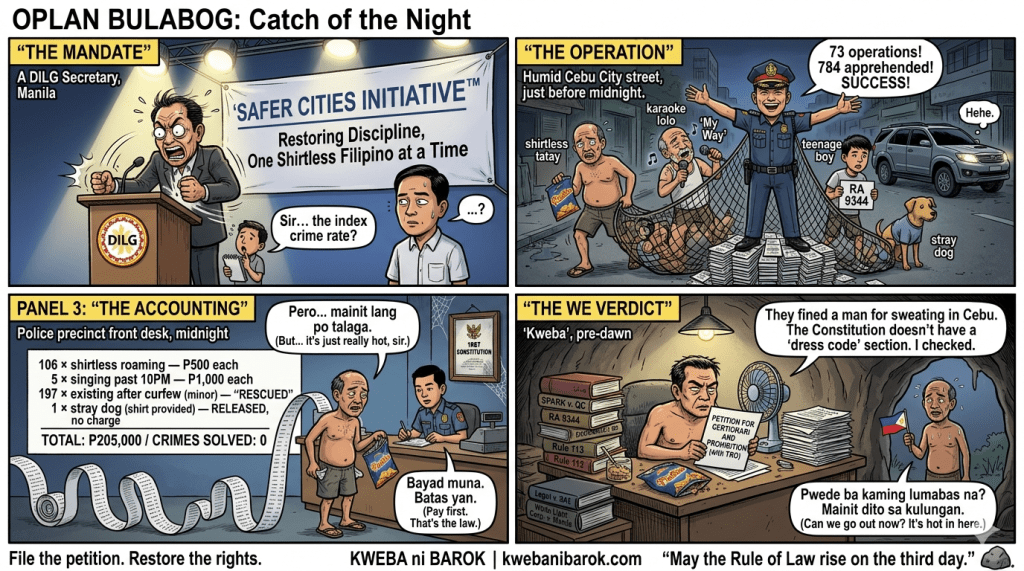
THE encore nobody clapped for has arrived, and if you still have a pulse, you’d better start trembling. Fresh from my last dispatch, From Podium to Police State: Jonvic Remulla’s Illegal War on Street Life, where I warned that the DILG Secretary’s “discipline” crusade was less law enforcement and more authoritarian cosplay, we now have Exhibit A in Cebu City: 784 apprehensions in one night. April 9, 2026. Oplan Bulabog and Oplan Pakigsandurot, the dynamic duo of performative policing, netting shirtless pedestrians, karaoke crooners past 10 p.m., public smokers, drinkers, and 197 minors “rescued” for the crime of existing after curfew.
Col. George Ylanan, CCPO Director, and Mayor Nestor Archival Sr.’s finest, in lockstep with Remulla’s Safer Cities Initiative, collected P205,000 in fines (some reports say P256,000) while issuing warnings to 565 others. SunStar Cebu called it a “success.” I call it a constitutional clown show dressed in police uniforms. This isn’t safer cities. This is safer photo-ops — optics over order, quotas over rights, and the Rule of the Stick over the Rule of Law.
Let me eviscerate this spectacle, point by surgical point, with the 1987 Constitution of the Republic of the Philippines, Republic Act No. 9344 (Juvenile Justice and Welfare Act), Rule 113 of the Rules of Court, Republic Act No. 7160 (Local Government Code), and the landmark SPARK v. Quezon City (G.R. No. 225442) precedent as my scalpel. Because when the state turns public spaces into a dragnet for the poor and the young, even a legal pitbull like me starts foaming at the mouth.
In a tropical country.
Where the sun hits 35 degrees.
The Constitution has no Section on Humidity.
Barok checked.”
Safer Cities Policy: Optics Over Order
The DILG’s brainchild — and Cebu’s eager execution — claims authority under RA 7160’s General Welfare Clause (Section 16). Fine. LGUs can pass ordinances for “public order, safety, and morality.” But police power has never been a blank check. It must be reasonable, not a rubber stamp for midnight roundups of the nakahubad and the tone-deaf.
This is politically convenient theater. Remulla pounds the podium in Manila about “restoring discipline.” Ylanan pounds the pavement in Cebu with 73 operations in one night. Result? A city where “safer” means fewer visible poor people, not fewer actual crimes. It’s the same failed script from Manila and Navotas that the Supreme Court already shredded.
The 784 Arrests: Dragnet, Not Due Process
Oplan Bulabog and Pakigsandurot weren’t surgical strikes against crime. They were assembly-line warrantless roundups: 106 for “shirtless roaming,” 139 traffic, 39 obstructions, 5 for excessive karaoke noise. Rule 113, Section 5 of the Rules of Court is crystal clear — warrantless arrests only when the offense is committed in the presence of the officer with personal knowledge of facts indicating a crime. These weren’t crimes; they were ordinance violations. Most should have been citations, not custody. Yet 784 bodies were processed like a midnight barangay raffle.
This is not law enforcement. This is volume policing — the kind that makes blotters look busy while index crime clearance rates gather dust.
Criminalization of Poverty: Fines for Existing While Poor
Fining a man P500 for being shirtless in 35-degree Cebu heat because he doesn’t own an air-conditioned SUV? That’s not anti-indecency. That’s class warfare with a receipt. The anti-indecency ordinance (passed November 2025) is a cultural tone-deaf disaster in a tropical archipelago where “half-naked” is how most laborers survive the sun. Wealthy violators drive off in their Fortuners. The poor pay or plead. Equal protection under Article III, Section 1 ? Crushed flatter than a jeepney tire.
Over-Policing Minor Offenses: Karaoke Gets the Heat
Karaoke at 10:01 p.m. gets the full Bulabog treatment. Meanwhile, the PNP’s national clearance rate for index crimes remains the embarrassing secret nobody in Malacañang wants to discuss. Priorities, anyone? The state chases singing uncles while murder, theft, and extortion cases collect cobwebs. This is not public safety. This is public relations.
Kotong Economy: Discretion Breeds Extortion
Give beat cops on-the-spot fine power with zero real oversight and what do you get? The classic Philippine “kotong” pipeline. Pay now or we process you. The research dossiers scream it: coercive fine collection without counsel, without rights advisories, in mass operations. Command responsibility lands squarely on Col. Ylanan. When discretion meets quotas, human rights become optional.
Chilling Effect: Martial Law-Lite for the Streets
A city where you can be accosted for “indecency” (translation: existing while poor and warm) is a city where the rights to loiter, travel (Article III, Section 6), and simply be are under siege. This is not order. This is the slow normalization of fear. The chilling effect is real: vendors, youth, informal workers now self-censor their very presence. Welcome to Cebu, where the Constitution takes a backseat to the citation book.
Juvenile Rights Nightmare: 197 Minors vs. RA 9344
Section 57-A of Republic Act No. 9344 (as amended) is not optional reading. It states, verbatim:
“Status Offenses. – The following shall not be considered as offenses and shall not be penalized: (a) Being a minor in a curfew hour; (b) Loitering; (c) Running away from home; and (d) Other analogous acts.”
These are status offenses — not criminal. Children at risk, not children in conflict with the law. Mandatory diversion, immediate turnover to parents/guardians/DSWS, no custodial detention as punishment. Yet 197 minors were “taken into custody” in one night and funneled to DSWS like midnight cargo. Logistical nightmare? Absolutely. Violation of the law’s spirit of protection and diversion? In neon letters. SPARK already warned us: curfews must have broad exemptions and least restrictive means. Cebu’s dragnet fails both.
Quota System Stench: Arrests or Revenue Grab?
P205,000 in one night. 784 bodies. 73 operations. The numbers game reeks. Is the goal safer streets or a juicier collection receipt for the city treasurer? The dossiers lay it bare: allegations of pressure for numbers, revenue incentives, urban cleansing for tourism optics. Pakigsandurot was re-launched for “community engagement.” This feels like community extraction.
Political Signaling: Podium Tantrum Meets Pavement Pound
Connect the dots. Remulla’s national “discipline” hunger meets Ylanan’s operational zeal and Archival’s local agenda. This is theater for an audience craving the illusion of control — regardless of legality. The previous piece nailed it: from podium to police state. Cebu is just the latest stage.
Strict Scrutiny: SPARK Test Flunks This Farce
The Supreme Court in SPARK applied strict scrutiny: (1) compelling state interest, and (2) least restrictive means. Shirtless roaming in tropical heat? Compelling? Please. Dragnet roundups? Least restrictive? Laughable. The ordinances may be prima facie valid under RA 7160, but enforcement is arbitrary, overbroad, and selective. Ynot v. IAC, White Light Corporation v. City of Manila, and Social Justice Society v. Dangerous Drugs Board all scream the same: police power dies when it becomes abusive.
Motivations Unpacked: Who Really Wins?
- Remulla & DILG: National narrative of “tough love” for elections and optics.
- Ylanan & CCPO: Operational metrics, career points, DILG compliance.
- City Hall: Visible “action” while ignoring root causes like poverty.
- The beat cop: Discretion plus pressure equals temptation.
Revenue, signaling, cleansing — none of it justifies trampling rights.
The Barok Verdict: Rule of Law Over the Stick
This is not discipline. This is discretionary despotism. The Safer Cities Initiative, as practiced in Cebu, is legally fragile, constitutionally bankrupt, and morally grotesque.
We have prepared the Petition for Certiorari and Prohibition (with TRO application) and the CHR Complaint-Affidavit exactly for this. They are ready for filing. They demand:
- Immediate TRO halting the dragnet.
- Declaration that current enforcement is unconstitutional.
- Rights-compliant protocols: individualized probable cause, mandatory rights advisories, proper juvenile diversion under RA 9344 Section 57-A, body cameras, and an end to quota-driven absurdity.
To the PNP, DILG, and City Hall: Enforce the law — strictly, lawfully, humanely. No more assembly-line justice for the poor. No more midnight processing of minors. No more fining sweat in the name of decency.
To the citizens of Cebu and the nation: The right to be — even shirtless, even singing badly, even poor — is non-negotiable. File your own complaints. Support the Petition. Demand the supremacy of the Rule of Law over the Rule of the Stick.
Because if we let them criminalize poverty, karaoke, and a warm breeze, the next dragnet won’t stop at the street corner. It will reach your doorstep.
This is Barok. Still watching. Still armed with the Constitution and zero tolerance for nonsense.
File the cases. Restore the rights. Or watch the police state grow one citation at a time.
Key Citations
A. Legal & Official Sources
- Philippines. The 1987 Constitution of the Republic of the Philippines. 1987. Official Gazette of the Republic of the Philippines.
- Philippines. Republic Act No. 7160: An Act Providing for Local Government Code of 1991. 10 Oct. 1991. Official Gazette of the Republic of the Philippines.
- Philippines. Republic Act No. 9344: Juvenile Justice and Welfare Act of 2006. 28 Apr. 2006. Lawphil.
- Supreme Court of the Philippines. “Rule 113, Section 5.” Rules of Court, 1997 (as amended), LawPhil.
- Philippines, Supreme Court. Samahan ng mga Progresibong Kabataan (SPARK) v. Quezon City. G.R. No. 225442, 8 Aug. 2017. Lawphil.
- Philippines, Supreme Court. Ynot v. Intermediate Appellate Court. G.R. No. 74457, 20 Mar. 1987. Lawphil.
- Philippines, Supreme Court. White Light Corporation v. City of Manila. G.R. No. 122846, 20 Jan. 2009. Lawphil.
- Philippines, Supreme Court. Social Justice Society v. Dangerous Drugs Board. G.R. No. 157870, 3 Nov. 2008. Lawphil.




 KWEBA ni BAROK
Leave a comment