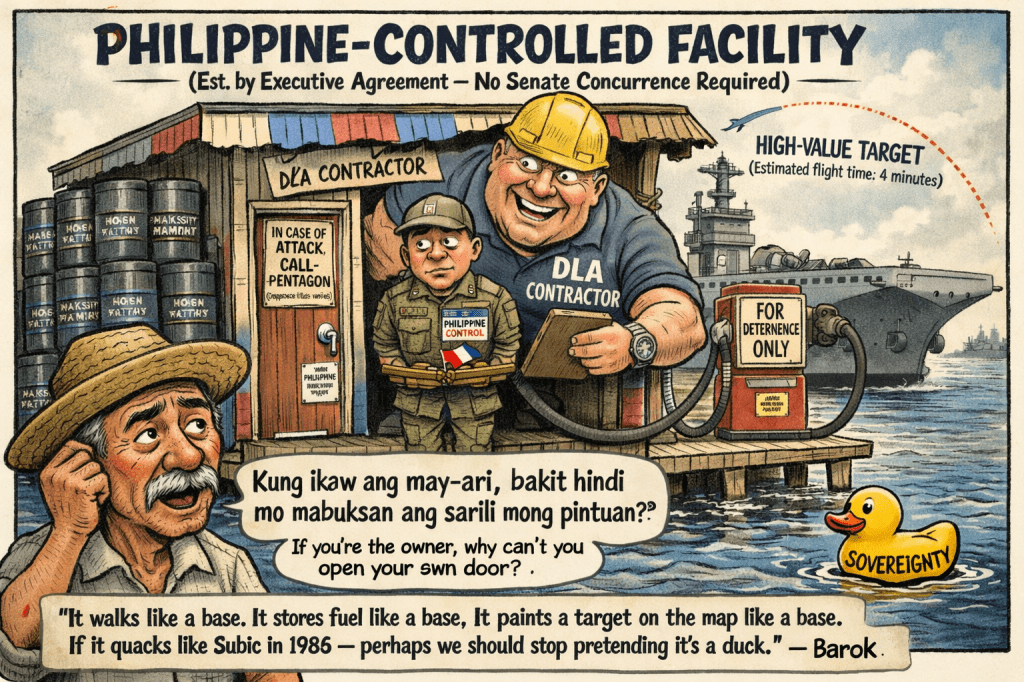
From “Philippine-controlled facility” to high-value target: How one depot in Mindanao could turn the Philippines into America’s unsinkable refueling stop.
By Louis ‘Barok‘ C. Biraogo — April 13, 2026
My fellow Filipinos,
Picture this: It’s 2026, the South China Sea is simmering like a pot about to boil over, and the Armed Forces of the Philippines (AFP) is standing before us with the straightest of faces, telling us that a shiny new American fuel depot in Mindanao—41 million gallons of U.S.-owned kerosene, run by a U.S. contractor—isn’t a base.
It’s a “Philippine-controlled facility.” Just a helpful little gas station for typhoons and maritime security. Nothing to see here, folks. Move along.
I am Louis “Barok” C. Biraogo, forensic pathologist of Philippine sovereignty, and today we are performing the autopsy on the Philstar report titled “AFP OK with planned US refueling depot in Mindanao.” The body on the table is not just a logistics plan.
It is the latest incision in the long, slow surgery being performed on our 1987 Constitution. Scalpel, please.
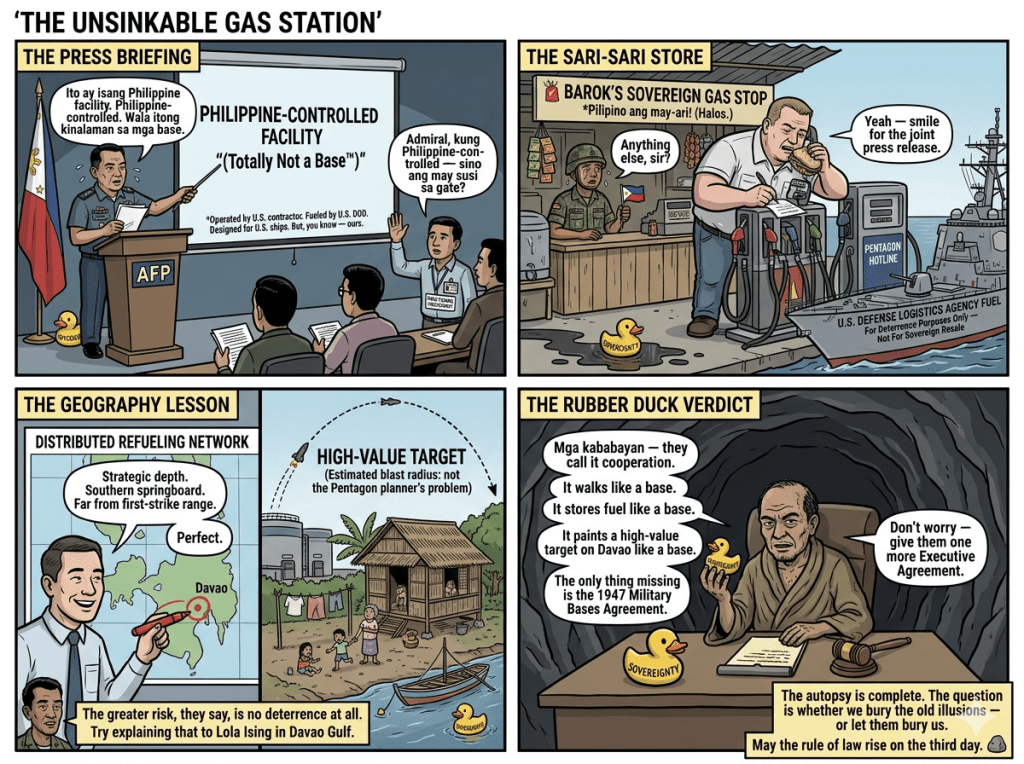
Beijing calls it a high-value target.
We call it Davao.
Lola Ising wasn’t consulted.” 🪨
1. The Legal Shell Game: Fig Leaf, Meet Constitution
Let us begin with the linguistic contortion that makes contortionists blush. Rear Admiral Roy Vincent Trinidad insists this will be a “Philippine facility, Philippine controlled.”
The AFP chief, Gen. Romeo Brawner Jr., nods solemnly. EDCA and the Visiting Forces Agreement, they say, cover it all. The Supreme Court’s 2016 Saguisag ruling supposedly blessed this arrangement as a mere “implementing agreement” to the Mutual Defense Treaty—no Senate ratification required.
Calling this a “Philippine-controlled facility” is like calling the parking lot outside Yankee Stadium “New York-owned.” Technically true—until the Yankees decide they need it for the World Series and suddenly the lot is full of their equipment, their staff, and their rules.
Here, the U.S. Defense Logistics Agency is soliciting an American contractor to store and operate American-owned fuel for American ships and planes. The depot is explicitly designed to support U.S. operations in the West Philippine Sea and the southern border.
The “Philippine control” is the fig leaf; the substance is forward logistics for someone else’s deterrence strategy.
The Saguisag Court gave the executive branch the benefit of the doubt because the deal was dressed up as temporary and rotational. But when the fuel is prepositioned for years, the operator is American, and the purpose is to keep U.S. forces fueled during a potential high-intensity conflict, the form has been devoured by the substance.
This is not cooperation. It is constitutional bypass surgery performed without the patient’s full consent.
2. The Mindanao Equation: Why Plant the Depot on Duterte’s Old Turf?
Why Davao? Why now? The Pentagon wants a distributed refueling network far from the vulnerable northern ports—Subic and Manila—that would be sitting ducks in any Taiwan or South China Sea flare-up.
Mindanao gives them strategic depth, access to the Sulu and Celebes Seas, and a southern springboard. Perfect on paper.
But politically? This is the former fiefdom of Rodrigo Duterte—the man who threatened to tear up the VFA, flirted with Beijing, and warned that Washington “won’t die for us.”
His son still runs Davao City. The military itself was denying rumors of an EDCA site in Davao as recently as March. Suddenly, in April, it’s all systems go.
Is this a deliberate wedge between the Marcos and Duterte camps, or a quiet unified front of the Philippine elite? Either way, the irony is deliciously bitter.
A facility sold to us as “humanitarian assistance and disaster response” (HADR) is being prepositioned for a typhoon of an entirely different kind—one made of Chinese hypersonic missiles. We are told it will help us respond to typhoons. Sure.
And the aircraft carrier parked next door will help us respond to traffic.
3. The Gulf State Precedent: When Allies Become Targets
Let us be brutally fair and look abroad. Gulf Arab states welcomed U.S. installations for decades. They, too, were promised deterrence and protection.
Then came the U.S.-Israel-Iran maelstrom, and those very bases became legitimate military targets. Retaliation rained down. Civilians paid the price.
The hosts discovered that “alliance-centered deterrence” is a lovely euphemism until the missiles start flying—and the superpower that built the target is not the one absorbing the first hits.
Now imagine that logic transplanted to Davao Gulf. In any U.S.-China clash—whether over Taiwan or the Spratlys—this depot becomes a high-value target.
The AFP assures us it “will not be a magnet for attacks.” That is a comforting thought—right up there with “the iceberg won’t sink the ship” and “the subprime mortgage won’t crash the economy.”
Who bears the eviscerating cost if the gamble goes south? Not the Pentagon planners in Washington. Not the contractors cashing checks.
It will be Filipino families in Davao, Filipino fishermen in the gulf, Filipino soldiers sent to defend a facility whose strategic purpose was never written by Filipinos.
4. The Lexicon of Subordination: “The Greater Risk Is No Deterrence”
The AFP’s mantra is now official doctrine: “The greater risk is to have no deterrence at all.” Translation: better to be a well-armed junior partner than a sovereign actor with empty tanks.
This is not strategy; it is the intellectual laziness of the client state. We are trading the slow, corrosive erosion of sovereignty for the immediate, shiny object of “credible deterrence”—a deterrence that, when the balloon goes up, will be paid for with American credit and Filipino blood.
We are told to be grateful for the strength of this alliance. But one must wonder: if you have to keep telling everyone you’re an equal partner, are you really?
5. The Fork in the Road: Cooperation… or the Quiet Return of the Bases?
So here is the mocking question we must ask out loud: Is this still cooperation, or just the quiet return of the bases under a different, more palatable acronym?
It walks like a base, stores fuel like a base, paints a target on the map like a base, and is operated under an executive agreement that bypasses the Senate exactly like a base.
If it quacks like Subic in 1985, perhaps we should stop pretending it’s a duck.
6. The Biraogo Manifesto: A Security Framework That Does Not Turn Us Into an Unsinkable Gas Station
Enough autopsy. Time for the prescription.
We do not need slogans. We need a security framework that treats the Philippines as the subject of its own defense narrative, not the object of American logistics.
Demand reciprocal benefits—real ones, not photo-ops. Demand sovereign oversight that is not nominal but actual: Philippine commanders with veto power over operations that affect our territory.
Demand environmental impact studies, local consultations, and ironclad liability clauses before a single gallon of foreign fuel touches Davao soil.
Pursue alternatives that do not mortgage our future: accelerated indigenous missile and naval programs, genuine ASEAN-centered diplomacy that does not require us to choose sides in someone else’s great-power duel, and energy independence so that our fuel depots serve Filipinos first.
Insist on Senate concurrence for any expansion of foreign military access—because that is what the Constitution demands, not what the executive finds convenient.
To my countrymen—Marcos supporters, Duterte loyalists, nationalists, leftists, and everyone in between—this is not about personalities. This is about whether we remain masters in our own house or become the unsinkable gas station for someone else’s war.
Let us choose collective unity, shared hope, and steadfast determination to build a more independent, effective, and sustainable security framework. One that safeguards our national interests without compromising our sovereignty.
One that never reduces the Republic to subordinate status—exploited without fair compensation or reciprocal benefit.
The choice is ours. The autopsy is complete. The question is whether we will bury the old illusions—or let them bury us.
Respectfully,
Barok
Key Citations
A. News Articles
- Punongbayan, Michael. “AFP OK with Planned US Refueling Depot in Mindanao.” Philstar, 12 Apr. 2026.
- Lariosa, Aaron-Matthew. “Pentagon Adds to Pacific Refueling Capacity with New Philippine Depot.” USNI News, 7 Apr. 2026.
- Reuters. “Philippine President Rodrigo Duterte Threatens to End U.S. Military Pact.” NBC News, 24 Jan. 2020.
- “Gulf Countries That Host U.S. Military Bases Say Iran Has Retaliated to U.S. Strikes.” NPR, 28 Feb. 2026.
B. Court Decisions
- Philippines, Supreme Court. Saguisag v. Executive Secretary. G.R. No. 212426, 12 Jan. 2016. LawPhil.
- ₱8B BBM Pork: CCTV for Every Captain’s Kumpare?
- ₱75 Million Heist: Cops Gone Full Bandit

- ₱6.7-Trillion Temptation: The Great Pork Zombie Revival and the “Collegial” Vote-Buying Circus

- ₱1.9 Billion for 382 Units and a Rooftop Pool: Poverty Solved, Next Problem Please

- ₱1.35 Trillion for Education: Bigger Budget, Same Old Thieves’ Banquet
- ₱1 Billion Congressional Seat? Sorry, Sold Out Na Raw — Si Bello Raw Ang Hindi Bumili

- “We Will Take Care of It”: Bersamin’s P52-Billion Love Letter to Corruption
- “Skewed Narrative”? More Like Skewered Taxpayers!

- “Scared to Sign Vouchers” Is Now Official GDP Policy – Welcome to the Philippines’ Permanent Paralysis Economy
- “Robbed by Restitution?” Curlee Discaya’s Tears Over Returning What He Never Earned
- “No Pressure” Luistro? The House Pork Bazaar Exposed
- “My Brother the President Is a Junkie”: A Marcos Family Reunion Special


 KWEBA ni BAROK
Leave a comment