By Louis ‘Barok‘ C. Biraogo
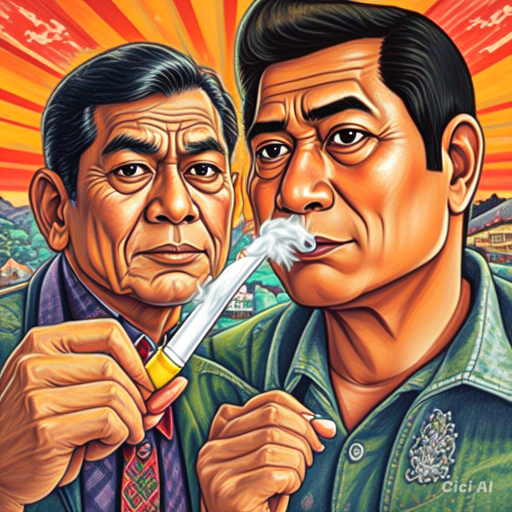
As the Philippines grapples with a storm of controversy, the political landscape is once again electrified by allegations of illegal drug use—this time aimed at President Ferdinand Marcos Jr. by none other than former President Rodrigo Duterte. The accusations, set against a backdrop of Duterte’s own turbulent history with similar claims, reveal a deeper struggle for power, integrity, and the soul of the nation.
A Timeline of Turbulence
The controversy erupted on July 22, when a video purportedly showing Marcos using cocaine surfaced just hours before his State-of-the-Nation Address. Duterte was quick to distance his organization, Hakbang sa Maisug, from the video’s release, yet he seized the moment to amplify suspicions about Marcos’s alleged drug addiction.
The Marcos administration swiftly denounced the video as a “malicious crude attempt” to destabilize the government, yet Duterte’s relentless pressure for Marcos to undergo a drug test added fuel to the fire. This echoes a similar scenario from 2017, when Senator Antonio Trillanes IV challenged Duterte to a drug test after he joked about using marijuana—a challenge Duterte deflected with characteristic bravado.
The Presidents: Histories Entwined with Controversy
Rodrigo Duterte, notorious for his brutal war on drugs, has faced allegations of drug use himself. In 2017, Trillanes publicly dared Duterte and his family to undergo drug testing, to which Duterte’s spokesperson, Harry Roque, responded that the President would not be ordered around. Duterte’s later joke about marijuana use further stoked suspicions, but he dismissed the calls for a drug test, labeling the remarks as humor.
Ferdinand Marcos Jr., son of the late dictator, now faces his own allegations of drug use, exacerbated by a viral video. The timing and source of these accusations are politically charged, raising questions about their authenticity and the motivations behind them.
Challenges to Duterte’s Allegations
- Ethical Standards: Ethics dictate that accusations should be based on credible evidence, not conjecture. The video in question, lacking clear verification, fails this basic test.
- Moral Grounds: Morality demands fairness. Condemning Marcos based on an unverified video sets a dangerous precedent of guilt by assumption, undermining the principle of innocent until proven guilty.
- Logical Fallacies: Duterte’s insistence that refusal to take a drug test implies guilt is a classic ad hominem fallacy, attacking Marcos’s character instead of addressing the validity of the evidence.
- Legal Provisions: Philippine law upholds the presumption of innocence (Article III, Section 14(2) of the 1987 Constitution). Without concrete evidence, Marcos cannot be deemed guilty.
- Supreme Court Precedents: The Philippine Supreme Court, in cases like People v. Hernandez, has emphasized the need for incontrovertible evidence before condemning an individual. The lack of such evidence here weakens Duterte’s allegations.
- Political Logic: The political rivalry between Duterte and Marcos may taint the credibility of the allegations. Marcos’s refusal to undergo a drug test, while politically damaging, is not an admission of guilt.
Substantiation of Duterte’s Accusations
- Ethical Standards and Transparency: Transparency in leadership is paramount. A public figure like the President should clear any doubts about his conduct to maintain public trust. A drug test, as Duterte argues, could swiftly dispel doubts.
- Moral Responsibility: As a leader, Marcos has a moral duty to dispel doubts about his conduct. A transparent drug test could restore faith in his leadership.
- Logical Consistency: Duterte’s argument that a refusal to undergo testing implies something to hide aligns with common sense. Innocent individuals typically welcome opportunities to clear their names.
- Legal Obligations: While the Constitution presumes innocence, it also mandates public officials to act with integrity (Article XI, Section 1). Marcos’s reluctance to take a drug test may be seen as failing this standard.
- Supreme Court Decisions: The Court, in Estrada v. Desierto, upheld the principle that public office is a public trust. Any doubt regarding a public official’s integrity must be addressed swiftly and transparently.
- Political Context: In a nation scarred by drug-related violence and Duterte’s own stringent anti-drug policies, any credible suspicion of a President’s drug use is a matter of national concern. The political pressure to ensure leaders are beyond reproach is immense.
Objective Assessment
The arguments against Duterte’s allegations, grounded in legal principles and ethical standards, present a compelling case for skepticism. The lack of verifiable evidence and the potential for political bias cast significant doubt on the accusations. Conversely, the arguments favoring Duterte’s claims underscore the necessity for transparency and accountability in public office. Marcos’s failure to proactively dispel these allegations fuels ongoing suspicion.
Recommendations
For President Marcos, addressing the allegations directly by undergoing a credible drug test could swiftly neutralize the controversy and restore public trust. Transparency and proactive measures are critical in maintaining credibility.
For Rodrigo Duterte and his supporters, substantiating claims with incontrovertible evidence is essential. Reckless allegations without proof can backfire, eroding their own credibility and undermining the legitimacy of their cause.
For the Philippine public and institutions, upholding the principles of due process and evidence-based judgments is crucial. Media, Congress, and other oversight bodies must ensure that political rivalries do not overshadow the pursuit of truth and justice.
In this unfolding saga, the stakes are high, not just for the individuals involved, but for the integrity of the nation’s governance. The path forward demands a commitment to truth, transparency, and the unwavering application of the rule of law. As the nation watches, the resolution of these allegations will define not only the legacy of its leaders but the future course of its democracy.

- Andres Heralds DoJ’s Transformative Justice

- Sailing to New Horizons: PEZA Sets Ambitious PHP250-B Approval Target for 2024

- Panga’s Bold Vision: The Paradigm Shift of Iwahig Mega Economic Zone

- Panga’s Pragmatic Approach to Sino-Philippine Investments

- The Shadow Over Manila

- Shadow of the Red Notice: Remulla hunts down Teves

- Frozen Enigma: NBI Bacolod’s Tussle with Darkness

- Quiboloy’s Supreme Court Shenanigans: A Pathetic Attempt to Dodge Justice

- RP’s cunundrum: A pawn in the SCS geopolitical chessboard

- Macapagal Leads: Navigating Relocation Challenges




 KWEBA ni BAROK
Leave a reply to John Joseph D. Cancel reply