
PNP’s Latest Tactic in Quiboloy Hunt: Sing Until He Surrenders

- “Forthwith” to Farce: How the Senate is Killing Impeachment—And Why Enrile’s Right (Even If You Can’t Trust Him)
 By Louis ‘Barok‘ C. Biraogo — June 20, 2025
A CONSTITUTIONAL TRAINWRECK IN SLOW MOTION
The Philippine Senate had one job: try Sara Duterte. Instead, on June 10, 2025, 18 senator-jurors staged a constitutional coup by remanding the impeachment articles back to the House—a move so legally dubious, it reeks of political arson[1]. The Constitution’s command is clear: once one-third of the House signs off, trial must proceed “forthwith”[2]. Yet here we are, four months later, drowning in procedural farce while the Senate whistles past its duty. Enter Juan Ponce Enrile, 101 years old and still the sharpest legal knife in the drawer. The Martial Law architect-turned-democracy whisperer is right about the Senate’s dereliction—but trust his legal brain, not his motives. This is the man who survived EDSA, the PDAF scam, and multiple regime changes by knowing exactly when to flip. Now, as Marcos’ chief legal counsel, he’s suddenly preaching constitutional fidelity[3]? Let’s dissect this mess—before impeachment becomes just another corpse in Congress’ graveyard of accountability.I. THE “FORTHWITH” FARCE: HOW THE SENATE BROKE IMPEACHMENT
A. The Constitution’s Crystal-Clear Command
Article XI, Section 3(4) doesn’t mince words:“Trial by the Senate shall Humanforthwith proceed.”
The House did its job: 215 signatures (70% of members) on February 5—more than double the 102 needed[4]. The Senate’s duty was to gavel in, not dither. Yet:- Election break excuse: The Senate adjourned without reading the articles, violating “forthwith”[5].
- Remand gambit: On June 10, Alan Peter Cayetano’s motion sent the case back, demanding the 20th Congress certify it—a requirement nowhere in the Constitution[6].
B. Precedent Says: NO DELAYS, NO REMANDS
History backs Enrile:- Corona (2012): As Senate President, Enrile rushed the trial—no remand, no certification demands[8].
- Estrada (2000): Trial began immediately after House transmission[9].
C. The Nuclear Precedent This Sets
If the Senate can remand impeachments on whim:- Future impeachments die by delay. Presidents/VPs could stall indefinitely.
- House independence erodes. The Senate just commanded a co-equal branch—a breach of comity[10].
II. ENRILE: RIGHT ON LAW, SUSPECT ON MOTIVES
A. The Legal Genius
Enrile’s arguments are bulletproof:- “Forthwith” means now. Not “after we stall.”
- The House’s work is presumed valid. The Senate isn’t a quality-control checkpoint[11].
- Impeachment is sui generis. It’s political—not a courtroom where technicalities kill cases[12].
B. The Hypocrisy
But let’s not canonize him:- Martial Law enabler: This is the man who helped Marcos Sr. dismantle democracy[13].
- PDAF scam accused: His “constitutional purity” rings hollow post-pork barrel[14].
- Marcos’ consigliere: As Bongbong’s lawyer, is he really neutral—or ensuring Duterte’s downfall helps his boss?[15]
III. THE REAL STORY: POWER PLAYS & DIRTY SECRETS
A. Follow the Money: The Confidential Funds Scandal
The impeachment’s real fuel? Duterte’s ₱612M confidential fund mess:- Fake recipients: 60% of DepEd fund recipients don’t exist per PSA data[16].
- OVP’s shady audits: No paper trail for millions—a gift to prosecutors[17].
B. The Assassination Bomb
Article I alleges Duterte threatened to kill Marcos, Liza Araneta, and Speaker Romualdez[18]. A trial would force public testimony—political dynamite before 2028. No wonder the Senate punted.IV. THE ENDGAME: IMPEACHMENT OR IMPLOSION?
Option 1: Senate Grows a Spine (LOL)
- Proceed now. Try Duterte properly—no more delays.
- Drop the remand farce. The House won’t re-certify; this is deadlock by design.
Option 2: Supreme Court Steps In (Spoiler: They Won’t)
Enrile suggests the SC could clarify—but the Court hates political grenades. Remember:- Corona’s revenge: The SC won’t risk another impeachment war[19].
Option 3: Constitutional Chaos
If impeachment dies:- Marcos consolidates. Duterte weakened, 2028 cleared.
- No check left. Future VPs/Presidents become untouchable.
FINAL VERDICT: DEMOCRACY LOSES
Enrile’s right: the Senate must proceed—or admit impeachment is dead. But let’s not pretend this is just legal. It’s raw power—Marcos vs. Duterte, with Congress as collateral. The chilling question? If Congress won’t enforce the Constitution… who will? Epilogue: For those keeping score—yes, the Martial Law architect is now the Constitution’s last defender. Ironic? Absolutely. But in Philippine politics, hypocrisy is just texture.FOOTNOTES
- Enrile: It seems Sara Duterte doesn’t want to face impeachment trial (Inquirer) ↑
- Impeachment of Sara Duterte (Wikipedia) ↑
- How to fix impeachment impasse? Proceed with trial or go to SC – Enrile (Inquirer) ↑
- How to fix impeachment impasse? Proceed with trial or go to SC – Enrile (Inquirer) ↑
- Philippine Senate returns VP impeachment case to lower house (Reuters) ↑
- Philippine Trial of VP Sara Duterte Thrown Into Doubt by Senate (Bloomberg ) ↑
- Enrile interview on ANC (YouTube) ↑
- Impeachment of Renato Corona (Wikipedia) ↑
- Trial of Joseph Estrada (Wikipedia) ↑
- 1987 Philippine Constitution (LawPhil) ↑
- House stands firm on impeachment articles (YouTube) ↑
- Impeachment Primer and Frequently Asked Questions (UP Law) ↑
- Martial law under Ferdinand Marcos (Wikipedia) ↑
- Enrile and the PDAF Scam (PCIJ) ↑
- Enrile serving 2nd Marcos as chief legal counsel (Inquirer) ↑
- PSA Report on DepEd Funds (Philippine Statistics Authority) ↑
- COA Report on OVP Confidential Funds (Commission on Audit) ↑
- Full Text: Articles of Impeachment against Vice President Sara Duterte (PhilStar) ↑
- SC Decisions on Political Questions (Supreme Court) ↑
- “HINDI AKO NAG-RESIGN!”

The Executive Secretary Screams from the Grave of His Own Political Funeral
By Louis “Barok” C. Biraogo — November 22, 2025
1. The Resignation That Wasn’t: A Love Story in Two Contrasting Scripts
Malacañang: “He stepped down out of delicadeza. So noble. So graceful. So very voluntary.”
Lucas Bersamin, live on national television: “Hindi ako nag-resign.”Two narratives. One megaphone. Zero resignation letters.
Welcome to Philippine governance in 2025 – where truth is whatever the Palace press release says it is… until the corpse starts talking back.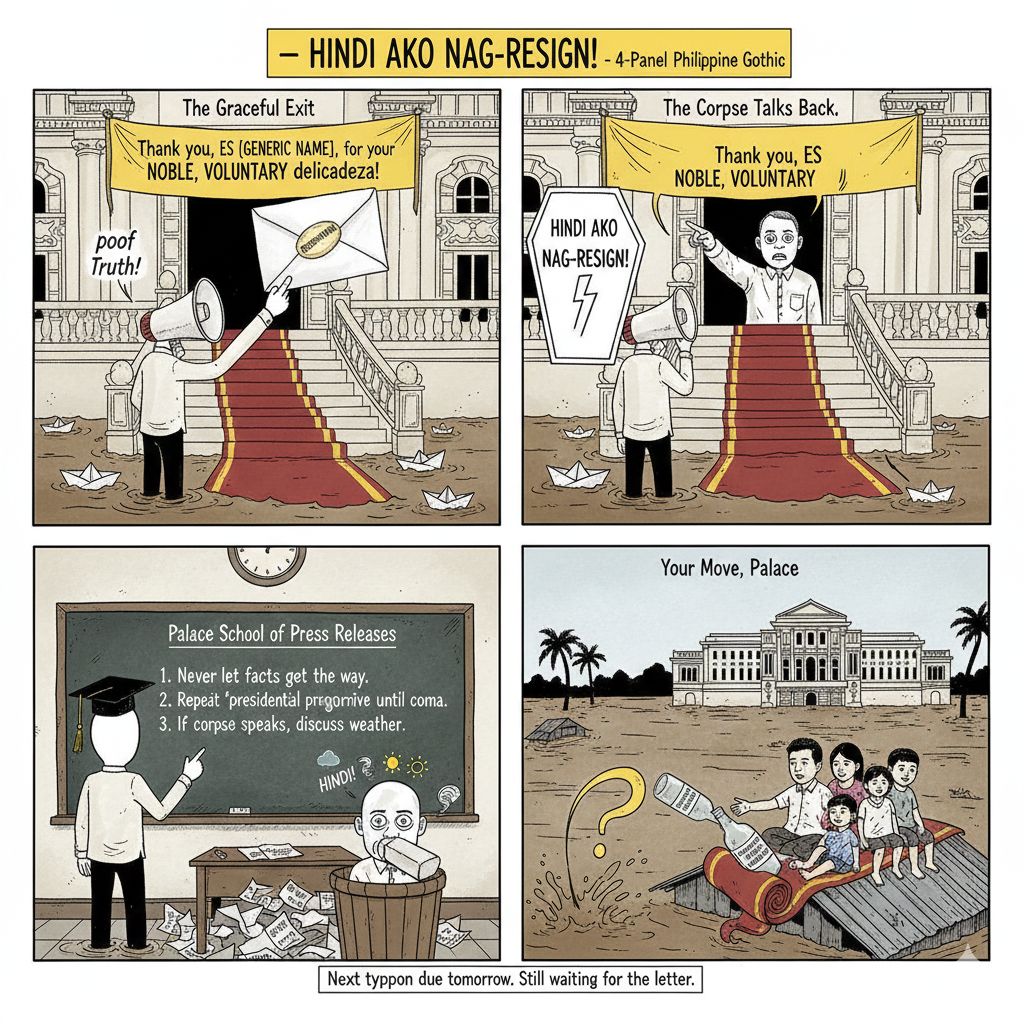
He never resigned—his tongue just signed a loyalty waiver to the flood. 2. Delicadeza: The Magical Word That Turns a Firing Squad into a Red-Carpet Exit
Delicadeza™ – now available in “Extra Strength Cover-Up” flavor!
Just sprinkle liberally whenever a high official becomes politically radioactive. Instantly transforms an unceremonious sacking into a heroic act of self-sacrifice. Side effects may include public nausea, uncontrollable laughter, and the slow death of whatever credibility the administration had left.3. The P52-Billion (or Was It P100-Billion?) Vanishing Flood Trick
While Metro Manila drowns every July, someone allegedly performed the greatest magic act in legislative history: making tens of billions in flood-control funds disappear into thin air – or, more likely, into very specific pockets.
Abracadabra! Ghost projects appear!
Presto! The money is gone!
For the grand finale: blame the guy we just “accepted the resignation” of – even though he swears he never resigned.4. “He Had to Go” – A Phrase That Should Chill Every Filipino Spine
Those four little words Bersamin let slip – “Sinabi sa akin na kailangan ko nang umalis” – are the political equivalent of hearing the safety click off.
When the former Chief Justice, the Little President himself, is told “you have to go” and then watches the Palace rewrite history in real time, we are no longer watching a reshuffle.
We are watching a palace coup disguised as delicadeza.5. The Palace School of Creative Writing: How to Announce a Non-Existent Resignation
- Lesson #1: Never let facts get in the way of a good narrative.
- Lesson #2: When cornered, simply repeat: “The announcement came from Malacañang.”
- Lesson #3: If the ex-official contradicts you on national TV, pretend you’re discussing the weather.
- Extra credit: Use the phrase “presidential prerogative” until people fall asleep.
6. The Bersamin Contradiction Is Now a National Emergency
When the second most powerful man in government and the Palace cannot agree on whether he quit or was pushed, we have crossed into banana-republic territory – except even bananas have documentation.
This is not a gaffe. This is a constitutional crisis wearing the cheap costume of a press briefing.7. One Simple Demand Before the Next Typhoon Kills Again
Publish the damn letter.
All of it. Unredacted. Today.
Let the Filipino people read for themselves whether Lucas Bersamin wrote “I hereby resign” or whether he wrote the bureaucratic equivalent of “Do whatever you want with me, boss.”If the letter says he resigned – great, Bersamin is the liar.
If the letter says nothing of the sort – congratulations, Malacañang, you just confessed to the nation that you will lie about anything, even the exit of your own alter-ego, to save the President’s skin.Your move, Palace.
Because the floods are coming again.
And this time, the Filipino people have every right to ask:
Are we drowning in water… or in lies?Hold them accountable.
Or prepare to swim.
Louis ‘Barok‘ C. Biraogo - “I’m calling you from my new Globe SIM. Send load!”

https://kwebanibarok.com/2024/09/04/a-cat-astrophic-error-globe-telecoms-sim-registration-tailspin/

Louis ‘Barok‘ C. Biraogo - “Mahiya Naman Kayo!” Marcos’ Anti-Corruption Vow Faces a Flood of Doubt

By Louis ‘Barok‘ C. Biraogo — August 2, 2025
Executive Summary: Can Marcos Break the Cycle of Corruption?
President Ferdinand Marcos Jr.’s fiery 2025 SONA pledge to expose and prosecute corruption in failed flood control projects taps into public fury over persistent flooding and squandered funds. His call to shame negligent officials and publish project data signals bold intent, but the Marcos family’s notorious history—linked to $5-10 billion in plundered wealth—casts doubt on sincerity.
Digital transparency and public pressure offer hope, yet entrenched patronage, a sluggish judiciary (8% conviction rate), and selective enforcement loom as barriers. The narrow focus on infrastructure sidesteps broader corruption in healthcare and local governance. Success demands independent oversight, robust whistleblower protections, and judicial reform. Without tackling elite impunity, this risks becoming empty rhetoric. Civil society, international partners, and citizens must hold Marcos accountable through data-driven monitoring and civic action to ensure reforms stick within 12-18 months.
Credibility Check: Is Marcos’ Anti-Corruption Vow Trustworthy?
Marcos’ pledge to combat flood project corruption, delivered with a dramatic “Mahiya naman kayo” in his 2025 SONA, resonates with Filipinos fed up with flooded streets and broken promises. Yet, the Marcos name—tied to Ferdinand Sr.’s regime, which siphoned $5-10 billion from public coffers—invites skepticism. Ongoing unpaid tax liabilities and social media campaigns whitewashing martial law abuses further erode trust.
Specific commitments include tasking the Department of Public Works and Highways (DPWH) to compile and publicize a list of flood control projects and launching audits via Regional Project Monitoring Committees. These are concrete, measurable steps. However, similar transparency vows under Aquino and Duterte yielded only an 8% conviction rate for graft cases (2016-2023).
Marcos’ high approval rating (68% in June 2025 Pulse Asia) offers political capital, but dynastic ties—relatives control key local posts with flood contracts—raise fears of selective prosecutions. Vague promises of “charges in coming months” lack timelines or named targets, unlike Singapore’s rigorous asset declaration mandates. Without judicial reform or elite accountability, this risks being performative posturing.
Stakeholder Showdown: Who’s Betting on Marcos, and Who’s Not?
Marcos’ Cheerleaders: Why Some See a Path to Victory
Supporters argue Marcos’ plan could succeed by leveraging public outrage and institutional tools. Publicizing project data, as mandated to DPWH, invites scrutiny from groups like Procurement Watch, mirroring global transparency successes. Digital governance—e-bidding and geotagged tracking—aligns with UNODC’s praise for reducing bribery.
Post-midterm political pressure, with 2028 elections looming, pushes Marcos to deliver visible wins. International validation, including FATF grey list removal, bolsters credibility. High-profile prosecutions could deter future corruption, especially if DPWH audits uncover hard evidence.
The Doubters: Why History and Structure Spell Trouble
Skeptics point to insurmountable barriers. The Marcos family’s cronyism legacy—with relatives holding governorships and mayorships tied to flood contracts—suggests conflicts of interest. Patronage politics, where DPWH directors are political appointees, undermines impartiality.
The Sandiganbayan’s 1,800+ backlog and 7-10 year case resolutions signal judicial gridlock. Past anti-corruption drives, like Duterte’s Build-Build-Build audits, fizzled with minimal convictions. Social media disinformation glorifying the Marcos era, as noted in 2022 election reports, dulls public pressure.
Critics argue the focus on flood projects ignores broader corruption in healthcare and local governance, per business surveys.
The Middle Ground: Forces That Could Tip the Scales
Public intolerance, especially among youth using platforms like X to expose corruption, creates reform momentum. Digital tools like e-procurement systems reduce human discretion, but require scaling. Extreme weather—2024-25’s record La Niña—complicates project evaluations, as some failures stem from design flaws, not just corruption.
Donors like ADB and JICA, withholding funds pending transparency, could enforce compliance but risk politicization in the 2025 election season.
Systemic Smackdown: Are Marcos’ Fixes Big Enough for the Mess?
Marcos’ plan—public lists and audits—tackles visible flood project failures but falls short of corruption’s vast scope, costing the Philippines ₱700 billion annually. Infrastructure markups of 20-30% reflect patronage networks, judicial weaknesses, and dynastic control, with 80% of local posts held by families. The measures address symptoms, not root causes.
Global models, like Singapore’s independent CPIB or Georgia’s post-2003 judicial overhaul, emphasize autonomous agencies and swift prosecutions. The Philippines’ Ombudsman and Sandiganbayan lack resources and independence, with an 8% conviction rate.
Marcos’ digital push—e-bidding and geotagging—is promising but needs training and infrastructure to scale. Patronage and disinformation, fueled by pro-Marcos propaganda, hinder cultural change. Delayed COA reports (12-24 months) and unaddressed poverty-driven corruption limit impact. Sustainability beyond 2025 elections is shaky without elite accountability.
Battle Plan: Actionable Steps to Crush Corruption
Government Institutions
- Fortify Oversight: Grant Ombudsman and COA full independence by Q2 2026; double Sandiganbayan divisions for 90-day case resolutions using e-subpoenas.
- Go Digital: Launch real-time DPWH data portals by Q1 2026, using blockchain for billing transparency.
- Protect Whistleblowers: Enact laws by Q1 2026, offering 1% of recovered funds as bounties and overseas relocation, funded by Presidential Social Fund.
Civil Society Organizations
- Citizen Audits: Form a Citizen Flood Audit Corps by Q2 2026, training 1,000 volunteers for drone surveys, partnered with AFP for security.
- Anti-Dynasty Push: Advocate for 1987 Constitution enforcement to curb dynastic control by 2027.
International Partners
- Tech Support: ADB and JICA fund LGU training on e-procurement by Q3 2026, tying aid to transparency.
- Global Standards: Back UNCAC implementation for ownership registries by 2027.
Citizens and Media
- Crowdsource Evidence: Create X-based dashboards by Q1 2026 to track DPWH disclosures.
- Educate: Push integrity curricula by 2026-27, countering disinformation with CHED support.
Success Metrics
- Short-Term (12-18 months): Publish flood data by Q1 2026; charge 50+ officials; boost e-procurement by 20%.
- Long-Term: Cut cost overruns by 10% by 2027; raise convictions to 15%; establish 5 graft courts.
These evidence-based steps, inspired by global successes, balance immediate wins with systemic change, leveraging public and international pressure to sustain reforms.
Final Verdict: Can Marcos Turn Words into Action?
President Marcos’ “Mahiya Naman Kayo!” rallying cry against corruption in flood control projects captures public frustration but faces a steep climb to deliver lasting change. While his transparency pledges and digital reforms show promise, the Marcos family’s historical baggage, entrenched patronage networks, and a limping judiciary (with an 8% conviction rate) threaten to drown these efforts in skepticism.
Success demands more than fiery rhetoric—it requires independent oversight, robust whistleblower protections, and prosecutions that target elites, not just scapegoats. By leveraging UNODC-backed digital tools, civil society momentum, and international pressure, Marcos could build trust within 12-18 months.
Yet, without dismantling dynastic power and addressing systemic corruption beyond infrastructure, this crusade risks fading into political noise. Citizens, media, and global partners must hold the administration accountable, ensuring promises translate into measurable outcomes by 2027.
Key Citations
- Philstar: Marcos’ 2025 SONA Anti-Corruption Pledge
- Guinness World Records: Marcos Family Scandals
- Rappler: Marcos Family Tax Issues
- Ombudsman: Graft Conviction Statistics
- Pulse Asia: June 2025 Approval Ratings
- UNODC: Philippines Anti-Corruption Progress
- FATF: Grey List Status
- Rappler: Social Media Disinformation
- Transparency International: Philippines Corruption
- PhilGEPS: E-Procurement
- PAGASA: La Niña 2024-25
- ADB: Infrastructure Funding
- JICA: Philippines Projects
- Sandiganbayan: Case Backlog
- PNA: Build-Build-Build Audits
- CPIB Singapore: Anti-Corruption Model
- Transparency International: Georgia Reforms
- COA: Audit Reports
- Ateneo: Political Dynasties
- UNCAC: Anti-Corruption Framework
- DPWH: Project Transparency
- Official Gazette: 1987 Constitution
- CHED: Education Reforms
- AFP: Security Support

Louis ‘Barok‘ C. Biraogo - “Meow, I’m calling you from my new Globe SIM!”

https://kwebanibarok.com/2024/09/04/a-cat-astrophic-error-globe-telecoms-sim-registration-tailspin/
Louis ‘Barok‘ C. Biraogo - “No Special Jail for Crooks!” Boying Remulla Slams VIP Perks for Flood Scammers

Country Club Custody Cancelled: Flood Thieves Now Share the Same Stink
By Louis ‘Barok‘ C. Biraogo — February 24, 2026
MGA ka-kweba, close your eyes and picture it.
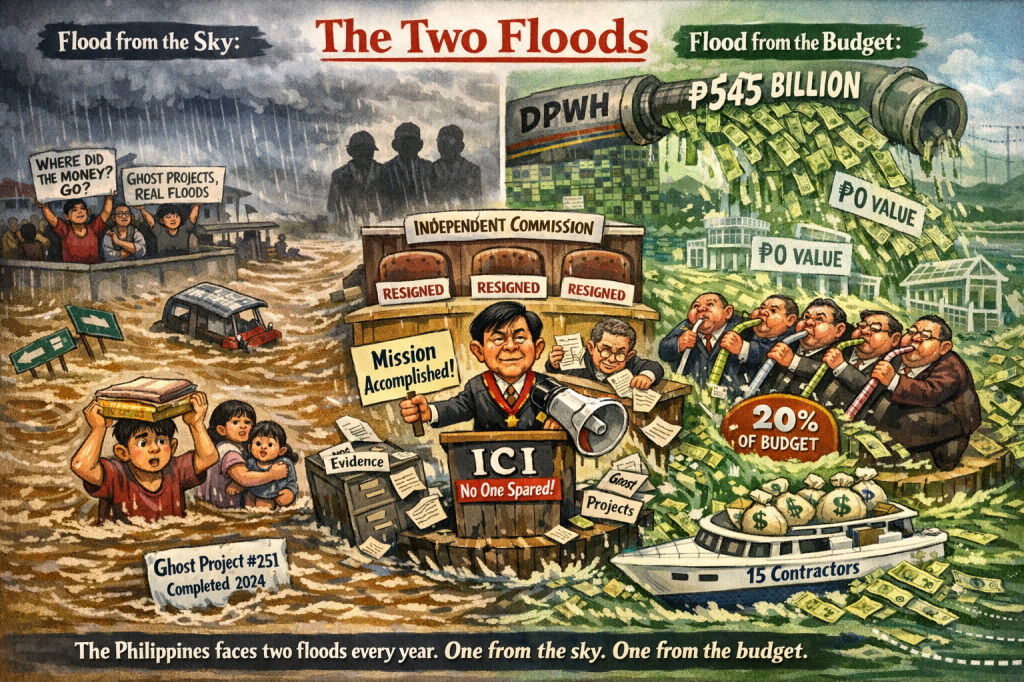
Your lola in Tondo, knee-deep in floodwater that smells like death and broken promises, because the ₱545 billion “flood control” budget from 2022-2025 somehow produced zero functional dikes and a lot of ghost concrete. Now zoom in on the guy who allegedly inserted the project and took his 20-40% cut: he’s lounging in an air-conditioned cell with pizza delivery, conjugal visits, and a Sandiganbayan hearing that can wait until 2028 because, well, comfort.
Ombudsman Jesus Crispin “Boying” Remulla just set that fantasy on fire.
In a Daily Tribune report dated February 22, 2026, he looked his own brother, Department of the Interior and Local Government (DILG) Secretary Jonvic Remulla, dead in the eye (metaphorically, via public airwaves) and said: “Don’t put up special jail. Because if there is a special jail the politicians that will be incarcerated will enjoy it and all the cases will be delayed.” He’s seen the “country club” quarters before. “It is not allowed. It shouldn’t happen anymore.”
Bong Revilla Jr. — freshly slapped with plunder and graft over alleged flood-control insertions — is already tasting the new reality at the brand-new Quezon City Jail Male Dormitory in Payatas. His petition to transfer back to the soon-to-be-demolished Philippine National Police (PNP) Custodial Center? Denied by the Sandiganbayan. Welcome to the plebeian wing, Senator. The only VIP here is the smell of 1,330% congestion in some cells.
This isn’t just policy. This is performance art with a constitutional spine. And as your resident Barok — the guy who’s been dissecting this circus since the Priority Development Assistance Fund (PDAF) days — I’m here to eviscerate every sacred cow, praise where praise is due, and warn where the rot still festers.

“Senator to Sardine: How Bong Revilla Lost His Aircon and Found His Soul (Maybe)”
The Flood of Filth: ₱118 Billion a Year Down the Drain, and the Water Still Rises
Let’s not pretend this is abstract. The flood-control scandal is the biggest corruption heist under Marcos Jr. so far. Ghost projects in Bulacan, substandard dikes in Mindoro, congressional insertions that smelled like kickbacks from day one. Contractors like the Discayas and Sunwest, Department of Public Works and Highways (DPWH) officials, and politicians (Revilla, Jinggoy Estrada, Zaldy Co, and whispers about higher up the food chain including Speaker Romualdez’s alleged ₱1.68B slice) allegedly turned public misery into private swimming pools.
Business groups screamed for an independent probe. The Senate Blue Ribbon did its dance. Commission on Audit (COA) flagged anomalies. The Independent Commission on Infrastructure (EO 94) produced referrals. Ombudsman Remulla (then still Justice Secretary) and now full Ombudsman filed the first batch of cases. Even the Remulla brothers say they rejected a ₱1 billion bribe to kill the investigation. Heroic? Sure. But in this country, rejecting one bribe while the system produces a thousand more is like refusing one lechon and calling yourself on a diet.
Meanwhile, Manila floods every habagat. Flood victims get relief goods and prayers. The thieves get options.
No VIP Perks: Boying Remulla’s Equal Protection Power Move
Remulla is right on the merits. Special cells for “high-profile” detainees are not security — they’re status symbols. They scream: “The law is equal, but some are more equal than others.” Article III, Section 1 of the 1987 Philippine Constitution doesn’t have an asterisk that says “unless you used to have a Senate office and a TV show.”
The equal protection clause allows reasonable classification, but it must rest on substantial distinctions germane to the purpose. “You’re a politician” is not a substantial distinction. It’s a job title. Security concerns? Fine — classify by risk, not by title. Aircon, flat-screen, and gourmet meals? That’s not security. That’s a resort membership paid by the same taxpayers you robbed.
Remulla’s logic on speedy trials? Brutal but brilliant. Under Republic Act No. 8493 (the Speedy Trial Act of 1998), arraignment must happen within 30 days, trial within 180 days. Comfortable detention turns the accused into a tortoise. Uncomfortable (but humane) detention turns him into a hare. It’s not coercion; it’s basic human incentive. You don’t want to stay in Payatas? Then waive dilatory motions and let’s finish this.
But let’s be honest — I’m not giving Boying a free pass just because he’s finally swinging the hammer I’ve been begging for since Estrada’s hospital arrest.
Legal Autopsy: Where Every Argument Dies a Painful Death
Arguments FOR special jails – “Security! These men have enemies! They’ll be killed in regular jails!”
Bull. The Bureau of Jail Management and Penology (BJMP) and PNP have high-risk classification protocols. Put them in a secure wing with extra guards. Not a five-star suite. The Supreme Court in Enrile v. Sandiganbayan (G.R. No. 213847, 2015) allowed humanitarian considerations for bail, not for luxury. Security is legitimate classification. Pampering is not.
Arguments AGAINST Remulla – “This is coercive detention! Violates presumption of innocence! Separation of powers!”
Half-true, half-copium. Pre-trial detention is not punishment. Using discomfort as leverage walks a thin line. But the Ombudsman isn’t ordering solitary confinement; he’s ordering no special privileges. That’s different.
Separation of powers? Remulla’s directive to DILG is executive-to-executive. Courts still decide case-by-case transfers (People v. Court of Appeals (G.R. No. 183652, February 25, 2015); Revilla’s recent denial). He’s not encroaching; he’s setting policy for the facilities the executive controls.
Under Republic Act No. 6770 (the Ombudsman Act of 1989), he has power to direct corrective action against impropriety. Special jails for the powerful is impropriety.
Republic Act No. 3019 (the Anti-Graft and Corrupt Practices Act) and Republic Act No. 7080 (the Plunder Act) lose moral force when the accused live better than the victims. Republic Act No. 6713 (the Code of Conduct and Ethical Standards for Public Officials and Employees) demands public officials avoid even the appearance of preferential treatment.
Republic Act No. 9745 (the Anti-Torture Act of 2009) prohibits degrading treatment — and luxury for the rich while the poor suffer in hellholes is degrading in reverse.
Estrada v. Sandiganbayan (G.R. No. 148560, 2001) already killed the “I’m too important” defense. Coscolluela v. Sandiganbayan (G.R. No. 191411, 2013) killed deliberate delay. The jurisprudence is clear: no VIP justice.
Who Are These People, Really? A Psychological Profile
Boying Remulla: Battle-scarred Cavite boy turned graft-buster. He’s seen the inside of the system from Congress, governorship, Justice Secretary, now Ombudsman. The ₱1B bribe rejection wasn’t theater — it was a man who knows that once you take the first envelope, the dynasty dies in shame. He wants a legacy as the guy who didn’t bend. But he’s also a Remulla. The dynasty angle stings.
Jonvic Remulla: The loyal younger brother, DILG fixer, jail administrator-in-chief. He’ll comply because family and administration survival demand it.
The Accused Politicians (Revilla et al.): Narcissistic entitlement wrapped in “public service.” They genuinely believe they are different. Prison is for the little people.
The Marcos Administration: Needs a win. Floods + corruption = electoral poison before 2028 presidential election.
The Public: Righteously furious today. Will forget by next viral scandal. Short attention span is the real enabler of impunity.
The Courts: The last firewall. Sandiganbayan has shown spine denying Revilla’s transfer. They must continue — case-by-case, transparent, no rubber-stamp.
VIP Jails Are an Abomination — Full Stop
The old PNP Custodial Center wasn’t a jail. It was a hotel with bars. Aircon, flat TVs, family quarters, catered food. While BJMP jails hit 386% congestion nationwide, the powerful got spa treatment. That is not “humane.” That is institutionalized two-tier justice. It spits on every flood victim, every taxpayer, every poor detainee sleeping on concrete.
Morally: Public office is a public trust (Article XI, Section 1 of the 1987 Philippine Constitution). You don’t get to steal from the public then demand better conditions than the public you robbed.
Optically: Every photo of a senator with a smile and a visitor’s badge erodes trust faster than any plunder acquittal.
Legally: It violates equal protection and the spirit of Republic Act No. 9745 in reverse.
The Deeper Disease: This Isn’t About Cells, It’s About the Plantation
Special jails are a symptom. The disease is elite impunity + dynastic politics + a justice system designed to bend for the connected. Flood control is the perfect case study: money meant for the poorest provinces funneled through congressional insertions to allies, contractors, and re-election funds. Dynasties protect dynasties. Remulla dynasty included — I’ll call it on my own side too.
Abolishing special cells while leaving regular jails at hellish congestion is treating a gunshot wound with a Hello Kitty Band-Aid. We need root-canal reform.
Projections: Short, Medium, Long — The Tsunami Is Coming
Short-term: Faster resolutions in some cases. More transfer petitions. Media circus. Possible Commission on Human Rights (CHR) complaints on “inhumane” Payatas conditions.
Medium-term: Deterrence signal. Contractors think twice. 2025 elections become a referendum on “no more VIP justice.” Remulla brothers become either heroes or nepotism villains depending on delivery.
Long-term: If paired with real jail reform — public trust inches up. Corruption culture takes a hit. If not — deeper cynicism. Flood resilience remains a joke. The Remulla dynasty either cements itself as reformers or joins the long list of “same same.”
What Must Happen Next — Concrete, Actionable, No Bullshit
To Ombudsman Remulla
You’re right. Now go further. File a formal recommendation to Congress for a law banning luxury amenities in all detention facilities for public officials. Use Republic Act No. 6770 powers to audit current BJMP/DILG practices. Fast-track flood cases with weekly status reports. And for the love of God, address the dynasty optics — recuse where family overlap exists.
To DILG Secretary Jonvic Remulla
Implement uniform standards immediately. High-risk classification equals enhanced security, NOT enhanced comfort. No air-conditioning (AC) for anyone unless medically necessary for all. Transparent criteria. Publish the list of who gets what.
To Congress
Pass the “Equal Detention Act” — one standard for all pre-trial detainees. Fund BJMP decongestion (build more facilities, use Supreme Court circulars on releases). Criminalize “special arrangements” as violation of Republic Act No. 6713.
To Sandiganbayan and Supreme Court
Strict scrutiny on all transfer petitions. Require medical evidence, not press releases. Monitor conditions proactively.
To the Public
Stop worshipping politicians. Demand live-streamed jail inspections. Support genuine reformers but verify. The power is yours — use it before the next flood kills more of your neighbors.
Complementary Jail Reform
Because I’m not a hypocrite. 386% congestion is torture. Build modular facilities. Accelerate good conduct time credits. Use technology for monitoring. Treat regular detainees with dignity too. Equality means lifting everyone, not dragging the powerful down to hell.
The Gavel Drops
This isn’t about vengeance. This is about the coldest, most beautiful legal principle we have left: ice-cold equality under the law.
No better. No worse. Just the same rules for the senator who allegedly stole flood money and the jueteng lord in the next cell.
Boying Remulla, you swung the hammer. Now don’t drop it. The Republic is watching. The flood victims are watching. History is watching.
And if the Remulla dynasty uses this moment to prove that power can be used against power — not just to protect it — then maybe, just maybe, this country still has a pulse.
Otherwise, we’ll all just keep drowning.
— Barok
The truth hurts. Impunity hurts more.
Key Citations
A. Legal & Official Sources
- The 1987 Constitution of the Republic of the Philippines. Official Gazette of the Republic of the Philippines.
- Republic Act No. 3019. Anti-Graft and Corrupt Practices Act, Official Gazette of the Republic of the Philippines, 17 Aug. 1960.
- Republic Act No. 6713. Code of Conduct and Ethical Standards for Public Officials and Employees, Official Gazette of the Republic of the Philippines, 20 Feb. 1989.
- Republic Act No. 6770. The Ombudsman Act of 1989, Official Gazette of the Republic of the Philippines, 17 Nov. 1989.
- Republic Act No. 7080. An Act Defining and Penalizing the Crime of Plunder, Official Gazette of the Republic of the Philippines, 12 July 1991.
- Republic Act No. 8493. Speedy Trial Act of 1998, Lawphil.net, 12 Feb. 1998, The LawPhil Project.
- Republic Act No. 9745. Anti-Torture Act of 2009, Official Gazette of the Republic of the Philippines, 10 Nov. 2009.
- People of the Philippines and AAA v. Court of Appeals, 21st Division, Mindanao Station, Raymund Carampatana, Joefhel Oporto, and Moises Alquizola. G.R. No. 183652. Supreme Court of the Philippines, 25 Feb. 2015. Lawphil Project.
- Estrada v. Sandiganbayan. G.R. No. 148560. Supreme Court of the Philippines, 19 Nov. 2001. Lawphil Project.
- Enrile v. Sandiganbayan. G.R. No. 213847. Supreme Court of the Philippines, 18 Aug. 2015. Supreme Court E-Library.
- Coscolluela v. Sandiganbayan. G.R. No. 191411. Supreme Court of the Philippines, 15 July 2013. Lawphil Project.
B. News Reports
Louis ‘Barok‘ C. Biraogo - “PLUNDER IS OVERRATED”? TRY AGAIN — IT’S A CALCULATED KILL SHOT

Why Ombudsman Remulla’s “No-Plunder” Gambit Is the Smartest Anti-Corruption Move Since the Wheel
By Louis “Barok” C. Biraogo — November 4, 2025
THE MOB’S HOLY WAR: “PLUNDER!” SCREAMED LOUDER THAN LOGIC
The mob is drunk on drama. PLUNDER! PLUNDER! PLUNDER! — chanted like a war cry at a frat hazing. Meanwhile, Ombudsman Jesus Crispin “Boying” Remulla drops a line that should be tattooed on every prosecutor’s forearm: “Plunder is overrated.”
Cue the meltdown.
“Whitewash!” scream the keyboard crusaders. “Downgrade!” wail the TikTok tribunes. “He’s shielding the big fish!” howls the echo chamber of eternal outrage.
Wake up, clowns. Remulla isn’t soft on corruption — he’s surgically ruthless about convictions. His “plunder is overrated” quip isn’t surrender. It’s a declaration of war fought with precision weapons, not fireworks.
THE LEGAL REALIST’S KNOCKOUT: WHY THIS IS A PROSECUTORIAL CHECKMATE
Critics screech: “They’re downgrading the charges!”
Reality: They’re upgrading the probability of actual prison time.Let’s dismantle the hysteria with cold, hard law:
Charge Legal Basis Evidentiary Burden Penalty Plunder Republic Act No. 7080 (Anti-Plunder Act) Prove series/combination of overt acts + ≥₱50M ill-gotten wealth Reclusion perpetua Malversation Article 217, Revised Penal Code (RPC) Funds missing + public officer accountable → presumption of guilt Up to life if >₱8.8M Bribery Article 210, RPC Gift + official act = done 6–15 years Falsification Article 171, RPC Fake docs to steal public funds 6–20 years Prosecutorial Discretion? Absolute.
Section 15, Republic Act No. 6770 (Ombudsman Act) gives Remulla sole authority to file charges “warranted by the evidence.” Not by rally decibels.Supreme Court Precedent? Crystal clear.
- Estrada v. Sandiganbayan, G.R. No. 148560 (2001): Plunder isn’t a dragnet. Must prove specific acts + traceable wealth.
- Enrile acquittals: Overreaching prosecutors lost because they couldn’t connect the dots.
Remulla looked at this graveyard of failed plunder cases and said: “Not today.”
THE CRITICS’ CIRCUS: A PARADE OF PERFORMATIVE PIETY
Critic’s Tantrum Barok’s Haymaker “Downgrading the charges!” No — upgrading the odds of handcuffs. A malversation win = jail + asset freeze + lifetime ban. “This is a whitewash!” Filing 6 cases by Nov. 25 is action. The real whitewash? A plunder case that collapses in 10 years, freeing everyone. “The public wants PLUNDER!” Justice isn’t a teleserye. Convictions > hashtags. These aren’t legal analysts. They’re rage influencers. They want spectacle. Remulla wants scalps.
THE 4D CHESSBOARD: SHOCK, AWE, AND FLIP
This isn’t the finale. It’s Phase One of a takedown.
- File slam-dunk charges now → Secure immediate convictions.
- Freeze assets → No loot escapes.
- Flip the minnows → DPWH (Department of Public Works and Highways) underlings become state witnesses.
- Build plunder later → With forensic audits, flipped testimony, and frozen paper trails.
If evidence never hits ₱50M? Then plunder was never warranted. That’s not weakness. That’s integrity.
THE PLAYBOOK: HOW TO SILENCE THE NOISE
To the Office of the Ombudsman:
- Drop a legal memo by Nov. 10 — bullet-pointed, public, brutal:
- “No plunder in Batch 1: Gaps in pattern/amount.”
- “Filing: Malversation, Bribery, Falsification.”
- “Next: Forensic audit for Batch 2.”
- Livestream the Nov. 25 filing → Let the nation watch the informations hit the Sandiganbayan docket.
- Blacklist the 15 contractors → No more public funds. Ever.
THE FINAL VERDICT: REMULLA ISN’T DODGING — HE’S DOMINATING
While critics scream into the void, Remulla is building airtight cases that will fill prison cells.
He’s not grandstanding.
He’s prosecuting.When the first lawmaker is dragged out in cuffs — when billions are clawed back — the same critics will go radio silent.
Because results > rallies.
Remulla didn’t dodge the fight. He rewrote the rules of engagement.
History will call this prosecutorial genius.
Key Citations
- Republic Act No. 7080, Anti-Plunder Act, The LawPhil Project, 1991.
- Republic of the Philippines. Article 210, Act No. 3815, The Revised Penal Code of the Philippines. Official Gazette of the Republic of the Philippines, 8 Dec. 1930. Articles 171, 210, 217.
- Republic Act No. 6770, Ombudsman Act of 1989, The LawPhil Project, 1989.
- Estrada v. Sandiganbayan, G.R. No. 148560, Supreme Court of the Philippines, 19 Sept. 2001.
- Mendoza, John Eric. “Ombudsman Filing Infra Mess Complaints by Nov. 25; No Plunder.” Inquirer.net, 3 Nov. 2025.
Louis ‘Barok‘ C. Biraogo - “Several Lifetimes,” Said Fajardo — Translation: “I’m Not Spending Even One More Day on This Circus”

Fajardo’s Final Lesson: You Can’t Fix a System That Rewards the People Breaking It
By Louis ‘Barok‘ C. Biraogo — January 31, 2026
IN A country where the poor wade through floodwaters that rise faster than our leaders’ excuses, Rossana Fajardo’s resignation from the Independent Commission for Infrastructure (ICI)—coupled with her bleak prophecy that rooting out corruption would “take several lifetimes”—stands as the perfect, bitter epitaph for a dying anti-corruption charade.
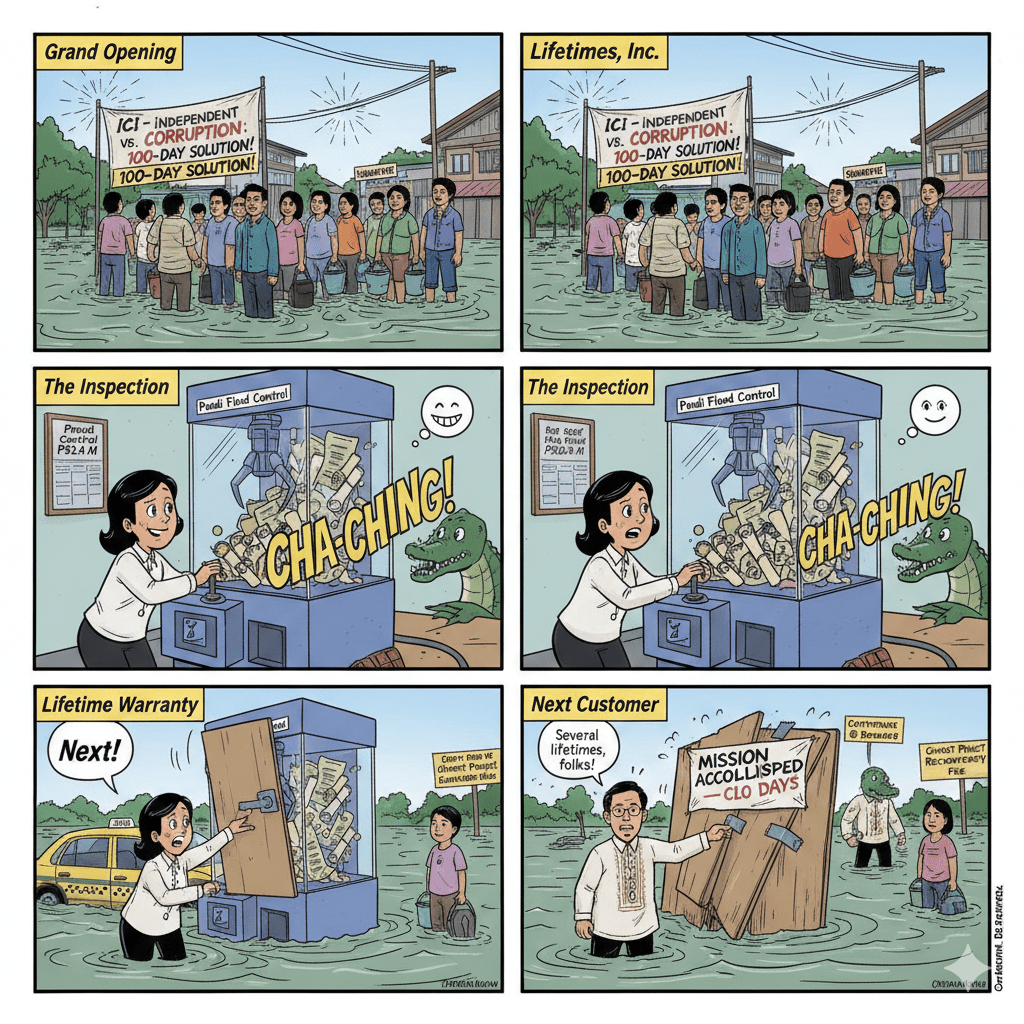
“Resignation speed-run any%: new world record—90 days, 0 convictions, ∞ lifetimes.”
The Symbolic Corpse on the Table
The ICI was born in September 2025 with presidential fanfare, heralded as the scalpel to excise the cancer of flood control corruption. By January 2026, it was effectively dead, its commissioners fleeing like actors from a collapsing stage.
Rossana Fajardo, the accomplished auditor from Sycip Gorres Velayo & Co. (SGV & Co.), lasted only three months before declaring her task complete and returning to private practice. Her parting words—that eradicating corruption would require removing “everyone who is part of the system”—read less as diagnosis than surrender.
This is tragicomic theater: a commission touted as independent, yet so toothless and temporary that its members treated it like a short-term consultancy. The ICI was never designed to endure; it was a prop to quiet public outrage after yet another flooding season revealed billions in “flood control” funds that controlled nothing except the bank accounts of the cunning.
The Anatomy of a Heist
The mechanics of this larceny are not crude—they are, as Fajardo grimly admitted, devilishly “smart.” Existing processes and controls in the Department of Public Works and Highways (DPWH) and budget deliberations are not broken; they are deliberately overridden.
Politicians and officials insert projects between the National Expenditure Program (NEP) and the General Appropriations Act (GAA), inflating budgets with phantom allocations. Ghost projects exist only on paper, funds are disbursed, kickbacks flow upward, and no structure is built—or what is built collapses with the first rain.
Consider the P92.8-million ghost flood control project in Pandi, Bulacan: money allocated, documents falsified, no structure erected, yet officials plead innocence while communities drown. This is intellectual looting, where bright minds apply cunning not to engineering typhoon defenses, but to engineering impunity.
Cast of Characters in a Farce
- Rossana Fajardo: She brought forensic rigor, questioned Department of Budget and Management (DBM) officials on NEP-GAA discrepancies, and exposed intentional sabotage of controls. Yet she fled prematurely, joining Rogelio Singson and Benjamin Magalong in abandoning the commission. Her “several lifetimes” remark, while realistic, risks becoming a self-fulfilling prophecy of cynicism.
- The Government & ICI: An “independent” body with no subpoena power, no legal protections, and no permanence—designed to fail. Multiple resignations, no replacements, findings shuttled to an overburdened Ombudsman. This is not oversight; it is a placebo.
- The Accused: Former Senator Ramon “Bong” Revilla Jr. and DPWH officials face charges before the Sandiganbayan for violating Section 3(e) of Republic Act No. 3019 (the Anti-Graft and Corrupt Practices Act). They plead not guilty while ghost projects haunt the record, employing motions to quash and lawyer swaps in a familiar delaying dance.
- The Private Sector: Business leaders like Manuel V. Pangilinan lament weak institutions yet thrive within the system they decry. Their calls to “demand more” sound performative when opacity benefits their interests.
The Shadow Play: Rumors and Intrigues
Where credibility has vanished, shadows flourish.
The mysterious death of former DPWH Undersecretary Maria Catalina Cabral in December 2025.
Suspicious fires gutting DPWH offices in October 2025 and January 2026, conveniently destroying records.
Whispers of political pressure on commissioners.
These are not proven facts, but symptoms of profound institutional distrust. Rumors thrive because truth is buried deeper than any flood control project.
The Rot in the Foundation
This scandal is not anomaly but archetype. Overlapping, vulnerable bodies—the ICI, Office of the Ombudsman, Sandiganbayan, Commission on Audit (COA)—guarantee impunity through diffused responsibility and political exposure. Cases drag for decades; “several lifetimes” is no hyperbole but a grim forecast echoing past scandals that faded into acquittals and amnesia.
At the core lies the corruption of values Fajardo identified. The system rewards cunning betrayal over public service. Capable minds become architects of national sabotage because loyalty to country ranks below loyalty to self and patron.
Pathways from Farce to Future
The most likely outcome? Whitewash and amnesia—minor officials sacrificed, big fish freed, the ICI quietly dissolved.
The necessary outcome: genuine prosecution without sacred cows and structural reform.
We need:
- To stop chasing mirages with disposable commissions and finally empower the constitutional sentinels we already have: the Office of the Ombudsman and the Commission on Audit (COA). Give them real prosecutorial muscle that can bite through political armor, bulletproof independence that no Malacañang phone call can crack, generous funding that matches the scale of the billions being stolen, and iron shields against executive meddling—so these bodies can function as the permanent, formidable guardians of public integrity the Constitution always intended, instead of birthing yet another fragile, short-lived “independent” body doomed to resign in three months.
- Ironclad budget transparency laws banning post-NEP insertions.
- Robust whistleblower shields with real enforcement.
Anything less is surrender.
A Final, Unflinching Plea
Fellow Filipinos, this is treason—not against an abstract state, but against the mother wading waist-deep to sell her wares, the child carried through streets that should have been safe, the families burying their dead after storms we paid billions to prevent.
Corruption is not a cost of doing business; it is a dagger in the heart of our people, a betrayal of the sacrifices that birthed this nation.
We are better than this. Demand a government that serves rather than loots, leaders who build dikes instead of fortunes, a patriotism militant enough to treat graft as mortal sin. Refuse the “several lifetimes” excuse. If we dare to fight—with outrage, unity, and unyielding love for this wounded land—we can yet redeem the Philippines into the just, prosperous nation our heroes dreamed of.
Walang susuko. Walang patatawarin hangga’t hindi napanagutan.
— Barok
Key Citations
- Macababbad, EJ. “Eradicating Corruption Will Take Several Lifetimes.” The Philippine Star, 29 Jan. 2026.
- “Republic Act No. 3019.” The LawPhil Project. Accessed 30 Jan. 2026.
- Avendano, Christine O., and Marlon Ramos. “Cabral Attempted Suicide at Home, Says Lawyer.” Philippine Daily Inquirer, 5 Jan. 2026.
- Buan, Lian. “Bong Revilla’s Return to Sandiganbayan: From Pork Barrel to Flood Control.” Rappler, 22 Jan. 2026.
- Valenzuela, Nikka G. “Fire Hits DPWH Office in Quezon City Amid Corruption Scandal.” Rappler, 22 Oct. 2025.
Louis ‘Barok‘ C. Biraogo - “Shimenet”: The Term That Broke the Internet and the Budget

HAVE you heard of “Shimenet”? No, it’s not a secret government program, a new flavor of ice cream, or a hidden island paradise. It’s the latest meme sensation sweeping the Philippines, thanks to an unexpected gaffe by Vice President Sara Duterte during a budget hearing. Turns out, even the hallowed halls of Congress can’t escape the power of the internet, and “shimenet” is proof that sometimes, the most serious situations can lead to the funniest results.
But first, let’s talk about the glorious Filipino tradition of poking fun at, well, everything. From the “Pepsi Paloma” mystery to “Asiong Salonga,” every nook and cranny of Philippine life is fodder for jokes, memes, and tweets. When former President Duterte made a habit of inventing new meanings for existing words, did we bat an eyelash? Of course not. We turned them into viral content. And now, following in the same linguistic footsteps, his daughter Sara has unwittingly given us “shimenet.”
So what is “shimenet”? Let’s dive into its humble origins. Picture it: August 2024, the air thick with anticipation, as Congress grills the Vice President about the mysterious disappearance of P125 million in confidential funds. House Assistant Minority Leader Arlene Brosas, ever the watchdog, demanded answers. And in classic Duterte fashion, Sara responded with a sequence of words that have now become immortalized: “She may not like my answer. She may not like how I answer. She may not like the content of my answer, but I am answering.” Simple, right? Well, it would have been if not for her peculiar pronunciation, which morphed “she may not” into what our ears happily embraced as “shimenet.”
From that moment on, “shimenet” was unleashed upon the world, and the internet responded with all the subtlety of a fiesta in full swing. It quickly became a catch-all term, much like “Bahala na si Batman” or “Pwede na ‘yan,” capturing the very essence of evasiveness with a dash of nonchalance. Have a problem? Shimenet. Need to explain where millions in taxpayer money went? Shimenet. Struggling to justify the budget for a mysterious 2025 OVP project? Just shimenet it.
Now, as the debate rages on about the 2025 OVP budget, “shimenet” has become the go-to defense. Why does the OVP need another P125 million in confidential funds? Well, the answer is simple: shimenet. Is this budget justified given the current economic situation? Of course, because—say it with me now—shimenet! The critics, on the other hand, argue that “shimenet” is just a convenient smokescreen to avoid real answers, akin to putting lipstick on a pig, but a very expensive pig funded by taxpayer money.
Even the proposed OVP projects for 2025 have not escaped the “shimenet” treatment. Plans for a series of “confidential” public engagements, budget allocations for “classified” educational programs, and a “top-secret” tour of government-funded infrastructure all fell under the mystical umbrella of shimenet. Opponents of these initiatives demand clarity and specifics, while supporters argue that “shimenet” is the new standard operating procedure—why mess with success?
So, what’s a nation to do? In the spirit of “shimenet,” I humbly offer the following recommendations:
- For the Government: When in doubt, “shimenet.” It’s a proven tactic that sidesteps accountability while providing just enough vagueness to keep the critics at bay. Who needs transparency when you can “shimenet” your way through the most probing questions?
- For the Critics: Embrace the “shimenet” mindset! Instead of wasting time demanding answers, why not just add “shimenet” to your political vocabulary? After all, it’s much more satisfying than the usual “no comment.”
- For the Filipino People: Let’s continue to celebrate “shimenet” as the linguistic embodiment of our unique political landscape. Why settle for transparency and accountability when we can have the comforting ambiguity of “shimenet”? Besides, it’s much more fun to meme.
“Shimenet” – the word that’s become a viral sensation, a symbol of the Philippines’ love for memes, and maybe even a new way to approach budgeting. Who knows, maybe the OVP will soon be offering “shimenet” workshops, teaching everyone how to turn their budget woes into internet gold. After all, in a nation where turning the mundane into meme gold is practically a national pastime, what else could we expect? “Shimenet” – the word that’s got everyone talking, laughing, and wondering what’s next.
Louis ‘Barok‘ C. Biraogo - “We Did Not Yield”: Marcos’s Stand and the Soul of Filipino Sovereignty

By Louis ‘Barok‘ C. Biraogo — June 28, 2025
A Fisherman’s Dreams Dashed on the Waves
Tolomeo Forones, a 70-year-old fisherman from Masinloc, Philippines, once sailed to Scarborough Shoal with hope in his heart and nets full of promise. His hands, etched with the labor of decades, hauled in catches worth $705 every three months—enough to feed his family and settle debts. Now, he sits on the shore, his boat tethered, staring at a horizon patrolled by Chinese Coast Guard vessels armed with water cannons and menace. “We borrow just to eat,” he told me, his voice cracking under the weight of loss. Tolomeo’s story echoes across the West Philippine Sea (WPS), where thousands of fishermen are caught in the crosshairs of a geopolitical standoff, their livelihoods sacrificed to a superpower’s ambition. This isn’t just a territorial dispute—it’s a human tragedy, where families go hungry while leaders trade bold words.
President Ferdinand Marcos Jr. recently declared, “We did not yield,” vowing to defend Filipino sovereignty in the WPS. But for Tolomeo, the question isn’t whether Marcos stands firm—it’s whether his government, and the world, will fight for the people who call these waters home or leave them to sink into poverty and despair.
Unveiling the Layers of a Global Heist
The WPS crisis lays bare a brutal power imbalance: China, a global titan, bullies a smaller nation with impunity. Beijing’s “nine-dash line” claim, struck down by the 2016 Hague ruling, swallows nearly the entire South China Sea, including the Philippines’ 200-mile Exclusive Economic Zone (EEZ). Chinese vessels harass Filipino fishermen, block supply missions, and construct artificial islands atop razed coral reefs, flouting international law. This is no mere dispute—it’s a calculated campaign to dominate, echoing imperial conquests of centuries past, from the Opium Wars to today’s militarized reefs.
Economic Plunder: The WPS holds 12,158 billion cubic feet of natural gas and 6,203 million barrels of oil—resources that could fuel the Philippines’ future. Yet Chinese intimidation halts exploration, chaining the nation to costly energy imports. Fisheries, employing 1.6 million Filipinos and contributing 1.3% to GDP, suffer most. In 2024, 77 Chinese-flagged vessels illegally fished in the Philippines’ EEZ, driving a 6.78% drop in fish catch and a 0.02% GDP loss from mid-2021 to mid-2022. Coastal communities face 17,000 lost jobs and 24,000 more Filipinos pushed into poverty. While China plunders the sea, families like Tolomeo’s spiral into debt.
Marcos’s Gambit: Marcos’s “no yield” rhetoric aims to ignite national pride, but its impact is murky. His administration has bolstered ties with the U.S., Japan, and Australia, and launched a transparency initiative, inviting journalists to witness Chinese aggression. Initiatives like the LAYAG-WPS Project offer fishermen fuel subsidies, but these are mere patches on a gaping wound. Critics question whether Marcos’s defiance masks political posturing, with defense modernization lagging and corruption scandals undermining trust. His family’s past—his father’s regime cozied up to China while neglecting fishermen—raises doubts: Is this a fight for sovereignty or a bid to polish a tarnished legacy before 2028?
Global Hypocrisy Exposed: The international response is a masterclass in empty promises. The U.S. reaffirms its Mutual Defense Treaty, patrolling with freedom-of-navigation operations, while allies like Japan and the EU decry China’s actions. But where is the action that matters—sanctions, trade pressure, or UN-backed enforcement? The 2016 Hague ruling, a beacon of international law, lies ignored as China’s defiance goes unchecked. This reveals a bitter truth: global institutions falter when powerful nations opt for expediency, leaving countries like the Philippines to face giants alone.
Echoes of History, Shadows of Betrayal
The WPS crisis is a modern chapter in a centuries-old saga of territorial greed, where human lives are pawns in strategic games. The Philippines’ colonial past—Spanish, then American—left it vulnerable to external powers. The 1898 Treaty of Paris and 1900 Treaty of Washington defined its maritime borders, but post-colonial leaders struggled to enforce them. Rodrigo Duterte’s dismissal of the 2016 ruling for Chinese economic favors mirrored earlier betrayals, like Gloria Arroyo’s 2005 joint exploration deal with China, which violated the Constitution. Each compromise emboldened Beijing, proving Marcos’s warning: “Give them an inch, they’ll take a mile.”
China’s tactics—artificial islands as military outposts, illegal fishing bans—mirror its regional playbook, from the Spratly Islands to Japan’s Senkaku/Diaoyu dispute. For the Philippines, this is a battle for more than resources; it’s a stand for dignity, a nation refusing to bow. Yet the Marcos legacy complicates this narrative. Ferdinand Marcos Sr.’s 1978 claim to the Kalayaan Island Group was bold, but his regime’s corruption and abuses fractured unity. Can his son, with three years left, redeem this history, or is he merely staging a performance for political gain?
Questions That Demand Answers
Marcos’s defiance raises searing questions. Is his “no yield” stance a true shield for Filipinos or a distraction from domestic failures like inflation and electoral losses? His cabinet reshuffles signal urgency, but do they deliver aid to fishermen or just bureaucratic chaos? How do we weigh the urgent needs of families like Tolomeo’s against the long-term goal of deterring China? Escalation risks war, potentially pulling in the U.S. and upending the region. Accommodation, as Duterte tried, surrenders sovereignty and invites further aggression. What’s the true price of each choice?
Globally, why does “support” for the Philippines stop at words? The U.S. and allies fear China’s economic clout, but doesn’t their inaction embolden Beijing? For Filipinos, how much trust should they place in a government that promises change but struggles to deliver? The LAYAG-WPS Project is a step, but fishermen need boats and protection, not platitudes, to face Chinese intimidation. These questions aren’t rhetorical—they demand accountability from Manila to Washington.
Charting a Course Through the Storm
The WPS crisis tests the Philippines’ resolve, international law’s strength, and humanity’s commitment to justice over power. Here are three bold recommendations to forge a path forward:
- Lifeline for Fishermen Now: Expand the LAYAG-WPS Project to equip fishermen with modern boats, satellite communication, and legal aid to document Chinese harassment. Local governments must offer zero-interest loans and alternative livelihoods like aquaculture to end debt cycles. International donors, led by the U.S. and Japan, should commit $50 million yearly to support 50,000 coastal families, ensuring immediate relief.
- Forge a United Front: The Philippines must spearhead an ASEAN coalition to negotiate a binding South China Sea Code of Conduct, backed by UN sanctions for violations. Marcos should host a 2026 WPS summit, rallying allies like Vietnam and Indonesia, with the EU and Australia as mediators. This would isolate China diplomatically unless it honors UNCLOS.
- Build a Resilient Shield: Accelerate the Comprehensive Archipelagic Defense Concept, dedicating 2% of GDP to modernize the navy and coast guard by 2028. Transparent budgeting is non-negotiable to prevent corruption. The U.S. and Japan should co-fund joint exercises and supply patrol vessels, while Manila develops clear rules of engagement to deter China without sparking conflict.
Long-term, a just resolution demands a world where international law has teeth. Reform global institutions to enforce rulings like the 2016 award with trade penalties or asset freezes. For the Philippines, sustainability lies in diversifying its economy—investing in renewable energy and marine conservation to reduce reliance on contested waters.
Your Voice Can Save a Sea
Tolomeo Forones doesn’t seek sympathy—he demands his sea, his dignity, his life back. His struggle, shared by millions of Filipinos, reminds us that sovereignty is more than maps; it’s the right to thrive. Marcos’s vow to “not yield” is a spark, but it needs fuel—action from Manila, pressure from allies, and voices like yours. The Philippines, with the world’s backing, must protect its people, uphold international law, and build a future where small nations stand tall.
You can act. Urge your leaders—in Washington, Tokyo, Brussels—to match their words with sanctions and aid. Support groups like the National Federation of Fisherfolk Organizations, amplifying Filipino voices. Share Tolomeo’s story, because every share stokes the fire of change. The West Philippine Sea isn’t a far-off problem—it’s a test of our collective resolve. Will we pass it?
Key Citations
- Inquirer.net, “Marcos: ‘We did not yield’ on WPS issue,” June 21, 2025
- Maritime Fairtrade, “Fish catch in West Philippine Sea declines amid geopolitical tensions,” October 7, 2024.
- Maritime Fairtrade, “China-Philippines conflict impact on West Philippine Sea economy,” December 6, 2024.
- FULCRUM, “Philippines needs deterrence strategy for West Philippine Sea,” August 15, 2024.
- China-Global South Project, “Fight for food and sovereignty impacts Filipino fishermen,” November 28, 2024.
- DA-NFRDI, “Unlocking the diverse bounty of West Philippine Sea resources,” May 20, 2024.
- ORF Online, “Examining Manila’s contemporary West Philippine Sea strategy,” May 23, 2024.
- Philstar.com, “Fishers feel impact of West Philippine Sea tensions,” October 1, 2024.

Louis ‘Barok‘ C. Biraogo



 KWEBA ni BAROK
Leave a comment