
PNP’s Latest Tactic in Quiboloy Hunt: Sing Until He Surrenders

- “Ang Hirap Maging Mahirap”: The PAO Scandal That Proves Government Contempt Is Nothing New

A viral video, an eye-rolling staffer, and the ₱180,000 question: Why is Acosta’s PAO lecturing anyone about dignity?
By Louis ‘Barok‘ C. Biraogo — September 19, 2026
LET me tell you about the most predictable sentence in Philippine governance.
“We have ordered an investigation.”
Something embarrassing goes viral. An agency spokesperson emerges. The magic words are uttered. And then—if history is any guide—nothing of consequence happens.
The Public Attorney’s Office (PAO) just gave us a masterclass in this ritual.

“Ang Hirap Maging Mahirap” — When the Agency Built to Help the Poor Treats Poverty Like an Inconvenience” The Facts
A video surfaced showing an elderly man being treated with textbook bureaucratic contempt by a PAO staff member at the Meycauayan, Bulacan district office. According to the viral post by “Inday Panadera Gelyn,” a female employee in a green dress—holding a paper with a frowning face—demanded: “Asaan medical niyo!?”
When the man explained he left blanks because the hospital was closed, she allegedly snapped: “Hindi nagsasara ang ospital at walang ospital dun!” before turning away with an eye roll visible from orbit.
The post ended with: “Ang hirap maging mahirap.”
Translation: It’s hard to be poor.
The Institutional Response
Deputy Chief Public Attorney Ana Lisa Soriano announced that Chief Persida Rueda-Acosta had “immediately ordered an investigation.” The Legal Research Service issued notices to explain. Personnel—including the office head—were given 72 hours. Due process would be respected. Sanctions would follow if liability were established.
Soriano said Rueda-Acosta “deeply regrets that a client experienced or perceived inappropriate treatment.”
Perceived.
That word is doing an awful lot of heavy lifting.
A government employee was caught on video treating an elderly indigent client—the exact constituency PAO exists to serve—with mockery. And the official response includes language subtly questioning whether the misconduct was real or just a matter of perception.
This is accountability theater.
The Credibility Problem You Can’t Investigate Away
Here’s the thing about PAO’s leadership lecturing anyone about professionalism: the Chief Public Attorney herself was fined ₱180,000 by the Supreme Court in A.M. No. 23-05-05-SC (the Acosta contempt Decision) in February 2024 for indirect contempt and “grossly undignified conduct.”
Acosta’s offense? Launching a public campaign—using PAO lawyers, staff, and clients—against the Supreme Court’s A.M. No. 22-09-01-SC (Code of Professional Responsibility and Accountability) provision on conflict of interest. She posted Facebook videos. She insinuated the Court was trying to “destroy” the justice system.
The Supreme Court’s language was devastating: “Instead of being at the forefront of upholding the Court’s dignity and independence, Atty. Acosta sowed hate and disrespect against the Court.”
This is the same person now ordering investigations into subordinates for disrespectful conduct.
The irony is so thick you could serve it at a wake.
Can an agency credibly discipline frontline staff for rudeness when its own chief has a documented history of grossly undignified conduct? That’s not rhetorical. That’s the institutional credibility deficit PAO operates with.
The “We Investigated Ourselves” Problem
Soriano’s statements suggest commitment to process. Not prejudging. Giving a chance to explain. Conditioning sanctions on findings. All procedurally proper.
But here’s what’s missing: any indication PAO is investigating itself with the same rigor.
Did this elderly client actually receive legal assistance? Reports don’t say. Did he return? Was he eventually served? Or did he walk out humiliated and empty-handed?
Is this isolated or a pattern? The Meycauayan office has apparently had prior complaints. One anonymous Reddit post from years ago described a similar experience—unverified, but suggestive. Is PAO tracking complaints? Or do they only become visible when someone films them?
What systemic conditions produced this? PAO offices are notoriously overworked. Was this a bad employee in a broken system—or did the system make her this way?
Did the office head know? The supervisor was included in the investigation. But what does that mean? Did previous complaints go unaddressed? Was there a culture of tolerating rudeness because “that’s just how it is”?
These aren’t gotcha questions. They’re what a genuine accountability process would ask.
The PAO Client Problem Nobody Wants to Talk About
PAO exists because poor Filipinos cannot afford lawyers.
Every person walking into a PAO office has already exhausted their options. They’re often elderly, confused, intimidated by legal processes, carrying the accumulated trauma of navigating systems not designed for them.
When a staff member rolls her eyes at such a person, she isn’t just being rude. She’s reinforcing that the poor should be grateful for whatever scraps they receive. That their confusion is an inconvenience. That their poverty is a personal failing.
The viral post ended with: “This kind of behavior from government employees is nothing new to us.”
Nothing new.
That’s the most damning line in the story. For the people PAO serves, this treatment is expected. It’s Tuesday. It’s just how things work.
If that perception is even partially accurate, PAO doesn’t have a rudeness problem. It has a culture problem. And culture problems don’t get fixed by investigating one employee.
What Real Accountability Would Look Like
I’m not suggesting summary firing based on a viral video. Due process matters, and Soriano is right to respect it.
But here’s what PAO leadership could do to prove this isn’t reputation management:
- First, complete the factual investigation transparently. Not “we investigated and found the controversy exaggerated,” but a genuine account: What happened? Was the video accurate? Was the client served? What rule was violated? What sanction was imposed?
- Second, address the client’s experience directly. If the elderly man was denied or delayed assistance, PAO should ensure he receives it. If he walked away without help, that’s not just a discipline issue—it’s a failure of PAO’s core mandate.
- Third, investigate the system, not just the individual. Was this a bad actor or a bad system producing bad behavior? PAO needs to examine intake procedures, staffing, training, and complaint mechanisms. The Supreme Court has emphasized PAO’s “primordial responsibility” is providing legal assistance to indigent persons. That includes treating them as human beings.
- Fourth, acknowledge the credibility gap. If PAO wants the public to believe it takes rudeness seriously, it needs to explain how its own leadership’s history—including the Chief’s Supreme Court sanctions—fits into the accountability picture. Uncomfortable. Also unavoidable.
The Bottom Line
The PAO Meycauayan incident is small in the grand scheme. One employee, one elderly client, one viral video.
But it’s a window into something larger: how government institutions that serve the poor often treat the poor as burdens rather than citizens deserving dignity.
PAO’s mandate is “justice against poverty.” But justice delivered with contempt isn’t justice. It’s charity with an attitude problem.
The investigation will run its course. Notices will be explained. Findings will be made. Sanctions may or may not be imposed.
The real test is whether anything changes.
Will PAO train staff to recognize that an elderly person with an incomplete form isn’t being difficult—they’re navigating a system that failed them before they walked through the door?
Will supervisors be held accountable for cultures where rudeness is tolerated?
Will PAO leadership recognize that the credibility of its accountability mechanisms depends on its own conduct?
Or will this be another case of “we investigated ourselves, found nothing systemic, and moved on”?
The cameras will stop rolling. The viral posts will fade. The news cycle will move on.
What remains is whether the next elderly Filipino who walks into a PAO office is treated with dignity—or with another eye roll.
Given the track record, I’m not holding my breath.
Key Citations
A. Legal & Official Sources
- The 1987 Constitution of the Republic of the Philippines. Official Gazette of the Republic of the Philippines, 1987, http://www.officialgazette.gov.ph/constitutions/the-1987-constitution-of-the-republic-of-the-philippines/the-1987-constitution-of-the-republic-of-the-philippines-article-iii/.
- Republic Act No. 9406. An Act Reorganizing and Strengthening the Public Attorney’s Office (PAO), Amending for the Purpose Pertinent Provisions of Executive Order No. 292, Otherwise Known as the “Administrative Code of 1987”, as Amended, Granting Special Allowance to PAO Officials and Lawyers, and Providing Funds Therefor. 23 Mar. 2007, http://www.officialgazette.gov.ph/2007/03/23/republic-act-no-9406/.
- Executive Order No. 292. Administrative Code of 1987, Book IV, Title III, Chapter 5 (Public Attorney’s Office). 25 July 1987, http://www.officialgazette.gov.ph/1987/07/25/executive-order-no-292-book-ivtitle-iiichapter-5-public-attorneys-office/.
- A.M. No. 22-09-01-SC. Code of Professional Responsibility and Accountability. Supreme Court of the Philippines, 11 Apr. 2023, sc.judiciary.gov.ph/wp-content/uploads/2023/05/22-09-01-SC.pdf.
- A.M. No. 23-05-05-SC. Request of the Public Attorney’s Office to Delete Section 22, Canon III of the Proposed Code of Professional Responsibility and Accountability. Supreme Court of the Philippines, 27 Feb. 2024, sc.judiciary.gov.ph/wp-content/uploads/2024/06/23-05-05-SC.pdf.
B. News Reports
- Calalo, Arlie O. “PAO Lawyers in Bulacan Office under Fire over Viral Video Post.” The Manila Times, 18 Sept. 2026, http://www.manilatimes.net/2026/09/18/news/pao-lawyers-in-bulacan-office-under-fire-over-viral-video-post/2428050.
- Untalan, Sherylin. “SC Fines PAO Chief Acosta P180K for Indirect Contempt.” GMA News Online, GMA Network, 27 Feb. 2024, http://www.gmanetwork.com/news/topstories/nation/898815/sc-fines-pao-chief-acosta-p180k-for-indirect-contempt/story/.
- Pulta, Benjamin. “SC Fines PAO Chief for Indirect Contempt, ‘Undignified Conduct.’” Philippine News Agency, 27 Feb. 2024, http://www.pna.gov.ph/articles/1219692.
Louis ‘Barok‘ C. Biraogo - ₱8B BBM Pork: CCTV for Every Captain’s Kumpare?
- ₱8.9 Billion, 331 Ghost Police Stations: The TIKAS Scandal Explained

- ₱8.4 Billion, 42,000 Barangays, 1 Election: The “Bawat Barangay Makikinabang” Vote-Buying Masterclass

- ₱75 Million Heist: Cops Gone Full Bandit

- ₱6.77B Ghost Haunts Duterte: RTC Dismisses Mans Carpio’s Desperate Plea
- ₱6.77 Billion and Zero Cash: The Sara Duterte SALN Math That Doesn’t Add Up

- ₱6.7-Trillion Temptation: The Great Pork Zombie Revival and the “Collegial” Vote-Buying Circus

- ₱58.53B, Zero Receipts: The LGSF Pork Barrel Nobody Wants to Name
- ₱53 Million Man Tells ₱695-a-Day Workers to Stop Being ‘Mayabang’: The Audacity of BSP’s Remolona
- ₱4.4 Billion and a Witness Who Can’t Explain It: The Duterte Impeachment’s Most Expensive Non-Answer
- ₱3.06 Billion for Evacuation Centers—But Nobody Knows Where They’ll Stand (Or If They’ll Exist)
- ₱16 Billion, 280 Accounts, 8 Helicopters: Boying Remulla’s Case Against the Yaps Is Not a Drill
- “Far-Off” My Axx: Malacañang’s Claire Castro Drowns in Her Own Legal Gaslighting
By Louis ‘Barok‘ C. Biraogo — September 4, 2026.
WELCOME back to the Kweba, my fellow troglodytes of truth, where we crack open the coconuts of state propaganda to suck out the sweet, sweet nectar of legal reality—or, in this case, the bitter bile of bureaucratic deflection.
Our subject today is the Honorable Undersecretary Claire Castro, the Palace’s legal pitbull, who has apparently traded her litigation skills for the dark art of political gaslighting.
Faced with the biblical flooding of Pampanga and Bulacan—where Aetas are dying and “ghost projects” are drowning entire towns—she looked into the camera and declared the link between this catastrophic governance failure and the entrenched political dynasties of those provinces is “malayo” (far-off).
Far-off? Susmaryosep. The only thing that is far-off here is the administration’s accountability.
If this is the Palace’s idea of “legal precision,” I suggest they send Undersecretary Castro back to the bar review center, because her understanding of “proximate cause” is as structurally unsound as the ₱300-million dike in Paombong that was designed for a river but built in the sea.
Let us dissect this rotting cadaver of an argument, shall we? We will analyze it, investigate it, mock it, and ultimately expose it for what it is: a desperate attempt to protect the political patrons that keep the Marcos administration afloat (pun absolutely intended).
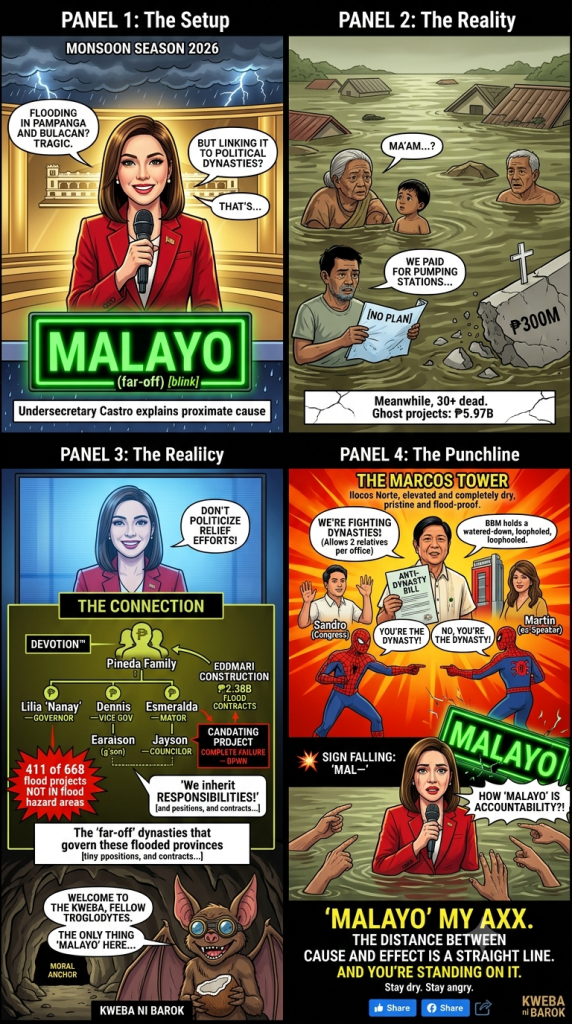
Stay Dry, Stay Angry: A 4-Panel Survival Guide to Palace Gaslighting I. The “Separation of Issues” Fallacy: A Deconstruction
Castro’s primary defense is the classic lawyer’s trick of artificial distinction. “Disaster response is immediate,” she implies. “Legislation is long-term.” She suggests that linking the floods to dynasties “politicizes relief” and detracts from “rescue operations.”
This is the logic of a wet match in a dark cave. It fails to ignite reality.
Since when did analyzing the cause of a disaster ever hinder the treatment of its symptoms? If a building collapses due to a corrupt contractor using substandard cement, do we tell the search-and-rescue teams, “Stop digging for survivors, let’s not politicize the engineering?” No. We pull out the bodies, and then we hang the engineer.
Moreover, the material evidence—which we at the Kweba do not ignore, unlike the Presidential Communications Office (PCO)—shows that the corruption is not abstract.
The East Asia Forum investigation cited in our research materials estimates ₱42.3 to ₱118.5 billion lost annually to flood control corruption.
The “ghost projects” in Bulacan, specifically the ₱5.97 billion awarded to Wawao Builders for projects that exist only on paper, are not “far-off” from the flooding. They are the flooding.
When 411 of 668 flood control projects in Bulacan are not even in flood hazard areas (per the Pro-People Engineers and Leaders (Propel) analysis), this is not incompetence. This is systematic theft orchestrated through political patronage.
To call this connection “far-off” is not just legally blind; it is an insult to the intelligence of every Filipino waist-deep in water.
II. The Pineda Paradox: “Devotion” or Monopoly?
Let us talk about the elephant in the flooded room: the Pineda family of Pampanga. We are told not to judge them. Why? Because Governor Lilia “Nanay” Pineda says they practice “devotion,” not “dynasty.”
How poetic. How profoundly, offensively ridiculous.
The Supreme Court in Lonzanida v. Commission on Elections (COMELEC) was not discussing poetry; it was discussing the concentration of power.
The Constitution’s Article II, Section 26—which Congress has violated for four decades by failing to pass an enabling law—exists precisely to prevent the situation we see in Pampanga.
We don’t have a “textbook” dynasty; we have a multi-volume encyclopedia set of dynastic power:
- Lilia Pineda: Governor
- Dennis “Delta” Pineda: Vice Governor (Son)
- Esmeralda Pineda: Mayor of Lubao (Daughter)
- Jayson Victorino: Councilor of Lubao (Grandson)
This is not “public service.” This is a family business. And the business is power. The resources of the province are the inventory.
When Undersecretary Castro says we shouldn’t connect the leadership to the flood response, she is asking us to pretend that the CEO of a corporation has no responsibility for the company’s dangerous, crumbling infrastructure just because they didn’t personally pour the concrete. It is a de facto immunity grant for the oligarchy.
III. The Conflict of Interest: The Dynasty Defending the Dynasty
Let us not be naive. Why would the Marcos administration instruct its spokesperson to run defense for local political dynasties accused of corruption?
The answer is staring us in the face from the halls of power.
Claire Castro is not a neutral arbiter of law; she is the mouthpiece of the most powerful political dynasty in the Philippines. She works for President Ferdinand Marcos Jr., whose son Sandro holds his seat in Ilocos Norte, whose sister Imee sits in the Senate, and whose cousin, Martin Romualdez, was until recently the most powerful man in the House of Representatives.
This is the “Spider-Man Pointing Meme” of governance.
The President is pushing an “Anti-Political Dynasty Bill” (HB 6771/HB 8389) that our research shows is hopelessly watered down, allowing “two relatives” to hold office.
It is a pantomime of reform—a piece of legislation designed to preempt the Supreme Court’s pending decision on the 1Sambayan petition (G.R. No. 279201) by giving the illusion of compliance with the Constitution, while surgically ensuring the Marcos-Romualdez power structure remains intact.
Castro’s dismissal of the flood-dynasty link is, therefore, a red flag. It signals that the Palace is terrified that the floodwaters will wash away the facade of their “reformist” agenda.
If the public connects the dots between dynastic power and deadly infrastructure, the demand for a genuine anti-dynasty law will become unstoppable, threatening the very family that signs her paycheck.
IV. The “Evidence” vs. The “Excuses”
Castro wants us to rely on “formal investigation findings” rather than “social media speculation.” A fair point, if the institutions doing the investigating weren’t also compromised.
But let us take her advice. Let us look at the “formal” evidence cited in our research:
- The Candating Fiasco: In Arayat, Pampanga, hundreds of millions were spent on successive flood control projects that collapsed, with reporting identifying familial connections between the contractor and a Pampanga legislator.
- The Pandi Ghost Town: A ₱92.8-million flood control project in Pandi, Bulacan, had “essentially no visible accomplishment” during a Sandiganbayan inspection.
- The DPWH Admissions: Former Department of Public Works and Highways (DPWH) Secretary Manuel Bonoan confirmed some projects “appeared to be non-existent.”
This is not random. It is a pattern. It is the political economy of disaster capitalism.
Dynasties don’t just govern these provinces; they extract from them. They maintain power by feeding contracts to allied businessmen, who in turn fund their political machines. The “flood control” budget is not a public safety fund; it is a slush fund.
When Undersecretary Castro says the failure of these “national” projects is a DPWH issue and not a local issue, she is playing a shell game.
Who lobbies the DPWH for these projects? Who influences the selection of contractors? Who maintains the local drainage that flows into these broken national dikes?
The Local Government Code (Republic Act (RA) 7160) gives governors the power of “general supervision” over programs. To claim the local dynasties are innocent bystanders in their own flooded territories is legally farcical.
V. The Ethical Bankruptcy of the Palace
Finally, let us judge Undersecretary Castro by the very law she should be upholding: RA 6713, the Code of Conduct and Ethical Standards for Public Officials.
Section 4 requires officials to act with “Commitment to public interest,” “Professionalism,” and “Responsiveness.” It states that public office is a public trust.
If you are a public official standing in front of the nation while communities are drowning because the government—both national and local—failed to build the infrastructure that was paid for, the “public interest” does not demand legalistic hair-splitting about “proximate cause.” It demands accountability.
Is it “just and sincere” to tell the Aeta communities of Pampanga, who watched their homes wash away, that the reason this happened is “far-off” from the people who have governed them for decades? Is that “responsiveness”? Or is it callousness wrapped in the veneer of legal caution?
VI. Conclusion: The “Far-Off” is Actually “Here and Now”
Claire Castro is right about one thing: We cannot convict a governor of a specific criminal charge just because it rained. Due process requires evidence.
But she is dead wrong to suggest that the systemic rot of political dynasties is irrelevant to the systemic failure of governance.
The connection between dynastic politics and the “ghost projects” is not far-off. It is the proximate cause of this disaster.
The real reason the Palace is slamming the door on this conversation is fear. They are afraid that if the public examines the structural rot of Pampanga and Bulacan, they will turn their gaze to Ilocos Norte.
They are afraid that the 2028 elections will be a referendum on family politics. They are afraid that the Supreme Court will finally enforce a Constitution they have spent 40 years ignoring.
Until the Philippine political system amputates the cancer of dynastic politics, the floods will keep coming. Not just the floods of water, but the floods of corruption, incompetence, and lies.
And for that, Undersecretary Castro, the distance between cause and effect is not “far-off.” It is a straight line. And you are standing right on top of it.
This has been an unsolicited, unpaid, and unapologetic critique from the Kweba ni Barok. Stay dry, and stay angry.
Key Citations
A. Reports & Studies
- Calimbahin, Cleo Anne. “Accountability Washed Away in Philippine Flood Control Corruption.” East Asia Forum, 2 Dec. 2025, eastasiaforum.org/2025/12/02/accountability-washed-away-in-philippine-flood-control-corruption/.
- Ramos, Mariejo. “How Flood Control Projects Fail the Poor in the Philippines.” Context, Thomson Reuters Foundation, 30 Sept. 2025, context.news/climate-risks/how-flood-control-projects-fail-the-poor-in-the-philippines.
B. News Articles
- Limos, Allen. “Palace Rejects Linking Flood Response to Political Dynasties.” The Manila Times, 2 Sept. 2026, http://www.manilatimes.net/2026/09/02/news/palace-rejects-linking-flood-response-to-political-dynasties/2416556.
- Bacelonia, Wilnard. “‘Ghost Projects’ in Bulacan Tied to DPWH Contractors.” Philippine News Agency, 19 Aug. 2025, http://www.pna.gov.ph/articles/1256889.
- “Not Dynasty but Devotion, Says Pampanga Governor Pineda.” Inquirer.net, 12 June 2025, http://www.inquirer.net/446754/not-dynasty-but-devotion-says-pineda-as-she-takes-oath-as-pampanga-gov/.
- “House Makes History, OKs Anti-Political Dynasty Bill on 3rd Reading.” Manila Bulletin, 3 June 2026, mb.com.ph/2026/06/03/house-makes-history-oks-anti-political-dynasty-bill-on-3rd-reading.
- “Petition Asks Supreme Court to Push Congress to Pass Anti-Dynasty Bill.” Rappler, 1 Apr. 2025, http://www.rappler.com/philippines/petitioners-ask-supreme-court-push-congress-pass-anti-dynasty-law/.
- “Relative of Pampanga Congresswoman Bondoc, Mayor Husband Bags P2.38-B Flood Control Deals.” Rappler, 3 Oct. 2025, http://www.rappler.com/newsbreak/in-depth/ana-york-bondoc-jayson-sagum-relative-eddmari-construction-flood-control-contractor-pampanga/.
- Baltasar, Cecile. “P92.8-Million Flood Control Project in Bong Revilla Case Non-Existent.” PhilSTAR Life, 16 Apr. 2026, philstarlife.com/news-and-views/182284-flood-control-project-bong-revilla-case-non-existent.
- “Dizon Flags ‘Faulty Design’ in Paombong, Bulacan Flood Project.” GMA News Online, 22 Aug. 2026, http://www.gmanetwork.com/news/topstories/regions/999481/dizon-flags-faulty-design-in-paombong-bulacan-flood-project/story/.
- “Weeks of Luzon Flooding, Landslides Kill over 30 in the Philippines.” The Straits Times, 30 Aug. 2026, http://www.straitstimes.com/asia/se-asia/weeks-of-luzon-flooding-landslides-kill-over-30-in-the-philippines.
C. Legal and Official Sources
- The 1987 Constitution of the Republic of the Philippines, art. II, sec. 26. Official Gazette.
- Lonzanida v. Commission on Elections. Supreme Court of the Philippines, E-Library.
- Republic Act No. 7160. “Local Government Code of 1991.” Official Gazette, 10 Oct. 1991.
- Republic Act No. 6713. “Code of Conduct and Ethical Standards for Public Officials and Employees.” Official Gazette, 20 Feb. 1989.
Louis ‘Barok‘ C. Biraogo - “Ang Hirap Maging Mahirap”: The PAO Scandal That Proves Government Contempt Is Nothing New
- “Far-Off” My Axx: Malacañang’s Claire Castro Drowns in Her Own Legal Gaslighting
- “Forthwith” to Farce: How the Senate is Killing Impeachment—And Why Enrile’s Right (Even If You Can’t Trust Him)

- “HINDI AKO NAG-RESIGN!”

- “I Know Nothing”: Baste Duterte’s Amnesia Defense Meets ₱33M in GenCorp Contracts

- “I’m calling you from my new Globe SIM. Send load!”

- “Mahiya Naman Kayo!” Marcos’ Anti-Corruption Vow Faces a Flood of Doubt

- “Manageable” Debt, Unmanageable Lies: DBM’s ₱21 Trillion Fairy Tale
- “Meow, I’m calling you from my new Globe SIM!”

- “Natrabaho”: One Word, One Ombudsman, and a Judiciary on Trial
- “No Special Jail for Crooks!” Boying Remulla Slams VIP Perks for Flood Scammers

- “Philippine-Controlled” or Yankee Gas Station? The Davao Fuel Depot Farce Exposed

- “Forthwith” to Farce: How the Senate is Killing Impeachment—And Why Enrile’s Right (Even If You Can’t Trust Him)By Louis ‘Barok‘ C. Biraogo — June 20, 2025
A CONSTITUTIONAL TRAINWRECK IN SLOW MOTION
The Philippine Senate had one job: try Sara Duterte. Instead, on June 10, 2025, 18 senator-jurors staged a constitutional coup by remanding the impeachment articles back to the House—a move so legally dubious, it reeks of political arson[1]. The Constitution’s command is clear: once one-third of the House signs off, trial must proceed “forthwith”[2]. Yet here we are, four months later, drowning in procedural farce while the Senate whistles past its duty. Enter Juan Ponce Enrile, 101 years old and still the sharpest legal knife in the drawer. The Martial Law architect-turned-democracy whisperer is right about the Senate’s dereliction—but trust his legal brain, not his motives. This is the man who survived EDSA, the PDAF scam, and multiple regime changes by knowing exactly when to flip. Now, as Marcos’ chief legal counsel, he’s suddenly preaching constitutional fidelity[3]? Let’s dissect this mess—before impeachment becomes just another corpse in Congress’ graveyard of accountability.I. THE “FORTHWITH” FARCE: HOW THE SENATE BROKE IMPEACHMENT
A. The Constitution’s Crystal-Clear Command
Article XI, Section 3(4) doesn’t mince words:“Trial by the Senate shall Humanforthwith proceed.”
The House did its job: 215 signatures (70% of members) on February 5—more than double the 102 needed[4]. The Senate’s duty was to gavel in, not dither. Yet:- Election break excuse: The Senate adjourned without reading the articles, violating “forthwith”[5].
- Remand gambit: On June 10, Alan Peter Cayetano’s motion sent the case back, demanding the 20th Congress certify it—a requirement nowhere in the Constitution[6].
B. Precedent Says: NO DELAYS, NO REMANDS
History backs Enrile:- Corona (2012): As Senate President, Enrile rushed the trial—no remand, no certification demands[8].
- Estrada (2000): Trial began immediately after House transmission[9].
C. The Nuclear Precedent This Sets
If the Senate can remand impeachments on whim:- Future impeachments die by delay. Presidents/VPs could stall indefinitely.
- House independence erodes. The Senate just commanded a co-equal branch—a breach of comity[10].
II. ENRILE: RIGHT ON LAW, SUSPECT ON MOTIVES
A. The Legal Genius
Enrile’s arguments are bulletproof:- “Forthwith” means now. Not “after we stall.”
- The House’s work is presumed valid. The Senate isn’t a quality-control checkpoint[11].
- Impeachment is sui generis. It’s political—not a courtroom where technicalities kill cases[12].
B. The Hypocrisy
But let’s not canonize him:- Martial Law enabler: This is the man who helped Marcos Sr. dismantle democracy[13].
- PDAF scam accused: His “constitutional purity” rings hollow post-pork barrel[14].
- Marcos’ consigliere: As Bongbong’s lawyer, is he really neutral—or ensuring Duterte’s downfall helps his boss?[15]
III. THE REAL STORY: POWER PLAYS & DIRTY SECRETS
A. Follow the Money: The Confidential Funds Scandal
The impeachment’s real fuel? Duterte’s ₱612M confidential fund mess:- Fake recipients: 60% of DepEd fund recipients don’t exist per PSA data[16].
- OVP’s shady audits: No paper trail for millions—a gift to prosecutors[17].
B. The Assassination Bomb
Article I alleges Duterte threatened to kill Marcos, Liza Araneta, and Speaker Romualdez[18]. A trial would force public testimony—political dynamite before 2028. No wonder the Senate punted.IV. THE ENDGAME: IMPEACHMENT OR IMPLOSION?
Option 1: Senate Grows a Spine (LOL)
- Proceed now. Try Duterte properly—no more delays.
- Drop the remand farce. The House won’t re-certify; this is deadlock by design.
Option 2: Supreme Court Steps In (Spoiler: They Won’t)
Enrile suggests the SC could clarify—but the Court hates political grenades. Remember:- Corona’s revenge: The SC won’t risk another impeachment war[19].
Option 3: Constitutional Chaos
If impeachment dies:- Marcos consolidates. Duterte weakened, 2028 cleared.
- No check left. Future VPs/Presidents become untouchable.
FINAL VERDICT: DEMOCRACY LOSES
Enrile’s right: the Senate must proceed—or admit impeachment is dead. But let’s not pretend this is just legal. It’s raw power—Marcos vs. Duterte, with Congress as collateral. The chilling question? If Congress won’t enforce the Constitution… who will? Epilogue: For those keeping score—yes, the Martial Law architect is now the Constitution’s last defender. Ironic? Absolutely. But in Philippine politics, hypocrisy is just texture.FOOTNOTES
- Enrile: It seems Sara Duterte doesn’t want to face impeachment trial (Inquirer) ↑
- Impeachment of Sara Duterte (Wikipedia) ↑
- How to fix impeachment impasse? Proceed with trial or go to SC – Enrile (Inquirer) ↑
- How to fix impeachment impasse? Proceed with trial or go to SC – Enrile (Inquirer) ↑
- Philippine Senate returns VP impeachment case to lower house (Reuters) ↑
- Philippine Trial of VP Sara Duterte Thrown Into Doubt by Senate (Bloomberg ) ↑
- Enrile interview on ANC (YouTube) ↑
- Impeachment of Renato Corona (Wikipedia) ↑
- Trial of Joseph Estrada (Wikipedia) ↑
- 1987 Philippine Constitution (LawPhil) ↑
- House stands firm on impeachment articles (YouTube) ↑
- Impeachment Primer and Frequently Asked Questions (UP Law) ↑
- Martial law under Ferdinand Marcos (Wikipedia) ↑
- Enrile and the PDAF Scam (PCIJ) ↑
- Enrile serving 2nd Marcos as chief legal counsel (Inquirer) ↑
- PSA Report on DepEd Funds (Philippine Statistics Authority) ↑
- COA Report on OVP Confidential Funds (Commission on Audit) ↑
- Full Text: Articles of Impeachment against Vice President Sara Duterte (PhilStar) ↑
- SC Decisions on Political Questions (Supreme Court) ↑
- “HINDI AKO NAG-RESIGN!”
The Executive Secretary Screams from the Grave of His Own Political Funeral
By Louis “Barok” C. Biraogo — November 22, 2025
1. The Resignation That Wasn’t: A Love Story in Two Contrasting Scripts
Malacañang: “He stepped down out of delicadeza. So noble. So graceful. So very voluntary.”
Lucas Bersamin, live on national television: “Hindi ako nag-resign.”Two narratives. One megaphone. Zero resignation letters.
Welcome to Philippine governance in 2025 – where truth is whatever the Palace press release says it is… until the corpse starts talking back.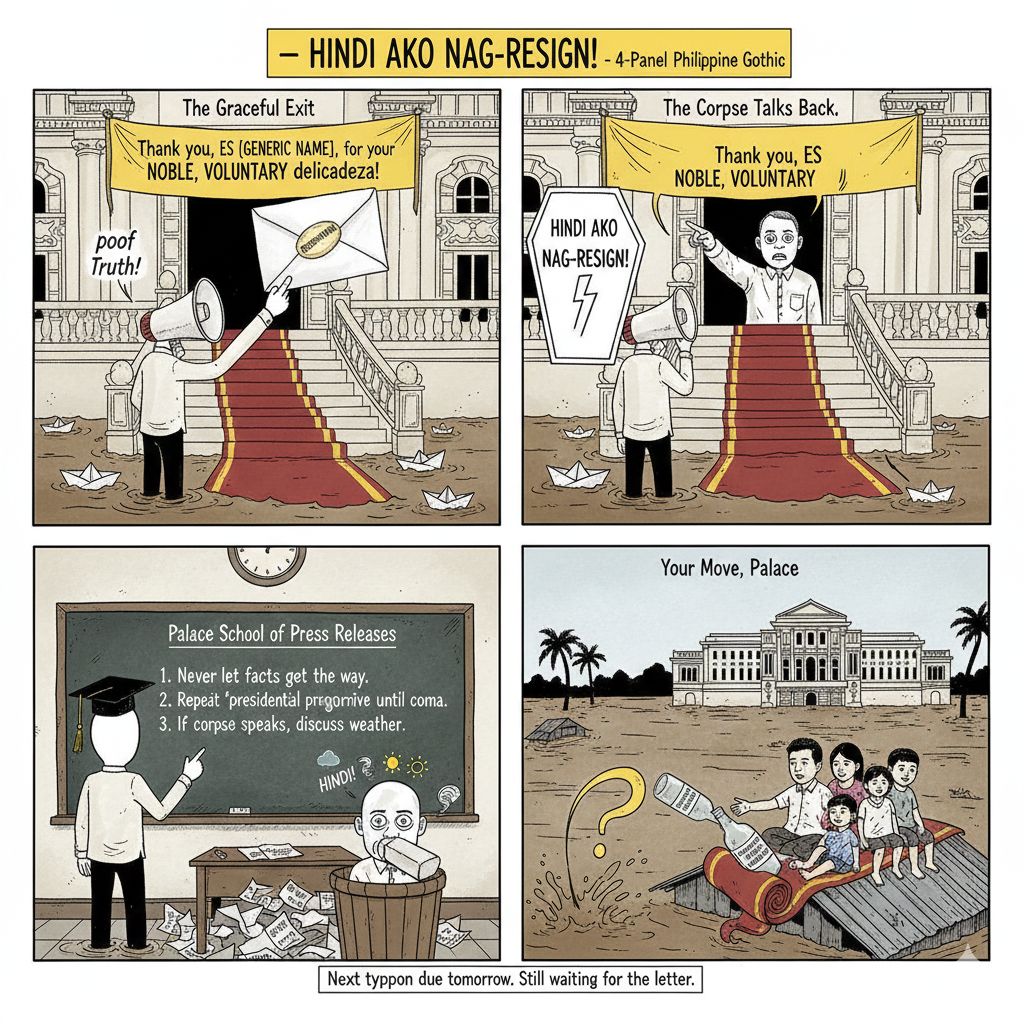
He never resigned—his tongue just signed a loyalty waiver to the flood. 2. Delicadeza: The Magical Word That Turns a Firing Squad into a Red-Carpet Exit
Delicadeza™ – now available in “Extra Strength Cover-Up” flavor!
Just sprinkle liberally whenever a high official becomes politically radioactive. Instantly transforms an unceremonious sacking into a heroic act of self-sacrifice. Side effects may include public nausea, uncontrollable laughter, and the slow death of whatever credibility the administration had left.3. The P52-Billion (or Was It P100-Billion?) Vanishing Flood Trick
While Metro Manila drowns every July, someone allegedly performed the greatest magic act in legislative history: making tens of billions in flood-control funds disappear into thin air – or, more likely, into very specific pockets.
Abracadabra! Ghost projects appear!
Presto! The money is gone!
For the grand finale: blame the guy we just “accepted the resignation” of – even though he swears he never resigned.4. “He Had to Go” – A Phrase That Should Chill Every Filipino Spine
Those four little words Bersamin let slip – “Sinabi sa akin na kailangan ko nang umalis” – are the political equivalent of hearing the safety click off.
When the former Chief Justice, the Little President himself, is told “you have to go” and then watches the Palace rewrite history in real time, we are no longer watching a reshuffle.
We are watching a palace coup disguised as delicadeza.5. The Palace School of Creative Writing: How to Announce a Non-Existent Resignation
- Lesson #1: Never let facts get in the way of a good narrative.
- Lesson #2: When cornered, simply repeat: “The announcement came from Malacañang.”
- Lesson #3: If the ex-official contradicts you on national TV, pretend you’re discussing the weather.
- Extra credit: Use the phrase “presidential prerogative” until people fall asleep.
6. The Bersamin Contradiction Is Now a National Emergency
When the second most powerful man in government and the Palace cannot agree on whether he quit or was pushed, we have crossed into banana-republic territory – except even bananas have documentation.
This is not a gaffe. This is a constitutional crisis wearing the cheap costume of a press briefing.7. One Simple Demand Before the Next Typhoon Kills Again
Publish the damn letter.
All of it. Unredacted. Today.
Let the Filipino people read for themselves whether Lucas Bersamin wrote “I hereby resign” or whether he wrote the bureaucratic equivalent of “Do whatever you want with me, boss.”If the letter says he resigned – great, Bersamin is the liar.
If the letter says nothing of the sort – congratulations, Malacañang, you just confessed to the nation that you will lie about anything, even the exit of your own alter-ego, to save the President’s skin.Your move, Palace.
Because the floods are coming again.
And this time, the Filipino people have every right to ask:
Are we drowning in water… or in lies?Hold them accountable.
Or prepare to swim.
Louis ‘Barok‘ C. Biraogo - ₱8B BBM Pork: CCTV for Every Captain’s Kumpare?
- ₱8.9 Billion, 331 Ghost Police Stations: The TIKAS Scandal Explained
- ₱8.4 Billion, 42,000 Barangays, 1 Election: The “Bawat Barangay Makikinabang” Vote-Buying Masterclass
- ₱75 Million Heist: Cops Gone Full Bandit
- ₱6.77B Ghost Haunts Duterte: RTC Dismisses Mans Carpio’s Desperate Plea
- ₱6.77 Billion and Zero Cash: The Sara Duterte SALN Math That Doesn’t Add Up
- ₱6.7-Trillion Temptation: The Great Pork Zombie Revival and the “Collegial” Vote-Buying Circus
- ₱58.53B, Zero Receipts: The LGSF Pork Barrel Nobody Wants to Name
- ₱53 Million Man Tells ₱695-a-Day Workers to Stop Being ‘Mayabang’: The Audacity of BSP’s Remolona
- ₱4.4 Billion and a Witness Who Can’t Explain It: The Duterte Impeachment’s Most Expensive Non-Answer
- ₱3.06 Billion for Evacuation Centers—But Nobody Knows Where They’ll Stand (Or If They’ll Exist)
- ₱16 Billion, 280 Accounts, 8 Helicopters: Boying Remulla’s Case Against the Yaps Is Not a Drill
- “I Know Nothing”: Baste Duterte’s Amnesia Defense Meets ₱33M in GenCorp Contracts
The Mayor Who Forgot His Sister’s Business, The VP Who Swore She Had One, and The SEC That Can’t Find Either
By Louis ‘Barok’ C. Biraogo — September 24, 2026
FORGIVE me while I untangle this pretzel of Duterte logic.
The Vice President of the Republic of the Philippines declares in two consecutive sworn Statements of Assets, Liabilities and Net Worth (SALNs) that she is a shareholder of GenCorp Industries Inc. The House prosecutors call this an “admission against interest”. The Securities and Exchange Commission (SEC) then testifies that her name appears nowhere in the company’s corporate records — not as incorporator, not as director, not as stockholder.
And the Vice President’s brother, the Mayor of Davao City, responds to this by saying… he had no idea.
Mayor Sebastian “Baste” Duterte wants us to believe that his sister declared a business interest in a company that won 19 contracts worth ₱33.2 million from the city he governs, and he knew absolutely nothing about it. He wants us to believe that the Duterte family — the most tightly-wound political dynasty in modern Philippine history, a family that has turned “loyalty” into an art form and “secrecy” into a governing philosophy — somehow failed to mention this at Sunday lunch.
This is either the most astonishing case of sibling non-communication in Philippine political history, or Baste is taking us for fools.
Let’s examine the evidence.
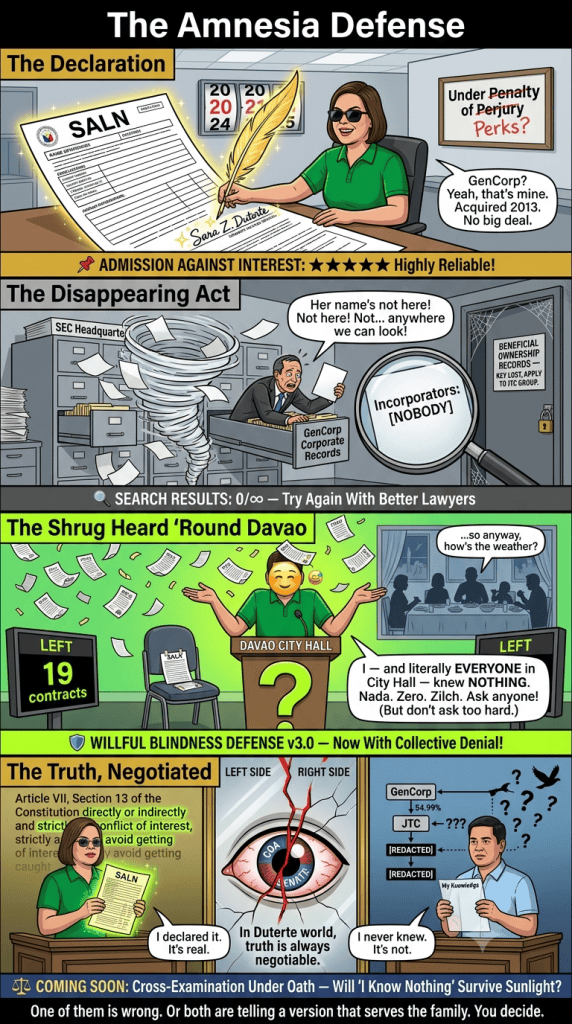
“I Know Nothing”: The Shrug That Launched ₱33M The Mathematical Miracle of the Disappearing Shareholder
The prosecution’s case rests on a beautiful, almost poetic irony: Sara Duterte is the star witness against herself.
She swore under oath that GenCorp was her business interest. She declared it in 2024 and 2025. The interest was “acquired in 2013,” she said. This is not a rumor, not an allegation, not a prosecution fabrication. It is the Vice President’s own signature on a legally binding document.
The House prosecution panel calls this an “admission against interest,” and they’re right to do so. In evidence law, an admission against interest is considered supremely reliable precisely because no rational person would voluntarily make a statement that damages their own position. Sara Duterte had every incentive to hide a GenCorp interest if one existed. She declared it anyway. Why?
Three possibilities:
- Scenario 1: She genuinely believed she had an interest. Maybe she was a beneficial owner through a nominee arrangement that never made it into the corporate records. Maybe she held shares through a trust. Maybe her interest was real but formally undocumented.
- Scenario 2: She made a mistake. A very sophisticated, very expensive, very repeated mistake across two consecutive SALNs. The prosecution’s response to this is blunt: “It was not an honest mistake”.
- Scenario 3: She knew exactly what she was doing. She declared an interest she knew existed but that existed in a form she didn’t want the SEC to see. This is the theory that makes Baste’s “I know nothing” defense so suspicious.
Let’s be clear: the SEC’s testimony does not exonerate Sara. It establishes that her name isn’t in the corporate records. That’s a different proposition from “she has no interest.” The SEC’s own beneficial ownership framework exists precisely because registered shareholders are not always the real owners. The SEC’s Company Registration and Monitoring Department, which testified, doesn’t even have access to beneficial ownership declarations.
So the documentary gap cuts both ways. But it does not help Baste.
The Mayor’s Convenient Amnesia
Baste’s statement is a masterpiece of legal hedging wrapped in folksy Davao bravado. Let’s parse it.
Note the construction: “I, and all other officials and employees.” This is not merely a personal denial. It’s a collective denial, a sweeping assertion that nobody in the entire Davao City government knew anything. This is a remarkably broad claim, especially given that:
- GenCorp received 19 contracts from the city;
- 15 of those were “small value procurement”;
- The Duterte family has governed Davao for decades;
- Sara was Mayor of Davao from 2016 to 2022 — right up until she became Vice President.
Baste says the “Duterte” name doesn’t appear in GenCorp’s documents. But the SEC has now identified JTC Group of Companies Philippines Inc. as holding 54.99% of GenCorp. The ultimate beneficial owners of JTC remain unknown. The court hasn’t seen those records.
So Baste’s defense amounts to: “We didn’t see her name, so we didn’t know.” This is the willful blindness defense dressed up as civic virtue.
The Procurement Theater
Baste’s procurement defense has a certain superficial appeal. Four competitive bids. Fifteen small-value procurements. All published on the Philippine Government Electronic Procurement System (PhilGEPS). GenCorp was the “lowest calculated responsive bid”.
But let’s examine this more carefully.
Small-value procurement is not “no-competition procurement.” It requires requests for quotations, and it has thresholds. More importantly, 15 out of 19 transactions using SVP is a pattern. Repeatedly awarding contracts to the same company through a less-scrutinized procurement method is exactly the kind of thing that should raise eyebrows in a Commission on Audit (COA) audit.
Baste says GenCorp was the “lowest calculated responsive bid.” The Supreme Court has repeatedly held that being the lowest bidder does not immunize a procurement from scrutiny. Specifications can be tailored. Competitors can be excluded. Procurement can be split. The lowest bidder can still be the beneficiary of an unlawful process.
And then there’s the numbers discrepancy — a detail that should be flashing red on every senator-judge’s screen.
Baste says: 19 Davao City transactions, ₱33,263,161.
PhilGEPS says: 15 Davao City awards, ₱34,216,900.
Same city. Same company. Different counts. Different totals. Which is it?
Baste says 19. PhilGEPS says 15. The difference — four transactions — could be amendments, purchase orders, or something else entirely. But Baste didn’t explain the discrepancy. He just asserted his numbers and moved on. This is not transparency. This is information control.
The Constitutional Elephant in the Room
Here’s what Baste’s statement doesn’t address: Article VII, Section 13 of the 1987 Constitution of the Republic of the Philippines (1987 Constitution).
This provision bars the Vice President from “directly or indirectly” participating in any business or being “financially interested in any contract with… the Government” during their tenure. It also requires them to “strictly avoid conflict of interest.”
The House prosecutors have argued that Sara’s continued GenCorp interest — if it existed — violated this provision. Baste’s response doesn’t engage with this at all. He focuses on what city officials knew, not on what the Constitution prohibits.
This is telling. Baste can claim ignorance of his sister’s affairs. He cannot claim that Article VII, Section 13 doesn’t apply to her. The only question is whether she had an interest — and her own SALN says she did.
The Family That Knows Everything Except This One Thing
The Duterte family’s political operation is built on information control. They know who’s loyal. They know who’s not. They know who’s been talking. They know everything.
Baste Duterte is not some naive local official who stumbled into City Hall. He is part of a political machine that has governed Davao for decades. He succeeded his sister as mayor. He inherited her political network. He knows where the bodies are buried — perhaps literally.
And now he wants us to believe that his sister declared a business interest in a company that kept winning city contracts, and he was completely in the dark.
The prosecution has already characterized Sara’s SALN disclosure as an “admission against interest”. Baste’s statement, by contrast, is an assertion of ignorance — a much weaker evidentiary proposition. Anyone can claim they didn’t know. The question is whether the documents prove it.
Baste says the Duterte name isn’t in GenCorp’s documents. But JTC Group’s 54.99% stake creates a corporate veil that hasn’t been pierced. The beneficial ownership records — the ones that would show who really controls GenCorp — haven’t been examined. Baste’s defense is built on the absence of evidence, not the presence of innocence.
The Bottom Line
Baste Duterte’s statement is legally defensible. It is politically precarious. And it is evidentially incomplete.
He says Davao City’s transactions with GenCorp were aboveboard. Maybe they were. But “aboveboard” depends on what the procurement folders actually show — not what a press statement claims.
He says nobody in City Hall knew about Sara’s interest. Maybe they didn’t. But “nobody knew” is not the same as “there was nothing to know.”
He says the Duterte name isn’t in GenCorp’s documents. Maybe it isn’t. But the SEC’s beneficial ownership framework exists precisely because registered shareholders are not always the real owners.
The central question remains unanswered: What was Sara Duterte’s actual relationship with GenCorp? Her own SALN says she had one. The SEC says it can’t find her in the records. JTC Group sits on top of the ownership chain, its own owners hidden from view.
Baste’s “I know nothing” defense is the political equivalent of a shrug. It may satisfy his base. It will not satisfy the Senate impeachment court. And it should not satisfy the Filipino public.
The Vice President declared a business interest under oath. Her brother says the family knew nothing. One of them is wrong.
Or, more likely, both are telling a version of the truth that serves the family’s interests. In Duterte world, the truth is always negotiable. The only question is who gets to define it.
The Senate will get its chance. Baste will testify under oath. And then we’ll see whether “I know nothing” holds up under cross-examination — or whether it joins the long list of Duterte family explanations that crumble when exposed to sunlight.
Louis ‘Barok’ C. Biraogo is the author of the Kweba ni Barok blog. He has never declared a business interest in a company that won ₱33 million in government contracts and then claimed he didn’t know about it. But then again, he’s not a Duterte.
Key Citations
A. Legal & Official Sources
- The 1987 Constitution of the Republic of the Philippines. Official Gazette of the Republic of the Philippines, 1987, http://www.officialgazette.gov.ph/constitutions/1987-constitution/.
- The 1987 Constitution of the Republic of the Philippines, Article VII. Official Gazette of the Republic of the Philippines, http://www.officialgazette.gov.ph/constitutions/the-1987-constitution-of-the-republic-of-the-philippines/the-1987-constitution-of-the-republic-of-the-philippines-article-vii/.
- Republic Act No. 6713. An Act Establishing a Code of Conduct and Ethical Standards for Public Officials and Employees. 20 Feb. 1989, http://www.officialgazette.gov.ph/1989/02/20/republic-act-no-06713/.
- Republic Act No. 9184. An Act Providing for the Modernization, Standardization and Regulation of the Procurement Activities of the Government and for Other Purposes (Government Procurement Reform Act). 10 Jan. 2003, http://www.officialgazette.gov.ph/2003/01/10/republic-act-no-9184/.
- Implementing Rules and Regulations of Republic Act No. 9184. Official Gazette of the Republic of the Philippines, 29 Aug. 2016, http://www.officialgazette.gov.ph/2016/08/29/implementing-rules-and-regulations-of-republic-act-no-9184/.
- Securities and Exchange Commission. Home, http://www.sec.gov.ph/.
- Philippine Government Electronic Procurement System. Home, philgeps.gov.ph/.
- Commission on Audit. Home, http://www.coa.gov.ph/.
- Supreme Court of the Philippines. Home, sc.judiciary.gov.ph/.
B. News Reports
- Suelto, Diana Lhyd. “Sara Holds No Interest in GenCorp – Baste.” Philstar.com, The Philippine Star, 23 Sept. 2026, http://www.philstar.com/headlines/2026/09/23/2558338/sara-holds-no-interest-gencorp-baste.
- Rita, Joviland. “Baste Duterte Says He’s Unaware of VP Sara’s Alleged Link to GenCorp.” GMA News Online, GMA Network, 22 Sept. 2026, http://www.gmanetwork.com/news/topstories/nation/1003221/baste-duterte-says-he-s-unaware-of-vp-sara-s-alleged-link-to-gencorp/story/.
- Panti, Llanesca T. “Prosecution: Baste Duterte’s Statement on GenCorp ‘a Confession of Sins.’” GMA News Online, GMA Network, 22 Sept. 2026, http://www.gmanetwork.com/news/topstories/nation/1003252/prosecution-baste-duterte-s-statement-on-gencorp-a-confession-of-sins/story/.
- “Duterte-Linked Firm Got 49 Govt Contracts.” The Manila Times, 23 Sept. 2026, http://www.manilatimes.net/2026/09/23/news/duterte-linked-firm-got-49-govt-contracts/2430688.
- Peralta-Malonzo, Third Anne. “Sara Duterte-Linked Firm Bags P34.2M in Davao City Hall Contracts.” SunStar, 22 Sept. 2026, http://www.sunstar.com.ph/manila/sara-duterte-linked-firm-bags-p342m-in-davao-city-hall-contracts.
- Avendaño, Christine O. “SEC Official Reveals Duterte Corporate Role in Food Firm.” CoverStory.ph, 22 Sept. 2026, coverstory.ph/2026/09/22/sec-official-reveals-duterte-business-interests/.
Louis ‘Barok‘ C. Biraogo - “Ang Hirap Maging Mahirap”: The PAO Scandal That Proves Government Contempt Is Nothing New
- “Far-Off” My Axx: Malacañang’s Claire Castro Drowns in Her Own Legal Gaslighting
- “Forthwith” to Farce: How the Senate is Killing Impeachment—And Why Enrile’s Right (Even If You Can’t Trust Him)
- “HINDI AKO NAG-RESIGN!”
- “I Know Nothing”: Baste Duterte’s Amnesia Defense Meets ₱33M in GenCorp Contracts
- “I’m calling you from my new Globe SIM. Send load!”
- “Mahiya Naman Kayo!” Marcos’ Anti-Corruption Vow Faces a Flood of Doubt
- “Manageable” Debt, Unmanageable Lies: DBM’s ₱21 Trillion Fairy Tale
- “Meow, I’m calling you from my new Globe SIM!”
- “Natrabaho”: One Word, One Ombudsman, and a Judiciary on Trial
- “No Special Jail for Crooks!” Boying Remulla Slams VIP Perks for Flood Scammers
- “Philippine-Controlled” or Yankee Gas Station? The Davao Fuel Depot Farce Exposed
- “I’m calling you from my new Globe SIM. Send load!”
A Cat-astrophic Error: Globe Telecom’s SIM Registration Tailspin

Louis ‘Barok‘ C. Biraogo - Andres Heralds DoJ’s Transformative Justice

- Sailing to New Horizons: PEZA Sets Ambitious PHP250-B Approval Target for 2024

- Panga’s Bold Vision: The Paradigm Shift of Iwahig Mega Economic Zone

- Panga’s Pragmatic Approach to Sino-Philippine Investments

- The Shadow Over Manila

- Shadow of the Red Notice: Remulla hunts down Teves

- Frozen Enigma: NBI Bacolod’s Tussle with Darkness

- Quiboloy’s Supreme Court Shenanigans: A Pathetic Attempt to Dodge Justice

- RP’s cunundrum: A pawn in the SCS geopolitical chessboard

- Macapagal Leads: Navigating Relocation Challenges

- “Mahiya Naman Kayo!” Marcos’ Anti-Corruption Vow Faces a Flood of Doubt
By Louis ‘Barok‘ C. Biraogo — August 2, 2025
Executive Summary: Can Marcos Break the Cycle of Corruption?
President Ferdinand Marcos Jr.’s fiery 2025 SONA pledge to expose and prosecute corruption in failed flood control projects taps into public fury over persistent flooding and squandered funds. His call to shame negligent officials and publish project data signals bold intent, but the Marcos family’s notorious history—linked to $5-10 billion in plundered wealth—casts doubt on sincerity.
Digital transparency and public pressure offer hope, yet entrenched patronage, a sluggish judiciary (8% conviction rate), and selective enforcement loom as barriers. The narrow focus on infrastructure sidesteps broader corruption in healthcare and local governance. Success demands independent oversight, robust whistleblower protections, and judicial reform. Without tackling elite impunity, this risks becoming empty rhetoric. Civil society, international partners, and citizens must hold Marcos accountable through data-driven monitoring and civic action to ensure reforms stick within 12-18 months.
Credibility Check: Is Marcos’ Anti-Corruption Vow Trustworthy?
Marcos’ pledge to combat flood project corruption, delivered with a dramatic “Mahiya naman kayo” in his 2025 SONA, resonates with Filipinos fed up with flooded streets and broken promises. Yet, the Marcos name—tied to Ferdinand Sr.’s regime, which siphoned $5-10 billion from public coffers—invites skepticism. Ongoing unpaid tax liabilities and social media campaigns whitewashing martial law abuses further erode trust.
Specific commitments include tasking the Department of Public Works and Highways (DPWH) to compile and publicize a list of flood control projects and launching audits via Regional Project Monitoring Committees. These are concrete, measurable steps. However, similar transparency vows under Aquino and Duterte yielded only an 8% conviction rate for graft cases (2016-2023).
Marcos’ high approval rating (68% in June 2025 Pulse Asia) offers political capital, but dynastic ties—relatives control key local posts with flood contracts—raise fears of selective prosecutions. Vague promises of “charges in coming months” lack timelines or named targets, unlike Singapore’s rigorous asset declaration mandates. Without judicial reform or elite accountability, this risks being performative posturing.
Stakeholder Showdown: Who’s Betting on Marcos, and Who’s Not?
Marcos’ Cheerleaders: Why Some See a Path to Victory
Supporters argue Marcos’ plan could succeed by leveraging public outrage and institutional tools. Publicizing project data, as mandated to DPWH, invites scrutiny from groups like Procurement Watch, mirroring global transparency successes. Digital governance—e-bidding and geotagged tracking—aligns with UNODC’s praise for reducing bribery.
Post-midterm political pressure, with 2028 elections looming, pushes Marcos to deliver visible wins. International validation, including FATF grey list removal, bolsters credibility. High-profile prosecutions could deter future corruption, especially if DPWH audits uncover hard evidence.
The Doubters: Why History and Structure Spell Trouble
Skeptics point to insurmountable barriers. The Marcos family’s cronyism legacy—with relatives holding governorships and mayorships tied to flood contracts—suggests conflicts of interest. Patronage politics, where DPWH directors are political appointees, undermines impartiality.
The Sandiganbayan’s 1,800+ backlog and 7-10 year case resolutions signal judicial gridlock. Past anti-corruption drives, like Duterte’s Build-Build-Build audits, fizzled with minimal convictions. Social media disinformation glorifying the Marcos era, as noted in 2022 election reports, dulls public pressure.
Critics argue the focus on flood projects ignores broader corruption in healthcare and local governance, per business surveys.
The Middle Ground: Forces That Could Tip the Scales
Public intolerance, especially among youth using platforms like X to expose corruption, creates reform momentum. Digital tools like e-procurement systems reduce human discretion, but require scaling. Extreme weather—2024-25’s record La Niña—complicates project evaluations, as some failures stem from design flaws, not just corruption.
Donors like ADB and JICA, withholding funds pending transparency, could enforce compliance but risk politicization in the 2025 election season.
Systemic Smackdown: Are Marcos’ Fixes Big Enough for the Mess?
Marcos’ plan—public lists and audits—tackles visible flood project failures but falls short of corruption’s vast scope, costing the Philippines ₱700 billion annually. Infrastructure markups of 20-30% reflect patronage networks, judicial weaknesses, and dynastic control, with 80% of local posts held by families. The measures address symptoms, not root causes.
Global models, like Singapore’s independent CPIB or Georgia’s post-2003 judicial overhaul, emphasize autonomous agencies and swift prosecutions. The Philippines’ Ombudsman and Sandiganbayan lack resources and independence, with an 8% conviction rate.
Marcos’ digital push—e-bidding and geotagging—is promising but needs training and infrastructure to scale. Patronage and disinformation, fueled by pro-Marcos propaganda, hinder cultural change. Delayed COA reports (12-24 months) and unaddressed poverty-driven corruption limit impact. Sustainability beyond 2025 elections is shaky without elite accountability.
Battle Plan: Actionable Steps to Crush Corruption
Government Institutions
- Fortify Oversight: Grant Ombudsman and COA full independence by Q2 2026; double Sandiganbayan divisions for 90-day case resolutions using e-subpoenas.
- Go Digital: Launch real-time DPWH data portals by Q1 2026, using blockchain for billing transparency.
- Protect Whistleblowers: Enact laws by Q1 2026, offering 1% of recovered funds as bounties and overseas relocation, funded by Presidential Social Fund.
Civil Society Organizations
- Citizen Audits: Form a Citizen Flood Audit Corps by Q2 2026, training 1,000 volunteers for drone surveys, partnered with AFP for security.
- Anti-Dynasty Push: Advocate for 1987 Constitution enforcement to curb dynastic control by 2027.
International Partners
- Tech Support: ADB and JICA fund LGU training on e-procurement by Q3 2026, tying aid to transparency.
- Global Standards: Back UNCAC implementation for ownership registries by 2027.
Citizens and Media
- Crowdsource Evidence: Create X-based dashboards by Q1 2026 to track DPWH disclosures.
- Educate: Push integrity curricula by 2026-27, countering disinformation with CHED support.
Success Metrics
- Short-Term (12-18 months): Publish flood data by Q1 2026; charge 50+ officials; boost e-procurement by 20%.
- Long-Term: Cut cost overruns by 10% by 2027; raise convictions to 15%; establish 5 graft courts.
These evidence-based steps, inspired by global successes, balance immediate wins with systemic change, leveraging public and international pressure to sustain reforms.
Final Verdict: Can Marcos Turn Words into Action?
President Marcos’ “Mahiya Naman Kayo!” rallying cry against corruption in flood control projects captures public frustration but faces a steep climb to deliver lasting change. While his transparency pledges and digital reforms show promise, the Marcos family’s historical baggage, entrenched patronage networks, and a limping judiciary (with an 8% conviction rate) threaten to drown these efforts in skepticism.
Success demands more than fiery rhetoric—it requires independent oversight, robust whistleblower protections, and prosecutions that target elites, not just scapegoats. By leveraging UNODC-backed digital tools, civil society momentum, and international pressure, Marcos could build trust within 12-18 months.
Yet, without dismantling dynastic power and addressing systemic corruption beyond infrastructure, this crusade risks fading into political noise. Citizens, media, and global partners must hold the administration accountable, ensuring promises translate into measurable outcomes by 2027.
Key Citations
- Philstar: Marcos’ 2025 SONA Anti-Corruption Pledge
- Guinness World Records: Marcos Family Scandals
- Rappler: Marcos Family Tax Issues
- Ombudsman: Graft Conviction Statistics
- Pulse Asia: June 2025 Approval Ratings
- UNODC: Philippines Anti-Corruption Progress
- FATF: Grey List Status
- Rappler: Social Media Disinformation
- Transparency International: Philippines Corruption
- PhilGEPS: E-Procurement
- PAGASA: La Niña 2024-25
- ADB: Infrastructure Funding
- JICA: Philippines Projects
- Sandiganbayan: Case Backlog
- PNA: Build-Build-Build Audits
- CPIB Singapore: Anti-Corruption Model
- Transparency International: Georgia Reforms
- COA: Audit Reports
- Ateneo: Political Dynasties
- UNCAC: Anti-Corruption Framework
- DPWH: Project Transparency
- Official Gazette: 1987 Constitution
- CHED: Education Reforms
- AFP: Security Support

Louis ‘Barok‘ C. Biraogo - ₱8B BBM Pork: CCTV for Every Captain’s Kumpare?
- ₱8.9 Billion, 331 Ghost Police Stations: The TIKAS Scandal Explained
- ₱8.4 Billion, 42,000 Barangays, 1 Election: The “Bawat Barangay Makikinabang” Vote-Buying Masterclass
- ₱75 Million Heist: Cops Gone Full Bandit
- ₱6.77B Ghost Haunts Duterte: RTC Dismisses Mans Carpio’s Desperate Plea
- ₱6.77 Billion and Zero Cash: The Sara Duterte SALN Math That Doesn’t Add Up
- ₱6.7-Trillion Temptation: The Great Pork Zombie Revival and the “Collegial” Vote-Buying Circus
- ₱58.53B, Zero Receipts: The LGSF Pork Barrel Nobody Wants to Name
- ₱53 Million Man Tells ₱695-a-Day Workers to Stop Being ‘Mayabang’: The Audacity of BSP’s Remolona
- ₱4.4 Billion and a Witness Who Can’t Explain It: The Duterte Impeachment’s Most Expensive Non-Answer
- ₱3.06 Billion for Evacuation Centers—But Nobody Knows Where They’ll Stand (Or If They’ll Exist)
- ₱16 Billion, 280 Accounts, 8 Helicopters: Boying Remulla’s Case Against the Yaps Is Not a Drill
- “Manageable” Debt, Unmanageable Lies: DBM’s ₱21 Trillion Fairy Tale
The Marcos Administration’s Greatest Fiction Since Martial Law: Debt Is Fine
By Louis ‘Barok‘ C. Biraogo — August 19, 2026
ON August 17, 2026, Acting Budget Secretary Kim Robert C. De Leon—a 35-year-old former assistant professor who now holds the unenviable distinction of being the third person to occupy that chair in under a year—stood before Congress and delivered what can only be described as a masterclass in the art of saying nothing while appearing to say everything.
“Debt remains manageable,” he intoned, as if repetition alone could transform a prayer into a fact.
The proposed ₱7.2-trillion FY2027 National Expenditure Program, he assured the assembled legislators, proves the government can honor its obligations “without sacrificing investments in people, infrastructure, [and the] economy.”
The performance was pitch-perfect. The delivery was smooth. The PowerPoint slides, one imagines, were immaculate.
And every single word was technically true—in the same way that a condemned man’s last meal is technically “dinner.”
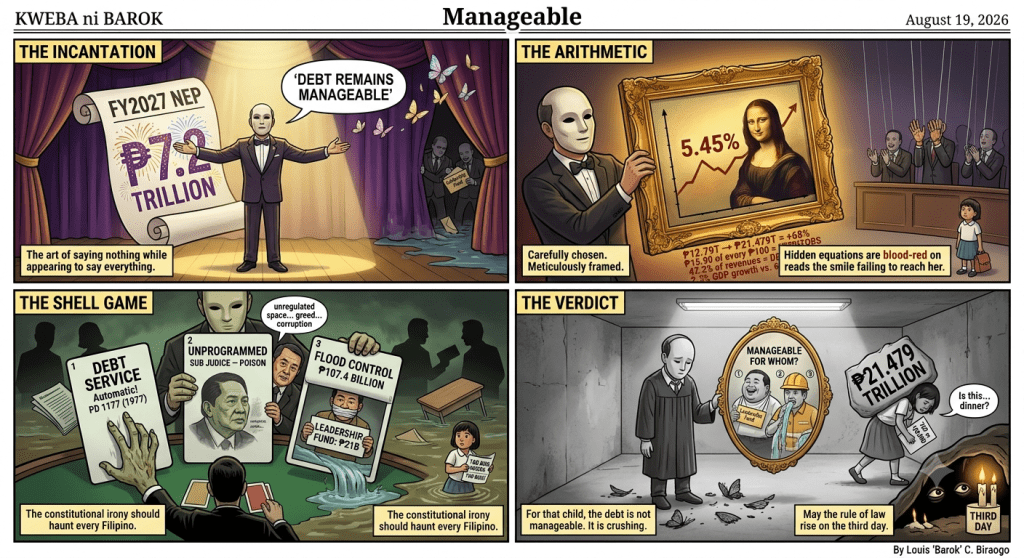
“‘Debt Remains Manageable’ — Said the Guy Who’ll Be Long Dead Before the Last Peso Is Paid.”
PART I: THE ARITHMETIC OF ANXIETY
Let us begin where the Department of Budget and Management (DBM) would prefer we not look: the actual numbers.
The press release speaks lovingly of deficit-to-GDP ratios—5.45% in 2026, the “lowest since the start of the Administration.” It is a beautiful statistic, carefully chosen, meticulously framed.
But here is what the press release does not tell you: The debt stock is ₱18.488 trillion as of March 2026—up 10.81% year-on-year. By 2027, DBM’s own projections show it reaching ₱21.479 trillion—a 68% increase since the Marcos administration inherited ₱12.79 trillion in 2022.
Read that again. Sixty-eight percent. In five years.
Financial expenses—interest payments—will consume ₱1.143 trillion in 2027, a 17.3% increase that outpaces the 6% overall budget growth by nearly threefold. For every ₱100 the government spends, approximately ₱15.90 goes directly to creditors before a single classroom is built, a hospital bed added, or a flood-control project completed.
In 2025, debt service consumed 47.2% of national government revenues. Nearly half of everything collected in taxes went to paying creditors. Not to education. Not to health. Not to infrastructure. To interest and principal on loans accumulated by politicians who will be long retired—or long dead—by the time the final peso is repaid.
The Philippines is not borrowing to build its future; it is borrowing to pay for its past, and charging the bill to its children.
PART II: THE CONSTITUTIONAL SHELL GAME
The DBM’s assertion that “debt servicing is explicitly provided for in the budget” is technically accurate. What it omits is that this provision is not a policy choice—it is a legal straitjacket imposed by Presidential Decree No. 1177, issued by Ferdinand Marcos Sr. in 1977, which created an “automatic appropriation” for debt service that bypasses annual congressional review.
The Supreme Court upheld this in Guingona v. Carague (1991), reasoning that Congress can appropriate automatically through standing law. It is a doctrine that has served successive administrations well: no matter how disastrously they manage finances, the debt gets paid first, and everything else competes for whatever remains.
The constitutional irony should haunt every Filipino: the 1987 Constitution was written specifically to prevent the abuses of the Marcos dictatorship, and yet its drafters preserved the very mechanism Marcos created to ensure his debts could never be questioned. Now Ferdinand Marcos Jr. inherits both the mechanism and its consequences.
The constitutional questions do not end there. The Supreme Court currently has before it a challenge to unprogrammed appropriations—that budgetary device allowing the executive to spend money it has not actually secured. The DBM boasts that the 2027 UA allocation of ₱111.98 billion is the “lowest nominal amount since 2019.”
What the press release does not mention is that the entire mechanism is sub judice—two lawmakers, Edgar Erice and Leila de Lima, have petitioned the Court to declare it unconstitutional. Justice Ramon Paul Hernando called UA “an unregulated space where discretion replaces discipline and where the temptations of greed and corruption inevitably find room to operate.”
The DBM’s response? To propose using the same mechanism again, at a reduced scale, as if lowering the dose of poison makes it medicine.
PART III: THE CORRUPTION THAT EATS EVERYTHING
The flood-control scandal is not a footnote to this story—it is the story’s beating heart.
Former Department of Public Works and Highways (DPWH) Secretary Manuel Bonoan testified before the Sandiganbayan on August 12, 2026—five days before De Leon’s polished presentation—that a “Senate Leadership Fund” had quietly operated inside DPWH’s budget since 2024. Roughly ₱500 million per senator, up to ₱1 billion for committee chairs. ₱13.29 billion availed in 2024. Approximately ₱21 billion in 2025.
Bonoan’s account describes a mechanism tracing to 2023, when foreign-assisted DPWH project funding was cut by as much as 88.8% and the deducted amounts—plus additional allocations totaling ₱292.7 billion—were converted into 8,075 “inserted projects” in the 2023 General Appropriations Act (GAA). The President, Bonoan testified, was “alarmed” when he reported it.
Alarmed enough to stop it? Apparently not. Alarmed enough to institutionalize it under a cleaner name? That is what Bonoan describes.
The Philippine Center for Investigative Journalism reports that the President’s own son, Ilocos Norte Rep. Sandro Marcos, and former Speaker Martin Romualdez received the largest shares of “allocable” funds from 2023 to 2025.
And the 2027 budget? It restores ₱107.4 billion for flood-control projects—the very program at the center of the scandal—while targeting only about 700 new public-school classrooms against a nationwide shortage of roughly 160,000.
Let those numbers sit together: ₱107.4 billion for flood control in a department that admitted, through its former secretary’s testimony, to operating an undisclosed allocation channel for three consecutive budget cycles. Seven hundred classrooms for a country that needs one hundred sixty thousand.
This is not governance. This is looting with better lighting.
PART IV: THE CONFIDENTIAL FUNDS CONUNDRUM
The proposed 2027 budget includes ₱10.773 billion in confidential and intelligence funds. The DBM assures us these are “subject to existing budgeting, utilization, liquidation, and auditing rules.”
But the Senate impeachment trial of Vice President Sara Duterte has already demonstrated what those rules are worth. More than ₱600 million in CIFs were “quickly disbursed” by the Office of the Vice President and the Department of Education—including ₱125 million spent in just 11 days in December 2022, with liquidation documents bearing names like “Mary Grace Piattos,” “Milky Secuya,” and “Kokoy Villamin”—names that could not be verified with PSA records.
These are not accounting irregularities. They are evidence of systemic fraud—a parallel budget operating outside the constitutional requirement that “no money shall be paid out of the Treasury except in pursuance of an appropriation made by law.”
Article VI, Section 25(6) of the 1987 Constitution requires that discretionary funds be disbursed “only for public purposes to be supported by appropriate vouchers.”
“Mary Grace Piattos” is not a public purpose. “Kokoy Villamin” is not a voucher.
PART V: THE INTERGENERATIONAL THEFT
Economist Benjamin Diokno—someone who has actually managed public finances rather than merely described them—put it bluntly: “Subsequent administrations—and future generations of Filipinos—have to bear the brunt of adjustment in terms of higher taxes or constrained public services.”
This is the hidden violence of the “manageable debt” narrative. It transforms current consumption into future obligation. It allows politicians to spend today what the nation’s children will be forced to repay tomorrow, with interest, at the expense of their own children’s education, health, and future.
The DBM’s fiscal strategy assumes sustained 6%+ GDP growth, stable or appreciating currency, continued revenue improvement, and political discipline across two more election-adjacent budget cycles.
But actual Q2 2026 GDP growth came in at 2.3%—well below the already-lowered 3.5%–4.5% target. Fitch downgraded its outlook from “stable” to “negative” in April 2026. The peso is projected at ₱62 to the dollar, meaningfully weaker than the ₱49.6 level when much pandemic-era debt was contracted.
Every one of the assumptions underpinning “manageable” is currently failing.
PART VI: THE POLITICAL ECONOMY OF DENIAL
Why does the government insist on the “manageable debt” narrative? The answer is not complicated.
Because the alternative is unthinkable within the current political structure.
If the debt is genuinely problematic—if fiscal room is actually narrow, if interest is crowding out productive spending, if corruption is systemic—then the entire edifice of patronage sustaining the administration’s coalition collapses.
The “leadership fund” exists because legislators need projects. Flood-control projects exist because they are visible, geographically specific, and contractor-friendly. Debt exists because the political system demands spending that exceeds the government’s willingness to tax.
“Manageable debt” is not a fiscal assessment. It is a political necessity—a shield against the uncomfortable truth that the Philippines is trapped in a cycle where borrowing funds corruption, corruption necessitates more borrowing, and more borrowing deepens the corruption.
PART VII: WHAT MUST BE DONE
First: Abolish unprogrammed appropriations entirely. No constitutional mechanism should allow spending beyond what Congress has actually appropriated.
Second: Subject automatic debt-service appropriation to annual congressional review. Guingona was decided when debt was a fraction of its current size. Congress must exercise genuine oversight over the single largest budget item.
Third: Establish a statutory debt ceiling. The International Monetary Fund (IMF) recommended this in 2019. The Philippines ignored it. Debt has grown 68% in five years without any legislative check.
Fourth: Create an independent fiscal council to provide nonpartisan analysis of debt sustainability. No government agency should grade its own homework.
Fifth: Publish a real-time debt dashboard showing debt-to-GDP, interest-to-revenue, debt-service-to-revenue, primary balance, maturity profile, and contingent liabilities. If the debt is truly “manageable,” the government should welcome scrutiny.
Sixth: Criminalize budget insertions and the “leadership fund” mechanism. Belgica v. Ochoa struck down the PDAF for violating separation of powers. The “leadership fund” is PDAF by another name—worse, because it operates without even the transparency of a formal line item.
Seventh: Strengthen the Commission on Audit’s (COA) audit capacity. An auditor that cannot audit effectively is not a watchdog—it is a decoration.
Eighth: Convert debt from burden to investment. Every peso borrowed should be traceable to a specific, verifiable, productive asset.
PART VIII: THE VERDICT
The DBM’s press release is not dishonest. It is worse—it is selective, which in public finance means deceptive.
The debt is “manageable” only in the technical sense that the Philippines is not currently in default. But so does every country that eventually defaults. The question is not whether debt is manageable today but whether it is sustainable tomorrow—and the answer depends on variables currently moving in the wrong direction.
The government’s own projections assume growth it is not achieving, revenue it is not collecting, and fiscal discipline it is not demonstrating. The corruption scandals are not aberrations; they are the logical consequence of a system that borrows without accountability, spends without transparency, and audits without enforcement.
The DBM says the debt is manageable. The real question is: manageable for whom?
For politicians who use borrowed money to build patronage networks? Yes.
For contractors who overcharge for substandard flood-control projects? Certainly.
For senators who quietly avail of “leadership funds” while publicly denouncing corruption? Absolutely.
But for the Filipino child who will inherit a nation mortgaged to creditors—a nation that spent its future on ghost projects and ghost employees and ghost accountability—for that child, the debt is not manageable.
It is crushing.
EPILOGUE: THE THIRD DAY
The Kweba ni Barok has long maintained: the rule of law must rise on the third day. First comes denial; then exposure; then accountability.
For the Philippines’ debt, we remain in denial, though exposure nears—Sandiganbayan testimony, the impeachment trial, the Supreme Court’s pending ruling. The cracks are forming. Whether accountability follows depends on Filipinos demanding it—Congress exercising its power, the Court upholding Belgica and Araullo, COA actually auditing.
The debt is ₱18.488 trillion and climbing. Every day, interest accrues. Every year, another generation is mortgaged.
The question is not whether the debt is manageable. The question is whether the Filipino people will manage to hold their government accountable before the third day arrives—or whether, like so many promises of reform, it will be buried under the weight of the very debt that was supposed to be “manageable.”
May the rule of law rise on the third day.
May the truth find its voice.
And may the Filipino people finally demand a debt that serves them—not one that enslaves their children.
— Barok
Key Citations
A. Official Reports & Court Decisions
- Bureau of the Treasury. “NG debt reaches P18.49 trillion as of end-March 2026.” Bureau of the Treasury, 2026, https://www.treasury.gov.ph/?p=75312.
- Department of Budget and Management. “DBM: PH debt manageable as gov’t cuts deficit, protects growth in proposed 2027 budget.” DBM.gov.ph, 17 Aug. 2026, https://www.dbm.gov.ph/index.php/management-2/4170-dbm-ph-debt-manageable-as-gov-t-cuts-deficit-protects-growth-in-proposed-2027-budget.
- Belgica v. Ochoa, G.R. No. 208566. Supreme Court of the Philippines, 19 Nov. 2013, https://lawphil.net/judjuris/juri2013/nov2013/gr_208566_2013.html.
- Guingona, Jr. v. Carague, G.R. No. 94571. Supreme Court of the Philippines, 22 Apr. 1991, https://www.lawphil.net/judjuris/juri1991/apr1991/gr_94571_1991.html.
- Presidential Decree No. 1177. Lawphil.net, 1977, https://lawphil.net/statutes/presdecs/pd1977/pd_1177_1977.html.
B. News Articles & Investigations
- “Bonoan: ‘All senators’ got share of ‘leadership fund’.” Inquirer.net, 13 Aug. 2026, https://newsinfo.inquirer.net/2283475/bonoan-all-senators-got-share-of-leadership-fund.
- “De Lima, Erice ask Supreme Court to strike down P150-B unprogrammed funds.” Philstar.com, 8 Jan. 2026, https://www.philstar.com/headlines/2026/01/08/2499585/de-lima-erice-ask-supreme-court-strike-down-p150-b-unprogrammed-funds.
- “PH gov’t debt seen surging to record high P21.5T in ’27.” Inquirer Business, 12 Aug. 2026, https://business.inquirer.net/605260/ph-govt-debt-seen-surging-to-record-high-p21-5t-in-27.
- Philippine Center for Investigative Journalism. “‘Allocables’ are the new pork and Sandro Marcos…” PCIJ.org, 29 Nov. 2025, https://pcij.org/2025/11/29/allocables-are-the-new-pork/.
- “Sara Duterte won’t explain why ‘Piattos,’ ‘Chippy’ received confidential funds.” Philstar.com, 11 Dec. 2024, https://www.philstar.com/headlines/2024/12/11/2406657/sara-duterte-wont-explain-why-piattos-chippy-received-confidential-funds.
- “Unprogrammed funds in any form unconstitutional, says SC justice.” Inquirer.net, 9 Dec. 2025, https://newsinfo.inquirer.net/2152558/unprogrammed-funds-in-any-form-unconstitutional-says-sc-justice.
C. Economic Data & Analysis
- Diokno, Benjamin E. “UP School of Economics Discussion Papers.” Econstor, 1990s, https://www.econstor.eu/bitstream/10419/46673/1/574680748.pdf.
- Fitch Ratings. “Fitch Revises the Philippines’ Outlook to Negative; Affirms at BBB.” FitchRatings.com, 20 Apr. 2026, https://www.fitchratings.com/research/sovereigns/fitch-revises-philippines-outlook-to-negative-affirms-at-bbb-20-04-2026.
- Philippine Statistics Authority. “GDP Grows by 2.3 Percent in the Second Quarter of 2026.” PSA.gov.ph, 7 Aug. 2026, https://psa.gov.ph/content/gdp-grows-23-percent-second-quarter-2026.
Louis ‘Barok‘ C. Biraogo - ₱8B BBM Pork: CCTV for Every Captain’s Kumpare?
- ₱8.9 Billion, 331 Ghost Police Stations: The TIKAS Scandal Explained
- ₱8.4 Billion, 42,000 Barangays, 1 Election: The “Bawat Barangay Makikinabang” Vote-Buying Masterclass
- ₱75 Million Heist: Cops Gone Full Bandit
- ₱6.77B Ghost Haunts Duterte: RTC Dismisses Mans Carpio’s Desperate Plea
- ₱6.77 Billion and Zero Cash: The Sara Duterte SALN Math That Doesn’t Add Up
- ₱6.7-Trillion Temptation: The Great Pork Zombie Revival and the “Collegial” Vote-Buying Circus
- ₱58.53B, Zero Receipts: The LGSF Pork Barrel Nobody Wants to Name
- ₱53 Million Man Tells ₱695-a-Day Workers to Stop Being ‘Mayabang’: The Audacity of BSP’s Remolona
- ₱4.4 Billion and a Witness Who Can’t Explain It: The Duterte Impeachment’s Most Expensive Non-Answer
- ₱3.06 Billion for Evacuation Centers—But Nobody Knows Where They’ll Stand (Or If They’ll Exist)
- ₱16 Billion, 280 Accounts, 8 Helicopters: Boying Remulla’s Case Against the Yaps Is Not a Drill
- “Meow, I’m calling you from my new Globe SIM!”
A Cat-astrophic Error: Globe Telecom’s SIM Registration Tailspin
Louis ‘Barok‘ C. Biraogo - ₱8B BBM Pork: CCTV for Every Captain’s Kumpare?
- ₱8.9 Billion, 331 Ghost Police Stations: The TIKAS Scandal Explained
- ₱8.4 Billion, 42,000 Barangays, 1 Election: The “Bawat Barangay Makikinabang” Vote-Buying Masterclass
- ₱75 Million Heist: Cops Gone Full Bandit
- ₱6.77B Ghost Haunts Duterte: RTC Dismisses Mans Carpio’s Desperate Plea
- ₱6.77 Billion and Zero Cash: The Sara Duterte SALN Math That Doesn’t Add Up
- ₱6.7-Trillion Temptation: The Great Pork Zombie Revival and the “Collegial” Vote-Buying Circus
- ₱58.53B, Zero Receipts: The LGSF Pork Barrel Nobody Wants to Name
- ₱53 Million Man Tells ₱695-a-Day Workers to Stop Being ‘Mayabang’: The Audacity of BSP’s Remolona
- ₱4.4 Billion and a Witness Who Can’t Explain It: The Duterte Impeachment’s Most Expensive Non-Answer
- “Natrabaho”: One Word, One Ombudsman, and a Judiciary on Trial
When the Head Prosecutor Whispers What the Whole Republic Is Screaming
By Louis ‘Barok‘ C. Biraogo — August 7, 2026
THE structure does not exist. The Sandiganbayan justices went to Barangay Bunsuran, Pandi, Bulacan, and saw for themselves: no concrete, no rebar, no flood control barrier. Just, as the inspection report noted, “bushes and lushes.” Yet ₱92.8 million had been released. Disbursement vouchers signed. Accomplishment reports certified. The paperwork was perfect. Only the project was a ghost.
What happens next is a magic trick. The senator who allegedly caused this ghost to be funded, who allegedly expected a kickback, walks free on a ₱1-million bond. The Department of Public Works and Highways (DPWH) cashier and engineer who processed the paperwork remain behind bars. The Sandiganbayan majority calls this a faithful application of the “strong evidence of guilt” standard. Justice Karl Miranda, dissenting, calls Bong Revilla’s role “indispensable.” The Ombudsman mutters two words: “Mukhang natrabaho.”
A bail hearing becomes a constitutional stress test. The Republic is failing.
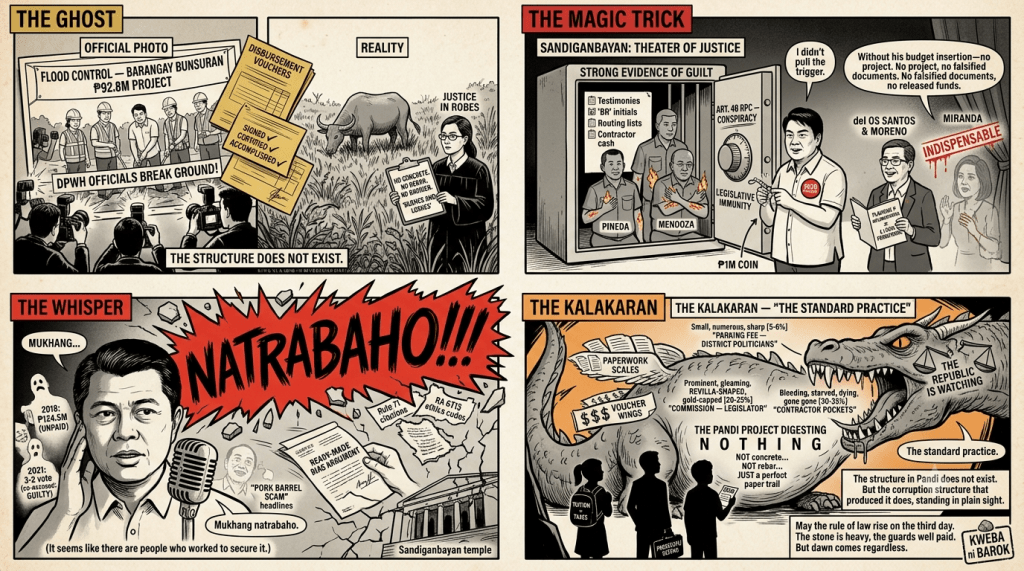
₱92.8M for bushes. The Senator walks, the cashier rots, and the paper trail is chef’s kiss immaculate. Welcome to the Kalakaran I. The Indispensable Senator and the Vanishing Conspiracy
The majority’s 107-page resolution—penned by Associate Justice Fritz Bryn Anthony Delos Santos, with Associate Justice Ronald Moreno concurring—declares there is “not an iota of proof” that Revilla explicitly or implicitly agreed to receive kickbacks with the understanding that funds would be recovered through malversation.
Read that again. The majority demands a signed receipt. A notarized kickback agreement. This is not a standard of proof. It is a shield for the powerful.
The evidence presented was not trivial. Former DPWH Undersecretary Roberto Bernardo testified to delivering money to Revilla’s Cavite residence and described a P1.5-billion allocation with a 25-percent “commitment” rate. Former DPWH engineer Henry Alcantara testified to transmitting project lists. DPWH Regional Director Gerard Opulencia testified to raising money from contractors. Documentary evidence included lists bearing Revilla’s initials and a DPWH routing list marked “For Funding Sen. Bong Revilla.”
The majority’s response? Those acts occurred during the planning stage. Malversation occurred during implementation. Revilla, as a legislator, had no participation in implementation.
This is the legal equivalent of arguing the man who hires a hitman did not pull the trigger. Article 48 of Act No. 3815 (the Revised Penal Code) punishes complex crimes where a single act constitutes multiple felonies and does not require the principal to be present at every stage. The act of one conspirator is the act of all. That is first-year criminal law. By severing planning from execution, the majority has invented a new rule: legislators who create the conditions for corruption bear no responsibility for the corruption they create.
Justice Miranda’s dissent dismantles this. Revilla was “indispensable.” Without his budget insertion—effected through a legislative errata—there would be no project. No project, no falsified documents. No falsified documents, no released funds. The chain of causation is unbroken. The majority simply chose not to follow it.
II. The Two-Tiered Justice System, Live and Uncut
Bong Revilla is free. Christina Pineda, the DPWH cashier, is not. Jaypee Mendoza, the engineer, is not. The alleged mastermind is at home preparing a 2028 comeback. The subordinates who executed his will remain in detention.
The majority explains: the DPWH officials had direct custody of funds, signed falsified documents, and were accountable officers under Article 217 of the Revised Penal Code. Revilla had no such custody. Legally, a distinction. Morally, an obscenity.
Article III, Section 1 of the 1987 Constitution guarantees equal protection. The New Code of Judicial Conduct for the Philippine Judiciary (A.M. No. 03-05-01-SC) mandates that justice must be seen to be done. The public sees a senator walk while a cashier rots. Whatever the legal merits, the public sees what it sees: a justice system where proximity to power is the most reliable predictor of liberty.
The comparison to political detainees is unavoidable. Elderly, ill prisoners like 77-year-old Vicente Ladlad have been detained for years without conviction. Revilla, facing a ghost project where no structure exists, is free within a year of indictment. This asymmetry is not anomaly. It is design.
III. The “Natrabaho” Earthquake
Ombudsman Jesus Crispin Remulla knew what he was doing. A veteran lawyer, former Justice Secretary, and scion of the Remulla dynasty—arch-rivals of the Revillas for Cavite’s political soul—he did not casually say the bail looked “natrabaho.” He launched a grenade into the architecture of inter-branch relations.
Rule 71 of the Rules of Court punishes statements degrading the administration of justice. Republic Act No. 6713 (Code of Conduct and Ethical Standards for Public Officials and Employees) requires public officials to deal with other institutions professionally. Publicly suggesting a collegial court was compromised flirts with contempt and hands the defense a ready-made bias argument.
And yet, is he wrong to be suspicious?
This is not Revilla’s first escape. In 2018, the Sandiganbayan acquitted him of plunder in the pork barrel scam while ordering him to return P124.5 million—still unpaid. In 2021, a 3-2 vote acquitted him of graft. His co-accused, including his staff member, were convicted and sentenced to reclusion perpetua. The pattern is undeniable: the principal walks, subordinates absorb the sanctions, civil liability becomes theoretical abstraction. The Pandi bail ruling is the third movement in a symphony of impunity.
The Ombudsman’s procedural move—filing a motion for reconsideration before seeking a Rule 65 certiorari petition—is legally correct. He must exhaust remedies before alleging grave abuse of discretion. But the certiorari bar is punishingly high: he must show not error, but arbitrariness so extreme it constitutes a jurisdictional defect. Even Miranda’s dissent may not clear that threshold.
IV. The Dynastic Subtext
This case is a dynastic war by other means. The Revillas of Bacoor and the Remullas of Cavite’s political establishment have been rivals for decades. Bong Revilla is a former senator; his wife Lani Mercado is a congresswoman; his children occupy elective posts. Boying Remulla is the Ombudsman; his brother Jonvic is the DILG Secretary; his family has produced governors and congressmen.
When the Ombudsman prosecutes a Revilla, it is never just about evidence. It is simultaneously a legal proceeding and a political contest. Every procedural victory is capital. Every legal defeat is humiliation. The Remullas have institutional incentive to secure conviction. The Revillas have personal incentive to portray themselves as victims of weaponized justice.
This does not mean the case is fabricated. The documentary evidence exists. The ghost project does not exist—which is the point. But it means the public cannot trust the case is prosecuted solely for justice. It is prosecuted, in part, for Cavite. Revilla’s defense has a narrative to sell: “They are not prosecuting a crime; they are prosecuting a man.”
V. The Kalakaran That Devours the Republic
This case is not about one senator or one ghost project. It is about a corruption system so embedded it has a name: kalakaran. The standard practice.
Senator Lacson’s 2025 privilege speech laid out the architecture: 5-6 percent as a “parking fee” for district politicians, 20-25 percent as commission for the legislator who secured budget inclusion, and—at best—40 percent for actual construction. The remaining 30-35 percent evaporates into contractor pockets.
The Pandi ghost is not anomaly. It is specimen. Under this formula, a P92.8-million appropriation yields approximately P55.68 million in kickbacks and zero in construction. The project site is a monument to the system’s perfection: paperwork complete, funds disbursed, flood control barrier existing only in collective imagination.
When the anti-graft court treats kalakaran as isolated, legally distinct acts rather than an integrated conspiracy, it ignores reality. The Supreme Court in People v. Dumlao and Basco v. Rapatalo has held that bail hearings require summary assessment of the totality of evidence. The totality here includes DPWH insider testimony, documentary records of Revilla’s budget intervention, a physical inspection revealing nothing, and the documented kalakaran that explains why these pieces fit together. The majority’s atomization of this evidence is not faithful adjudication. It is willful blindness.
VI. The Citation Game: Enrile as Misdirection
The resolution reportedly invokes Enrile v. Sandiganbayan (G.R. No. 213847, August 18, 2015) for the proposition that bail may issue when evidence of guilt is not strong. This is misdirection.
The Enrile ruling allowed the ailing Senator Juan Ponce Enrile provisional liberty on humanitarian grounds despite assuming evidence might be strong. The decision rested on constitutional guarantees against undue restraint and bail’s purpose as security for appearance. It did not hold evidence was weak. It held that even strong evidence could yield to humanitarian considerations.
The Revilla majority borrows Enrile’s rhetorical weight for a legally distinct proposition—an “evidence not strong” holding unrelated to humanitarian concerns. The Ombudsman’s motion for reconsideration should press this. If the Sandiganbayan is releasing alleged plunderers, it should at least cite the right cases.
VII. What Comes Next
The motions for reconsideration will likely be resolved within weeks. The Third Division can deny them, grant them and reverse itself (institutionally costly), or deny reconsideration while clarifying reasoning to address Miranda’s points.
If denied, the Ombudsman faces the certiorari gauntlet. The Supreme Court can decline to disturb the bail grant or annul it and order re-detention—a rare intervention. It could also clarify Enrile’s actual scope, correcting the citation ambiguity.
Whatever happens on bail, the malversation case proceeds to trial, where the standard is proof beyond reasonable doubt—a standard Revilla’s team has defeated twice. The Ombudsman’s task is not merely winning bail. It is building a trial record strong enough that even a reluctant court cannot reasonably acquit.
VIII. The Unpaid P124.5 Million
The Ombudsman has repeatedly invoked Revilla’s unpaid civil liability from the 2018 acquittal. The paradox is real: how can one be ordered to return money a court found him not guilty of stealing? Civil liability can survive an acquittal based on reasonable doubt rather than a finding the act did not occur. But the paradox points to deeper dysfunction: the state’s near-total inability to recover assets from the politically powerful. The unpaid judgment is a monument to the gap between legal accountability and actual consequence.
IX. A Call to the Republic
We are left staring at a field of bushes and lushes in Bulacan, holding a 107-page resolution insisting there is no proof against the senator whose initials are on the routing list, while a cashier and engineer sit in detention. The majority has spoken. What it has said is that kalakaran is legal, that the indispensable conspirator is not a conspirator, that the architecture of Philippine corruption is safe from judicial scrutiny so long as no one signs a confession.
The rule of law cannot survive where senators are immune from ghost projects and cashiers are not. It cannot survive where the kalakaran is common knowledge and courts treat it as legally invisible. It cannot survive where dynastic rivals use prosecution as weapon and courts as shield.
What is required: a reversal of this bail ruling, yes. But more—a systematic dismantling of the kalakaran. Comprehensive DPWH procurement reform eliminating discretionary pools from which legislators extract commissions. A strengthened Ombudsman investigative capacity that builds cases even reluctant courts cannot dismiss. A judicial culture that treats the totality of circumstantial evidence in conspiracy cases as sufficient rather than demanding signed confessions.
Most of all, a citizenry that refuses to accept the pattern. The youth who will inherit this Republic—students whose taxes will fund ghost projects, young lawyers who will prosecute or defend them, future voters choosing between dynastic candidates—must see this case as a choice between accountability and impunity. The choice will be made not in paneled chambers but in the public square, by those who refuse to believe the kalakaran is inevitable simply because it is old.
The structure in Pandi does not exist. But the corruption structure that produced it does, standing in plain sight, waiting for a judiciary with the courage to tear it down. May the rule of law rise on the third day. The stone is heavy, the guards well paid. But dawn comes regardless, and with it, the possibility of an accounting.
The Republic is watching. 🪨
Key Citations
A. Legal & Official Sources
- The 1987 Constitution of the Republic of the Philippines. Official Gazette of the Republic of the Philippines, 1987, http://www.officialgazette.gov.ph/constitutions/1987-constitution/.
- Act No. 3815. The Revised Penal Code. 1930, lawphil.net/statutes/acts/act1930/act_3815_1930.html.
- Republic Act No. 6713. An Act Establishing a Code of Conduct and Ethical Standards for Public Officials and Employees. 1989, lawphil.net/statutes/repacts/ra1989/ra_6713_1989.html.
- A.M. No. 03-05-01-SC. New Code of Judicial Conduct for the Philippine Judiciary. 27 Apr. 2004, http://www.ecodalplus.com/ecodals/legal-and-judicial-ethics/Code-of-Judicial-Conduct.
- Rules of Court, Rule 71. 1997, lawphil.net/courts/rules/rc_1-71_civil.html.
- Rules of Court. Rule 65, Certiorari, Prohibition and Mandamus. 1997 (as amended), lawphil.net/courts/rules/rc_1-71_civil.html#r65.
- Enrile v. Sandiganbayan. G.R. No. 213847, 18 Aug. 2015, lawphil.net/judjuris/juri2015/aug2015/gr_213847_2015.html.
- Basco v. Rapatalo. A.M. No. RTJ-96-1335, 5 Mar. 1997, lawphil.net/judjuris/juri1997/mar1997/am_96_1335_1997.html.
- People v. Dumlao. G.R. No. 168918, 2 Mar. 2009, lawphil.net/judjuris/juri2009/mar2009/gr_168918_2009.html.
B. News Reports
- Panti, Llanesca T. “Ombudsman Appeals Bong Revilla’s Temporary Freedom in Flood Control Project Case.” GMA News Online, GMA Network, 5 Aug. 2026, http://www.gmanetwork.com/news/topstories/nation/997469/ombudsman-appeals-bong-revilla-s-temporary-freedom-in-flood-control-project-case/story/.
- Mangaluz, Jean. “Bong Revilla Was Granted Bail in Flood Control Case.” GMA News Online, GMA Network, 1 Aug. 2026, http://www.gmanetwork.com/news/topstories/nation/997019/explainer-why-bong-revilla-was-granted-bail-in-flood-control-case/story/.
- Lalu, Gabriel. “Bong Revilla Acquitted of Plunder.” Inquirer.net, Philippine Daily Inquirer, 7 Dec. 2018, newsinfo.inquirer.net/1060679/bong-revilla-not-guilty-of-plunder-sandiganbayan.
- “Out on Bail, Revilla Still Owes Gov’t P124.5M, Says Ombudsman.” Inquirer.net, Philippine Daily Inquirer, 1 Aug. 2026, newsinfo.inquirer.net/2275418/out-on-bail-revilla-still-owes-govt-p124-5m-says-ombudsman.
- “Dissenting Sandigan Justices: Bong Revilla Can’t Be Innocent.” Inquirer.net, Philippine Daily Inquirer, 8 July 2021, newsinfo.inquirer.net/1457151/dissenting-sandigan-justices-bong-revilla-cant-be-innocent.
- Lacson, Panfilo. “Flooded Gates of Corruption: Privilege Speech on Flood Control Projects.” Office of Senator Ping Lacson, 20 Aug. 2025, pinglacson.net/2025/08/20/flooded-gates-of-corruption-privilege-speech-on-flood-control-projects/.
Louis ‘Barok‘ C. Biraogo - “Ang Hirap Maging Mahirap”: The PAO Scandal That Proves Government Contempt Is Nothing New
- “Far-Off” My Axx: Malacañang’s Claire Castro Drowns in Her Own Legal Gaslighting
- “Forthwith” to Farce: How the Senate is Killing Impeachment—And Why Enrile’s Right (Even If You Can’t Trust Him)
- “HINDI AKO NAG-RESIGN!”
- “I Know Nothing”: Baste Duterte’s Amnesia Defense Meets ₱33M in GenCorp Contracts
- “I’m calling you from my new Globe SIM. Send load!”
- “Mahiya Naman Kayo!” Marcos’ Anti-Corruption Vow Faces a Flood of Doubt
- “Manageable” Debt, Unmanageable Lies: DBM’s ₱21 Trillion Fairy Tale
- “Meow, I’m calling you from my new Globe SIM!”
- “Natrabaho”: One Word, One Ombudsman, and a Judiciary on Trial
- “No Special Jail for Crooks!” Boying Remulla Slams VIP Perks for Flood Scammers
- “Philippine-Controlled” or Yankee Gas Station? The Davao Fuel Depot Farce Exposed

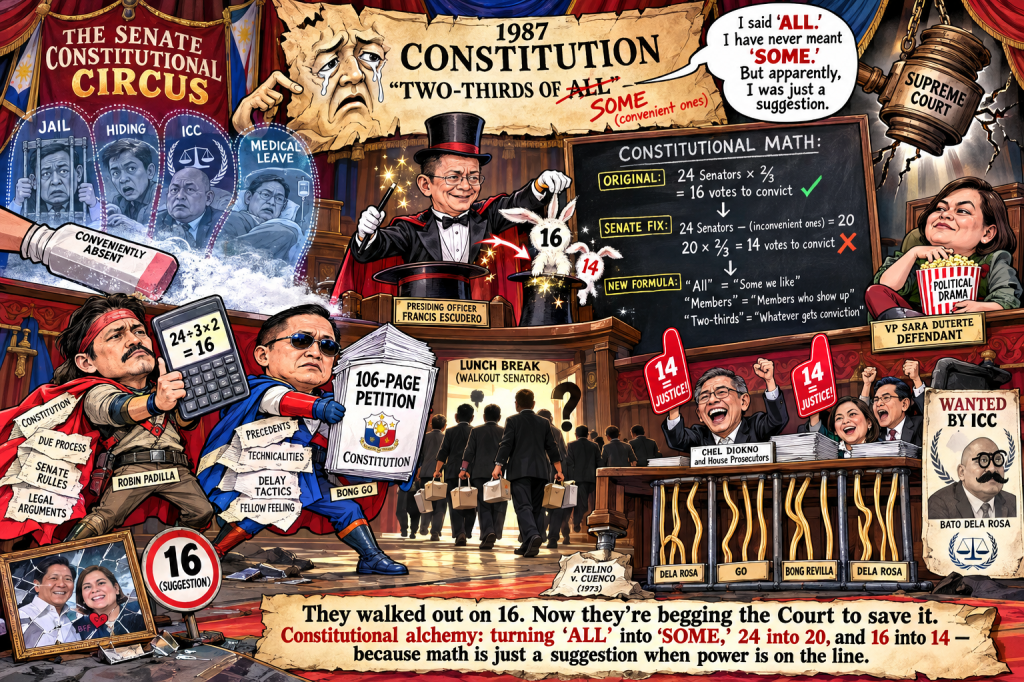
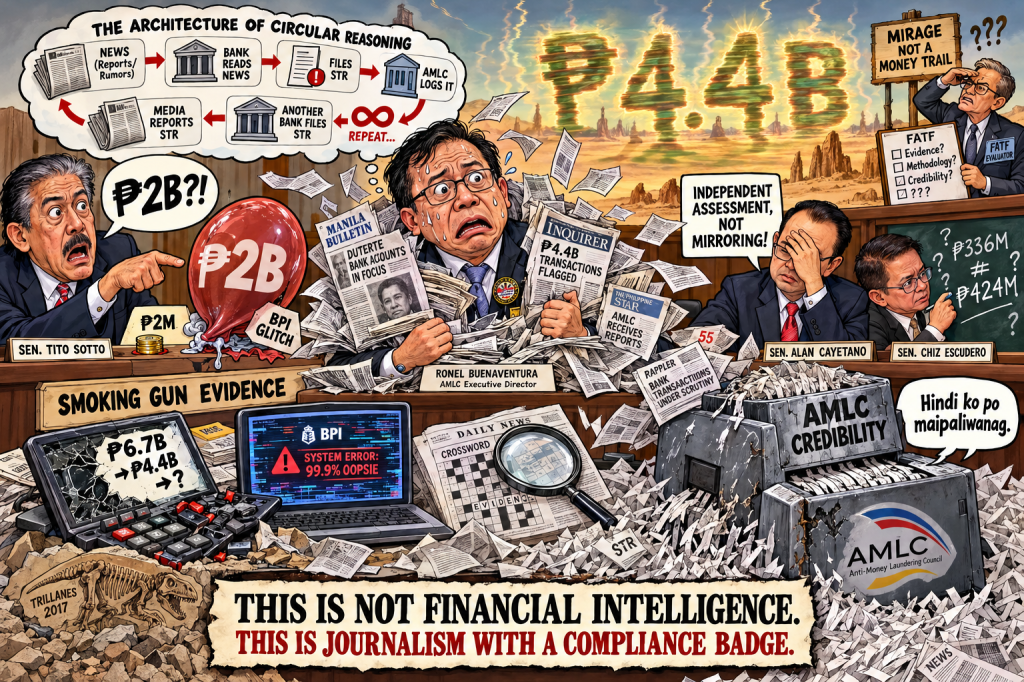

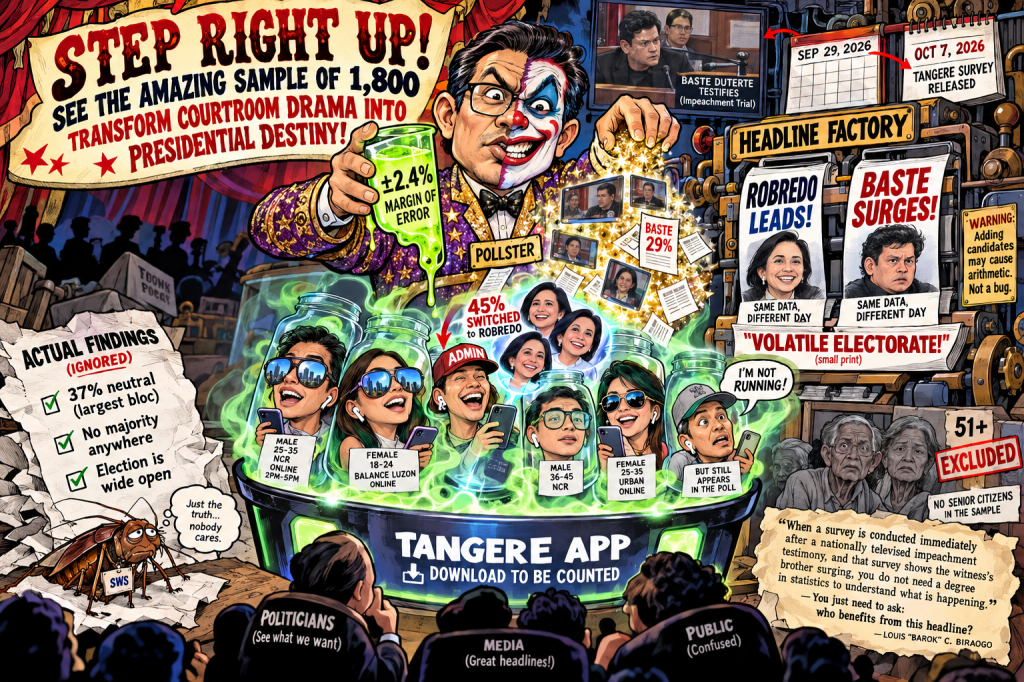
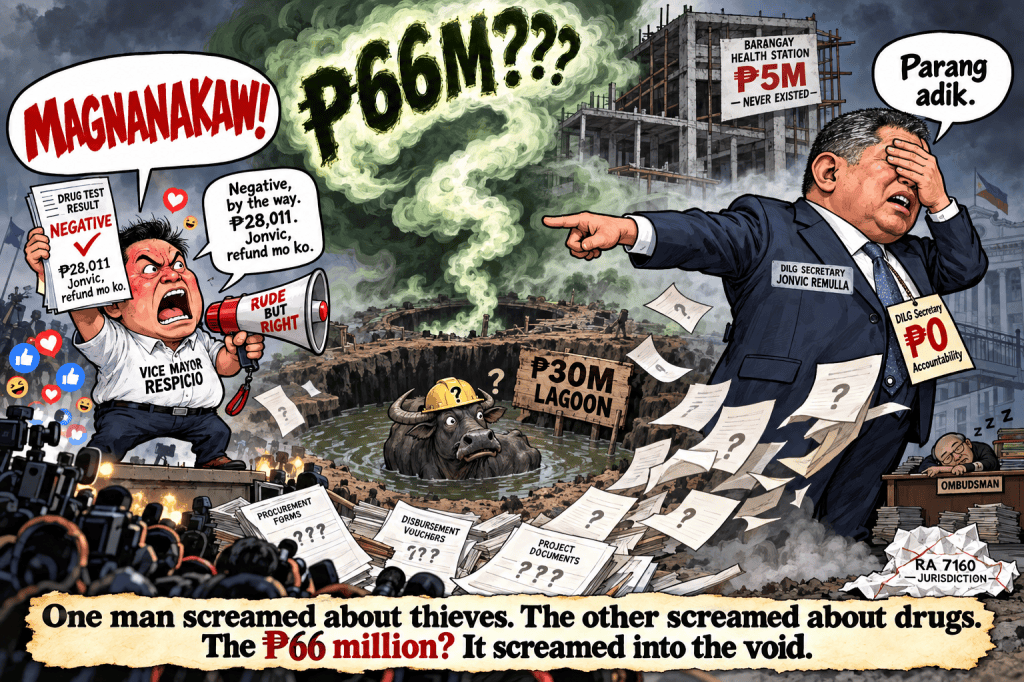
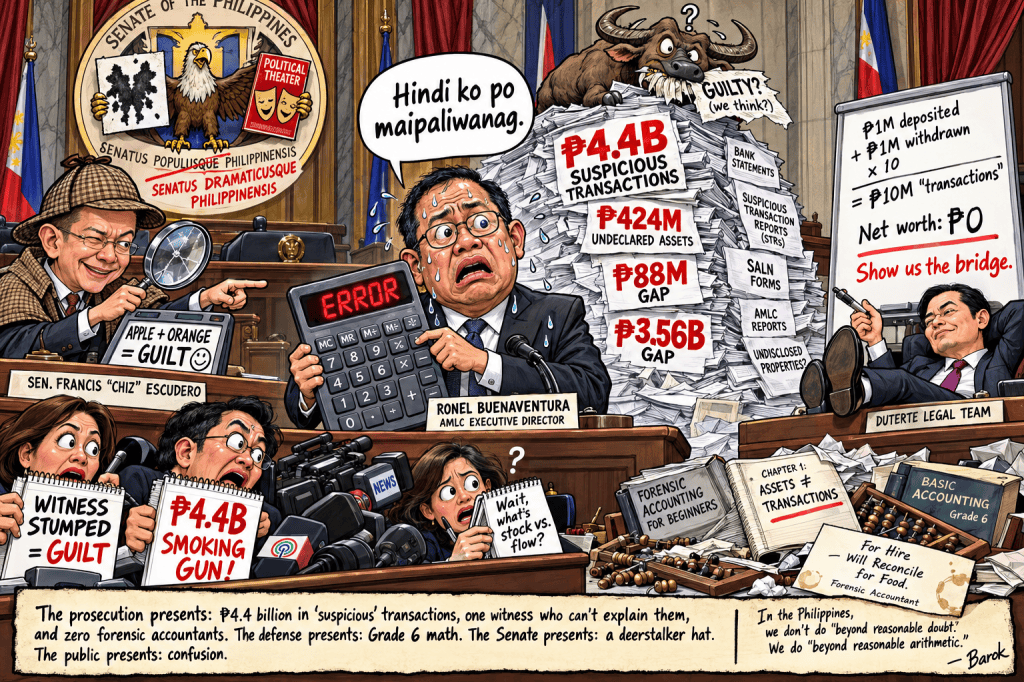


Leave a comment