
Legitimacy Dies First: Why Escudero’s Chair Turns the Impeachment Court into a Global Laughingstock
By Louis ‘Barok‘ C. Biraogo — June 20, 2026
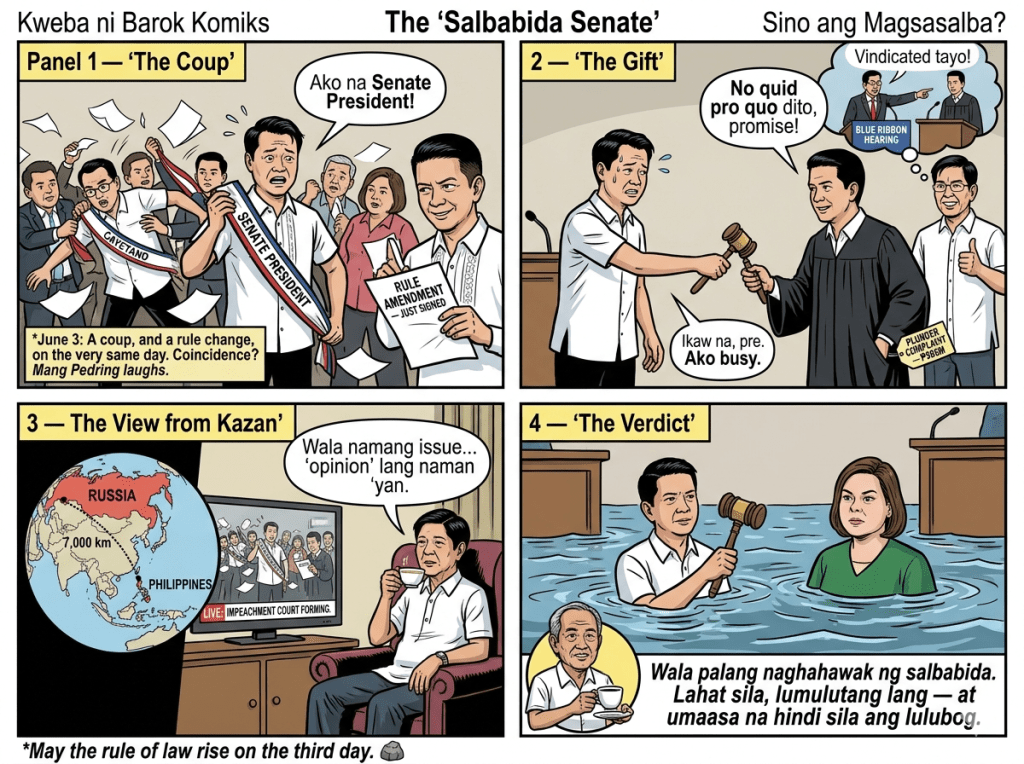
SOMEWHERE in a dimly lit sari-sari store in Quezon City, Mang Pedring is watching the Senate livestream again. His television is old, the picture flickering with the kind of static that seems almost thematic when observing Philippine democracy. Between sips of instant coffee, he mutters the line that has haunted me since he first said it: “Pareho silang nahuhuli sa parehong baha — yung isa, sa baha ng katarungan; yung isa, sa baha ng pondo. Tanong ko lang, sino ang dapat magsalbabida?”
They are both caught in the same flood. One in the flood of justice. The other in the flood of public funds. Who is supposed to be holding the life vest?
Mang Pedring, as usual, has diagnosed the disease before the doctors have even finished washing their hands.
The Senate of the Republic of the Philippines, freshly reconstituted after a June 3 leadership coup that would make Byzantine court politics look like a Jaycee Club election, is poised to commit an act of institutional self-sabotage so breathtaking that future political science textbooks will require a trigger warning. They intend to elect Senator Francis “Chiz” Escudero — a man currently drowning in an Ombudsman plunder complaint involving up to ₱586 million in alleged flood-control kickbacks — as the presiding officer of the impeachment court that will try Vice President Sara Duterte for, among other things, betrayal of public trust and graft.
Let that marinate. A man accused of plundering flood-control funds will gavel to order a trial about plundering public trust. The irony is not merely rich; it is obese. It is the kind of irony that should make the marble floors of the Senate building weep with shame.
But the Senate majority bloc, through Senator Panfilo “Ping” Lacson, has reached a “consensus.” Senator Sherwin Gatchalian, the newly installed Senate President, has decided to outsource the presiding officer role to Escudero like a manager delegating a particularly toxic project to a subordinate whose career is already circling the drain. And President Ferdinand Marcos Jr., speaking from the safety of Kazan, Russia — approximately 7,000 kilometers from accountability — has waved away concerns as mere “opinions.”
The fix, as they say in the vernacular, is in.
The Competence Fig Leaf: Why a Law Degree Does Not Wash the Flood Clean
Let us first dispense with the argument that Escudero must preside because he is a lawyer with experience. This is the rhetorical fig leaf the majority bloc is desperately clutching, and it is so thin that a gentle breeze of scrutiny would shred it entirely.
Yes, Escudero has a law degree. Yes, he has presided over an impeachment trial before. But as Tindig Pilipinas correctly notes, “legal knowledge alone does not guarantee fairness, impartiality, or fidelity to the spirit of the Constitution”. The logical fallacy at work here is a classic non sequitur: competence in parliamentary procedure does not equate to the moral authority to sit in judgment over others while one’s own hands are, allegedly, deep in the cookie jar.
The more pernicious fiction is the notion that the presiding officer is merely an administrative functionary — a potted plant with a gavel, as it were. This is either naive or deliberately deceptive. The presiding officer controls the flow of proceedings, rules on objections, determines the scope of evidence, and sets the tempo of the trial. In a political proceeding where delay is often synonymous with death, the presiding officer’s procedural philosophy is everything. And Escudero’s procedural philosophy, as demonstrated in 2025, is one of creative obstruction dressed in the language of constitutional caution.
Let us revisit the 2025 debacle, shall we? When the first impeachment complaint against Sara Duterte landed on the Senate’s doorstep, the Constitution commanded the chamber to proceed “forthwith.” Escudero, then Senate President, gave the word a “twisted interpretation” — Tindig Pilipinas’ phrase, and a charitable one at that — that transformed a constitutional imperative into a leisurely stroll through procedural limbo. He stalled. He delayed. He returned the articles to the House. And when the Supreme Court ultimately ruled the complaint procedurally infirm under the one-year bar doctrine, Escudero’s supporters — including President Marcos — declared him vindicated.
This is historical revisionism of the most self-serving variety. The Supreme Court ruling was the proximate legal cause of the case’s termination, but Escudero’s earlier procedural sabotage was the efficient cause of its atrophy. A patient who dies of pneumonia after being left naked in the rain for three months was not killed by the bacteria alone. The Supreme Court’s 2025 ruling did not retroactively sanctify every dilatory tactic Escudero employed; it merely closed a door that Escudero had already bolted, chained, and barricaded.
June 3’s Bespoke Tailoring: The Rule Change That Fits Only One Man
Here we arrive at the procedural sleight of hand that makes the entire Escudero plan legally suspect: the June 3, 2026, rule amendment.
On the very day that the Gatchalian bloc ousted Alan Peter Cayetano as Senate President, the newly installed majority amended the Senate impeachment rules to allow “a senator other than the Senate President” to serve as presiding officer “through a majority vote of members present.” The timing is too perfect to be coincidental. The rule change is the legislative equivalent of a bespoke suit: measured, cut, and stitched for one body and one body alone. Escudero’s.
The Constitution, in Article XI, Section 3(6) of the 1987 Constitution of the Republic of the Philippines, vests the power to try impeachments in the Senate and designates the Senate President as the presiding officer, with one explicit exception: when the Senate President himself is on trial. By negative inference, the constitutional design is clear: the Senate President presides in all other cases. The substitution mechanism is reserved for a narrow, enumerated contingency, not a general license for the majority to rotate the chair like a timeshare whenever political convenience dictates.
The June 3 rule change, therefore, is not a neutral procedural reform. It is enabling legislation for a predetermined outcome, adopted at the exact moment of a leadership coup, designed to install a specific individual whose claim to the role is otherwise constitutionally suspect. Deference to internal Senate rules under Arroyo v. De Venecia, G.R. No. 127255 and the political question doctrine is not unlimited. When a rule is written to circumvent a constitutional design, the Court should — and, one hopes, will — take a harder look.
The Ethical Abyss: A Plunder-Accused Referee Judges Public Trust
Even if we concede, arguendo, that the Escudero plan is technically legal — survives Senate rules, evades justiciability, avoids formal disqualification — the ethical case against it remains devastating. Legality is the basement of democratic legitimacy, not the penthouse. A proceeding that is lawful can still be profoundly illegitimate.
Escudero is currently the subject of a live Office of the Ombudsman (Ombudsman) complaint for plunder, graft, and indirect bribery. The allegations involve flood-control projects — the very infrastructure meant to protect Filipinos from the literal floods that Mang Pedring watches rise every rainy season. The figures are staggering: between ₱160 million and ₱586 million in alleged kickbacks, channeled through a conspiracy that Ombudsman officials have described, in their characteristically understated fashion, as involving “master plunderers.”
Now, consider the trial he is being asked to preside over. The Articles of Impeachment against Vice President Duterte include charges of betrayal of public trust and graft. The thematic overlap is not subtle. A senator accused of plundering public funds would be sitting in judgment over an official accused of betraying public trust. The proceeding would not merely raise an appearance of impropriety; it would be drenched in it, marinated in it, served on a silver platter with a garnish of public contempt.
The ethical case against Escudero’s designation, however, stands independent of technical legality. The 2025 Code of Judicial Conduct and Accountability (A.M. No. 25-04-04-SC) upholds and strengthens the long-standing principle that judges — and by necessary analogy, senator-judges in an impeachment court — must avoid not only impropriety but even the appearance of impropriety in all their activities. Installing a senator under a live plunder complaint to preside over a betrayal-of-public-trust trial is drenched in exactly that appearance.
The Senate Zoo: Autopsy of Motives and Hypocrisies
Let us now perform a political autopsy on the cadaver of this controversy, examining the motives of each key player with the cold precision of a coroner investigating a suspicious death.
Chiz Escudero: Why does he want this role? The possibilities form a triptych of ambition. First, rehabilitation: presiding over a high-visibility trial credibly could cleanse the stench of 2025 and the plunder complaint in one stroke. Second, insulation: occupying the chair of moral authority makes it harder for critics to simultaneously demand his prosecution. Third, debt collection: Escudero’s vote to oust Cayetano was pivotal to Gatchalian’s ascension; the presiding officer role is his reward, the political equivalent of a finder’s fee. He reportedly declined the Senate President pro tempore post. Was that modesty, or was he holding out for a bigger prize?
Sherwin Gatchalian: The new Senate President’s studied neutrality — “I don’t want to preempt the presiding officer discussion” — is a masterclass in strategic abdication. By ceding the gavel to Escudero, Gatchalian achieves three objectives simultaneously: he locks in Escudero’s loyalty to his fragile 12-member majority; he avoids personally absorbing the political radiation of the Duterte trial; and he keeps his own hands clean for whatever outcome emerges. It is risk transfer dressed as coalition management. The paradox is exquisite: Gatchalian orchestrated a coup to become Senate President, only to immediately surrender the chamber’s most consequential power to the very man whose defection made his presidency possible.
Panfilo Lacson: Here lies the most gaping credibility wound in the entire affair. Lacson, as chair of the Senate Blue Ribbon Committee, led the investigation that generated the flood-control plunder findings against Escudero. He publicly declared that the Ombudsman’s findings “vindicated” his committee’s work. And now, with a straight face that would make a poker champion weep with envy, he proposes the same Escudero as the paragon of probity fit to preside over an accountability trial. Lacson preemptively denies a “quid pro quo.” The lady doth protest too much, methinks. If this is not a quid pro quo, then it is something more damning: a politician so inured to contradiction that he can prosecute a man and elevate him simultaneously without feeling the cognitive dissonance.
Ferdinand Marcos Jr.: From the safety of Kazan, the President declares that he sees “no issue” with Escudero and will support whatever the Senate decides. This is either principled institutional deference or calculated strategic distance; the two are not mutually exclusive. An administration with strained relations with Vice President Duterte has no strong incentive to ensure a maximally rigorous, fast-moving trial. “No comment, it’s the Senate’s call” is a posture that avoids ownership of any outcome while preserving the option to benefit from delay or procedural confusion. The President’s defense of Escudero — that the 2025 trial collapsed because of the Supreme Court, not Escudero’s actions — conveniently ignores the distinction between proximate and efficient causes that I have already dissected above.
Tindig Pilipinas: The civil society coalition’s position is principled and its arguments are sound, but its leverage is limited. Moral clarity does not translate into votes on the Senate floor, where the majority bloc’s “consensus” has already calcified. Tindig’s statement will serve, at best, as a prophetic marker for future accountability narratives: we warned you. Their strategic options — lobbying individual senators, exploring justiciability, mobilizing public pressure — are all long shots. But in a political culture that too often confuses silence with sophistication, the simple act of speaking truth to power retains a certain stubborn nobility.
Choose Your Farce: The Four Roads to Institutional Ruin
What are the possible paths forward? Let us survey the landscape with the grim realism it demands.
Scenario One: The Escudero Coronation. The majority bloc’s numbers carry the day, Escudero takes the chair, and the trial proceeds under a cloud of illegitimacy that will shadow every ruling he makes. This is the most likely outcome. It is also the most dangerous. If Escudero presides and the trial collapses again — through delay, procedural sabotage, or the quiet suffocation that killed the 2025 proceeding — public trust in the Senate will not merely erode; it will crater. And the specter of his own plunder complaint proceeding in parallel will compound the farce exponentially. Imagine, if you will, the presiding officer of a betrayal-of-public-trust trial being indicted for plunder mid-proceeding. This is not a hypothetical; it is a live possibility that Tindig Pilipinas’ “dangerous” framing seems to anticipate.
Scenario Two: Gatchalian Reclaims the Gavel. The majority bloc, perhaps after reading this very column, realizes the Escudero plan is a poison pill and quietly lets the default rule stand. Gatchalian presides. The advantage is a cleaner appearance of neutrality; the disadvantage is Gatchalian’s relative inexperience in impeachment procedure. But procedure can be learned; legitimacy, once lost, cannot be easily regained.
Scenario Three: The Compromise Candidate. A senator-judge who is legally trained, untainted by either the 2025 controversy or the flood-control scandal, emerges as a face-saving alternative. This preserves the majority’s strategic logic — not having Gatchalian preside — while defusing the Escudero controversy. The pool of candidates, however, is shallow, and the majority’s consensus would need to be unwound.
Scenario Four: The Recusal Motion. The House prosecution panel or the Duterte defense (both have tactical reasons to consider this) files a formal motion for Escudero’s inhibition, forcing the chamber to litigate the disqualification question on the record. This would transform the presiding-officer fight from an informal political dispute into a formal legal one, generating a paper trail that could, theoretically, reach the Supreme Court.
The Life Vest Protocol: Five Steps the Senate Must Take Now
If the Senate wishes to salvage even a shred of institutional credibility from this wreckage, it must take the following steps.
First, abandon the Escudero plan immediately. The arguments in its favor are a Potemkin village of proceduralism masking a rot of political convenience. The Senate must recognize that the presiding officer’s role is not merely administrative but symbolic, and that symbolism matters profoundly in democratic legitimacy. Installing a man under a live plunder complaint to preside over an accountability trial is not clever politics; it is a self-inflicted wound of historic proportions.
Second, let Gatchalian preside. The constitutional default exists for a reason: it provides institutional continuity and avoids the appearance of manipulation. Gatchalian’s inexperience is a manageable problem; Escudero’s toxicity is not. The Senate President should accept the responsibility that comes with the office he fought so hard to obtain.
Third, adopt a formal recusal and disqualification rule for impeachment proceedings. The current vacuum is unacceptable. A senator-judge who is the subject of a pending criminal complaint or Ombudsman investigation for offenses thematically similar to those being tried should be presumptively disqualified, or at minimum subject to a mandatory disclosure and recusal vote. The appearance-of-impropriety standard from judicial ethics should be codified into the Senate impeachment rules.
Fourth, the House prosecution panel must prepare a motion for Escudero’s inhibition if the majority persists in its plan. Forcing a floor vote on the recusal question would, at minimum, put every senator-judge on the record. Those who vote to retain a plunder-implicated presiding officer will own that decision for the rest of their political careers.
Fifth, civil society and the media must sustain pressure. Tindig Pilipinas’ statement is a necessary but insufficient intervention. The coalition should escalate: issue follow-up statements naming individual senators, organize public forums, and coordinate with academic and legal organizations to build a consensus around minimum standards of impartiality for impeachment proceedings.
Mang Pedring’s Verdict: The Referendum the Senate Cannot Dodge
Mang Pedring’s question lingers. Who is supposed to be holding the life vest?
The presiding-officer fight is not, in the end, a dispute about parliamentary procedure. It is a referendum, conducted in the key of Robert’s Rules, on whether the Philippine Senate can hold anyone accountable while its own leadership ranks remain entangled in the very corruption architecture the country is trying to dismantle.
If Escudero presides, the Senate will have answered Mang Pedring’s question with a shrug. No one is holding the life vest, because the people entrusted to throw it are too busy trying to save themselves.
The impeachment trial of Sara Duterte is supposed to be a defining test for Philippine democracy — a moment when the country’s institutions demonstrate that no one, not even the second-highest official in the land, is above the law. But a trial is only as legitimate as the tribunal that conducts it, and a tribunal led by a man accused of plunder is no tribunal at all. It is a pantomime. A tragicomedy. A farce in robes.
The Senate majority bloc has a choice. It can listen to the voices of civil society, the dictates of ethical governance, and the silent judgment of history. Or it can listen to the siren song of political convenience and install Chiz Escudero as the presiding officer of a trial that will, in that case, be over before it begins.
Mang Pedring is still watching. And he is not laughing.
May the rule of law rise on the third day. 🪨
Louis ‘Barok’ C. Biraogo is the publisher of Kweba ni Barok, a legal-political commentary blog. He is a recovering idealist and a perpetual mourner at the funeral of Philippine democracy.
Key Citations
A. Legal & Official Sources
- The 1987 Constitution of the Republic of the Philippines. Official Gazette of the Republic of the Philippines, 1987, http://www.officialgazette.gov.ph/constitutions/1987-constitution/.
- Arroyo v. De Venecia. G.R. No. 127255, Supreme Court of the Philippines, 14 Aug. 1997, lawphil.net/judjuris/juri1997/aug1997/gr_127255_1997.html.
- 2025 Code of Judicial Conduct and Accountability. A.M. No. 25-04-04-SC, Supreme Court of the Philippines, 11 Nov. 2025, sc.judiciary.gov.ph/?p=157435.
B. News Reports
- De Silva, Angie. “Group Says Escudero ‘Most Imperfect’ Choice to Preside over Impeachment Trial.” Rappler, 19 June 2026, http://www.rappler.com/philippines/tinding-pilipinas-oppose-chiz-escudero-presiding-officer-sara-duterte-impeachment-trial/.
- Morong, Joseph. “Chiz Escudero Faces P586-M Plunder Complaint over Flood Control Mess.” GMA News Online, GMA Network, 27 May 2026, http://www.gmanetwork.com/news/topstories/nation/989200/escudero-plunder-flood-control/story/.
- Mendoza, J. E. “Ombudsman: Plunder Raps vs Escudero, Romualdez Set in May.” Inquirer.net, Inquirer Group, 7 Apr. 2026, newsinfo.inquirer.net/2207912/ombudsman-plunder-raps-vs-escudero-romualdez-set-in-may
- ₱9 Billion in ‘Savings’? DILG’s Fire Truck Deal Smells Like Smoke

- ₱8B BBM Pork: CCTV for Every Captain’s Kumpare?

- ₱8.9 Billion, 331 Ghost Police Stations: The TIKAS Scandal Explained

- ₱8.4 Billion, 42,000 Barangays, 1 Election: The “Bawat Barangay Makikinabang” Vote-Buying Masterclass

- ₱75 Million Heist: Cops Gone Full Bandit

- ₱63 to the Dollar: The Only Thing Falling Faster Than the Peso Is the Government’s Credibility

- ₱6.77B Ghost Haunts Duterte: RTC Dismisses Mans Carpio’s Desperate Plea

- ₱6.77 Billion and Zero Cash: The Sara Duterte SALN Math That Doesn’t Add Up

- ₱6.7-Trillion Temptation: The Great Pork Zombie Revival and the “Collegial” Vote-Buying Circus

- ₱58.53B, Zero Receipts: The LGSF Pork Barrel Nobody Wants to Name

- ₱53 Million Man Tells ₱695-a-Day Workers to Stop Being ‘Mayabang’: The Audacity of BSP’s Remolona

- ₱4.4 Billion and a Witness Who Can’t Explain It: The Duterte Impeachment’s Most Expensive Non-Answer





Leave a Reply