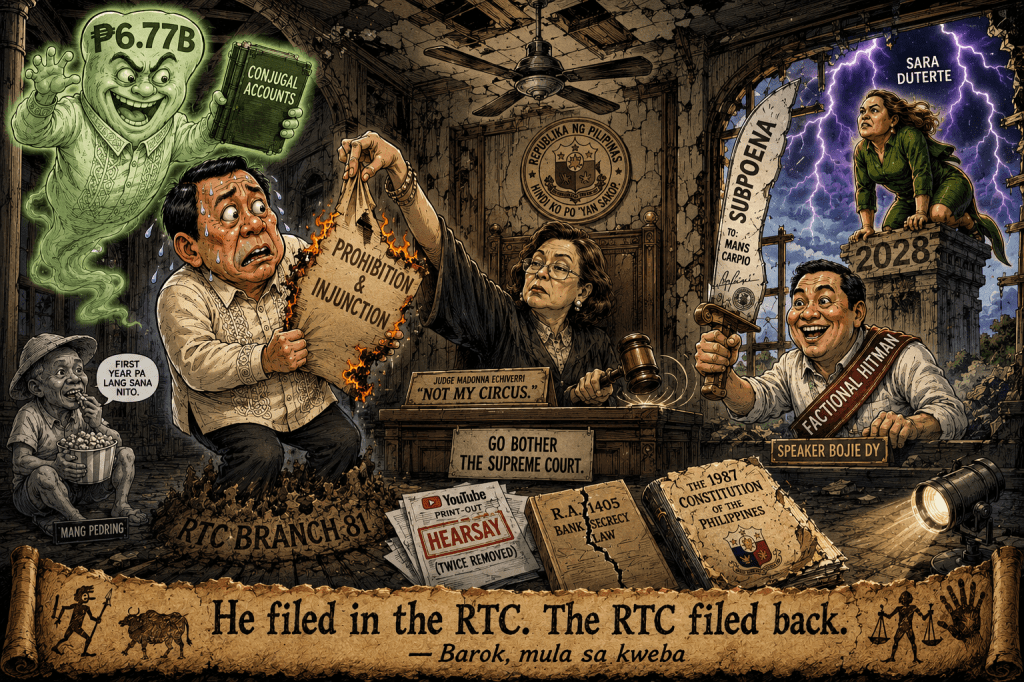
House Hitmen Win Round One as Judge Tosses Hot Potato
By Louis ‘Barok‘ C. Biraogo — May 8, 2026
Carpio’s Legal Suicide Note
MGA ka-kweba, what a masterpiece of legal strategy, this petition for prohibition and injunction filed by Atty. Manases “Mans” Carpio in the Quezon City Regional Trial Court Branch 81. One can almost picture the first-year law student scribbling it in the margins of a tattered copy of the Rules of Court, convinced that a trial court could somehow handcuff the House of Representatives mid-impeachment like a teleserye villain dramatically halting a wedding. The man who once moved in the rarefied air of presidential in-laws has now produced a procedural abortion so exquisite it deserves its own wing in the Museum of Philippine Legal Imbecility.
Rule 65 of the 1997 Rules of Civil Procedure Revised Rules of Court is crystal clear: prohibition lies only against tribunals, boards, or officers exercising judicial, quasi-judicial, or ministerial functions without or in excess of jurisdiction. The House Committee on Justice, however, was not moonlighting as a barangay tribunal; it was wielding the exclusive constitutional power to initiate impeachment under Article XI, Section 3(1) of the 1987 Constitution—the very provision the RTC correctly cited before smacking the petition down like a poorly forged affidavit. Filing in an RTC was not audacious; it was suicidal forum-shopping, a desperate delay tactic wrapped in the tattered cloak of “marital privacy” and Republic Act No. 1405 (Bank Secrecy Law). Even the judge, in her surgically precise five-page order, reminded everyone that YouTube videos and news clippings offered by Carpio were “hearsay evidence, twice removed”—the evidentiary equivalent of a drunk uncle’s Facebook rant.
The strategic genius, if one can call it that, appears to have been threefold: slow the train long enough for the 2028 election circus to arrive, generate headlines that scream “persecution,” and perhaps—whispers suggest—keep the conjugal billions from the harsh glare of a subpoena duces tecum. But the Constitution does not bend for conjugal convenience. The “Follow the Money” doctrine does not evaporate simply because the money is allegedly shared with an impeachable official. Carpio’s insistence that he is a mere “private citizen” while his wife’s confidential funds and unexplained wealth are under the microscope is the legal equivalent of claiming diplomatic immunity while standing in the middle of EDSA traffic. The petition was never lawyering; it was performance art for the Duterte die-hards, and the RTC delivered the only verdict a first-year student should have predicted: dismissal for lack of jurisdiction, with a polite but unmistakable suggestion to take the matter where it belongs—the Supreme Court. Curtain down. Applause from the cheap seats.
Judge’s Cowardly Hot Potato
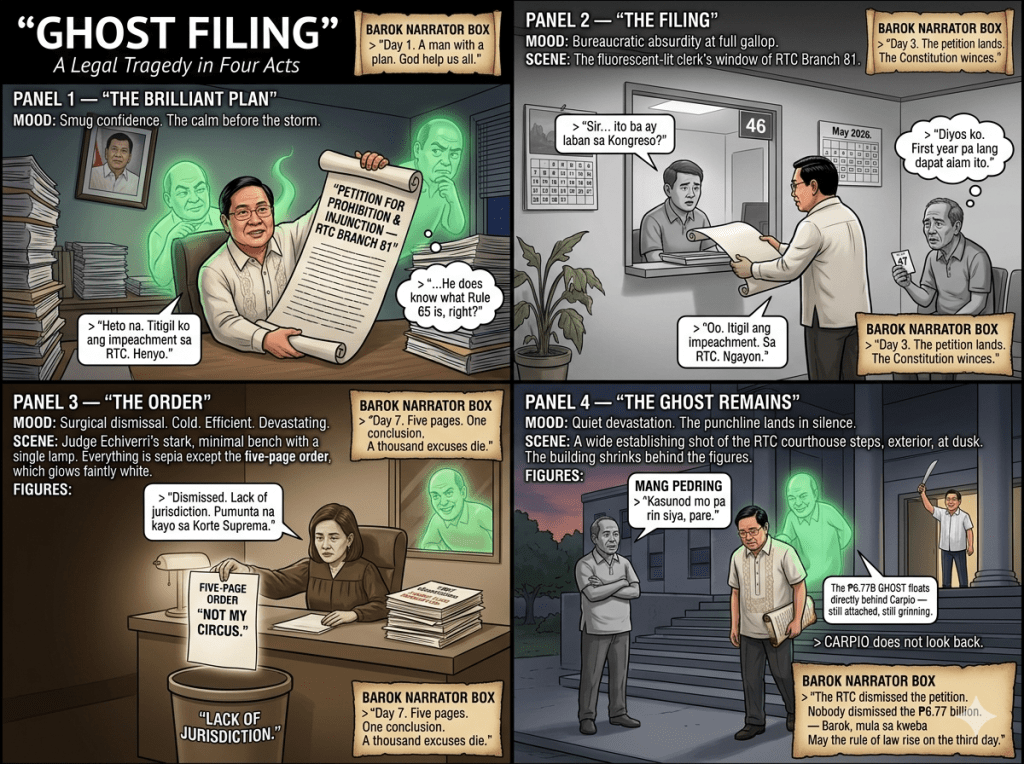
Judge Madonna Echiverri’s five-page order is a clinic in judicial minimalism—technically correct, politically convenient, and constitutionally evasive in that special way Philippine courts reserve for controversies that smell of Malacañang and Mindanao. She correctly bowed to the House’s “exclusive power” under Article XI, Section 3(1), declared the committee no mere ministerial errand boy, and reminded everyone that trial courts do not supervise co-equal branches unless the Supreme Court itself has already drawn the constitutional line.
Yet one cannot help but notice the elegant sidestep. The same Francisco v. House of Representatives precedent the RTC invoked to justify deference is the very case where the Supreme Court flexed its judicial-review muscle precisely because impeachment is not immune from constitutional scrutiny when grave abuse of discretion rears its ugly head. The RTC, however, has chosen the path of the prudent hot-potato tosser: “Not my circus, not my monkeys—go bother the Supreme Court.” It is the judicial version of “thoughts and prayers,” delivered with the straight face of a judge who knows that issuing an injunction against Congress would trigger the kind of chaos that makes legal scholars weep and politicians cheer.
The opinion’s internal contradiction is delicious: the House Committee is simultaneously a “co-equal branch” performing a sacred constitutional duty and yet somehow not subject to the ordinary restraints that apply when it issues subpoenas that allegedly shred the Bill of Rights. The political-question doctrine, narrowed since 1987, has been conveniently resurrected here like a zombie in a barong tagalog. The RTC has not so much decided the case as it has politely declined to referee the cage match, leaving the real constitutional surgery to the higher tribunal. One almost admires the surgical cowardice.
Clowns, Hitmen & the Lioness
Let us dispense with the polite fiction that any of this is about high principle.
Atty. Manases Carpio, self-proclaimed “private citizen” and husband of the hour, is not storming the barricades for marital privacy; he is the frantic gatekeeper of a financial fortress allegedly built on ₱6.77 billion in suspicious flows—rumors, of course, mere spectral whispers that nevertheless haunt every corridor of the House inquiry like Banquo’s ghost in a barong. The Bank Secrecy Law is a shield, not a moat around unexplained wealth, and the “Follow the Money” doctrine does not evaporate at the mention of conjugal property. He is not defending the Constitution; he is defending the family ledger.
Speaker Bojie Dy and his House puppets are not noble sentinels of accountability; they are factional hitmen wielding subpoenas like machetes on behalf of the embattled Marcos clan. This is not “betrayal of public trust” in the lofty constitutional sense; it is the ultimate political betrayal of a former ally who dared to dream of 2028. The impeachment process has become the blood sport of Philippine dynasties—less about graft and corruption under R.A. 3019 than about liquidating a rival before the next election cycle. The confidential funds, the alleged threats, the whispers of Sammy Uy—none need be proven today; they merely need to bleed in public long enough to wound.
And Vice President Sara Duterte? She is the cornered lioness of the Duterte legacy, wrapped in the martyrdom complex that has sustained the clan through every controversy. Her options are now pure political theater: fight the Senate trial and emerge as the persecuted heroine who will rise again in 2028; resign in a blaze of defiant glory and let the myth grow; or, in the darkest rumor mills, contemplate a dramatic exit toward The Hague, turning ICC scrutiny into exile chic. She is no longer merely an official under fire; she is the living fuse of a constitutional time bomb.
Billions, Bloodsport & Bombs
The impeachment complaints—culpable violation of the Constitution, graft and corruption under Republic Act No. 3019 (Anti-Graft and Corrupt Practices Act), and that glorious catch-all, betrayal of public trust—are less a legal indictment than a political exorcism. “Betrayal of public trust” is the constitutional equivalent of “whatever we say it is,” broad enough to swallow every rumor of ₱6.77 billion in flagged transactions and every whispered connection to shadowy benefactors. The House is not conducting an investigation in aid of legislation; it is conducting an investigation in aid of character assassination, and the RTC’s dismissal has merely handed the baton to the next arena.
The possible resolutions are each more grotesque than the last. A Senate acquittal will canonize Sara as the martyr who survived the Marcos machine, turbo-charging her 2028 ambitions. A conviction will strip her of office, trigger perpetual disqualification, and open the floodgates to criminal liability that could make the confidential-funds scandal look like petty cash. A Supreme Court TRO, should it come, will ignite the full-blown constitutional crisis everyone pretends to fear: two co-equal branches at each other’s throats, the judiciary accused of favoritism, the legislature accused of tyranny, and the Filipino public forced to watch its institutions devour each other like starving dogs in a cockpit.
Republic on Life Support
Enough of the savage laughter. What remains is fury.
This entire carnival reduces the 1987 Constitution to a blood-stained prop, the courts to a forum-shopping playground for the connected, and Congress to a gladiatorial arena where dynastic score-settling masquerades as accountability. The true victims are not the Dutertes, not the Marcoses, but the rule of law itself—already battered, now bleeding out in open court—while a weary public is fed the spectacle like bread and circuses.
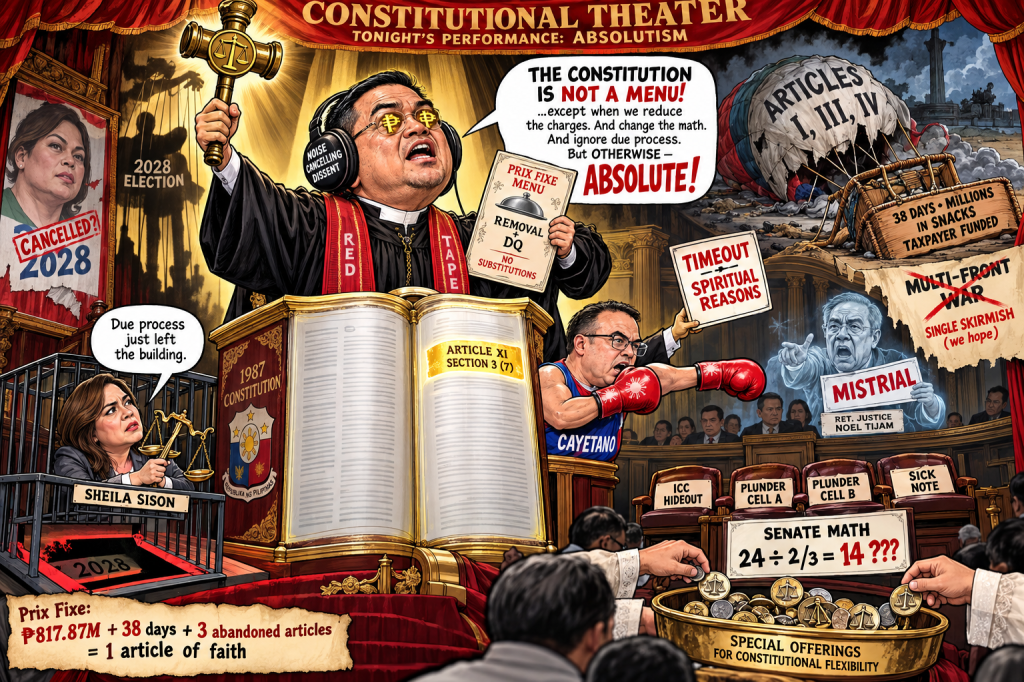
The Supreme Court must rise above the noise and clarify once and for all the limits of judicial review in impeachment, lest every future controversy become another game of constitutional hot potato. The Senate must remember that it is not a rubber stamp for the House nor a cheering section for the Vice President; it is a court of impeachment sworn to render justice above partisan loyalty. And the Filipino people—those who still believe in something larger than the next election—must recoil in disgust at every actor who treats the fundamental law as a mere script in a dynastic telenovela.
The Republic is not yet dead. But it is on the table, and the surgeons are drunk. Fortify the institutions now, or watch the entire edifice collapse under the weight of its own corruption. The choice is no longer political. It is existential.
Key Citations
A. Legal & Official Sources
- The 1987 Constitution of the Republic of the Philippines. Official Gazette of the Republic of the Philippines, 1987.
- Philippines, Supreme Court. “The 1997 Rules of Civil Procedure (Rules 1-71, Rules of Court).” Lawphil, Arellano Law Foundation.
- Republic Act No. 1405. An Act Prohibiting Disclosure of or Inquiry into, Deposits with Any Banking Institution and Providing Penalty Therefor. 1955, The LawPhil Project.
- Republic Act No. 3019. Anti-Graft and Corrupt Practices Act. 1960, The LawPhil Project.
- Francisco, Jr. v. House of Representatives. G.R. No. 160261, Supreme Court of the Philippines, 10 Nov. 2003, The LawPhil Project.
B. News Reports
- “Ang Hirap Maging Mahirap”: The PAO Scandal That Proves Government Contempt Is Nothing New

- “Far-Off” My Axx: Malacañang’s Claire Castro Drowns in Her Own Legal Gaslighting
- “Forthwith” to Farce: How the Senate is Killing Impeachment—And Why Enrile’s Right (Even If You Can’t Trust Him)
- “HINDI AKO NAG-RESIGN!”

- “I Know Nothing”: Baste Duterte’s Amnesia Defense Meets ₱33M in GenCorp Contracts

- “I’m calling you from my new Globe SIM. Send load!”

- “Mahiya Naman Kayo!” Marcos’ Anti-Corruption Vow Faces a Flood of Doubt

- “Manageable” Debt, Unmanageable Lies: DBM’s ₱21 Trillion Fairy Tale
- “Meow, I’m calling you from my new Globe SIM!”

- “Natrabaho”: One Word, One Ombudsman, and a Judiciary on Trial

- “No Special Jail for Crooks!” Boying Remulla Slams VIP Perks for Flood Scammers

- “Philippine-Controlled” or Yankee Gas Station? The Davao Fuel Depot Farce Exposed







Leave a Reply