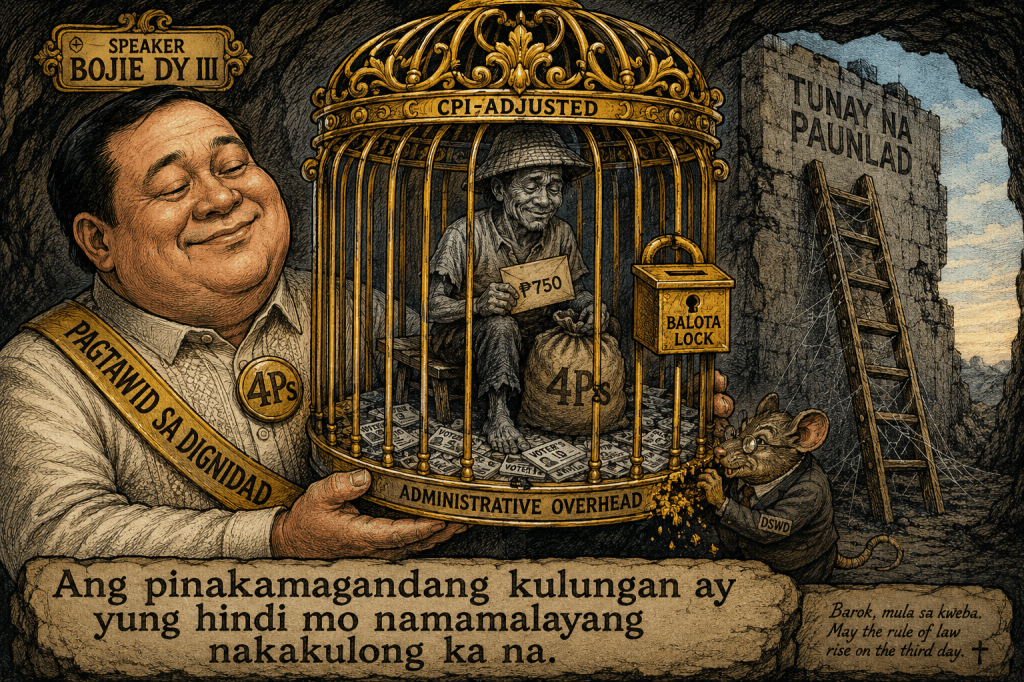
Expanded 4Ps: Noble Intention or Sophisticated Vote Farm?
By Louis ‘Barok‘ C. Biraogo — May 7, 2026
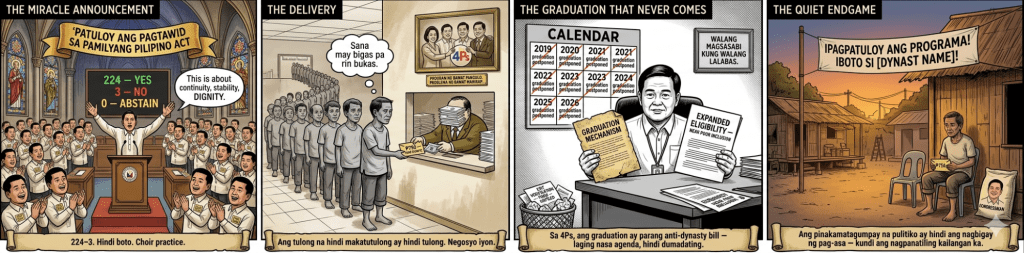
HOUSE Bill No. 8647—the self-congratulatory Patuloy ang Pagtawid sa Pamilyang Pilipino Act—has just sailed through the House on a 224–3 vote, with zero abstentions and the solemn piety of a prayer meeting. Speaker Faustino “Bojie” Dy III, scion of Isabela’s iron-fisted Dy dynasty, beams like a benevolent patriarch: “This is about continuity, stability, and dignity.” Our objective, he intones, is “to make a good program better.”
Hoy, spare us the sanctimony, Speaker. In the grand theater of Philippine governance, where good intentions are the favorite costume of the political class, this bill is not a ladder out of poverty. It is a sophisticated cage—polished, expanded, inflation-indexed, and wrapped in the language of human capital investment—designed to keep millions dependent, compliant, and eternally grateful at election time.
Let us eviscerate this charade with the moral urgency it deserves.
1. Pro & Con: Sweet Talk Meets the Knife
The best case for Speaker Dy and HB 8647 is seductive, almost noble. Inflation is ravaging the poor. The original grants, frozen since RA 11310’s 2019 enactment, buy less rice and fewer check-ups. The bill indexes benefits (P750 health/nutrition, P850 for pregnant women and toddlers under two, P1,000 early childhood development grant, P1,500 rice fund), adds “First 1,000 Days” nutrition focus, expands to homeless families and geographically isolated areas, and throws in adult education, entrepreneurship training, and livelihood support. World Bank studies once praised 4Ps for boosting school attendance and cutting stunting. LEDAC priority status signals executive buy-in. Continuity across administrations, the argument goes, prevents the poor from becoming political footballs.
Fair enough. A program that keeps kids in school and mothers healthy is, on paper, better than nothing.
Now watch it all unravel.
This is not investment; it is vote-harvesting with better branding. The near-unanimous 224–3 House vote on HB 8647 is not genuine consensus—it is the unmistakable sound of congressmen securing their own district “rice funds” and pet projects in the quiet budgetary horse-trading that always accompanies big-ticket welfare bills. The “dignity” Dy speaks of is the dignity of the dole: cash that arrives predictably, conditions that are weakly enforced, and graduation clauses quietly diluted into irrelevance. Studies showing short-term gains never tracked the long-term rot—dependency, labor disincentive, and the quiet conversion of citizens into clients. One hundred thousand ghost beneficiaries were already purged in recent years; expansion simply multiplies the pasture for more ghosts.
The devil got his due. Now the guillotine falls.
2. Legal Scam: Temporary Bridge to Eternal Entitlement
RA 11310 institutionalized 4Ps as conditional, targeted, time-bound, and developmental. Listahanan data, periodic reassessment, graduation mechanisms—the law’s DNA screamed “temporary bridge,” not “lifetime annuity.”
HB 8647 quietly buries that DNA. More frequent indexing against CPI turns grants into de facto entitlements. Expanded eligibility (homeless, GIDA, “near-poor”) loosens the poverty threshold until it becomes a rubber band. The new “socio-economic resilience” and “transition programs” sound progressive until you realize they mask the real shift: 4Ps is drifting from conditional cash transfer to unconditional political subsidy.
Constitutional tension? Separation of powers is mocked when Congress mandates ever-growing budgetary obligations that future executives cannot easily unwind. Equal protection is insulted when Listahanan—already politically captured at the barangay level—becomes the gatekeeper for millions more. Fiscal autonomy? The bill’s “improved delivery” is code for centralizing discretion in the hands of the same DSWD bureaucracy that has struggled with delayed payouts and 1.1 million complaints.
This is not legislative refinement. It is statutory sleight-of-hand, transforming a poverty-alleviation tool into a patronage machine with the force of law.
3. Who’s Really Hungry: Players’ Greedy Motives
- Speaker Bojie Dy III and the House machinery: The Dy clan has ruled Isabela for generations like a private fiefdom. Bojie’s speakership is not about poverty; it is about legacy, positioning for 2028, and reminding Malacañang that the House delivers the “masa” vote. Dynastic entrenchment dressed as compassion.
- Executive Branch and DSWD: Social stability amid economic headwinds. Preempt unrest. Keep the poor fed enough not to riot, dependent enough not to demand structural change. LEDAC priority = Malacañang blessing for a program that buys peace without taxing the elite.
- Opposition and civil society watchdogs: Some genuine. Most performative. The Makabayan bloc will grandstand for stricter audits while knowing full well that real oversight would expose their own past dalliances with patronage politics.
- Beneficiaries: Immediate survival. They are not villains; they are rational actors in a system that rewards compliance over self-reliance.
- The bureaucracy: Empire-building. More beneficiaries = bigger budget = more influence, more patronage appointments, more chances to skim.
No player is pure. Every “pro-poor” speech reeks of calculation.
4. Escape Routes: Brilliant Cynicism or Epic Blunder
In the grand casino of Philippine politics, where self-interest always sits at the high-roller table, every major player is quietly weighing their moves. They all have two doors before them: the glittering, foolproof path of brilliant cynicism that protects power and harvests votes, or the noble but suicidal road of epic blunder — actually doing the right thing. Predictably, only one door ever gets heavy traffic.
- Speaker Dy/Congress:
- Cynically brilliant: Ram it through the Senate, claim credit, let local dynasties harvest the votes.
- Disastrous: Actually enforce graduation and audits—risk alienating the machine that put him in the rostrum.
- Executive/DSWD:
- Brilliant: Use IRR to tighten Listahanan biometrics and real-time monitoring.
- Miscalculated: Let local officials hand-pick beneficiaries—guaranteed scandal by 2028.
- Critics/Civil Society:
- Brilliant: Demand independent COA real-time audits and public beneficiary dashboards.
- Miscalculated: Settle for token amendments and declare victory while the cage is built.
- Beneficiaries:
- Brilliant: Use grants for education and micro-enterprise; treat it as bridge, not hammock.
- Miscalculated: Treat it as birthright—guaranteeing intergenerational mendicancy.
5. Endgames: Clean Dream, Patronage Reality, Total Meltdown
- Clean (fantasy): Strict graduation after seven years with livelihood exit packages, biometric-only payouts, independent third-party audits, and measurable poverty-exit metrics. Poverty incidence plummets.
- Managed Patronage (most probable): The program “works”—kids stay in school, some health gains—but ghost lists proliferate quietly, barangay captains take their cut, and 4Ps becomes the glue holding dynastic power together. Public shrugs: “At least may bigas.”
- Catastrophic: Massive leakage scandal explodes pre-election. COA flags billions. Public outrage. House leadership bloodied. Program scaled back amid fiscal panic. The poor pay twice—once in stolen funds, once in lost trust.
Bet on managed patronage. Philippine politics always does.
6. Fallout Map: Economic Poison, Political Win, Social Rot
- Economic: Short-term consumption boost. Long-term fiscal black hole competing with infrastructure, health infrastructure, and debt service. Productivity stagnates as able-bodied adults learn dependency.
- Political: Incumbents fortified. Opposition neutered. Welfare-based campaigning becomes the only game in town. Dynasties laugh last.
- Social: Extreme poverty eases on paper. Intergenerational transmission of mendicancy accelerates. The poor internalize that the state is Santa Claus, not partner. Stigma and learned helplessness replace dignity.
- Governance: Legislature proves itself captive to executive priorities and internal patronage. Accountability mechanisms—Listahanan, COA, DSWD—further compromised. Public trust in institutions erodes another notch.
Final Indictment: Break the Golden Cage Now
Speaker Dy, your bill is not patuloy ang pagtawid. It is patuloy ang pagkakadepende—continued entrapment. You have taken a program born of good intentions and turned it into the most sophisticated vote-buying apparatus since the old patronage machines of the martial-law era.
To the Filipino people: This is not governance. This is the quiet corruption of compassion itself.
Concrete demands, now:
- Enforce iron-clad seven-year graduation with mandatory livelihood training and exit verification.
- Full biometric, blockchain-tracked beneficiary database open to public scrutiny.
- Independent oversight board with civil society, COA, and private sector—outside DSWD and congressional control.
- Automatic delisting for non-compliance after two warnings—no more “extensions.”
- Ban political advertisements featuring 4Ps beneficiaries.
- Pass a genuine anti-political dynasty law with teeth—not the toothless version dynasts love to file and forget.
- Redirect a portion of expanded funds into genuine job-creation infrastructure in the poorest provinces.
Until we stop mistaking cash transfers for development, the poor will remain poor—and the powerful will remain powerful. The cage is being gilded as we speak.
Break it. Demand better. Or prepare your children for another generation of polite begging.
Barok has spoken.
Key Citations
A. Reports & Studies
- Velarde, Rashiel, and Luisa Fernandez. Welfare and Distributional Impacts of the Pantawid Pamilyang Pilipino Program. World Bank, 2011. — PDF
- Philippines. Congress. Republic Act No. 11310: An Act Institutionalizing the Pantawid Pamilyang Pilipino Program (4Ps). The LawPhil Project, 2019.
B. News Articles
- Escosio, Jan. “Dy: Expanded 4Ps Bill Ensures Continued Aid for Poor Filipinos.” Inquirer.net, 6 May 2026.
- “Speaker Dy: ‘Tuloy ang pagtawid’ for Poorest Filipinos as House Passes Expanded 4Ps Bill.” Congress of the Philippines, 6 May 2026.
C. Official & Other Sources
- ₱9 Billion in ‘Savings’? DILG’s Fire Truck Deal Smells Like Smoke
- ₱8B BBM Pork: CCTV for Every Captain’s Kumpare?
- ₱8.9 Billion, 331 Ghost Police Stations: The TIKAS Scandal Explained

- ₱8.4 Billion, 42,000 Barangays, 1 Election: The “Bawat Barangay Makikinabang” Vote-Buying Masterclass
- ₱75 Million Heist: Cops Gone Full Bandit

- ₱6.77B Ghost Haunts Duterte: RTC Dismisses Mans Carpio’s Desperate Plea
- ₱6.77 Billion and Zero Cash: The Sara Duterte SALN Math That Doesn’t Add Up
- ₱6.7-Trillion Temptation: The Great Pork Zombie Revival and the “Collegial” Vote-Buying Circus

- ₱58.53B, Zero Receipts: The LGSF Pork Barrel Nobody Wants to Name
- ₱53 Million Man Tells ₱695-a-Day Workers to Stop Being ‘Mayabang’: The Audacity of BSP’s Remolona
- ₱4.4 Billion and a Witness Who Can’t Explain It: The Duterte Impeachment’s Most Expensive Non-Answer
- ₱3.06 Billion for Evacuation Centers—But Nobody Knows Where They’ll Stand (Or If They’ll Exist)



Leave a Reply