When Congress Unclothes the Secret, Carpio Wants to Jail the Reporters Who Saw It
By Louis ‘Barok‘ C. Biraogo — May 5, 2026
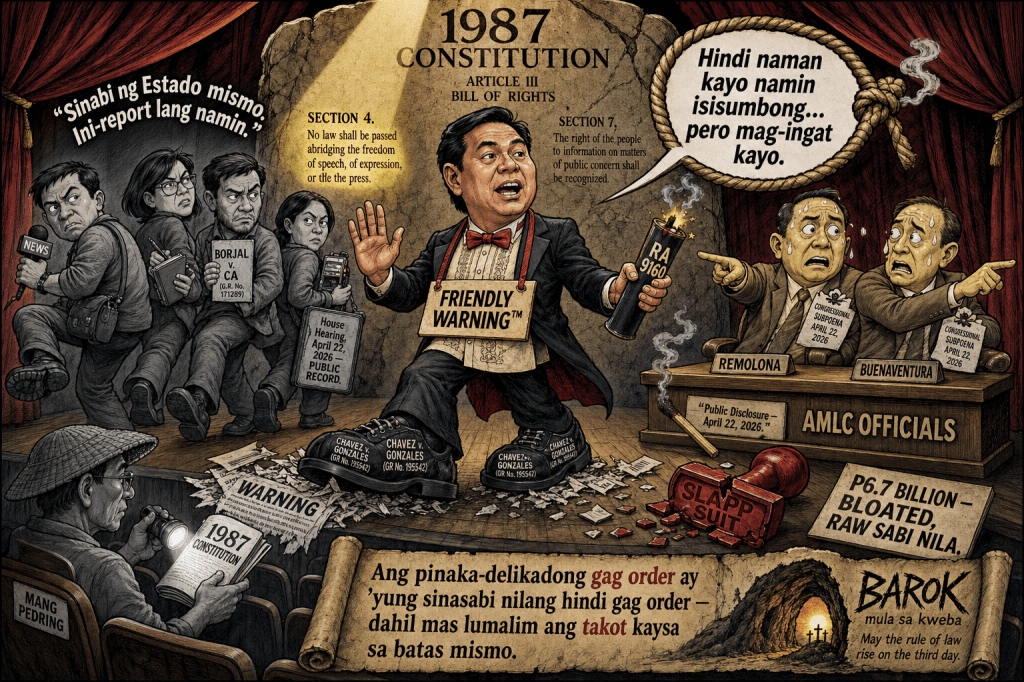
MGA ka-kweba, ladies and gentlemen of the Republic, grab your popcorn and your 1987 Constitution. Today, in the grand theater of Philippine public life, we witness a masterclass in legal hypocrisy: Atty. Manases “Mans” Carpio’s camp issuing a velvet-gloved threat to the media for daring to report what the Anti-Money Laundering Council (AMLC) itself spilled like cheap gin in a House impeachment hearing. “Be careful citing that AMLC report,” intoned Atty. Peter Paul Danao, waving Republic Act No. 9160 (Anti-Money Laundering Act of 2001) (AMLA), Section 14(d) like a talisman. But relax, folks—he swears they won’t actually sue the journalists. Just a friendly “maghinay-hinay tayo,” because someone else might.
This isn’t law. This is Strategic Lawsuit Against Public Participation (SLAPP) theater dressed in statutory drag. And as your merciless legal sleuth, I’m here to eviscerate it, section by bloody section. No statute survives. No motive escapes ridicule. No constitutional principle gets left undefended. Let’s burn the hierarchy of laws to the ground and rebuild it with the 1987 Constitution as its cornerstone.
I. Burn the Hierarchy: Constitution Crushes Mere Statutes
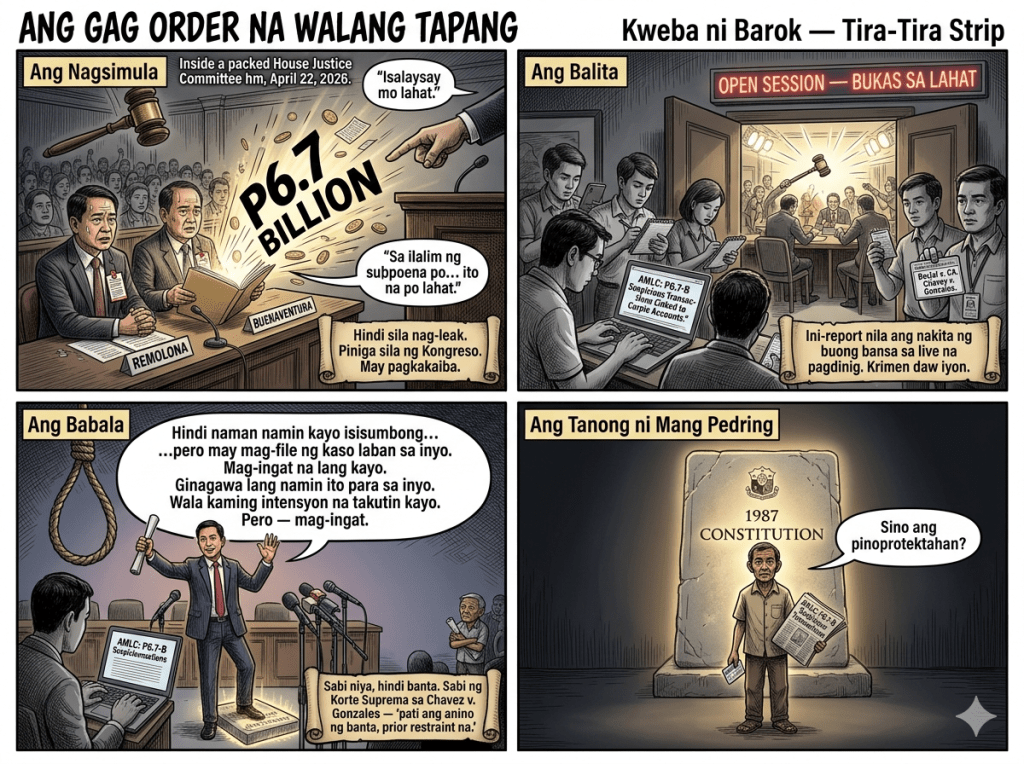
Here’s the core obscenity: Carpio’s camp insists a mere statute—RA 9160, Section 14(d)—can slap criminal liability on media for publishing what the AMLC itself “unclothed” in open session. Imprisonment from three to eight years and a half-million-peso fine for the reporter, editor, publisher—the works. As if Congress, in a fit of bureaucratic piety, could simply legislate away the Bill of Rights.
Wrong. Dead wrong. Article III, Section 4 (Freedom of Press) and Section 7 (Right to Information) of the 1987 Constitution guarantee freedom of speech and of the press. When a statute collides with these, the Constitution wins. Every. Single. Time. This isn’t some academic footnote; it’s black-letter supremacy.
Enter Chavez v. Gonzales (G.R. No. 168338). The Supreme Court struck down NTC and DOJ “warnings” to media not to air the Garci Tapes as unconstitutional prior restraint. The Court didn’t mince words: official statements chilling press freedom—without formal orders even—are still prior restraint. A “blow too soon struck for freedom is preferred than a blow too late.” Danao’s press-conference sermon? Same stench. It’s not a “caution.” It’s a veiled gag order, presumptively unconstitutional, especially when the information flowed from a public legislative hearing, not a leaked Suspicious Transaction Report (STR).
RA 9160, Section 14(d) is a statute. Statutes yield to the Constitution. Inside that House hearing room on April 22, 2026, the collision was decisive: legislative inquiry power (Article VI, Section 11) versus AMLA secrecy. The Constitution reigns supreme. Any interpretation of RA 9160 that criminalizes reporting official proceedings is a constitutional nullity—void ab initio. Burn it down. Rebuild it with Chavez as the foundation: no prior restraint on matters of public concern, especially when the State itself pulls back the curtain.
II. The Great Unclothing: Whodunit? AMLC Lit the Match
Cue the suspenseful music. Who broke confidentiality first? Who lit the match that set this P6.7-billion bonfire ablaze?
Spoiler: It wasn’t the media. It was the AMLC—Eli Remolona Jr. and Ronel Buenaventura—testifying under oath before the House Justice Committee during the impeachment probe against VP Sara Duterte. Thirty-three suspicious transactions. Six hundred thirty covered dealings. P4.4 billion in, P1.5 billion out, P791 million unclassified. All laid bare in a public proceeding compelled by subpoena.
The proximate cause? Legislative oversight, not journalistic overreach. Article VI, Section 11 grants lawmakers immunity for speeches and debates in Congress. Senate v. Ermita (G.R. No. 169777) cements it: inquiries in aid of legislation are broadly construed; executive privilege is narrow and must be asserted with specificity. AMLC officials didn’t “leak”—they executed a duty when Congress called. Refusal could have meant contempt. Their disclosure wasn’t a crime; it was compelled performance under the people’s sovereign right to probe public officials.
Here’s my modest proposal: the Public Disclosure Doctrine. Once the State unclothes a secret in an official proceeding —especially an impeachment hearing, where Republic Act No. 1405 (The Law on Secrecy of Bank Deposits) itself carves out an explicit exception for bank records—the information is forever naked and reportable. Confidentiality dies at the witness stand. The media doesn’t “breach” it; they merely report the corpse. The AMLC lit the match under duress. Now Carpio’s camp wants to arrest the firefighters for the smoke.
III. Cross-Examination: Carpio’s Arguments Get Shredded
For Carpio: His camp’s position is airtight in a vacuum—statutory cherry-picking at its finest. RA 9160 doesn’t distinguish venue; confidentiality “attaches to the nature of the document.” Carpio’s not even a party to the impeachment; he’s a “private citizen” dragged into a “political circus.” The P6.7 billion is “bloated.” Don’t ask for proof; privacy forbids it. Republic v. Eugenio Jr. (G.R. No. 174629) is trotted out to remind us bank secrecy is “near-sacrosanct.”
Cute. But constitutionally pathetic. Eugenio upholds secrecy as policy, yet explicitly notes exceptions—including AMLA itself and impeachment under Republic Act No. 1405 (The Law on Secrecy of Bank Deposits), Section 2. Carpio’s “non-party” plea ignores the obvious: as spouse of the impeached Vice President, his finances are inextricably linked to “unexplained wealth” allegations. Selective exposure? The House didn’t fish; the AMLC swam into the hearing room voluntarily under subpoena. Due process for the “bloated figure”? He can explain it anytime—open the ledgers or embrace the label.
Against Carpio: Critics like Attys. Edre Olalia and Michael Henry Yusingco don’t just fortify—they obliterate. Olalia: the AMLC “unclothed” it; media reports of public disclosure are protected speech. Yusingco: none of the info is privileged from reporting official proceedings.
They’re right. Fuse that with the Fair Reporting Privilege under Rules of Court, Rule 130, Section 54 and Borjal v. Court of Appeals (G.R. No. 126466): fair and true reports of official proceedings are qualifiedly privileged. Fair commentaries on public interest destroy any presumption of malice. This isn’t a “gray area.” It’s blazing constitutional white light. Protected speech isn’t optional when the State itself testifies in open session. Carpio’s statutory shield crumbles under strict scrutiny. The Constitution doesn’t bend for “chilling effects” on financial confidentiality when public accountability is at stake.
IV. Autopsy of Motives: Hypocrisy on Full Display
- Atty. Mans Carpio: The SLAPP-suit artist in chief. He files raps against AMLC officials and solons while issuing a non-threat threat to the media. Damage control deluxe. He creates a chilling effect without the guts to actually sue a journalist — because he knows Chavez would eviscerate him in open court. “We know you’re doing your job,” Danao coos. Translation: “Please self-censor so I don’t have to explain the ‘bloated’ numbers.” Classic weaponization of privacy to shield the powerful.
- The AMLC (Remolona/Buenaventura): Bureaucratic tragicians. They complied with a congressional subpoena under pain of contempt, spilled the beans in aid of impeachment legislation, then got burned at the stake by the very man whose family is under scrutiny. They lit the match of disclosure under duress. Now Carpio wants their heads. Poetic justice for the enforcers of transparency who suddenly discover “oops, confidentiality.”
- The Media & Defenders (Olalia, Yusingco, et al.): The last adults in the room. Clinging to the Constitution while others dance around a P6.7-billion bonfire of public interest. They report what the State itself disclosed. They defend the people’s right to know. Heroes? Absolutely. Intimidated? Not on your life.
V. Resolutions & Call to Arms: Free Press or Gag Orders?
Possible resolutions? Prosecutor’s office dismisses the raps against AMLC officials (and any potential ones against media), citing legislative privilege and press freedom. Or Congress amends RA 9160 to explicitly codify the Public Disclosure Doctrine. Or the whole thing politically evaporates if impeachment fizzles.
Impacts? A ruling against media births a nation of “confidential” gag orders—every legislative probe becomes a potential felony trap for reporters. A ruling for media? Landmark precedent cementing the public’s right to know when the State speaks first.
My thunderous call to arms:
- Supreme Court: Take cognizance now via certiorari and prohibition. Settle this with finality. Chavez already drew the line; draw it thicker.
- Rule of Law: Supremacy over the weaponization of privacy. Statutes serve the Constitution, not the other way around.
- Legislative Fix: Amend RA 9160. Explicitly declare: public disclosure in a government proceeding destroys confidentiality. Codify the Public Disclosure Doctrine.
To the main actors, here is my no-holds-barred advice:
- To Mr. Carpio: Open your ledgers or embrace the label of “bloated figure” in the court of public opinion. Privacy is not a shield for unexplained wealth when your spouse faces impeachment.
- To AMLC Officials: Stand tall. You executed legislative duty. Demand immunity and counter-sue for harassment if needed.
- To Media: Keep reporting. Borjal and Chavez are your armor. The public deserves the truth the State itself uttered.
- To Congress: Stop subpoenaing secrets only to clutch pearls when they leak. Own the transparency you demand.
The defense of a free press is not negotiable. It is the closing argument of every democracy worth its salt. Carpio’s warning isn’t law—it’s a constitutional crime scene. And Barok just performed the autopsy.
The Republic is watching. The Constitution demands better. Let’s deliver it.
— Barok
Key Citations
A. Legal & Official Sources
- Philippines. The 1987 Constitution of the Republic of the Philippines. 1987. Official Gazette of the Republic of the Philippines.
- Philippines. Republic Act No. 1405: An Act Prohibiting Disclosure of or Inquiry into, Deposits with Any Banking Institution and Providing Penalty Therefor. 9 Sept. 1955. Official Gazette of the Republic of the Philippines.
- Philippines. Republic Act No. 9160: An Act Defining the Crime of Money Laundering, Providing Penalties Therefor and for Other Purposes. 29 Sept. 2001. Official Gazette of the Republic of the Philippines.
- Philippines, Supreme Court. Borjal v. Court of Appeals. G.R. No. 126466, 14 Jan. 1999. Lawphil.
- Philippines, Supreme Court. Chavez v. Gonzales. G.R. No. 168338, 15 Feb. 2008. Lawphil.
- Philippines, Supreme Court. Republic v. Eugenio, Jr. G.R. No. 174629, 14 Feb. 2008. Lawphil.
- Philippines, Supreme Court. “Rules of Court: Rules 128-134.” The Lawphil Project, Arellano Law Foundation. Accessed 5 May 2026.
- Philippines, Supreme Court. Senate v. Ermita. G.R. No. 169777, 20 Apr. 2006. Lawphil.
B. News Reports
- Mendoza, John Eric. “FWD: Carpio Camp Warns Media Citing AMLC Report Against Law; Lawyer Differs.” Inquirer.net, 2026.
- Bordadora, Norman. “What Went Before: Saga of the ‘Hello Garci’ Tapes.” Inquirer.net, 29 May 2014.
- “Ang Hirap Maging Mahirap”: The PAO Scandal That Proves Government Contempt Is Nothing New
- “Far-Off” My Axx: Malacañang’s Claire Castro Drowns in Her Own Legal Gaslighting
- “Forthwith” to Farce: How the Senate is Killing Impeachment—And Why Enrile’s Right (Even If You Can’t Trust Him)
- “HINDI AKO NAG-RESIGN!”

- “I Know Nothing”: Baste Duterte’s Amnesia Defense Meets ₱33M in GenCorp Contracts

- “I’m calling you from my new Globe SIM. Send load!”

- “Mahiya Naman Kayo!” Marcos’ Anti-Corruption Vow Faces a Flood of Doubt

- “Manageable” Debt, Unmanageable Lies: DBM’s ₱21 Trillion Fairy Tale
- “Meow, I’m calling you from my new Globe SIM!”

- “Natrabaho”: One Word, One Ombudsman, and a Judiciary on Trial
- “No Special Jail for Crooks!” Boying Remulla Slams VIP Perks for Flood Scammers

- “Philippine-Controlled” or Yankee Gas Station? The Davao Fuel Depot Farce Exposed




Leave a Reply