One Fake Number. Zero Brain Cells. Total Career Annihilation.
By Louis ‘Barok‘ C. Biraogo — May 8, 2026
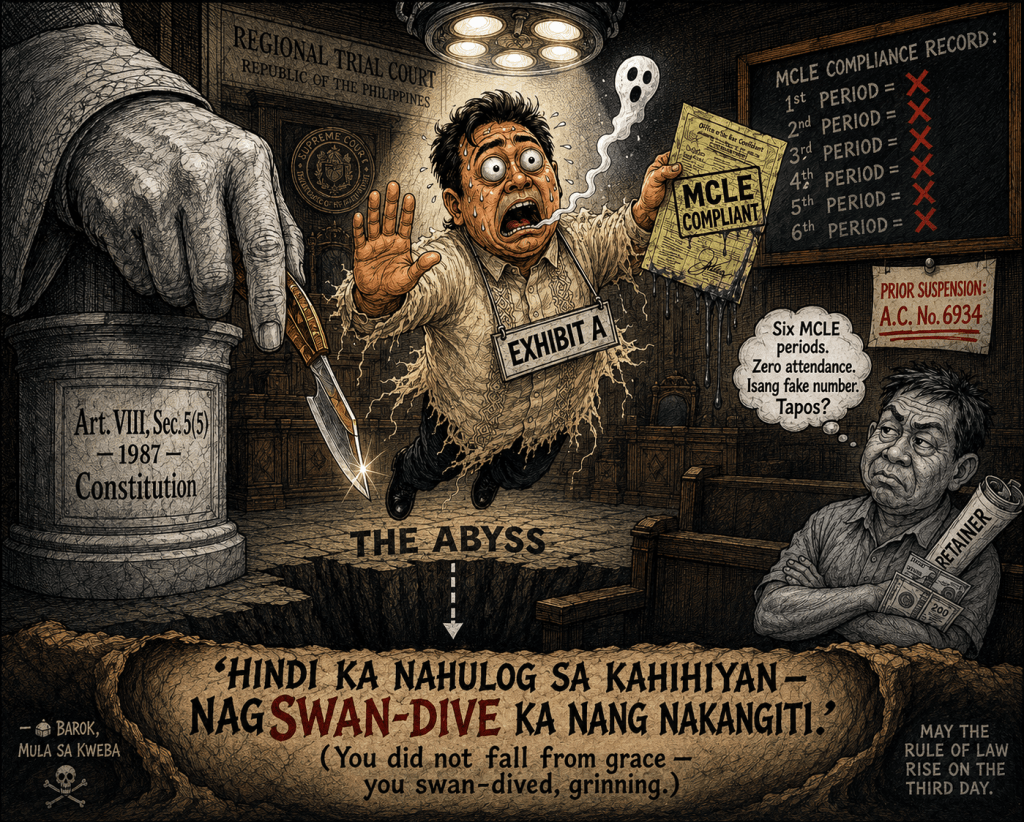
IN A per curiam decision that rings like the clang of a guillotine in the dead of night, the Supreme Court has once again reminded the Philippine legal profession that it is not running a charity for the ethically challenged. Atty. Jose R. Hidalgo—disbarred, stripped of his privilege to practice, and slapped with a ₱35,000 fine—now stands as Exhibit A in the High Court’s relentless campaign to amputate the gangrenous limbs before the whole body politic of justice rots from within. This was no mere administrative slap on the wrist. This was institutional surgery performed without anesthesia. The Court had no choice. To have done otherwise would have been to declare open season on the very foundations of public trust. When a lawyer looks the judiciary in the eye and lies on official pleadings, the High Court does not negotiate with terrorists of the truth. It excises. It must. The body must live.
Idiot’s Masterpiece
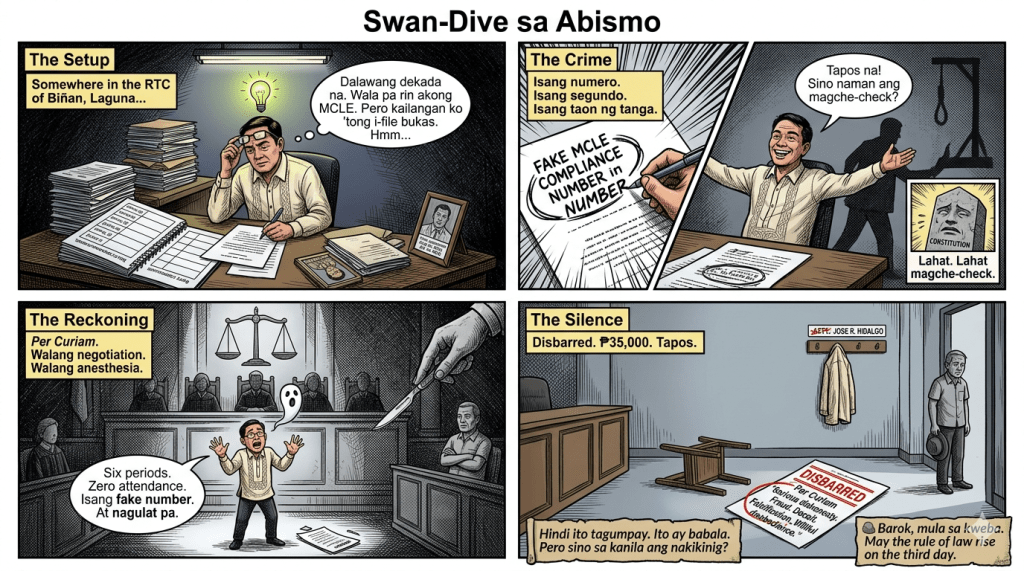
Let us now turn the scalpel on the patient himself, the late (professionally speaking) Atty. Jose R. Hidalgo, that recidivist architect of his own exquisite ruin. Here was no master criminal, no Machiavellian schemer weaving webs of grand corruption. No, dear readers, we are treated to the far more pathetic spectacle of a man who, already carrying the scarlet letter of a prior one-year suspension (A.C. No. 6934, Chang v. Hidalgo, for abandoning his client like a rat fleeing a sinking ship), decided the cleverest way forward was to forge an MCLE compliance number and shove it into court pleadings before the Regional Trial Court of Biñan, Laguna.
A fake attendance slip. A paper-trail fraud so transparently idiotic it could have been detected by a first-year law student with a decent internet connection. Hidalgo had not complied with a single MCLE period from the 1st to the 6th—spanning nearly two decades of willful legal illiteracy—yet he thought the gods of the judiciary would simply shrug and let him sail on. He ignored Integrated Bar of the Philippines (IBP) orders to explain himself. He treated the disciplinary process with the contempt usually reserved for parking tickets. And for this masterpiece of self-sabotage, the Court rightly branded him with serious dishonesty, fraud, deceit, falsification, and willful disobedience.
Behold the sheer theatrical stupidity: a lawyer who already knew the taste of suspension, who had already felt the cold hand of the Court on his collar, still chose to commit the one sin that leaves a paper trail wider than EDSA at rush hour. This was not cunning. This was clownery elevated to career-ending art. Hidalgo did not fall from grace; he swan-dived into the abyss while flipping the bird at the lifeguards. The penalty—disbarment—is not disproportionate. It is poetic justice. The man killed his own career with a lie so small, so petty, so easily disproven that one almost feels embarrassed for the profession that once sheltered him.
Privilege, Not Birthright
Let us be brutally clear, as the Supreme Court has always been: the practice of law in this archipelago is not a constitutional birthright. It is not a lawyer’s divine entitlement, not a family heirloom to be passed down like a rusty balisong. It is a privilege—fragile, conditional, revocable at the sovereign pleasure of the Court that guards the gates. Article VIII, Section 5(5) of the 1987 Constitution of the Republic of the Philippines (1987 Constitution) does not hand out licenses like candy; it grants the Supreme Court the solemn duty to police those who wear the robe of officer of the court.
The entitlement mentality that festers in certain quarters of the Bar—“I paid my dues, I passed the bar, I am untouchable”—is the very rot the Court must cauterize. Hidalgo embodied it. He treated MCLE compliance as an optional suggestion, his pleadings as personal playgrounds for creative fiction, and the disciplinary process as beneath his dignity. The Court’s message is thunderous: you do not own this profession. The profession owns you, and it can revoke your membership the moment you prove yourself unworthy of the public trust. To argue otherwise is to demand that the temples of justice be run like a barangay sari-sari store—open to anyone who can fog a mirror and scribble “Esq.” after their name.
Holy Seminar, Profane Racket
The Mandatory Continuing Legal Education (MCLE) program, born of Bar Matter No. 850 (Re: Mandatory Continuing Legal Education for Members of the Integrated Bar of the Philippines) and sharpened by Bar Matter No. 1922 (Re: Number and Date of MCLE Certificate of Completion/Exemption Required in All Pleadings/Motions), exists for a reason as pure as the driven snow: to keep lawyers from becoming intellectual dinosaurs, to drag them kicking and screaming into the latest jurisprudence, to hammer ethics into skulls grown thick with complacency, and—most crucially—to shield helpless litigants from counsel who cannot distinguish a tort from a tart. In theory, it is the profession’s vaccine against obsolescence. In practice… ah, here the satire writes itself.
For while the purpose is noble, the execution has long reeked of a partially revenue-oriented racket. Thirty-six hours every three years, at seminar prices that would make a Makati hotel blush. Providers who treat the program like a cash cow. Enforcement that falls heaviest on the small-town solo practitioner scraping by in the provinces, while the big-firm rainmakers glide through with sponsored “executive programs” and convenient exemptions. The MCLE has become, in the bitter jest of many practitioners, a regressive tax on competence—a bureaucratic tollbooth where the rich pay with Amex and the struggling pay with their livelihoods. None of this excuses Hidalgo’s forgery. But it does explain why some desperate souls reach for the shortcut. The system’s hypocrisy does not justify the sin; it merely makes the sin more understandable, and the Court’s hammer more necessary.
Guillotine Now, Reforms Later
This disbarment is not the end of the story; it is the opening salvo of a necessary revolution. The Supreme Court has done its part—now the Integrated Bar, the law schools, and the profession itself must rise to the collective endeavor of genuine reform, lest we merely trade one set of dishonest lawyers for another.
Demand state-subsidized or fully free MCLE for practitioners earning below a certain threshold. Grant the IBP real auditing teeth, not ceremonial ones. Create a public shaming docket—online, transparent, searchable—so that every litigant can check whether their counsel is in good standing before handing over hard-earned retainers. Mandate tech-updating modules so that lawyers stop filing pleadings like it’s still 1995. And above all, let every member of the Bar understand that continuing legal education is not a punishment but a patriotic duty: a direct contribution to national welfare in a country where justice delayed is justice denied to the poorest among us.
The Hidalgo case is a warning shot across the bow of every lawyer who still thinks the rules are for the little people. The Supreme Court has spoken with the cold finality of history. The profession can either evolve into something worthy of public confidence—or it can continue to hemorrhage credibility one fake compliance number at a time.
The choice, as always, belongs to the Bar.
But the sword, dear colleagues, remains in the hands of the Court.
And it is sharp.
— Louis “Barok” C. Biraogo
Kweba ni Barok
Where the truth is served raw, and the hypocrites are served notice.
Key Citations
A. Legal & Official Sources
- The 1987 Constitution of the Republic of the Philippines. Official Gazette of the Republic of the Philippines, 1987.
- Philippines, Supreme Court. Bar Matter No. 850. Re: Mandatory Continuing Legal Education for Members of the Integrated Bar of the Philippines. 2000.
- Philippines, Supreme Court. Bar Matter No. 1922: Re: Number of Bar Subjects to be Taken in the Bar Examinations. 3 June 2008. Lawphil, Arellano Law Foundation.
- Philippines, Supreme Court. Bar Matter No. 1922. Re: Number and Date of MCLE Certificate of Completion/Exemption Required in All Pleadings/Motions. 3 June 2008, The LawPhil Project.
- Philippines, Supreme Court. A.C. No. 6934. Chang v. Hidalgo. 6 Apr. 2016, The LawPhil Project.
B. News Reports
- Pulta, Benjamin. “Supreme Court Disbars Lawyer for Using Fake MCLE Compliance Number in Pleadings.” PNA.gov.ph, 2026.
- ₱9 Billion in ‘Savings’? DILG’s Fire Truck Deal Smells Like Smoke

- ₱8B BBM Pork: CCTV for Every Captain’s Kumpare?
- ₱8.9 Billion, 331 Ghost Police Stations: The TIKAS Scandal Explained

- ₱8.4 Billion, 42,000 Barangays, 1 Election: The “Bawat Barangay Makikinabang” Vote-Buying Masterclass
- ₱75 Million Heist: Cops Gone Full Bandit

- ₱6.77B Ghost Haunts Duterte: RTC Dismisses Mans Carpio’s Desperate Plea
- ₱6.77 Billion and Zero Cash: The Sara Duterte SALN Math That Doesn’t Add Up
- ₱6.7-Trillion Temptation: The Great Pork Zombie Revival and the “Collegial” Vote-Buying Circus

- ₱58.53B, Zero Receipts: The LGSF Pork Barrel Nobody Wants to Name
- ₱53 Million Man Tells ₱695-a-Day Workers to Stop Being ‘Mayabang’: The Audacity of BSP’s Remolona
- ₱4.4 Billion and a Witness Who Can’t Explain It: The Duterte Impeachment’s Most Expensive Non-Answer
- ₱3.06 Billion for Evacuation Centers—But Nobody Knows Where They’ll Stand (Or If They’ll Exist)



Leave a Reply