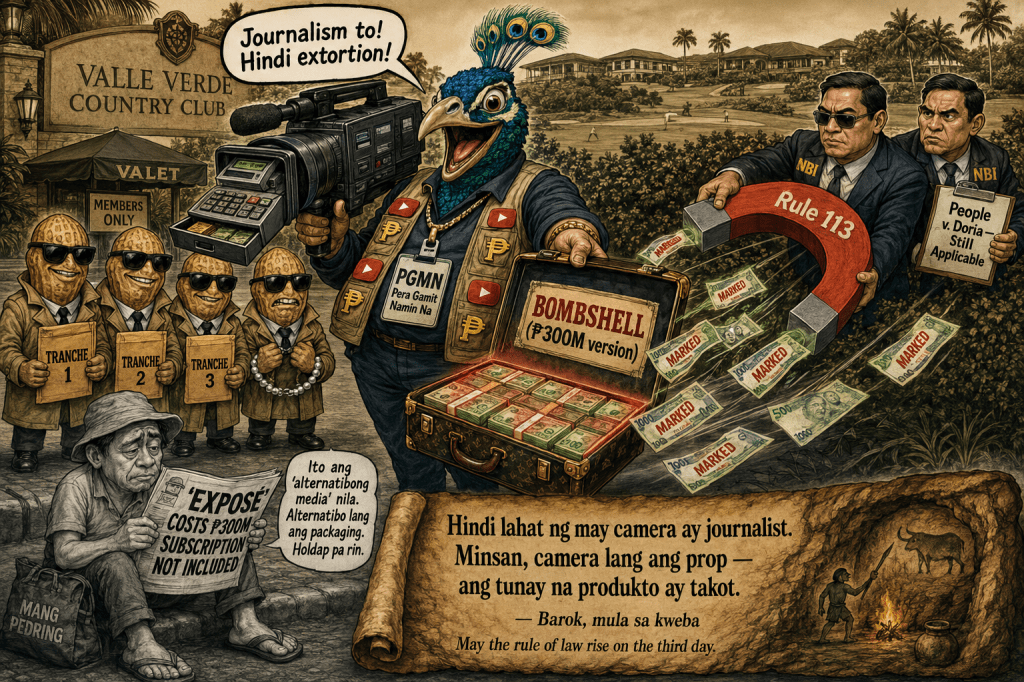
Marked Money, Manila Peninsula Meetings, and a Very Expensive “Bombshell”
By Louis ‘Barok‘ C. Biraogo — May 7, 2026
MGA ka-kweba, ladies and gentlemen of the Republic, grab your popcorn and your Revised Penal Code. On May 5–6, 2026, the National Bureau of Investigation’s Organized and Transnational Crime Division (NBI-OTCD) dropped the hammer in the most deliciously cinematic entrapment since People v. Doria. Roberto Ma. Franco Cruz Mabanta—founder and chairman of that self-proclaimed “alternative media” outfit Peanut Gallery Media Network (PGMN)—and his four merry collectors (Jardine Christian Serrano a.k.a. “Jimmy,” Franco Jose Gallardo, Ericson James Pacaba, and John Alexander Vasquez Gomez) were caught red-handed, suitcase of marked money in tow, at Valle Verde Country Club in Pasig. Their alleged crime? A textbook ₱300-million (some reports say ₱350M) robbery-extortion scheme against Leyte 1st District Rep. Ferdinand Martin Romualdez: “Pay us four fat tranches of ₱75 million each, or we drop the 90-minute ‘bombshell’ video linking you to the flood-control kickback circus.”
Mabanta’s immediate response? The classic cry of every cornered hustler: “Setup! Zero threats! We’re innocent journalists!” Cue the violins.
This isn’t journalism. This is extortion wearing a YouTube thumbnail and a fake press badge. And I, Barok, merciless legal caveman of the Kweba, am here to eviscerate the defense, torch the “public interest” fairy tale, and apply the full force of the law to protect the complainant—Rep. Martin Romualdez—while the law does what it was designed to do: punish predators who weaponize information for profit.
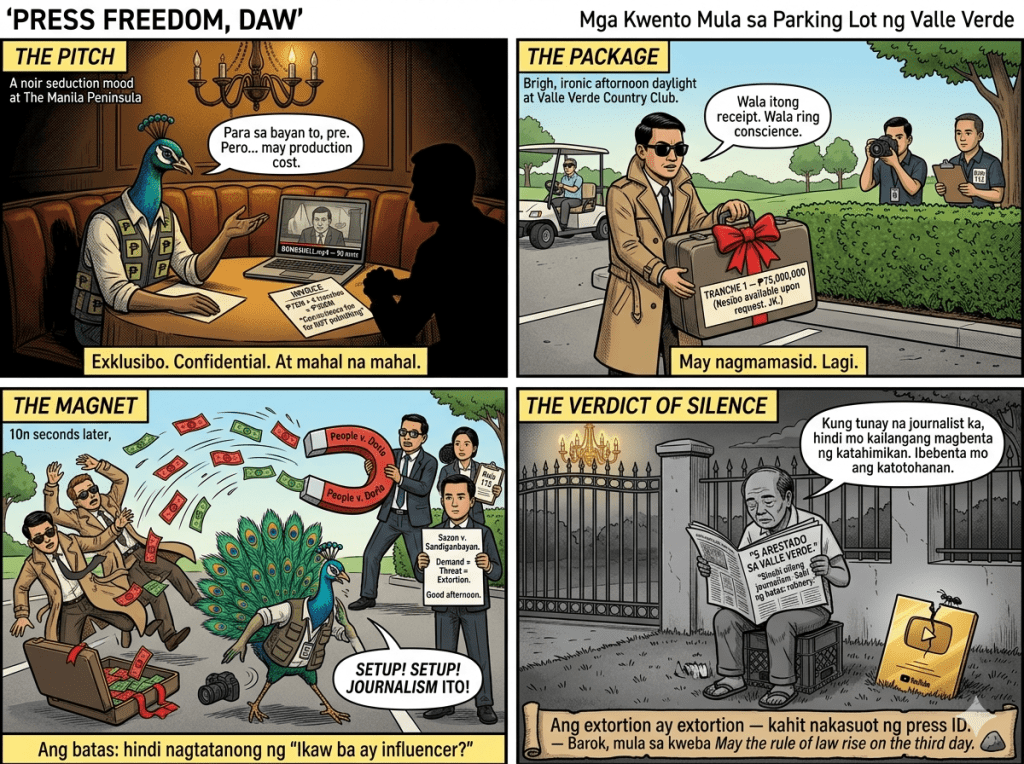
Rogues’ Gallery Unmasked: Mabanta’s Crew vs. the Victim Who Refused to Pay Up
Mabanta and his co-accused deserve the full prosecutorial flaying. Let’s start with the ringleader. Former MYX VJ, model, actor, and one-time Marcos-adjacent social media strategist who pivoted faster than a weather vane in a typhoon. Once allegedly aligned with the DDS/pro-Marcos ecosystem, Mabanta rebranded PGMN into a “political commentary” aggregator that suddenly discovered its conscience the moment Romualdez’s flood-control headaches became public fodder.
The pattern is textbook Article 293-294, Revised Penal Code (Act No. 3815): intimidation that vitiates consent, followed by the taking of property with intent to gain. They didn’t just “threaten to publish.” They conditioned suppression on cold cash—structured in four tranches, no less, like a mafia protection racket. A sample video snippet was allegedly dangled as proof of concept. That’s not investigative journalism; that’s a sales pitch for silence. Jurisprudence is crystal clear (Sazon v. Sandiganbayan): when a demand for money is tied to the threat of reputational destruction or exposure, it constitutes robbery by intimidation under Articles 293 and 294 of the Revised Penal Code, full stop. The “You know what you did to the country” taunt? That’s not righteous indignation. That’s the velvet glove over the iron fist of coercion.
His four associates? Mere facilitators? Please. Article 8 of the Revised Penal Code (Act No. 3815) on conspiracy laughs at that defense. Unity of purpose, coordinated acts—meetings at The Manila Peninsula, role assignments, delivery of the first tranche. Act of one is act of all. They weren’t “intermediaries.” They were the getaway drivers in a digital heist.
The NBI? Flawless execution. They acted on a formal complaint, deployed a classic entrapment operation under Rule 113, Section 5(b) of the Revised Rules of Criminal Procedure, recovered marked money, and preserved the chain of custody. People v. Doria draws the line with surgical precision: entrapment merely affords the opportunity to a predisposed offender. Here, the predisposition was already on record—a year-long pattern of threats, according to the complaint. No instigation. Just predators walking into their own trap. Critics whining about “political weaponization” forget the NBI didn’t invent the demand; Mabanta’s crew did.
Rep. Martin Romualdez? The victim who did exactly what the law invites: report the crime, cooperate with authorities, and let due process run its course. Yes, he sits at the center of the Ombudsman’s flood-control probe (the P56-billion kickback allegations that earned him a precautionary hold-departure order). But that probe is separate. Being investigated for one thing does not license anyone to extort you over it. Romualdez’s decision to fight back through legal channels is not “silencing critics.” It’s refusing to be shaken down. In a country where powerful men sometimes prefer backroom deals, this is refreshing accountability in the other direction.
Fever Swamps and “Setup” Fairy Tales: The Desperate Spin Cycle Begins
Social media is already a fever swamp of conspiracy: “Marcos-orchestrated ploy!” “Retaliation for the exposé!” “Chilling effect on press freedom!” Spare me. The only “setup” here was Mabanta’s crew setting up a payment schedule. The shifting allegiances? Classic opportunism—ride the Marcos wave when convenient, then flip to “whistleblower” when the scent of scandal (and easy money) appears. If the video was truly devastating and in the public interest, why not release it for free? Why the four-tranche price tag? Because the goal was never sunlight; it was a Swiss bank account.
The “journalism defense” is the most pathetic fig leaf of all. The 1987 Constitution of the Republic of the Philippines protects publication of matters of public concern—not monetized suppression. Chavez v. Gonzales forbids prior restraint, but it does not immunize blackmail. This wasn’t a negotiation or settlement; it was a shakedown. Mabanta’s PGMN isn’t the Philippine Center for Investigative Journalism. It’s a content farm that discovered extortion pays better than clicks.
Surgical Strikes from the Statute Books: The Law’s Blades Are Already Out
Let’s get surgical.
- Articles 293 & 294, Revised Penal Code (Act No. 3815): Robbery by intimidation. The threat of reputational harm (the video) created fear sufficient to compel delivery of ₱75 million (first tranche). Consent was vitiated. Game over.
- Article 282, Revised Penal Code (Act No. 3815) (Grave Threats): Threat to publish damaging content with a demand for money? Penalty escalates. Backup charge if the robbery theory needs reinforcement.
- Republic Act No. 10175 (Cybercrime Prevention Act of 2012): Committed “by, through, and with the use of” ICT—videos, chats, digital intermediaries. Penalty goes up one degree. Perfect overlay for the digital age of blackmail.
- Rule 113, Revised Rules of Criminal Procedure: Warrantless arrest in flagrante delicto? Marked money recovered on site? Surveillance footage? Textbook lawful.
- Entrapment doctrine (People v. Doria): NBI provided opportunity. Mabanta supplied the criminal design.
- Sazon v. Sandiganbayan: Demand + threat to expose = extortion. The Supreme Court has spoken.
The defense’s predictable Hail Marys—instigation, “protected speech,” chain-of-custody quibbles—will crumble under forensic digital evidence, witness testimony from the undercover operatives, and the sheer stupidity of accepting marked bills in a country club parking lot.
Motivations Laid Bare, Options Crushed, Ripples Guaranteed
Motivations unmasked: For Mabanta & Co.—pure greed dressed in anti-corruption drag. For Romualdez—self-preservation against reputational terrorism while his own legal battles rage. For the NBI—institutional duty plus the optics of nailing a high-profile cyber-extortion ring.
Strategic options: Mabanta can cry “setup” all the way to the docket, but the marked money has already spoken. Plea bargain? Possible for the lesser players who flip. Full trial? Devastating precedent against “pay-for-silence” schemes. Romualdez’s path: full cooperation, let the evidence do the talking, and keep fighting the Ombudsman case on its merits.
Possible resolutions: Conviction is the only just outcome. Reclusion temporal to perpetua, plus cyber enhancement. Acquittal would require the court to believe that demanding ₱300 million to bury a story is “journalism.” It isn’t. It’s crime.
Ripples: This case clarifies the firewall between press freedom and predation. It deters the next “influencer” who thinks a scandal equals a retirement fund. It strengthens digital media regulation without chilling legitimate exposés. Politically, it sends a message: power does not license blackmail, and neither does “alternative media.” The flood-control scandal continues on its own track; this extortion case stands alone as a victory for the rule of law.
Final Verdicts and Marching Orders from the Kweba
Verdict on Mabanta et al.: Guilty in the court of public evidence and, soon, in the halls of justice. You did not seek truth. You sought treasure. The Republic rejects your “setup” sob story.
Verdict on Rep. Martin Romualdez: Victim. Citizen. Fighter. Your decision to report this instead of paying up deserves applause, not suspicion.
Thunderous call: Immediate, transparent inquest. Full forensic disclosure of chats, videos, metadata. No delays. No political interference. The Department of Justice must treat this as the high-stakes cyber-extortion case it is.
The law is not a shield for the shameless. It is a sword. And in this case, it is already drawn, sharpened, and pointed straight at the heart of a ₱300-million scam that masqueraded as journalism.
Justice is coming, Mabanta. The Kweba is watching. And the Republic will not be extorted.
— Louis “Barok” C. Biraogo
Kweba ni Barok – Where Extortionists Enter Alive and Exit in Handcuffs
Key Citations
A. Legal & Official Sources
- Philippines. The Revised Penal Code [Act No. 3815]. 8 Dec. 1930. LawPhil.
- Philippines. Republic Act No. 10175: An Act Defining Cybercrime Prevention and Establishing a Comprehensive Framework for Its Prevention, Investigation, and Suppression. 12 Sept. 2012. Official Gazette.
- Philippines, Supreme Court. “Rule 113: Arrest. The Revised Rules of Criminal Procedure.” Lawphil, Arellano Law Foundation.
- Philippines, Supreme Court. People of the Philippines v. Federico Segui Doria and Esmeraldo Gaddi Reyes. G.R. No. 125299, 22 Jan. 1999. LawPhil.
- Philippines, Supreme Court. Zenaida V. Sazon v. Sandiganbayan (Fourth Division). 10 Feb. 2009. Lawphil, Arellano Law Foundation.
- Philippines, Supreme Court. Francisco I. Chavez v. Raul M. Gonzales and National Telecommunications Commission. G.R. No. 168338, 15 Feb. 2008. LawPhil.
- Philippines. The 1987 Constitution of the Republic of the Philippines. 2 Feb. 1987. Official Gazette.
B. News Reports

- “Ang Hirap Maging Mahirap”: The PAO Scandal That Proves Government Contempt Is Nothing New
- “Far-Off” My Axx: Malacañang’s Claire Castro Drowns in Her Own Legal Gaslighting
- “Forthwith” to Farce: How the Senate is Killing Impeachment—And Why Enrile’s Right (Even If You Can’t Trust Him)
- “HINDI AKO NAG-RESIGN!”

- “I Know Nothing”: Baste Duterte’s Amnesia Defense Meets ₱33M in GenCorp Contracts

- “I’m calling you from my new Globe SIM. Send load!”

- “Mahiya Naman Kayo!” Marcos’ Anti-Corruption Vow Faces a Flood of Doubt

- “Manageable” Debt, Unmanageable Lies: DBM’s ₱21 Trillion Fairy Tale
- “Meow, I’m calling you from my new Globe SIM!”

- “Natrabaho”: One Word, One Ombudsman, and a Judiciary on Trial
- “No Special Jail for Crooks!” Boying Remulla Slams VIP Perks for Flood Scammers

- “Philippine-Controlled” or Yankee Gas Station? The Davao Fuel Depot Farce Exposed







Leave a Reply