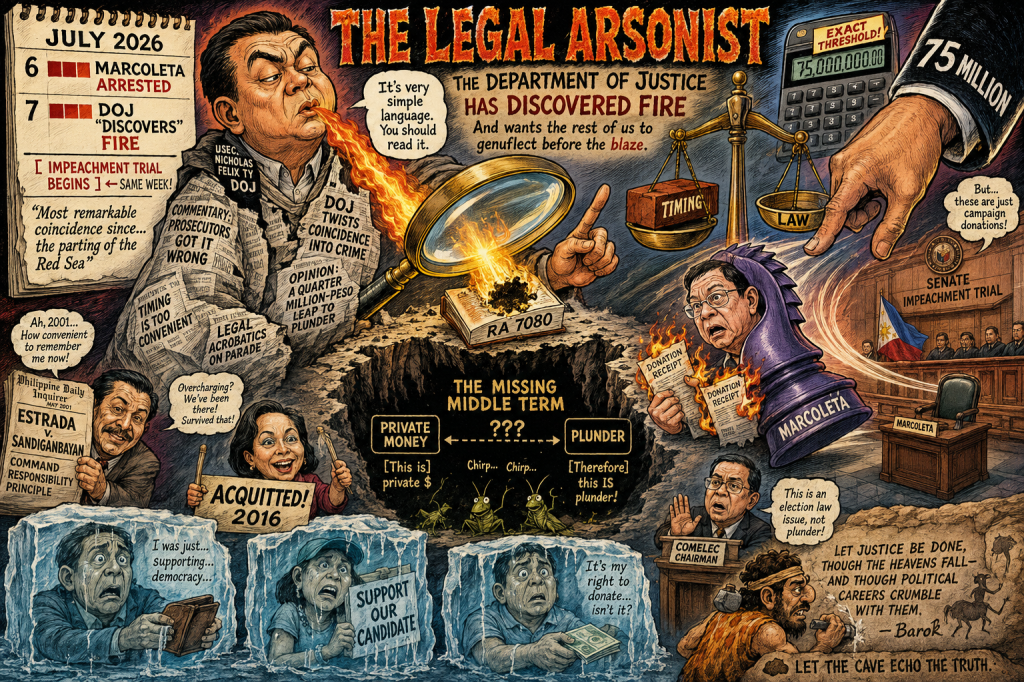
DOJ discovers private money can be plunder — just in time to sideline a Duterte senator-judge.
By Louis ‘Barok‘ C. Biraogo — July 11, 2026
THE Department of Justice (DOJ) has discovered fire, and it wants the rest of us to genuflect before the blaze.
Last Monday, Justice Undersecretary Nicholas Felix Ty, with the theatrical solemnity of a man unveiling the Rosetta Stone, informed the Filipino people that the Anti-Plunder Law covers gifts and private money, not just public funds. He then urged the public and media to actually read Republic Act No. 7080 (The Anti-Plunder Law), which he described as a short measure using “very simple language.”
The condescension lands with a thud. Still, the underlying legal maneuver proves more compelling than the scolding.

Where the Text Supports the DOJ
Let us begin where the DOJ is, in fact, correct. The Anti-Plunder Law’s definition of “ill-gotten wealth” under Section 1(d) of Republic Act No. 7080 is not limited to the misappropriation of public funds. Paragraph 2 explicitly covers “any commission, gift, share, percentage, kickbacks or any other form of pecuniary benefit from any person and/or entity in connection with any government contract or project or by reason of the office or position of the public officer concerned.”
On this narrow textual proposition, the DOJ stands on solid ground. A private contractor’s hundred-million-peso kickback to a cabinet secretary is private money at the moment of transfer, and no serious jurist would argue that plunder is legally impossible simply because the cash never passed through the Bureau of Treasury. The Supreme Court in Estrada v. Sandiganbayan (G.R. No. 148560, November 19, 2001) sustained the constitutionality of RA 7080 precisely by recognizing that the law targets the accumulation of ill-gotten wealth through a combination or series of predicate acts—not merely the theft of public funds.
But here is where the DOJ’s rhetorical strategy becomes clever in a way that should alarm anyone who cares about the rule of law. The Department has taken a correct general proposition—”private money can constitute plunder”—and is using it to insinuate a highly contestable specific conclusion: “this private money constitutes plunder.”
The two are not the same. And the distinction is everything.
The Political Calculus and Timing
The case against Senator Rodante Marcoleta involves ₱75 million in allegedly undeclared campaign donations from former Congressman Mike Defensor and businessmen Joseph Espiritu and Aristotle Viray during the 2025 midterm elections. Marcoleta was arrested on July 6, 2026. The timing, coinciding with the commencement of Vice President Sara Duterte’s impeachment trial, where Marcoleta would sit as a senator-judge, is either the most remarkable coincidence since the parting of the Red Sea or something considerably less divine.
Let us state the obvious political calculus that everyone in Manila knows but few will articulate publicly. The Marcos-Duterte alliance has curdled into open warfare. Vice President Duterte faces impeachment. Senator Marcoleta is a known Duterte ally whose vote matters. Remove Marcoleta from the Senate, and the arithmetic shifts. President Ferdinand Marcos Jr. benefits. The Ombudsman, Jesus Crispin Remulla, may well be acting on genuine anti-corruption conviction. But the administration that benefits from his timing is not going to complain.
None of this means Marcoleta is innocent. Political motivation and actual guilt can coexist. A corrupt politician does not become honest merely because his enemies are also unsavory. The question is whether the prosecution’s legal theory survives scrutiny—and here, the DOJ’s edifice begins to crack.
The Core Legal Vulnerability: “By Reason of Office”
The decisive battlefield is not the source of the funds. It is the statutory phrase “by reason of the office or position of the public officer concerned.”
The DOJ, through Undersecretary Ian Norman Dato, invokes Article 211 of the Revised Penal Code (Act No. 3815) on indirect bribery, where liability arises even without a specific quid pro quo, as long as a public officer accepts a gift “by reason of his office.” Dato stated the elements simply: the offender is a public officer, he accepts a gift, and the gift is given because of his office.
But this formulation is deceptively simple. The phrase “by reason of office” must perform limiting work. It cannot rationally mean that every birthday present, wedding gift, or—crucially—campaign contribution received by a public officer constitutes indirect bribery, let alone a predicate act for plunder.
Regulated Political Financing vs. Criminal Acquisition
Philippine election law expressly regulates campaign contributions and expenditures. Republic Act No. 7166, as Commission on Elections (COMELEC) Chairman Garcia noted in the Commission’s March 17, 2026 resolution, contains its own framework and remedies. The existence of an extensive campaign finance regime demonstrates that private political contributions are not per se illegal gifts to public officers. A donation to help elect a candidate may be given because the donor supports the candidate’s ideology, belongs to the same coalition, or expects lawful political alignment—none of which automatically constitutes a criminal gift by reason of office.
The prosecution must therefore explain why these particular transfers crossed the line from regulated political financing into the criminal acquisition of ill-gotten wealth. Was the money given because Marcoleta already held public office and could deliver specific governmental favors? Was there a corrupt understanding involving legislation, regulatory intervention, or government contracts? Or were these donations intended for campaign purposes—perhaps undeclared in violation of election law, but not thereby transformed into plunder?
The DOJ’s public statements have conspicuously failed to articulate this nexus. Instead, they have offered tautologies dressed as legal reasoning: plunder covers private money; this is private money; therefore this could be plunder. The missing middle term is the entire case.
The “Combination or Series” and Exact Threshold Problems
The “combination or series” requirement under RA 7080 presents another vulnerability. As the Supreme Court clarified in Estrada, plunder requires accumulation through a combination or series of overt or criminal acts. Three donors do not automatically equal a “series” of criminal acts within the meaning of the statute. The prosecution must prove that the transfers formed part of a coherent scheme, not merely that multiple people contributed to a campaign.
Then there is the threshold. The charge alleges exactly ₱75 million—the statutory floor for plunder under RA 7080 as amended. The precision is either damning evidence of a carefully structured criminal enterprise or suspiciously convenient pleading. An exact-threshold allegation in a politically explosive prosecution deserves scrutiny, not deference.
The Supreme Court’s 2016 decision in Macapagal-Arroyo v. People (G.R. No. 220598, July 19, 2016) provides a cautionary tale. The Court acquitted the former president through demurrer, emphasizing that plunder cannot become a generalized accusation that politically prominent persons were associated with suspicious money. The prosecution must prove a coherent statutory scheme with identifiable predicate acts and a clear theory of accumulation. The Marcoleta defense will certainly invoke this precedent.
The Constitutional Chilling Effect
What, then, is the core legal question that the Sandiganbayan—and potentially the Supreme Court—must resolve?
It is this: Under Section 1(d)(2) of RA 7080, does “by reason of the office or position of the public officer” require only that the accused’s status as a public official prompted the gift (the DOJ’s apparent position), or does it demand a direct link between the exercise of official authority and the acquisition of the benefit in the course of governmental functions (the interpretation more consistent with prevailing jurisprudence)?
If the DOJ’s expansive reading prevails, every substantial campaign contribution to an incumbent official becomes potentially prosecutable as plunder. The chilling effect on political speech, protected under Article III, Section 4 of the 1987 Constitution of the Republic of the Philippines, would be catastrophic. Donors would face liability under Presidential Decree No. 46, which the DOJ correctly notes runs “both ways.” Political fundraising would either cease or go entirely underground.
If the narrower reading prevails, the prosecution must prove something it has not yet demonstrated in public: that Marcoleta’s office was the operative cause of the transfers, not merely his candidacy, political alliances, or ideological compatibility with the donors.
The DOJ is not wrong that PD 46 and Article 211 create exposure for gift-giving and gift-receiving by reason of office. But applying a 1972 Marcos-era decree to ordinary campaign contributions would have consequences the DOJ has not adequately considered. Courts harmonize statutes; they do not read one law as silently criminalizing an entire system regulated by another.
The Imperative for Judicial Precision and Legislative Clarity
What should happen now?
First, the Sandiganbayan must demand precision from the prosecution. The Information must specify which predicate acts constitute the “combination or series,” how each transfer was “by reason of office” rather than campaign-related, and how the funds became personal ill-gotten wealth rather than campaign resources.
Second, the courts must resist the political gravity pulling from both directions. The Marcos administration wants a conviction that eliminates a Duterte ally from the impeachment calculus. The Duterte camp wants an acquittal that validates its persecution narrative. The judiciary’s only legitimate interest is the law.
Third, Congress should clarify the intersection of campaign finance law and anti-corruption statutes. The current ambiguity invites precisely this kind of prosecutorial adventurism. Clear statutory guidance would protect both genuine anti-corruption efforts and legitimate political participation.
Fourth, the media and public must demand evidence, not press releases. The DOJ’s abstract legal propositions are interesting. The specific proof against Marcoleta is what matters. The two are not interchangeable, however much the Department might wish otherwise.
The Anti-Plunder Law is a weapon of last resort, not a tool for resolving political disputes or punishing reporting violations. The DOJ knows this. The Ombudsman knows this. And the Sandiganbayan, one hopes, will remember it.
Let justice be done, though the heavens fall—and though the political careers of the mighty crumble with them.
— Barok
🪨 Let the cave echo the truth.
Key Citations
A. Legal & Official Sources
- The 1987 Constitution of the Republic of the Philippines. Official Gazette of the Republic of the Philippines, 1987, https://www.officialgazette.gov.ph/constitutions/1987-constitution/.
- Republic Act No. 7080. An Act Defining and Penalizing the Crime of Plunder. 12 July 1991, https://lawphil.net/statutes/repacts/ra1991/ra_7080_1991.html.
- Joseph Ejercito Estrada v. Sandiganbayan (Third Division) and People of the Philippines, G.R. No. 148560. Supreme Court of the Philippines, 19 November 2001, https://lawphil.net/judjuris/juri2001/nov2001/gr_148560_2001.html.
- Republic Act No. 7166. An Act Providing for Synchronized National and Local Elections and for Electoral Reforms, Authorizing Appropriations Therefor, and for Other Purposes. 26 November 1991, https://lawphil.net/statutes/repacts/ra1991/ra_7166_1991.html.
- Act No. 3815. The Revised Penal Code of the Philippines. 8 December 1930, Official Gazette of the Republic of the Philippines, https://www.officialgazette.gov.ph/1930/12/08/act-no-3815-s-1930/.
- Presidential Decree No. 46. Making It Punishable for Public Officials and Employees to Receive, and for Private Persons to Give, Gifts on Any Occasion, Including Christmas. 10 November 1972, https://lawphil.net/statutes/presdecs/pd1972/pd_46_1972.html.
- Gloria Macapagal-Arroyo v. People of the Philippines and the Sandiganbayan (First Division), G.R. No. 220598. Supreme Court of the Philippines, 19 July 2016, https://lawphil.net/judjuris/juri2016/jul2016/gr_220598_2016.html.
B. News Reports
- Ramirez, Renalyn “DOJ: Plunder cases cover gifts, private money, not just public funds.” The Philippine Star, 7 July 2026, http://www.philstar.com/headlines/2026/07/07/2540267/doj-plunder-cases-cover-gifts-private-money-not-just-public-funds.
- Nazario, Dhel. “Comelec Clears Marcoleta but Seeks Filing of Election Cases vs Campaign Contributors.” Manila Bulletin, 18 Mar. 2026, https://mb.com.ph/2026/03/18/comelec-clears-marcoleta-but-seeks-filing-of-election-cases-vs-campaign-contributors.
- “Ang Hirap Maging Mahirap”: The PAO Scandal That Proves Government Contempt Is Nothing New
- “Far-Off” My Axx: Malacañang’s Claire Castro Drowns in Her Own Legal Gaslighting
- “Forthwith” to Farce: How the Senate is Killing Impeachment—And Why Enrile’s Right (Even If You Can’t Trust Him)
- “HINDI AKO NAG-RESIGN!”

- “I Know Nothing”: Baste Duterte’s Amnesia Defense Meets ₱33M in GenCorp Contracts

- “I’m calling you from my new Globe SIM. Send load!”

- “Mahiya Naman Kayo!” Marcos’ Anti-Corruption Vow Faces a Flood of Doubt

- “Manageable” Debt, Unmanageable Lies: DBM’s ₱21 Trillion Fairy Tale
- “Meow, I’m calling you from my new Globe SIM!”

- “Natrabaho”: One Word, One Ombudsman, and a Judiciary on Trial
- “No Special Jail for Crooks!” Boying Remulla Slams VIP Perks for Flood Scammers

- “Philippine-Controlled” or Yankee Gas Station? The Davao Fuel Depot Farce Exposed






Leave a Reply