Inside the Pre-SONA Survey That Confirmed What Every Sari-Sari Store Owner Already Knew
By Louis ‘Barok‘ C. Biraogo — July 27, 2026
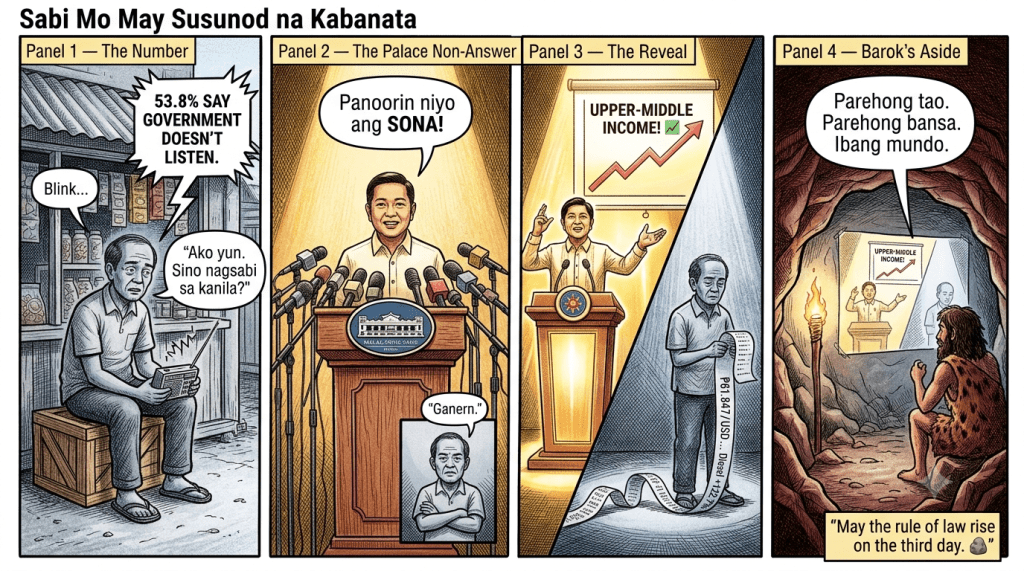
THE EON–Tangere Pre-SONA Survey 2026 landed like a slap across the face of the Marcos administration on the eve of its fifth State of the Nation Address. Fifty-four percent of Filipinos say their government doesn’t understand them. Fifty-five percent believe it has stopped listening. Nearly half distrust it entirely.
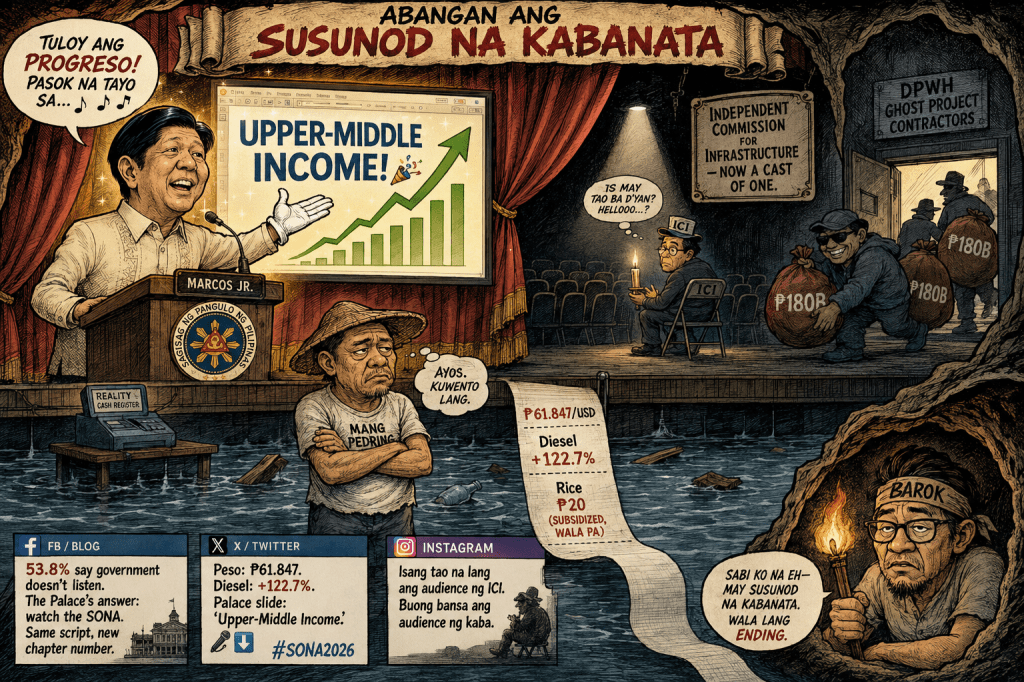
Malacañang’s reflexive response? “Listen to the SONA,” chirped the Presidential Communications Secretary, promising a showcase of accomplishments. The President himself offered only a coy “abangan ang susunod na kabanata”—wait for the next chapter.
This is the tragicomedy at the heart of the Philippine crisis: a public screaming in economic agony, and a Palace responding with a theatrical wink. The survey, whatever its methodological blemishes, is not an outlier. It is a diagnosis. And the patient is hemorrhaging.
The Triangulation of Rage
Let us first bury the lazy dismissal that this is just one flawed poll. The triangulation is devastating. The Social Weather Stations—the gold standard of face-to-face, area-probability sampling—found Marcos’s trust rating collapsing to a record-low 34 percent in June, a net score of -11, which SWS clinically classifies as “poor.” Meanwhile, Pulse Asia, using an entirely different open-ended methodology, found corruption topping the unprompted list of what Filipinos want addressed in the SONA. When three different pollsters using three different methods arrive at the same intersection of rage, you are not looking at noise. You are looking at a verdict.
And why shouldn’t Filipinos be enraged? The economic numbers don’t read like data—they read like a distress signal from a sinking ship. Diesel inflation has exploded by 122.7 percent following a Strait of Hormuz blockade. The peso has collapsed to a historic ₱61.847 to the dollar. GDP growth sputtered to 2.8 percent in the first quarter of 2026. For the bottom 30 percent of households, inflation runs at 8.4 percent. To lecture a mother queuing for subsidized P20 rice that the Philippines has ascended to “upper-middle income” status is not merely tone-deaf. It is an obscenity dressed in a statistician’s spreadsheet.
The Smell of Plunder
Then there is the smell of plunder, acrid and unmistakable. The ₱180 billion flood control scandal is no abstract allegation; it is a documented crime scene. Ghost projects. Substandard infrastructure. DPWH officials arrested. A Speaker forced to step down. The Independent Commission for Infrastructure, announced with great fanfare as a shield against corruption, has withered to a single commissioner—a bureaucratic Potemkin village guarding a vault that had already been emptied. When respondents in the Pulse Asia survey spontaneously name this scandal as their top concern, they are not parroting opposition talking points. They are responding rationally to evidence that their government is structurally engineered to steal from them.
The Survey’s Own Blind Spots
Before we crown EON-Tangere as the people’s tribune, a closer look at their methodology is instructive—and it deserves its share of mockery. The methodology is a glorious mess of modernity’s blind spots. The survey was fielded via a mobile app where respondents earn raffle tickets and prizes for participating—a gamified, reward-seeking panel that systematically overrepresents young, smartphone-addicted urbanites while erasing the rural poor, the elderly, and the digitally invisible. Is this the voice of the people, or the voice of people with enough data load and time to play survey-lotto? EON is a public-relations and stakeholder-relations firm, not a dispassionate academic institution. Its “non-commissioned” label may signal independence from a paying client, but it does not magically confer the methodological rigor of a SWS or Pulse Asia face-to-face instrument.
The timing reeks of distortion as well. Fielded July 7-10 at the absolute nadir of the oil crisis, the survey functions as a thermometer thrust into a patient mid-fever. It measures peak panic, not settled opinion. Pile on the structural pathologies: polarization that weaponizes every response into a proxy war between Marcos and Duterte loyalists, survey fatigue that turns despondency into a self-reinforcing national tic, and quota-based sampling that hits geographic targets while leaving self-selection bias to fester inside each stratum. The specific percentages in this release are not precision instruments; they are directional flares shot into a hurricane.
But here is the uncomfortable truth the Palace will not admit: these flaws make the administration’s position more damning, not less. The youth—the digital natives this mobile survey overrepresents—are supposed to be the future base of any durable political project. If they are this alienated, the administration is not losing a polling cycle. It is losing a generation.
The Hollow Response
And what is the response from the hollow men? A Presidential Communications Undersecretary tells critics to “file your own cases if you have solid evidence”—a staggering abdication of prosecutorial duty that outsources justice to the very citizens the state has failed. The President warns that the government “is not done yet” holding wrongdoers accountable, a threat as credible as a cardboard sword after allies have been shielded and the ICI has been reduced to a one-man theater troupe. The 2025 SONA gave us “Mahiya naman kayo”—have some shame. The 2026 version, pre-briefed as accomplishments-heavy, promises a sequel nobody asked for. Only 22 percent of respondents want to hear a report on achievements. Forty-eight percent want solutions. This is a public begging to hear something it can believe in, and Malacañang is responding with a PowerPoint presentation.
What should the President do instead? Lead the SONA with the flood control scandal. Name names. Announce concrete, time-bound prosecutorial milestones. Announce a freeze on new infrastructure disbursements until procurement reform passes. Demand Congress deliver the Freedom of Information Act and a genuine anti-political dynasty law—not the “weak” version that protects incumbents by limiting prohibitions to the second degree of consanguinity. In short, demonstrate through specific, verifiable acts that the government has stopped running a protection racket for its own.
The Sound of Hope Being Euthanized
The most ominous figure isn’t the 53.8 percent who say the government doesn’t understand them. It is the 40.8 percent who do not believe the government will fulfill the commitments expected at this SONA—before the speech was even delivered. That is the sound of hope being preemptively euthanized. And it is the single most dangerous number for a democracy that still claims to derive its legitimacy from the consent of the governed.
The Philippines stands at a crossroads as familiar as it is tragic: between statistical fictions and lived destitution, between dynastic continuity and democratic renewal. The EON–Tangere survey is a mirror held up to that moment, and the reflection is of men who have stopped listening, governing a people who have started to stop hoping. The question this SONA must answer is not what the President has accomplished. It is whether anyone inside that Palace still possesses the moral imagination to hear a nation’s scream and respond with something other than a prepared script.
Louis “Barok” C. Biraogo is the founder and lead analyst of the Kweba ni Barok blog, where he writes about Philippine governance, corruption, and the long struggle for democratic accountability.
Key Citations
A. Reports & Studies
- Philippine Statistics Authority. “GDP Grows by 2.8 Percent in the First Quarter of 2026.” psa.gov.ph, 7 May 2026, https://psa.gov.ph/content/gdp-grows-28-percent-first-quarter-2026.
- Philippine Statistics Authority. “Summary Inflation Report Consumer Price Index for the Bottom 30% Income Households.” psa.gov.ph, 5 June 2026, https://psa.gov.ph/price-indices/bottom-30/node/1684083588.
- Social Weather Stations. “Marcos’ Trust Rating at 34%, Sara Duterte at 57% in SWS June Poll.” Inquirer.net, 20 July 2026, https://newsinfo.inquirer.net/2266435/marcos-trust-rating-at-34-sara-duterte-at-57-in-sws-june-poll.
- World Bank. “Upper-middle Income: A Launchpad for the Philippines’ Future.” worldbank.org, 7 July 2026, https://www.worldbank.org/en/news/opinion/2026/07/07/upper-middle-income-a-launchpad-for-the-philippines-future.
B. News Articles
- Chi, Cristina. “Corruption Tops Filipinos’ SONA 2026 Wishlist — Pulse Asia.” Philstar.com, 24 July 2026, https://www.philstar.com/headlines/2026/07/24/2544364/corruption-tops-filipinos-sona-2026-wishlist-pulse-asia.
- Delgado, Harlene “Marcos on Corruption in SONA: ‘Abangan ang Susunod na Kabanata.’” ABS-CBN News, 24 July 2026, https://www.abs-cbn.com/news/nation/2026/7/24/marcos-on-corruption-in-sona-abangan-ang-susunod-na-kabanata-1317.
- “Palace to Public: Listen to SONA.” Philstar.com, 27 July 2026, https://www.philstar.com/headlines/2026/07/27/2545029/palace-public-listen-sona.
- Ta-Asan, Keisha. “Peso Hits Fresh Record-Low 61.847 to US Dollar.” Philstar.com, 25 July 2026, https://www.philstar.com/headlines/2026/07/25/2544553/peso-hits-fresh-record-low-61847-us-dollar.
- Reuters. “Philippine Annual Inflation at 7.2% in April, Highest in Three Years.” Interaksyon, 5 May 2026, https://interaksyon.philstar.com/business/2026/05/05/312911/philippine-annual-inflation-at-7-2-in-april-highest-in-three-years/.
- Laqui, Ian “Survey: Most Filipinos Feel Gov’t Is Out of Touch with Ordinary Citizens.” Philstar.com, 26 July 2026, https://www.philstar.com/headlines/2026/07/26/2544825/survey-most-filipinos-feel-govt-out-touch-ordinary-citizens.
- “What Billions Look Like: Visualizing the Staggering Scale of Flood Control Corruption.” Inquirer.net, 1 Oct. 2025, https://newsinfo.inquirer.net/2118008/what-billions-look-like-visualizing-the-staggering-scale-of-flood-control-corruption.
C. Official Websites
- Independent Commission for Infrastructure. Wikipedia, https://en.wikipedia.org/wiki/Independent_Commission_for_Infrastructure.
- ₱9 Billion in ‘Savings’? DILG’s Fire Truck Deal Smells Like Smoke
- ₱8B BBM Pork: CCTV for Every Captain’s Kumpare?
- ₱8.9 Billion, 331 Ghost Police Stations: The TIKAS Scandal Explained

- ₱8.4 Billion, 42,000 Barangays, 1 Election: The “Bawat Barangay Makikinabang” Vote-Buying Masterclass
- ₱75 Million Heist: Cops Gone Full Bandit

- ₱6.77B Ghost Haunts Duterte: RTC Dismisses Mans Carpio’s Desperate Plea
- ₱6.77 Billion and Zero Cash: The Sara Duterte SALN Math That Doesn’t Add Up
- ₱6.7-Trillion Temptation: The Great Pork Zombie Revival and the “Collegial” Vote-Buying Circus

- ₱58.53B, Zero Receipts: The LGSF Pork Barrel Nobody Wants to Name
- ₱53 Million Man Tells ₱695-a-Day Workers to Stop Being ‘Mayabang’: The Audacity of BSP’s Remolona
- ₱4.4 Billion and a Witness Who Can’t Explain It: The Duterte Impeachment’s Most Expensive Non-Answer
- ₱3.06 Billion for Evacuation Centers—But Nobody Knows Where They’ll Stand (Or If They’ll Exist)



Leave a Reply