
In the Senate Impeachment Court, Impartiality Is Optional and Contempt Is for Everyone Else
By Louis “Barok” C. Biraogo | July 28, 2026
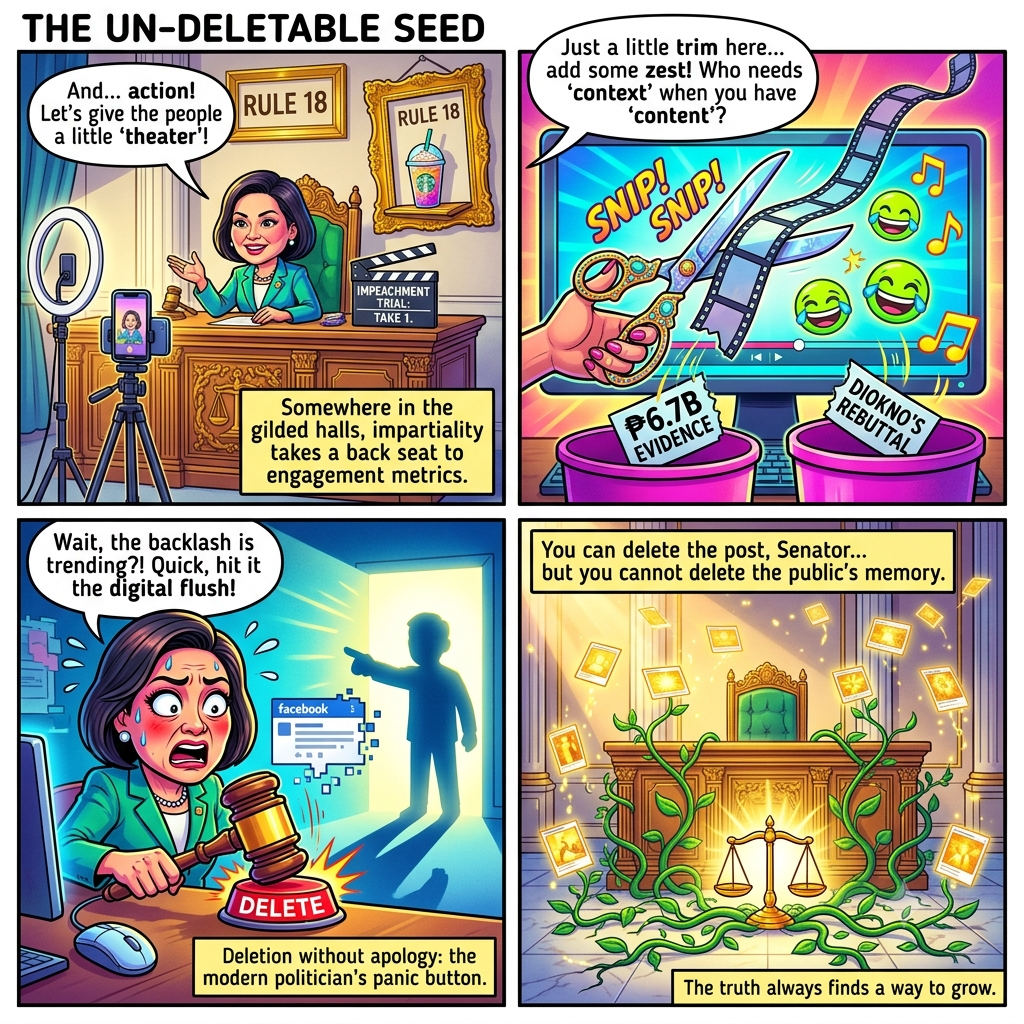
SOMEWHERE in the Senate’s gilded halls, Rule 18 of the Rules of Procedure on Impeachment Trials sits in a gilded frame, admired by tourists, cited by spokespersons, and enforced against absolutely no one. Senator Pia Cayetano’s now-deleted Facebook video—an edited one-minute clip of prosecutor Chel Diokno scored with upbeat music and a laugh track, captioned “Nagbabakasakali lang? Walang mga ebidensya pero nag-aakusa na!”—is merely the latest exhibit in a growing museum of unpunished sub judice violations. The museum’s curators are the senator-judges themselves, and admission is free to anyone with a verified social media account and a political axe to grind.
Let us state the obvious before the Senate Ethics Committee—another venerable institution that exists largely in theory—issues a strongly worded reminder: a sitting judge posting a mockery-laden video of a prosecutor arguing a motion the court has already granted is not “free expression.” It is performance art with a gavel, and the performance says everything about the tribunal’s true character.
The Video: A Masterclass in Calculated Impartiality-Erosion
The clip’s architecture deserves forensic appreciation. Senator Pia Cayetano did not post raw footage of Day 7’s proceedings. She curated her brother Alan Peter Cayetano’s cross-examination of Diokno on the “fishing expedition” question, surgically removed Diokno’s rebuttal about the Anti-Money Laundering Council records showing ₱6.7 billion in flagged transactions, and garnished the creation with a laugh-track sound effect. The caption—phrased as a rhetorical question but functioning as a declarative conclusion—told her followers the prosecution had accused the Vice President “without evidence.”
This was not a senator engaging constituents on a complex legal matter. This was a senator-judge trolling one party to a pending case using her official platform, then silently deleting the evidence when the backlash arrived. The deletion, notably, came without explanation or apology—the digital equivalent of flushing the smoking gun down the toilet and whistling past the ethics committee.
Rep. Zia Alonto Adiong, the prosecution spokesperson, correctly identified the caption as the more troubling element. “It is not only actual impartiality that matters,” he said. “The public must also see that no judgment has been formed. This is the appearance-of-impartiality standard from Canons 3 and 4 of the New Code of Judicial Conduct, translated into Tagalog common sense. The Senate impeachment court is not formally bound by the New Code of Judicial Conduct—a technicality senator-judges will surely clutch like a life raft—but the appearance-of-impropriety standard it articulates is not some esoteric judicial mysticism. It is the minimum requirement for any tribunal that expects its verdict to be received as law rather than as raw power.
Duterte v. House of Representatives and the Specter of Due Process
The Supreme Court’s 2025 ruling in Duterte v. House of Representatives held that impeachment is “not a purely political proceeding” and that due process protections—including the right to an impartial tribunal—apply with constitutional force. The Court did not carve out an exception for senator-judges who feel a creative impulse to edit comedy reels. It did not suggest that “political neutrality during the course of the impeachment trial,” a phrase the Court used approvingly in Generillo v. Senate earlier this year, could be satisfied by deleting the offending post after the damage to public perception was already done.
The Cayetano video implicates due process in two directions. First, Vice President Duterte, as respondent, is entitled to a tribunal that has not prejudged the evidentiary questions at the heart of Article II. A senator-judge’s public declaration—and a caption is a declaration—that the prosecution lacks evidence on the very subpoena request the court has already granted is, at minimum, a due process adjacent concern. Second, and more fundamentally, the sovereign Filipino people are entitled to an impeachment verdict that carries democratic legitimacy. A conviction or acquittal rendered by a body whose members openly mock the advocates before them is a verdict that settles nothing.
The Core Dilemma: Rule 18 Without Teeth
This brings us to the structural rot. Rule 18 of the Rules of Procedure on Impeachment Trials bars public discussion of the merits. Senate Impeachment Court spokesperson Atty. Reginald Tongol has cited it repeatedly, most recently after Senator Robin Padilla’s own Facebook post defending his questioning of witnesses. But Tongol has also been candid: Rule 18 is enforced only when a party files a motion, and the full impeachment court—not the presiding officer—decides. The body empowered to sanction a senator-judge is composed of that senator-judge’s peers, several of whom have identical exposure.
The result is predictable and, by now, confirmed by pattern. Padilla’s post: no motion. Duterte’s own public denial of the charges on July 15: no motion. Cayetano’s video: no motion filed as of this writing, and none likely. Rule 18 is not a rule; it is a press-release aspiration, a decorative cushion on the impeachment court’s furniture, present for aesthetics but supporting no weight.
The legal architecture for enforcement already exists. Rule 71 of the Rules of Court defines indirect contempt to include conduct tending to impede, obstruct, or degrade the administration of justice. The Supreme Court’s clear-and-present-danger doctrine, articulated in Chavez v. Gonzales, distinguishes protected commentary from actionable prejudice. Republic v. Sereno extended sub judice enforcement administratively against lawyers through the Code of Professional Responsibility. The 2023 Code of Professional Responsibility and Accountability (CPRA) now explicitly regulates lawyer conduct on social media under Canon II—a provision Cayetano, as a Bar member, cannot plead ignorance of. Republic Act No. 6713 (Code of Conduct and Ethical Standards for Public Officials and Employees) obliges all public officials to discourage “wrong perceptions” of their office.
The deficit is not doctrine. It is will.
The Political Calculus, Stripped Naked
No one seriously believes Cayetano’s post was a spontaneous outburst of procedural concern. The sibling alignment between Pia and Alan Peter Cayetano—who has challenged Presiding Officer Chiz Escudero’s authority, pressed Diokno aggressively on the fishing-expedition frame, and positioned himself as the defense-sympathetic procedural hawk—is too consistent to be coincidence. The video amplifies her brother’s cross-examination, signals solidarity, and builds a public record of prosecutorial skepticism that serves the defense’s narrative without requiring the defense to risk its own sub judice exposure.
The prosecution panel, for its part, is playing a media strategy it can win. Adiong’s statement preserves the issue for public consumption without forcing a floor motion the panel would likely lose, given the court’s composition and its demonstrated allergy to policing its own. Escudero remains silent—a strategic choice that avoids setting a precedent in either direction and keeps the coalition intact. Everyone is calculating, and the calculation is transparently political.
The Verdict on the Process
The most probable resolution is no resolution at all. The news cycle will move on, the deleted video will become a screenshot memory, and the impeachment court will continue hearing evidence as though the question of its own integrity had never been raised. This is the institutional equivalent of constitutional gaslighting.
Yet the cost accumulates. Each unenforced Rule 18 violation—Padilla, Duterte, Cayetano—compounds a public perception that the impeachment court’s rules are for press briefings, not for senators. When the eventual verdict arrives, whether conviction or acquittal, it will land on a public square already saturated with the belief that the outcome was determined by political arithmetic, not by evidence. An impeachment court that cannot enforce its own rules against its own members is not a court. It is a legislature in robes, and the robes are rented.
The remedy is not complicated. A formal motion from the prosecution would force the issue. A general reminder from Escudero would set a baseline. A social-media-specific amendment to the impeachment rules would close the ambiguity. What is missing is not a path forward—it is a senator-judge willing to walk it.
The impeachment of Sara Duterte will determine not only her political future but the credibility of the institution that judges her. An institution that tolerates its members mocking the advocates before them with laugh tracks is an institution that has already forgotten why it was convened. The 1987 Constitution demands an impartial tribunal. The Filipino people deserve nothing less. And Rule 18, that gilded ornament, deserves either enforcement or an honest funeral. Let the court choose before the laughter becomes the only verdict anyone remembers. 🪨
Key Citations
A. Legal & Official Sources
- The 1987 Constitution of the Republic of the Philippines. Official Gazette of the Republic of the Philippines, 1987, http://www.officialgazette.gov.ph/constitutions/1987-constitution/.
- Rules of Procedure on Impeachment Trials. Senate of the Philippines, Resolution No. 39, 2011, lawphil.net/congress/senate/r_39_2011.html.
- Supreme Court of the Philippines. “Code of Judicial Conduct.” Ecodal Plus, 27 Apr. 2004, https://www.ecodalplus.com/ecodals/legal-and-judicial-ethics/Code-of-Judicial-Conduct.
- Duterte v. House of Representatives. G.R. No. 278353, Supreme Court of the Philippines, 25 July 2025, lawphil.net/judjuris/juri2025/jul2025/gr_278353_2025.html.
- Catalino Aldea Generillo, Jr. v. Senate of the Philippines. G.R. No. 278311, Supreme Court of the Philippines, 29 Apr. 2026. Supreme Court of the Philippines, sc.judiciary.gov.ph/278311-catalino-aldea-generillo-jr-vs-senate-of-the-philippines-represented-by-hon-francis-g-escudero-in-his-capacity-as-senate-president/.
- Rules of Court, Rule 71. Supreme Court of the Philippines, lawphil.net/courts/rules/rc_1-71_civil.html.
- Chavez v. Gonzales. G.R. No. 168338, Supreme Court of the Philippines, 15 Feb. 2008, lawphil.net/judjuris/juri2008/feb2008/gr_168338_2008.html.
- Republic v. Sereno. G.R. No. 237428, Supreme Court of the Philippines, 19 June 2018, lawphil.net/judjuris/juri2018/jun2018/gr_237428_2018.html.
- Code of Professional Responsibility and Accountability. A.M. No. 22-09-01-SC, Supreme Court of the Philippines, 11 Apr. 2023, sc.judiciary.gov.ph/wp-content/uploads/2023/05/22-09-01-SC-FINAL.pdf.
- Republic Act No. 6713. An Act Establishing a Code of Conduct and Ethical Standards for Public Officials and Employees. 1989, lawphil.net/statutes/repacts/ra1989/ra_6713_1989.html.
B. News Reports
- Basilio, Kenneth Christiane. “Pia Cayetano’s Video Post Prompts Concern Over Impartiality.” Philippine Daily Inquirer, 27 July 2026, https://newsinfo.inquirer.net/2270933/pia-cayetanos-video-post-prompts-concern-over-impartiality.
- “Ang Hirap Maging Mahirap”: The PAO Scandal That Proves Government Contempt Is Nothing New

- “Far-Off” My Axx: Malacañang’s Claire Castro Drowns in Her Own Legal Gaslighting
- “Forthwith” to Farce: How the Senate is Killing Impeachment—And Why Enrile’s Right (Even If You Can’t Trust Him)

- “HINDI AKO NAG-RESIGN!”

- “I Know Nothing”: Baste Duterte’s Amnesia Defense Meets ₱33M in GenCorp Contracts

- “I’m calling you from my new Globe SIM. Send load!”

- “Mahiya Naman Kayo!” Marcos’ Anti-Corruption Vow Faces a Flood of Doubt

- “Manageable” Debt, Unmanageable Lies: DBM’s ₱21 Trillion Fairy Tale

- “Meow, I’m calling you from my new Globe SIM!”

- “Natrabaho”: One Word, One Ombudsman, and a Judiciary on Trial

- “No Special Jail for Crooks!” Boying Remulla Slams VIP Perks for Flood Scammers

- “Philippine-Controlled” or Yankee Gas Station? The Davao Fuel Depot Farce Exposed








Leave a Reply