By Louis ‘Barok‘ C. Biraogo — September 4, 2026.
WELCOME back to the Kweba, my fellow troglodytes of truth, where we crack open the coconuts of state propaganda to suck out the sweet, sweet nectar of legal reality—or, in this case, the bitter bile of bureaucratic deflection.
Our subject today is the Honorable Undersecretary Claire Castro, the Palace’s legal pitbull, who has apparently traded her litigation skills for the dark art of political gaslighting.
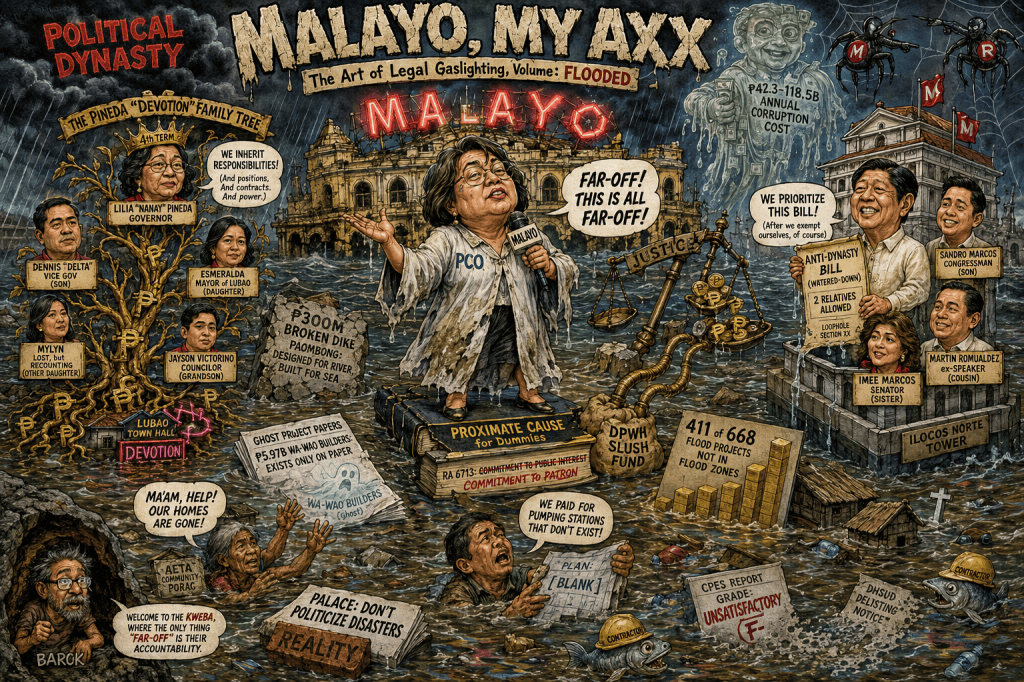
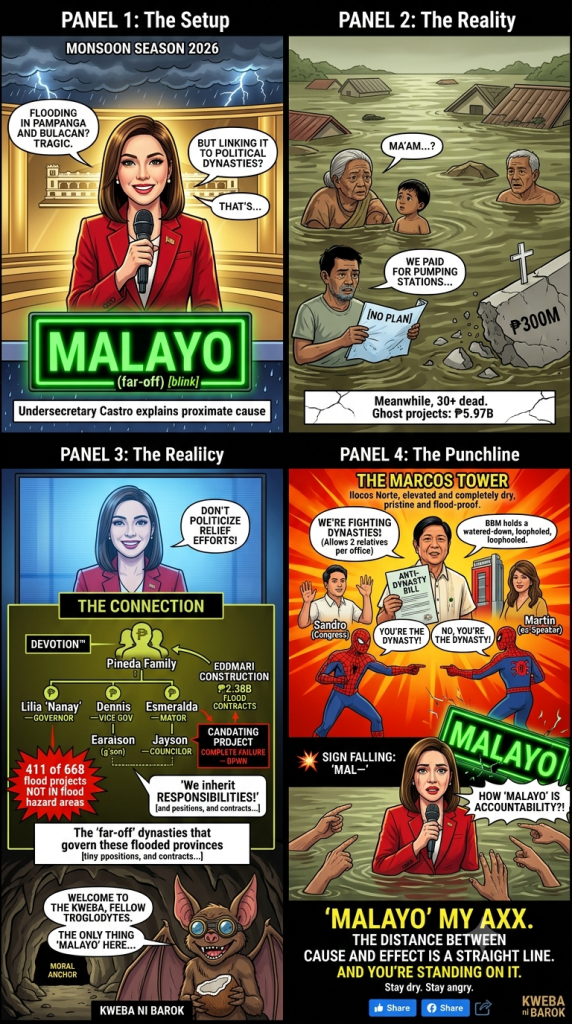
Faced with the biblical flooding of Pampanga and Bulacan—where Aetas are dying and “ghost projects” are drowning entire towns—she looked into the camera and declared the link between this catastrophic governance failure and the entrenched political dynasties of those provinces is “malayo” (far-off).
Far-off? Susmaryosep. The only thing that is far-off here is the administration’s accountability.
If this is the Palace’s idea of “legal precision,” I suggest they send Undersecretary Castro back to the bar review center, because her understanding of “proximate cause” is as structurally unsound as the ₱300-million dike in Paombong that was designed for a river but built in the sea.
Let us dissect this rotting cadaver of an argument, shall we? We will analyze it, investigate it, mock it, and ultimately expose it for what it is: a desperate attempt to protect the political patrons that keep the Marcos administration afloat (pun absolutely intended).
I. The “Separation of Issues” Fallacy: A Deconstruction
Castro’s primary defense is the classic lawyer’s trick of artificial distinction. “Disaster response is immediate,” she implies. “Legislation is long-term.” She suggests that linking the floods to dynasties “politicizes relief” and detracts from “rescue operations.”
This is the logic of a wet match in a dark cave. It fails to ignite reality.
Since when did analyzing the cause of a disaster ever hinder the treatment of its symptoms? If a building collapses due to a corrupt contractor using substandard cement, do we tell the search-and-rescue teams, “Stop digging for survivors, let’s not politicize the engineering?” No. We pull out the bodies, and then we hang the engineer.
Moreover, the material evidence—which we at the Kweba do not ignore, unlike the Presidential Communications Office (PCO)—shows that the corruption is not abstract.
The East Asia Forum investigation cited in our research materials estimates ₱42.3 to ₱118.5 billion lost annually to flood control corruption.
The “ghost projects” in Bulacan, specifically the ₱5.97 billion awarded to Wawao Builders for projects that exist only on paper, are not “far-off” from the flooding. They are the flooding.
When 411 of 668 flood control projects in Bulacan are not even in flood hazard areas (per the Pro-People Engineers and Leaders (Propel) analysis), this is not incompetence. This is systematic theft orchestrated through political patronage.
To call this connection “far-off” is not just legally blind; it is an insult to the intelligence of every Filipino waist-deep in water.
II. The Pineda Paradox: “Devotion” or Monopoly?
Let us talk about the elephant in the flooded room: the Pineda family of Pampanga. We are told not to judge them. Why? Because Governor Lilia “Nanay” Pineda says they practice “devotion,” not “dynasty.”
How poetic. How profoundly, offensively ridiculous.
The Supreme Court in Lonzanida v. Commission on Elections (COMELEC) was not discussing poetry; it was discussing the concentration of power.
The Constitution’s Article II, Section 26—which Congress has violated for four decades by failing to pass an enabling law—exists precisely to prevent the situation we see in Pampanga.
We don’t have a “textbook” dynasty; we have a multi-volume encyclopedia set of dynastic power:
- Lilia Pineda: Governor
- Dennis “Delta” Pineda: Vice Governor (Son)
- Esmeralda Pineda: Mayor of Lubao (Daughter)
- Jayson Victorino: Councilor of Lubao (Grandson)
This is not “public service.” This is a family business. And the business is power. The resources of the province are the inventory.
When Undersecretary Castro says we shouldn’t connect the leadership to the flood response, she is asking us to pretend that the CEO of a corporation has no responsibility for the company’s dangerous, crumbling infrastructure just because they didn’t personally pour the concrete. It is a de facto immunity grant for the oligarchy.
III. The Conflict of Interest: The Dynasty Defending the Dynasty
Let us not be naive. Why would the Marcos administration instruct its spokesperson to run defense for local political dynasties accused of corruption?
The answer is staring us in the face from the halls of power.
Claire Castro is not a neutral arbiter of law; she is the mouthpiece of the most powerful political dynasty in the Philippines. She works for President Ferdinand Marcos Jr., whose son Sandro holds his seat in Ilocos Norte, whose sister Imee sits in the Senate, and whose cousin, Martin Romualdez, was until recently the most powerful man in the House of Representatives.
This is the “Spider-Man Pointing Meme” of governance.
The President is pushing an “Anti-Political Dynasty Bill” (HB 6771/HB 8389) that our research shows is hopelessly watered down, allowing “two relatives” to hold office.
It is a pantomime of reform—a piece of legislation designed to preempt the Supreme Court’s pending decision on the 1Sambayan petition (G.R. No. 279201) by giving the illusion of compliance with the Constitution, while surgically ensuring the Marcos-Romualdez power structure remains intact.
Castro’s dismissal of the flood-dynasty link is, therefore, a red flag. It signals that the Palace is terrified that the floodwaters will wash away the facade of their “reformist” agenda.
If the public connects the dots between dynastic power and deadly infrastructure, the demand for a genuine anti-dynasty law will become unstoppable, threatening the very family that signs her paycheck.
IV. The “Evidence” vs. The “Excuses”
Castro wants us to rely on “formal investigation findings” rather than “social media speculation.” A fair point, if the institutions doing the investigating weren’t also compromised.
But let us take her advice. Let us look at the “formal” evidence cited in our research:
- The Candating Fiasco: In Arayat, Pampanga, hundreds of millions were spent on successive flood control projects that collapsed, with reporting identifying familial connections between the contractor and a Pampanga legislator.
- The Pandi Ghost Town: A ₱92.8-million flood control project in Pandi, Bulacan, had “essentially no visible accomplishment” during a Sandiganbayan inspection.
- The DPWH Admissions: Former Department of Public Works and Highways (DPWH) Secretary Manuel Bonoan confirmed some projects “appeared to be non-existent.”
This is not random. It is a pattern. It is the political economy of disaster capitalism.
Dynasties don’t just govern these provinces; they extract from them. They maintain power by feeding contracts to allied businessmen, who in turn fund their political machines. The “flood control” budget is not a public safety fund; it is a slush fund.
When Undersecretary Castro says the failure of these “national” projects is a DPWH issue and not a local issue, she is playing a shell game.
Who lobbies the DPWH for these projects? Who influences the selection of contractors? Who maintains the local drainage that flows into these broken national dikes?
The Local Government Code (Republic Act (RA) 7160) gives governors the power of “general supervision” over programs. To claim the local dynasties are innocent bystanders in their own flooded territories is legally farcical.
V. The Ethical Bankruptcy of the Palace
Finally, let us judge Undersecretary Castro by the very law she should be upholding: RA 6713, the Code of Conduct and Ethical Standards for Public Officials.
Section 4 requires officials to act with “Commitment to public interest,” “Professionalism,” and “Responsiveness.” It states that public office is a public trust.
If you are a public official standing in front of the nation while communities are drowning because the government—both national and local—failed to build the infrastructure that was paid for, the “public interest” does not demand legalistic hair-splitting about “proximate cause.” It demands accountability.
Is it “just and sincere” to tell the Aeta communities of Pampanga, who watched their homes wash away, that the reason this happened is “far-off” from the people who have governed them for decades? Is that “responsiveness”? Or is it callousness wrapped in the veneer of legal caution?
VI. Conclusion: The “Far-Off” is Actually “Here and Now”
Claire Castro is right about one thing: We cannot convict a governor of a specific criminal charge just because it rained. Due process requires evidence.
But she is dead wrong to suggest that the systemic rot of political dynasties is irrelevant to the systemic failure of governance.
The connection between dynastic politics and the “ghost projects” is not far-off. It is the proximate cause of this disaster.
The real reason the Palace is slamming the door on this conversation is fear. They are afraid that if the public examines the structural rot of Pampanga and Bulacan, they will turn their gaze to Ilocos Norte.
They are afraid that the 2028 elections will be a referendum on family politics. They are afraid that the Supreme Court will finally enforce a Constitution they have spent 40 years ignoring.
Until the Philippine political system amputates the cancer of dynastic politics, the floods will keep coming. Not just the floods of water, but the floods of corruption, incompetence, and lies.
And for that, Undersecretary Castro, the distance between cause and effect is not “far-off.” It is a straight line. And you are standing right on top of it.
This has been an unsolicited, unpaid, and unapologetic critique from the Kweba ni Barok. Stay dry, and stay angry.
Key Citations
A. Reports & Studies
- Calimbahin, Cleo Anne. “Accountability Washed Away in Philippine Flood Control Corruption.” East Asia Forum, 2 Dec. 2025, eastasiaforum.org/2025/12/02/accountability-washed-away-in-philippine-flood-control-corruption/.
- Ramos, Mariejo. “How Flood Control Projects Fail the Poor in the Philippines.” Context, Thomson Reuters Foundation, 30 Sept. 2025, context.news/climate-risks/how-flood-control-projects-fail-the-poor-in-the-philippines.
B. News Articles
- Limos, Allen. “Palace Rejects Linking Flood Response to Political Dynasties.” The Manila Times, 2 Sept. 2026, http://www.manilatimes.net/2026/09/02/news/palace-rejects-linking-flood-response-to-political-dynasties/2416556.
- Bacelonia, Wilnard. “‘Ghost Projects’ in Bulacan Tied to DPWH Contractors.” Philippine News Agency, 19 Aug. 2025, http://www.pna.gov.ph/articles/1256889.
- “Not Dynasty but Devotion, Says Pampanga Governor Pineda.” Inquirer.net, 12 June 2025, http://www.inquirer.net/446754/not-dynasty-but-devotion-says-pineda-as-she-takes-oath-as-pampanga-gov/.
- “House Makes History, OKs Anti-Political Dynasty Bill on 3rd Reading.” Manila Bulletin, 3 June 2026, mb.com.ph/2026/06/03/house-makes-history-oks-anti-political-dynasty-bill-on-3rd-reading.
- “Petition Asks Supreme Court to Push Congress to Pass Anti-Dynasty Bill.” Rappler, 1 Apr. 2025, http://www.rappler.com/philippines/petitioners-ask-supreme-court-push-congress-pass-anti-dynasty-law/.
- “Relative of Pampanga Congresswoman Bondoc, Mayor Husband Bags P2.38-B Flood Control Deals.” Rappler, 3 Oct. 2025, http://www.rappler.com/newsbreak/in-depth/ana-york-bondoc-jayson-sagum-relative-eddmari-construction-flood-control-contractor-pampanga/.
- Baltasar, Cecile. “P92.8-Million Flood Control Project in Bong Revilla Case Non-Existent.” PhilSTAR Life, 16 Apr. 2026, philstarlife.com/news-and-views/182284-flood-control-project-bong-revilla-case-non-existent.
- “Dizon Flags ‘Faulty Design’ in Paombong, Bulacan Flood Project.” GMA News Online, 22 Aug. 2026, http://www.gmanetwork.com/news/topstories/regions/999481/dizon-flags-faulty-design-in-paombong-bulacan-flood-project/story/.
- “Weeks of Luzon Flooding, Landslides Kill over 30 in the Philippines.” The Straits Times, 30 Aug. 2026, http://www.straitstimes.com/asia/se-asia/weeks-of-luzon-flooding-landslides-kill-over-30-in-the-philippines.
C. Legal and Official Sources
- The 1987 Constitution of the Republic of the Philippines, art. II, sec. 26. Official Gazette.
- Lonzanida v. Commission on Elections. Supreme Court of the Philippines, E-Library.
- Republic Act No. 7160. “Local Government Code of 1991.” Official Gazette, 10 Oct. 1991.
- Republic Act No. 6713. “Code of Conduct and Ethical Standards for Public Officials and Employees.” Official Gazette, 20 Feb. 1989.

- “Ang Hirap Maging Mahirap”: The PAO Scandal That Proves Government Contempt Is Nothing New
- “Far-Off” My Axx: Malacañang’s Claire Castro Drowns in Her Own Legal Gaslighting
- “Forthwith” to Farce: How the Senate is Killing Impeachment—And Why Enrile’s Right (Even If You Can’t Trust Him)
- “HINDI AKO NAG-RESIGN!”

- “I Know Nothing”: Baste Duterte’s Amnesia Defense Meets ₱33M in GenCorp Contracts

- “I’m calling you from my new Globe SIM. Send load!”

- “Mahiya Naman Kayo!” Marcos’ Anti-Corruption Vow Faces a Flood of Doubt

- “Manageable” Debt, Unmanageable Lies: DBM’s ₱21 Trillion Fairy Tale
- “Meow, I’m calling you from my new Globe SIM!”

- “Natrabaho”: One Word, One Ombudsman, and a Judiciary on Trial
- “No Special Jail for Crooks!” Boying Remulla Slams VIP Perks for Flood Scammers
- “Philippine-Controlled” or Yankee Gas Station? The Davao Fuel Depot Farce Exposed







Leave a Reply