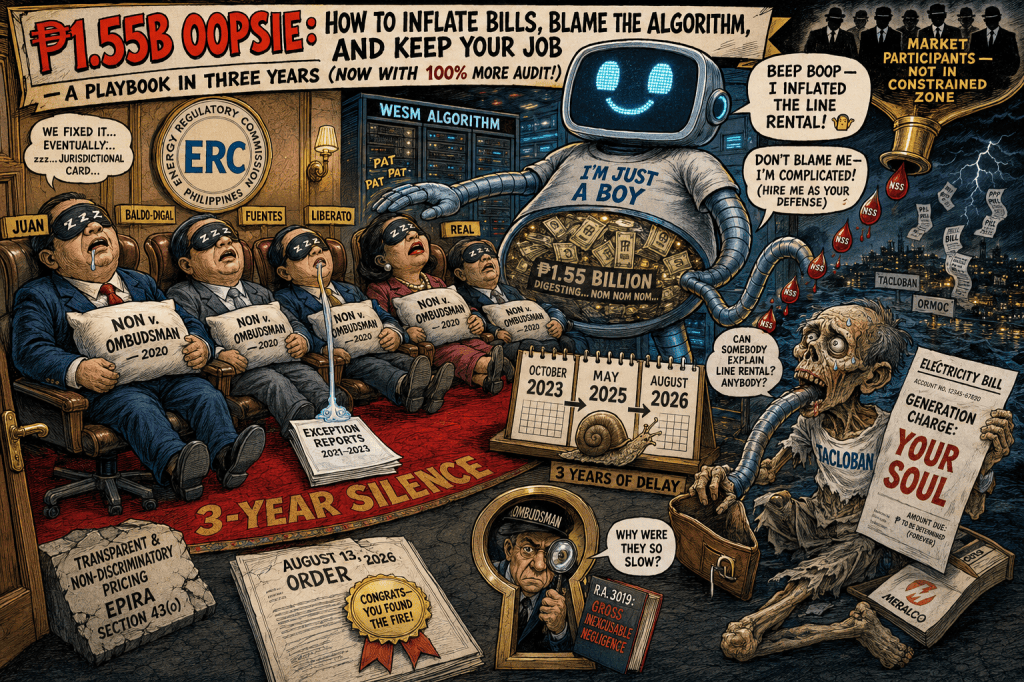
The 3-Year Silence That Cost Visayas Consumers Billions—And the Commissioners Who Still Sleep Soundly
By Louis ‘Barok‘ C. Biraogo — September 4, 2026
FOR years, the standard playbook for attacking the Energy Regulatory Commission (ERC) has been embarrassingly simple: scream “corruption,” wave a bill, and hope the public’s eyes glaze over with enough rage to ignore the fact that nobody can actually explain what “Line Rental” is.
The ERC’s technocrats would then retreat to their algorithmic fortress, mutter about nodal pricing and high-voltage direct current (HVDC) constraints, and everyone would go home frustrated. It was a stalemate built on public confusion.
But the complaint filed by the National Association of Electricity Consumers for Reforms, Inc. (NASECORE), and more importantly, the Office of the Ombudsman‘s decision to entertain it with the gravity it deserves, has the potential to break that cycle.
For the first time, we are seeing a path where a regulator is held accountable not for imagined villainy, but for the one thing regulators fear most: institutional negligence.
And here is the most intriguing twist—the best weapon against the ERC is the ERC itself.
The Confession That Isn’t a Defense
Let’s be clear about what we are not alleging today. We have found no offshore accounts. There is no smoking gun memo from Chair Francis Saturnino Juan ordering his commissioners to juice the books for the benefit of a shadowy generator.
If that evidence exists, it is buried deeper than the Ombudsman’s current fact-finding has managed to reach.
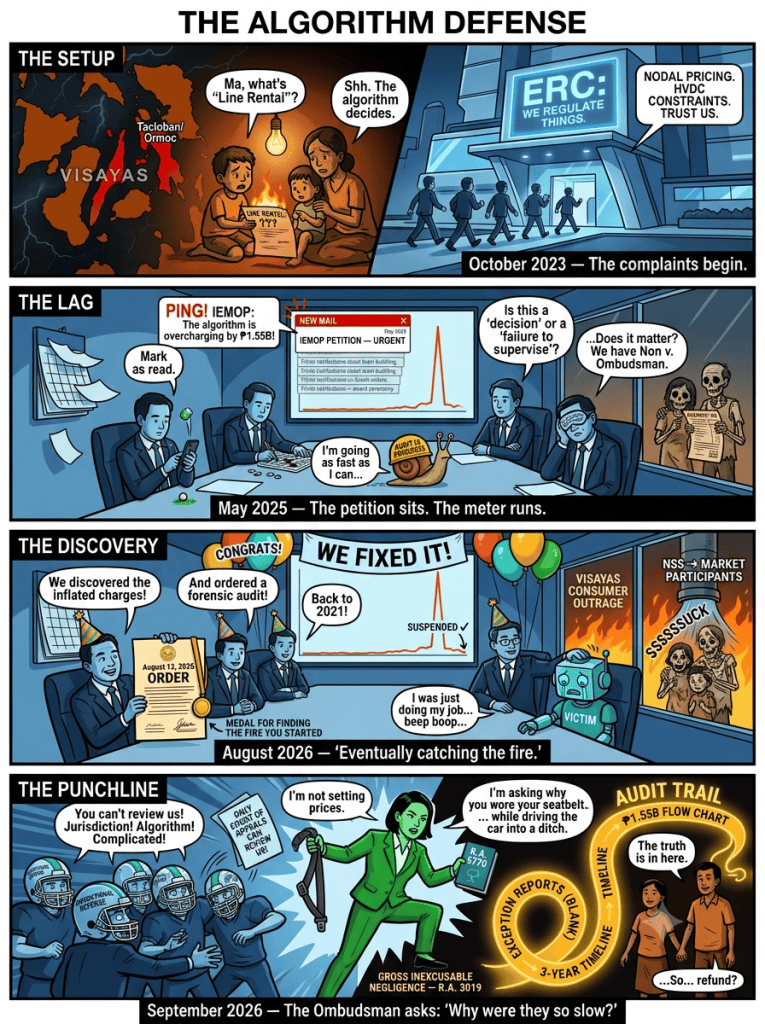
What we do have is an August 13, 2026 order from the ERC that is, frankly, a regulatory suicide note dressed up as a victory lap.
In that order, the ERC essentially admits that for years, the market’s dispatch optimization model was producing “inflated” line rental charges whenever the Luzon-Visayas and Visayas-Mindanao HVDC links hit their limits.
The system wasn’t just wrong; it was allocating the resulting Net Settlement Surplus (NSS) to market participants who had nothing to do with the congestion.
While consumers in Tacloban and Ormoc were bleeding out through the Generation Charge, the financial spoils of that suffering were being routed to entities sitting comfortably outside the constrained zones.
The ERC’s defense is that they fixed it. They suspended the charges, ordered an audit back to 2021, and promised refunds.
But this is a defense only if you believe that “eventually catching the fire” absolves you of having supplied the kindling and ignored the smoke.
The ERC is asking for a medal for discovering a disaster that they, as the sole regulator tasked with ensuring “transparent and non-discriminatory” pricing under Electric Power Industry Reform Act (EPIRA) Section 43(o), had a statutory duty to prevent.
The Ombudsman must recognize this for what it is: an admission of a prolonged oversight failure.
The Ghost of Non v. Ombudsman
The legal ghost haunting this entire affair is the Supreme Court’s 2020 decision in Non v. Ombudsman.
In that case, the High Court protected ERC commissioners from a graft complaint, ruling that a regulatory decision that is “wrong” or even void for grave abuse of discretion does not automatically equate to criminal liability under R.A. 3019 §3(e). The Court drew a hard line between bad judgment and criminal intent.
That precedent is a formidable shield for Chair Juan and Commissioners Baldo-Digal, Fuentes, Liberato, and Real. NASECORE cannot win this fight by simply arguing the Wholesale Electricity Spot Market (WESM) formula was flawed. They will lose that battle against the Non precedent every single time.
However, Non contains a critical warning for the respondents. The Court was protecting regulators who make decisions. It did not grant immunity to regulators who fail to supervise.
This is where the timeline becomes damning. The ERC admits the issue surfaced via complaints as early as October 2023. The Independent Electricity Market Operator of the Philippines (IEMOP) filed a petition in May 2025. Yet the ERC only acted to suspend charges and order a forensic audit in August 2026.
We are not looking at a “bad decision” here. We are looking at a nearly three-year lag in addressing a problem that was actively draining ₱1.55 billion from the poorest region in the country in just seven months.
That is not an error of technical judgment; it is a failure of responsiveness. The Ombudsman’s most potent angle here is Gross Inexcusable Negligence. It is the “conscious indifference to consequences” standard under R.A. 3019.
If the Ombudsman can prove that the Commissioners had the data—or negligently failed to demand it—to see the anomaly and simply sat on their hands, the Non shield cracks.
Follow the Money, Not Just the Men
The Ombudsman is reportedly prioritizing this case because it involves high-ranking officials and a massive sum. This is a compliment to the institution’s renewed vigor under the current leadership.
But it is here that I must offer my critical counsel: Do not be seduced by the simplicity of the headline figure.
The ₱1.55 billion is the billed amount. It is not the overcharge. The Ombudsman’s investigators must resist the urge to turn this into a press release war and instead dig into the “exception reports.”
If the ERC had any semblance of a monitoring system, there should be reports flagging when line rental charges exceeded statistical thresholds. Those reports are the key.
If those reports existed and were ignored by the Commission, that is negligence.
If those reports did not exist because the ERC lacked the institutional competence to generate them, that is a different, more systemic, but equally culpable form of regulatory failure.
The distinction between these two scenarios is where the truth lies. A sophisticated regulator cannot hide behind “the algorithm was complicated.” That excuse invites moral hazard.
If you cannot understand the algorithm, you have no business regulating it. If you can understand it and did not, you have no business staying in office.
A Strategic Warning to the Ombudsman
Finally, a word of caution to the institution that I suspect many are afraid to voice.
The ERC has already begun to play the “jurisdictional” card, arguing that only the Court of Appeals and Supreme Court can review their actions. This is a desperate, albeit legally clever, deflection. They want this out of the Ombudsman and into a forum where procedural delays can bleed the consumer outrage dry.
The Ombudsman must not surrender this ground. You are not being asked to set the price of electricity. You are being asked to determine if the men and women charged with protecting the public wore their seatbelts while driving the car into the ditch. That is the core of R.A. 6770.
This case should not be about finding a villain to throw in a cell. It should be about establishing a simple, terrifying principle: If you collect a salary to regulate the most complex market in the nation, you will be held personally accountable for understanding it.
If the current Commission is not up to that task, then the public deserves to know.
The ERC’s August 13 order proved the problem was real. Now, the Ombudsman must prove that responsibility is real, too. Stop asking if they are criminals. Start asking why they were so slow. The truth, as always, is in the audit trail.
Key Citations
A. Reports & Studies
- Energy Regulatory Commission. Notice, ERC Case No. 2025-009 RM, In the Matter of the Petition for the Approval of Proposed Amendments to the Rules for the Distribution of Net Settlement Surplus (NSS), Independent Electricity Market Operator of the Philippines Inc. (IEMOP) Petitioner. 14 May 2026, www.erc.gov.ph/Notices-Singular/84938.
- Independent Electricity Market Operator of the Philippines. Documents and Reports: Monthly Net Settlement Surplus Reports. www.iemop.ph/the-market/market-reports/.
B. News Articles
- Kritz, Ben. “ERC Addresses the Line Rental Bugaboo.” The Manila Times, 16 Aug. 2026, www.manilatimes.net/2026/08/16/opinion/columns/erc-addresses-the-line-rental-bugaboo/2406252.
- Kritz, Ben. “Demystifying Another ‘Hidden’ Charge in Electric Bills.” The Manila Times, 9 Aug. 2026, www.manilatimes.net/2026/08/09/opinion/columns/demystifying-another-hidden-charge-in-electric-bills/2401451.
- “ERC Move to Cut Visayas Power Rates.” The Freeman / The Philippine Star, 17 Aug. 2026, www.philstar.com/the-freeman/cebu-news/2026/08/17/2549860/erc-move-cut-visayas-power-rates.
- “NASECORE Files Complaint with Omb vs ERC Officials over Line Rental Charges.” ABS-CBN News, 1 Sept. 2026, www.abs-cbn.com/news/business/2026/9/1/nasecore-files-complaint-with-omb-vs-erc-officials-over-line-rental-charges-1610.
- Philippine Information Agency. “Malacañang Names New ERC Chair, Commissioners.” 17 July 2025, pia.gov.ph/news/malacanang-names-new-erc-chair-commissioners/.
C. Legal and Official Sources
- Republic Act No. 9136. Official Gazette of the Republic of the Philippines, 8 June 2001, www.officialgazette.gov.ph/2001/06/08/republic-act-no-9136/.
- Republic Act No. 3019: Anti-Graft and Corrupt Practices Act. Official Gazette of the Republic of the Philippines, 17 Aug. 1960, www.officialgazette.gov.ph/1960/08/17/republic-act-no-3019/.
- Republic Act No. 6770: The Ombudsman Act of 1989. The Lawphil Project, lawphil.net/statutes/repacts/ra1989/ra_6770_1989.html.
- Non v. Office of the Ombudsman, G.R. No. 239168, 15 Sept. 2020. The Lawphil Project, lawphil.net/judjuris/juri2020/sep2020/gr_239168_2020.html.
- Energy Regulatory Commission. Official website. www.erc.gov.ph.
- Office of the Ombudsman. Official website. www.ombudsman.gov.ph.
- Independent Electricity Market Operator of the Philippines. Official website. www.iemop.ph.
- “Ang Hirap Maging Mahirap”: The PAO Scandal That Proves Government Contempt Is Nothing New
- “Far-Off” My Axx: Malacañang’s Claire Castro Drowns in Her Own Legal Gaslighting

- “Forthwith” to Farce: How the Senate is Killing Impeachment—And Why Enrile’s Right (Even If You Can’t Trust Him)
- “HINDI AKO NAG-RESIGN!”

- “I Know Nothing”: Baste Duterte’s Amnesia Defense Meets ₱33M in GenCorp Contracts
- “I’m calling you from my new Globe SIM. Send load!”

- “Mahiya Naman Kayo!” Marcos’ Anti-Corruption Vow Faces a Flood of Doubt

- “Manageable” Debt, Unmanageable Lies: DBM’s ₱21 Trillion Fairy Tale
- “Meow, I’m calling you from my new Globe SIM!”

- “Natrabaho”: One Word, One Ombudsman, and a Judiciary on Trial

- “No Special Jail for Crooks!” Boying Remulla Slams VIP Perks for Flood Scammers

- “Philippine-Controlled” or Yankee Gas Station? The Davao Fuel Depot Farce Exposed






Leave a Reply