Four Articles Entered, One Survived: Inside the Prosecution’s Stunning Retreat
By Louis ‘Barok‘ C.. Biraogo — October 14, 2026
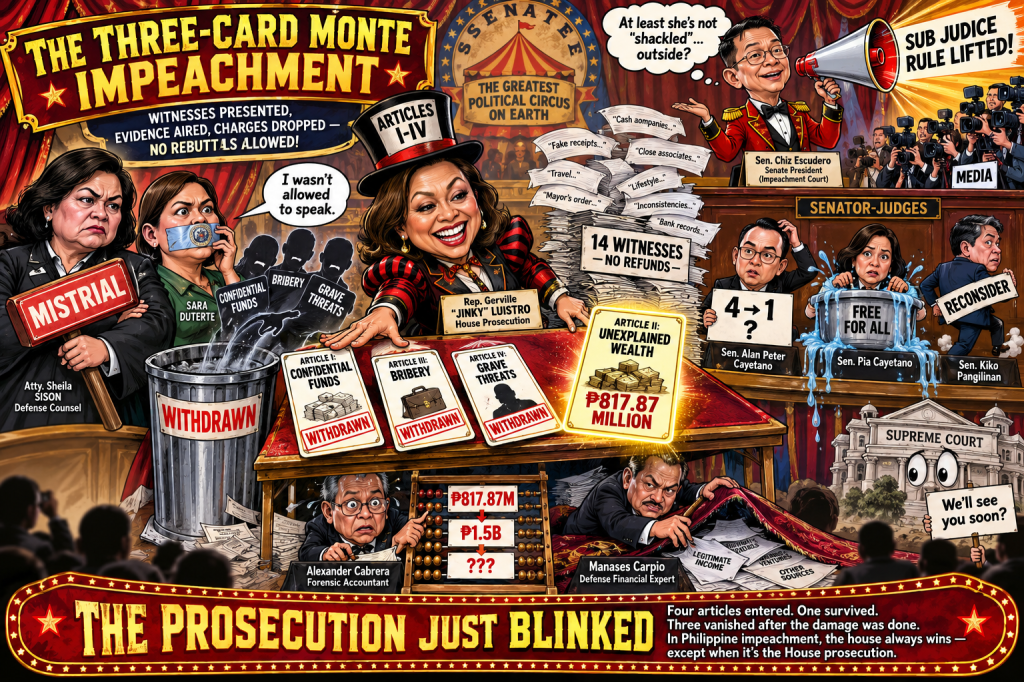
In the high-stakes theater of Philippine impeachment politics, October 13, 2026, will be remembered as the day the House prosecution team decided that three of their four accusations against Vice President Sara Duterte were not worth the Senate’s time. Or perhaps more accurately, not worth the risk of actually proving them.
The move, announced by lead prosecutor Rep. Gerville “Jinky” Luistro, leaves only Article II—alleged unexplained wealth—standing. The confidential funds scandal? Gone. The bribery allegations? Withdrawn. The grave threats against President Marcos? Dropped like a hot potato after the witnesses had already sung.
This is either brilliant trial strategy or an admission of evidentiary bankruptcy. And the defense’s reaction suggests they believe it’s the latter.
The Due Process Shell Game
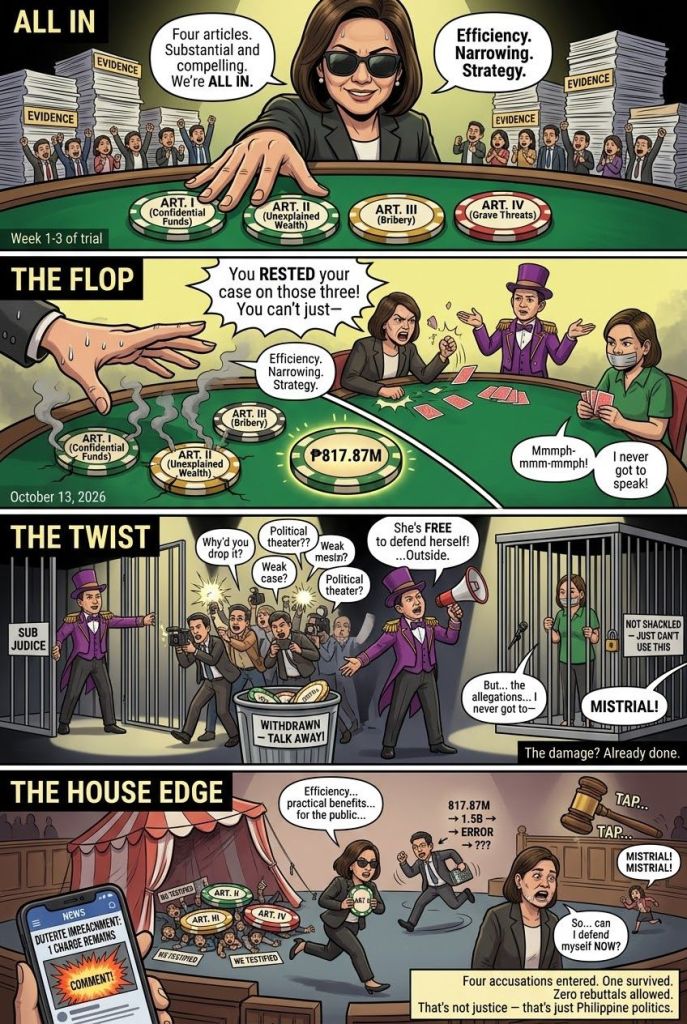
Defense counsel Sheila Sison did not mince words. “The prosecution cannot be allowed to have the benefit of its accusations without bearing the burden of having those accusations tested,” she thundered. Her warning of a potential mistrial was not hyperbole—it was a precise legal objection dressed in apocalyptic language.
Here’s the problem: the prosecution spent weeks parading witnesses before the Senate. Fourteen witnesses laid out evidence on confidential funds and grave threats. The public heard it all. The senator-judges heard it all. Then, after resting its case, the prosecution decided those articles were no longer worth pursuing.
Escudero’s ruling that Duterte “need not present evidence” on the dropped articles sounds magnanimous until you realize what it actually means: the allegations were aired, the damage to her reputation was done, and now she is denied the formal opportunity to rebut them in the very forum where they were made.
“They presented their evidence. The court allowed them time, gave them opportunity, gave them platform, but now, since they withdrew, your Vice President can no longer speak or defend herself from those allegations,” Sison said. “Just for the record, Your Honor, we find that not only a bit unfair, but I would say, it’s completely unfair.”
Senator-judge Alan Peter Cayetano cut to the heart of it: “If all the articles were continued or all were withdrawn, there wouldn’t be a problem. If there was no evidence presented for the articles that were withdrawn, there also would be no problem. But the problem is you presented evidence until the end.”
That is the crux of the procedural scandal. The prosecution wants the political benefit of having leveled four accusations while accepting the evidentiary burden of proving only one.
The Corona Precedent: A Convenient Misreading
Luistro cited the 2012 impeachment of Chief Justice Renato Corona, noting that prosecutors then also withdrew articles. But as Sison correctly pointed out, in Corona, the articles were dropped before evidence was presented. Here, the prosecution rested its case on those articles first.
The distinction matters because impeachment is not a criminal trial with a single defendant’s liberty at stake—it is a constitutional proceeding with political consequences that reverberate through the entire body politic. When you accuse a Vice President of misusing P612.5 million in confidential funds, then walk that accusation back after presenting evidence, you have not simply narrowed your case. You have implicitly conceded that the evidence was insufficient to sustain the charge.
Escudero, to his credit, understood the gravity of what he was approving. His warning to prosecutors was almost stern: “Congress must never be light-handed in initiating and prosecuting articles of impeachment. Impeachment is not a charge that may simply be filed, pursued through the presentation of evidence and thereafter withdrawn without the respondent’s consent”.
“Having elected to withdraw the Articles after resting its case, the prosecution must therefore accept the legal consequences of that withdrawal,” he added.
The legal consequence? Articles I and IV are withdrawn with prejudice—they cannot be revived in this Congress. Article III (bribery) was withdrawn without prejudice only because no evidence had been presented on it yet.
The Sub Judice Circus
Then came the bizarre twist: Escudero lifted the sub judice rule on the withdrawn articles, allowing all parties to discuss them publicly. This prompted another defense objection—why allow the prosecution to publicly defend its withdrawal while the defense has not yet had the chance to rebut the underlying allegations in court?
Sison called it an “unregulated and unbridled exercise of statements”. Senator-judge Pia Cayetano questioned why there needed to be a “free for all” while the court considered a motion for reconsideration. Senator Kiko Pangilinan moved to reconsider, arguing the rule should stay in force pending the defense’s motion.
Escudero’s justification was almost comically paternalistic: he didn’t want Duterte to be “shackled” from defending herself outside the courtroom after being denied the chance to defend herself inside it.
The logic is twisted. The prosecution gets to explain why it dropped charges. The defense gets to complain in the media that it never got to answer them in court. Everyone gets to talk except the senator-judges who actually have to decide the remaining article. Meanwhile, the public gets a free-for-all of competing narratives with no judicial resolution.
The Unexplained Wealth Article: The Last Lifeboat
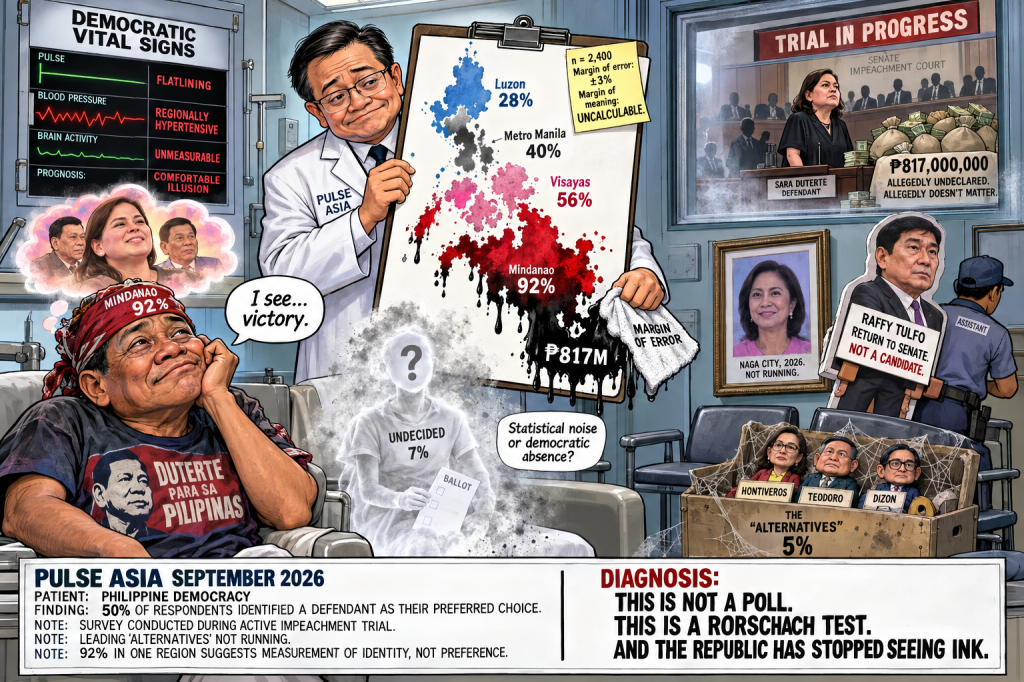
So now the entire impeachment hinges on Article II: unexplained wealth. The prosecution claims forensic accountant Alexander Cabrera found P817.87 million in allegedly unexplained wealth involving Duterte and her husband, Manases Carpio, from 2022 to 2025. At one point, Cabrera even suggested the figure could reach P1.5 billion.
But here’s the problem with unexplained wealth cases: they require a meticulous reconciliation of assets, liabilities, lawful income, and expenditures. The prosecution must show that the wealth is manifestly out of proportion to lawful income—not merely that the couple had substantial financial activity.
The defense will argue that legitimate sources were excluded, that transfers were double-counted, that business income was misclassified, and that spousal property was improperly attributed to Duterte. They have the precedent of Abid-Babano v. Executive Secretary, which held that a spouse’s exclusive property need not be included in a Statement of Assets, Liabilities and Net Worth (SALN) under complete separation of property.
The prosecution’s “substantial and compelling” evidence will be tested against these objections. If Cabrera’s methodology collapses under scrutiny—if the P817.87 million figure shrinks to something more mundane—the entire impeachment edifice crumbles.
The Real Question: Why Did They Blink?
Three articles dropped after weeks of evidence. Thirty-two witnesses eliminated. A prosecution that was “all in” now betting everything on one charge.
The official explanation is efficiency. “By focusing on one article, the matters requiring the impeachment court’s consideration are correspondingly narrowed, with practical benefits for the Senate, for the respondent, and even the public,” Luistro said.
But efficiency arguments are usually made before you’ve spent weeks presenting evidence. The timing suggests something else: the prosecution realized its confidential funds and grave threats cases were weaker than advertised.
The confidential funds article involved P612.5 million in allegedly misused funds. But proving misuse requires demonstrating intent, not just irregular liquidation. The grave threats article—alleging Duterte threatened Marcos and his family—was always going to be a credibility contest, and one the prosecution might lose if Duterte denied making the statements or claimed they were taken out of context.
Bribery was dropped even earlier, on October 6, with prosecutor Keith Flores insisting the decision “had nothing to do with the strength of the case” but was about “the timetable”. Sure. And I have a bridge in San Juan to sell you.
The prosecution’s retreat leaves Duterte with a single charge to fight—and a narrative of vindication on three others. “They couldn’t prove their wild accusations about threats and confidential funds, so they’re retreating to a fishing expedition on financial records,” the Duterte camp will say. It’s a compelling story, and the prosecution handed it to them.
The Verdict on the Withdrawal
This was not a masterstroke. It was a retreat dressed as a strategy.
The prosecution had four shots and decided to take one. That’s not surgical precision—that’s desperation masquerading as discipline. And the due process objections are not academic. If the Senate convicts Duterte on Article II alone, the verdict will forever be tainted by the knowledge that three other accusations were leveled, publicized, and then abandoned without the defense’s formal rebuttal.
Sison’s “mistrial” warning is more than rhetoric. It is a signal that any conviction will be challenged as procedurally infirm. The Supreme Court may ultimately have to decide whether the Senate’s rules permit this kind of selective withdrawal—and whether due process in impeachment requires that the accused be allowed to answer all accusations that were publicly aired.
The prosecution bet everything on Article II. If that bet fails, the House will have impeached a Vice President, presented weeks of evidence, and achieved nothing but political theater and a tarnished institutional record.
And Sara Duterte, denied her day in court on three charges, will be free to claim she was never given the chance to clear her name.
That’s not justice. That’s not accountability. That’s just another day in Philippine politics.
Key Citations
A. Legal & Official Sources
· The 1987 Constitution of the Republic of the Philippines. Official Gazette of the Republic of the Philippines, 1987, http://www.officialgazette.gov.ph/constitutions/1987-constitution/.
· Abid-Babano v. Executive Secretary. G.R. No. 201176, Supreme Court of the Philippines, 28 Aug. 2019, lawphil.net/judjuris/juri2019/aug2019/gr_201176_2019.html.
· Duterte v. House of Representatives. G.R. Nos. 278353 & 278359, Supreme Court of the Philippines, 25 July 2025, lawphil.net/judjuris/juri2025/jul2025/gr_278353_2025.html.
· Republic Act No. 1379. An Act Declaring Forfeiture in Favor of the State Any Property Found to Have Been Unlawfully Acquired by Any Public Officer or Employee. 1955, lawphil.net/statutes/repacts/ra1955/ra_1379_1955.html.
· Republic Act No. 3019. Anti-Graft and Corrupt Practices Act. 1960, lawphil.net/statutes/repacts/ra1960/ra_3019_1960.html.
· Republic Act No. 6713. Code of Conduct and Ethical Standards for Public Officials and Employees. 1989, http://www.officialgazette.gov.ph/1989/02/20/republic-act-no-06713/.
· Republic Act No. 1405. An Act Prohibiting Disclosure of or Inquiry into, Deposits with Any Banking Institution. 1955, http://www.officialgazette.gov.ph/1955/09/09/republic-act-no-1405/.
· Senate Rules of Procedure on Impeachment Trials. Senate of the Philippines, 2012, web.senate.gov.ph/lisdata/2961026309!.pdf.
B. News Reports
· “Prosecution moves to drop all cases vs Sara Duterte except unexplained wealth.” Rappler, 13 Oct. 2026, http://www.rappler.com/philippines/prosecution-motion-drop-cases-except-unexplained-wealth-sara-duterte-impeachment/.
· “Court lifts sub judice rule on dropped impeachment articles.” Inquirer.net, 13 Oct. 2026, newsinfo.inquirer.net/2323111.
· “Prosecution drops 3 of 4 cases vs Sara Duterte | The wRap.” Rappler, 13 Oct. 2026, http://www.rappler.com/video/daily-wrap/october-13-2026/.
· “House leader: Sub judice ruling won’t stop prosecution from giving factual updates on VP Sara trial.” Congress of the Philippines, 25 Aug. 2026, congress.gov.ph/index.php/media/press-releases/10093.
- ₱9 Billion in ‘Savings’? DILG’s Fire Truck Deal Smells Like Smoke

- ₱8B BBM Pork: CCTV for Every Captain’s Kumpare?

- ₱8.9 Billion, 331 Ghost Police Stations: The TIKAS Scandal Explained

- ₱8.4 Billion, 42,000 Barangays, 1 Election: The “Bawat Barangay Makikinabang” Vote-Buying Masterclass

- ₱75 Million Heist: Cops Gone Full Bandit

- ₱6.77B Ghost Haunts Duterte: RTC Dismisses Mans Carpio’s Desperate Plea
- ₱6.77 Billion and Zero Cash: The Sara Duterte SALN Math That Doesn’t Add Up

- ₱6.7-Trillion Temptation: The Great Pork Zombie Revival and the “Collegial” Vote-Buying Circus

- ₱58.53B, Zero Receipts: The LGSF Pork Barrel Nobody Wants to Name
- ₱53 Million Man Tells ₱695-a-Day Workers to Stop Being ‘Mayabang’: The Audacity of BSP’s Remolona
- ₱4.4 Billion and a Witness Who Can’t Explain It: The Duterte Impeachment’s Most Expensive Non-Answer
- ₱3.06 Billion for Evacuation Centers—But Nobody Knows Where They’ll Stand (Or If They’ll Exist)





Leave a Reply